

Fast answer
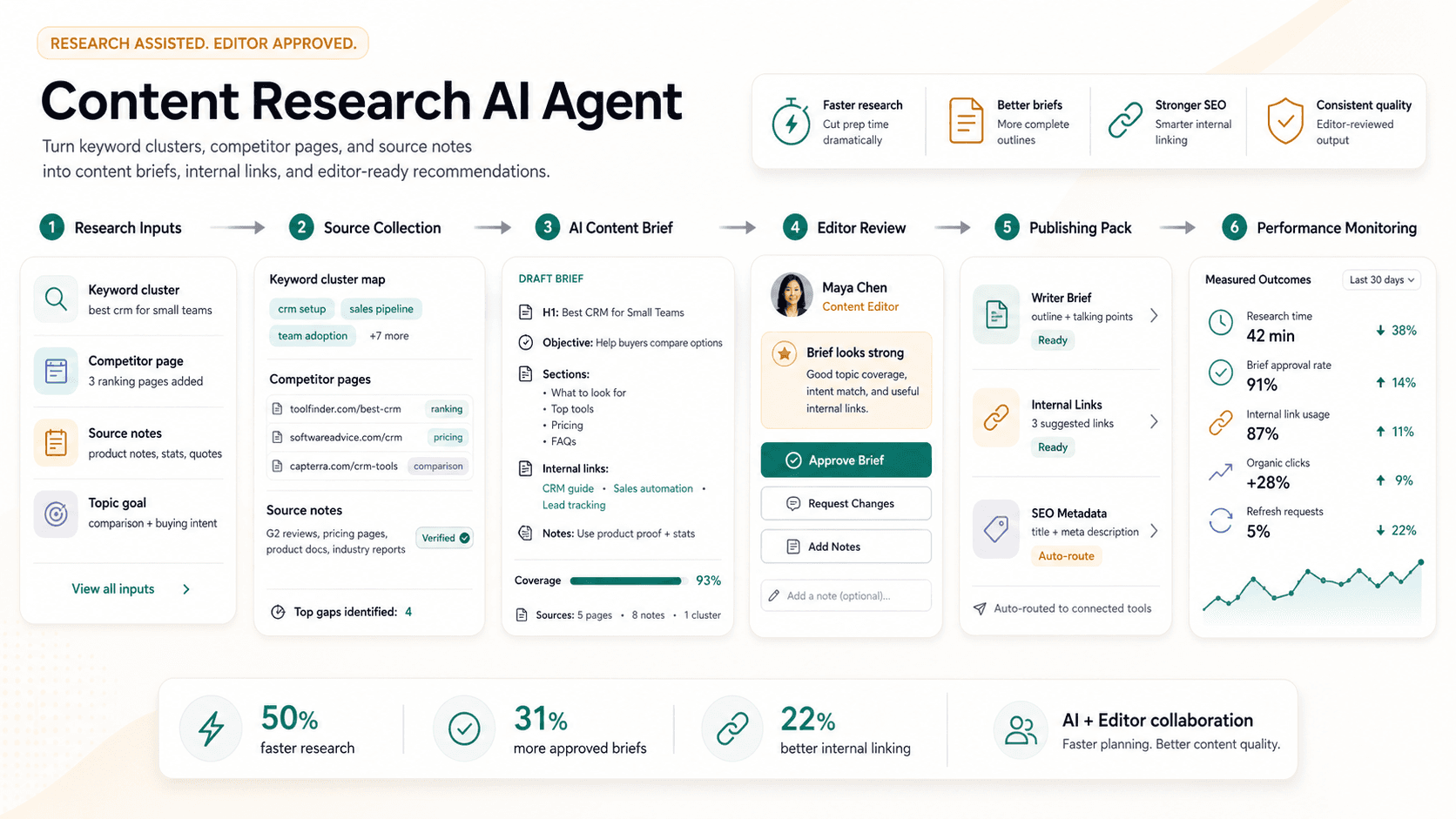
A content research AI agent turns keywords, competitors, customer questions, and source material into briefs, outlines, FAQs, and internal link maps. It should support editorial judgment rather than publish unchecked content, and while it can draft, its highest value is usually research, structure, examples, and link planning. Start by clustering the topic, grouping keywords by search intent, buyer stage, audience, and use case, and separating informational pages from build, compare, and buy pages. Feed it customer calls, notes, docs, product details, competitor pages, examples, and approved positioning. Ask each brief for the target reader, promise, outline, objections, examples, internal links, and evidence needed before writing. Customer language, sales objections, support tickets, and product notes improve briefs more than generic web summaries. Connect briefs to related courses, templates, tools, and adjacent agent pages, then have an editor check facts, originality, examples, and whether the page helps a real reader take the next step before publishing.
On this page
What this page covers
A use-case visitor should understand the workflow, the source data required, where humans review, and what a safe first version looks like.
- 01SEO use cases
- 02Research workflow
- 03Brief generation
- 04Human review
- 05Publishing cadence
- 06Measurement
Why does this matter now?
Content teams need depth, consistency, and full coverage of search intent, and doing that research by hand is slow enough that quality drops as output scales. A research agent absorbs keywords, competitor pages, customer questions, and source material and turns them into structured briefs that a writer can act on immediately. That keeps the human effort focused on judgment, original examples, and positioning rather than on gathering and organizing raw inputs. For A8gent-style sites it means creating genuinely useful pages at scale while keeping facts, internal links, and positioning fully reviewable before anything publishes.
Internal path
Where to go next from this page
These links are part of the A8gent learning and conversion path. Use them to move from concept, to diagnosis, to workflow build, to course.
What you should be able to do after this
- Cluster keywords
- Extract search intent
- Build briefs
- Create internal link maps
How do you do it, step by step?
1. Cluster the topic
Group keywords by search intent, buyer stage, audience, and use case, and separate informational pages from build, compare, and buy pages. Map how the cluster connects so you are planning a coherent set of pages rather than isolated posts. Decide which pages exist to inform and which exist to convert, because the brief for each is different.
2. Collect source material
Feed the agent customer calls, support tickets, internal docs, product details, competitor pages, real examples, and approved positioning. First-party material is what makes a brief better than a generic web summary, so prioritize it. Mark which sources are authoritative and which are only for context so the agent weights them correctly.
3. Analyze the competing pages
Have the agent read the pages currently ranking for the target intent and note what they cover, what they miss, and where they are shallow or outdated. Use those gaps to define the angle your page will own rather than restating what already exists. Never let the agent treat a competitor page as an authoritative fact source.
4. Generate the brief
Ask for the target reader, the core promise, a full outline, the objections to address, concrete examples to include, the internal links, and the evidence the writer must supply. Require the brief to state what the page should help the reader do next. Keep the structure consistent across briefs so writers and editors know exactly where to look.
5. Plan internal links
Connect each brief to related courses, templates, tools, blog posts, and adjacent agent pages so the content path feels intentional rather than random. Specify anchor context so links are relevant and not stuffed. Check that the new page both receives links from and points to the right places in the cluster.
6. Add evidence and originality requirements
For every claim in the outline, note what proof, data source, or example the writer needs so the finished page is not just rephrased consensus. Flag any assertion the agent could not verify so the writer confirms or drops it. This is what keeps the page trustworthy and distinct.
7. Review before publishing
Have an editor check facts, originality, examples, internal links, and whether the page actually helps a real reader take the next step. Cut anything that is filler or that only echoes competitors. Confirm the positioning matches the approved brand voice before it goes live.
What mistakes should you avoid?
- Publishing AI summaries that add no new judgment, examples, or original perspective.
- Targeting keywords without understanding whether the intent is to learn, compare, or buy.
- Forgetting internal links to courses, tools, and related agent pages, leaving pages stranded.
- Letting the agent cite competitors as if they are authoritative sources of fact.
- Accepting unverified claims into a brief instead of flagging them for the writer to confirm.
- Producing volume without an editor gate, so thin or duplicative pages dilute the whole site.
FAQ
Can this agent write the final article?
It can draft, but the highest value is usually in research, structure, examples, and link planning. A human writer and editor should still supply original judgment and verify facts before publishing.
What inputs improve briefs most?
Customer language, sales objections, support tickets, product notes, and examples of strong pages improve quality far more than generic web summaries. First-party material is the single biggest lever on brief quality.
Will AI-drafted content hurt our search rankings?
Not if the finished page is genuinely useful, original, and reviewed by a human. Thin, unedited output that only restates existing pages is the real risk, which is why the editor gate matters.
How do we keep facts accurate?
Require a source link for every claim, have the agent flag anything it cannot verify, and keep an editor responsible for checking evidence before publishing. Never publish a claim the agent could not trace.
How much time does it actually save?
Most of the savings come from research and outlining, which is the slow part of content work. Writers still write, but they start from a structured brief instead of a blank page.
Where should this link inside A8gent?
Link it to the AI agent SEO checklist, programmatic SEO for AI agent sites, and the marketing campaign AI agent pages for distribution planning.
Sources & further reading
Done for you
Want a content research agent built for your business?
Tell us the workflow. We scope, build, and ship the agent with guardrails and the numbers to prove it worked. The scoping call is free.
Free scoping call. You own the code.
Was this page helpful?