

Fast answer
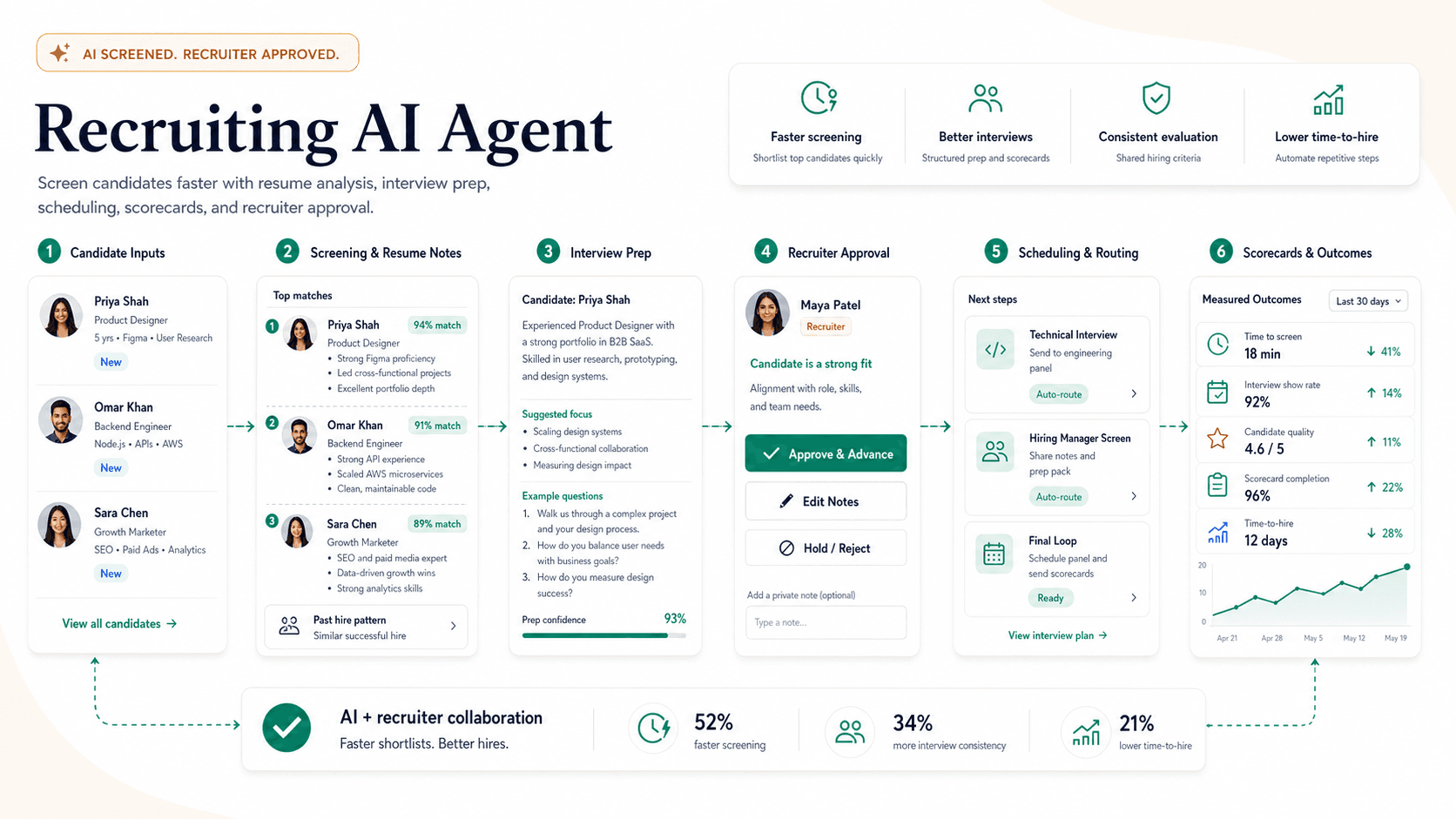
A recruiting AI agent screens resumes against a defined rubric, drafts candidate outreach, summarizes interviews, and flags fit gaps. Hiring decisions should remain human-led and bias-aware, so the agent summarizes evidence against a rubric while humans review recommendations and own the decision. Start by writing a scoring rubric that defines must-haves, nice-to-haves, disqualifiers, evidence standards, and examples before any resume is screened. Separate screening from decisions and never let the agent reject candidates automatically. Prepare role-specific outreach, scheduling replies, interview prep, and follow-up notes using approved tone and compensation language. Turn interview notes into structured summaries tied to the rubric, open questions, and next-step recommendations. Audit outputs for protected characteristics, proxy signals, inconsistent scoring, and missing evidence. Resume summaries, outreach drafts, interview note cleanup, and follow-up reminders are better first workflows than automated rejection, keeping accountability with recruiters and hiring managers while making evaluation more consistent.
On this page
What this page covers
A use-case visitor should understand the workflow, the source data required, where humans review, and what a safe first version looks like.
- 01Candidate intake
- 02Scoring rubric
- 03Bias controls
- 04ATS workflow
- 05Interview summaries
- 06Templates
Why does this matter now?
Recruiting teams spend most of their time on repetitive intake, follow-up, scheduling, and turning messy notes into something a hiring manager can use. A recruiting agent makes candidate evaluation more consistent by summarizing evidence against a defined rubric so every applicant is read the same way. That consistency both saves time and reduces the ad hoc judgment that lets bias creep in. The hard boundary is that hiring decisions stay human-led and bias-aware, because automated rejection carries legal and ethical risk that no efficiency gain justifies.
Internal path
Where to go next from this page
These links are part of the A8gent learning and conversion path. Use them to move from concept, to diagnosis, to workflow build, to course.
What you should be able to do after this
- Screen consistently
- Prepare interview notes
- Reduce manual follow-up
- Keep hiring decisions human
How do you do it, step by step?
1. Write the scoring rubric
Define must-haves, nice-to-haves, disqualifiers, evidence standards, and worked examples before any resume is screened. A clear rubric is what makes the agent consistent instead of arbitrary. Agree the rubric with the hiring manager up front so the summaries answer the questions they actually care about.
2. Separate screening from decisions
Let the agent summarize qualifications, gaps, and evidence, but never let it reject or advance candidates on its own. Every recommendation is a starting point for a recruiter, not a verdict. Make clear in the workflow that a human owns each advance-or-decline call.
3. Standardize resume summaries
Have the agent map each resume to the rubric, quoting the evidence for every rating so a recruiter can verify it fast. Require it to mark where evidence is missing rather than inferring it. Keep the format identical across candidates so comparisons are fair and quick.
4. Prepare outreach and scheduling
Draft role-specific messages, scheduling replies, interview prep, and follow-up notes using approved tone and compensation language. Let the agent handle the back-and-forth of booking slots while keeping offers and sensitive messages under human review. Personalize with real role detail so candidates do not feel processed.
5. Summarize interviews
Turn interviewer notes into structured summaries tied to the rubric, the open questions, and a clear next-step recommendation. Keep the summary anchored to role requirements rather than general impressions. Flag contradictions between interviewers so the panel can resolve them.
6. Audit for bias
Review outputs for protected characteristics, proxy signals like school or zip code, inconsistent scoring, and missing evidence. Keep audit logs so decisions can be explained and defended later. Have someone outside the immediate hiring pressure spot-check the agent regularly.
7. Review and refine the rubric
Compare who advanced and who succeeded to find where the rubric or the agent misjudged, and adjust. Retire criteria that predict nothing and sharpen the ones that do. Update compensation and tone guidance as roles and policy change.
What mistakes should you avoid?
- Using AI scores without a clear, agreed rubric behind them.
- Letting the agent reject or advance candidates automatically without human review.
- Ignoring bias controls, proxy signals, and audit logs.
- Summarizing interviews without tying notes back to the specific role requirements.
- Inferring evidence the resume does not actually contain instead of flagging the gap.
- Sending generic outreach that makes candidates feel processed rather than pursued.
FAQ
Can AI screen resumes safely?
It can summarize evidence against a rubric and make screening more consistent, but humans must review recommendations and own the decision. It should never reject a candidate on its own.
How do we prevent bias?
Use a fixed rubric, forbid proxy signals like school or location, keep audit logs, and have someone spot-check outputs regularly. Consistency plus review is what reduces bias rather than introducing it.
What should recruiters automate first?
Resume summaries, outreach drafts, interview note cleanup, and scheduling are better starting points than any decision automation. They save the most time at the lowest risk.
Is this legally risky?
Automated hiring decisions carry real legal exposure in many jurisdictions, which is why the agent only summarizes and recommends. Keeping a human accountable for every advance-or-decline call is the safeguard.
How long does setup take?
Writing and agreeing the rubric is the real work and can take a couple of weeks per role family. Once rubrics exist, new reqs reuse them with minor edits.
Which internal pages help?
Use the AI agent risk checklist, the AI agent implementation course, and the email assistant AI agent for the outreach and scheduling side.
Sources & further reading
Done for you
Want a recruiting agent built for your business?
Tell us the workflow. We scope, build, and ship the agent with guardrails and the numbers to prove it worked. The scoping call is free.
Free scoping call. You own the code.
Was this page helpful?