AI Agents for Consulting Firms: Research, Proposals and Deliverables (2026)
AI agents help consulting firms accelerate research, generate proposals in hours instead of days, and produce polished client deliverables - enabling boutique firms to compete with Big Four output quality at a fraction of the overhead.
10+ years shipping production ML across TensorFlow, PyTorch, AWS, and GCP. Ships every A8gent agent before it becomes a lesson. GitHub
- AI agents reduce consulting research time by 60-80% by synthesizing market data, competitor intelligence, and industry trends from hundreds of sources simultaneously - work that previously required junior analysts spending days on manual research.
- Proposal generation shifts from a 2-3 day effort to a 2-3 hour refinement process when AI agents draft initial proposals based on your firm's templates, past winning proposals, and client-specific context gathered during discovery calls.
- Client deliverables benefit from AI agents that maintain consistent formatting, ensure brand compliance, pull in relevant data visualizations, and produce first drafts that senior consultants review and elevate rather than build from scratch.
- Knowledge management becomes a competitive advantage when AI agents automatically capture, organize, and surface institutional expertise - ensuring insights from past engagements inform new ones without relying on tribal knowledge.
- Boutique consulting firms gain the most from AI agents because they can match the research depth and deliverable polish of large firms without the overhead of large analyst teams, leveling the competitive playing field significantly.
Why Consulting Firms Need AI Agents Now
Consulting has always been a knowledge business. Clients pay for expertise, insight, and the ability to synthesize complex information into actionable recommendations. But the economics of consulting are under pressure from every direction: clients demand faster turnarounds, fee compression squeezes margins, talent acquisition costs are rising, and competitors are already using AI to deliver more for less.
The consulting industry's traditional model - billing hours for research, analysis, and deliverable production - is fundamentally challenged when AI agents can perform these tasks in a fraction of the time. Firms that embrace AI agents are not just cutting costs; they are delivering higher-quality work faster, winning more competitive pitches, and freeing their consultants to focus on the high-value strategic thinking that clients actually want.
Consider the typical consulting engagement: a team spends 40-60% of project hours on research and data gathering, 20-30% on analysis and synthesis, and only 10-20% on the strategic recommendations that represent the actual value clients pay for. AI agents flip this ratio. When research is automated and deliverables are drafted by AI, consultants spend 60-70% of their time on strategic thinking, client relationship building, and innovative problem-solving.
The impact on firm economics is dramatic. A boutique firm with 10 consultants operating with AI agents can produce the output equivalent of a 25-30 person team. Proposals that took a week now take a day. Research that required dedicated analysts now happens in hours. Deliverables that consumed weekends now get drafted overnight and refined in the morning.
This is not theoretical. Consulting firms using AI agents report 50-70% reduction in proposal development time, 60-80% faster research cycles, 40% increase in proposal win rates (because they respond faster with more tailored content), and 30-50% improvement in consultant utilization rates. The firms that adopt AI agents early are establishing competitive advantages that will be extremely difficult for laggards to overcome.
In this guide, we will cover exactly how AI agents transform every phase of consulting work - from research and proposals to deliverables and knowledge management. Whether you are a solo consultant, a boutique firm, or a mid-size practice looking to compete with larger players, these strategies will show you how to deliver Big Four quality at boutique speed. Take our free assessment to identify which consulting workflows in your firm are ready for AI automation today.
Automated Research: From Days to Hours
Research is the foundation of every consulting engagement, and it is also the most time-intensive phase. Whether you are conducting market sizing, competitive analysis, industry trend mapping, or customer research, the traditional approach involves junior consultants spending days combing through reports, databases, news articles, and public filings to build a comprehensive picture. AI agents transform this entirely.
Market Research at Machine Speed
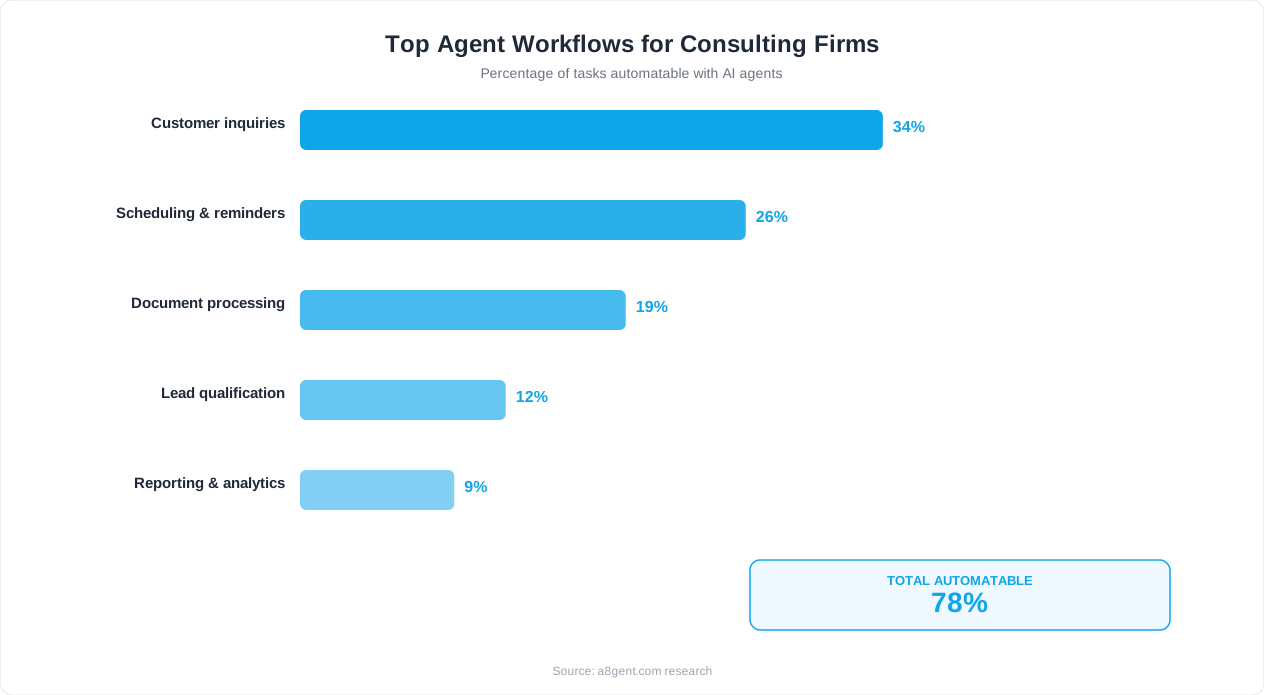
AI research agents can synthesize information from hundreds of sources simultaneously. Feed them a research brief - "Analyze the European electric vehicle charging market: market size, growth projections, key players, regulatory landscape, and emerging trends" - and within minutes they produce a structured research document that would have taken an analyst 2-3 full days. The output includes data points with source citations, conflicting estimates flagged for human review, and gaps identified where additional primary research may be needed.
Competitive Intelligence Gathering
For competitive analysis engagements, AI agents monitor and synthesize competitor activity across multiple channels: press releases, job postings (indicating strategic priorities), patent filings, social media activity, executive statements, product launches, and financial reports. Instead of your team manually tracking 15 competitors across 10 information sources, the AI produces a structured competitive landscape that is continuously updated. It identifies patterns humans miss - like a competitor hiring heavily in a new geography suggesting expansion plans, or patent filing patterns indicating technology direction changes.
Industry and Regulatory Analysis
Consulting engagements often require understanding complex regulatory environments. AI agents excel at processing regulatory documents, policy papers, and legal frameworks - synthesizing hundreds of pages into structured summaries of requirements, timelines, and implications for your client. When regulations change, the AI flags relevant updates and summarizes their impact on your ongoing recommendations.
Data Synthesis and Pattern Recognition
The real power emerges when AI agents synthesize across multiple research streams. They identify connections between market trends, competitive moves, regulatory changes, and customer behavior that create strategic opportunities or threats. A human analyst might take days to connect the dots across 50 different sources; an AI agent identifies these patterns in minutes and presents them as structured hypotheses for senior consultants to validate and develop.
Practical Implementation
Set up research automation on platforms like Autonoly by creating research workflow templates for your common engagement types. Define the output structure (executive summary, key findings, data tables, source citations), connect relevant data sources, and configure quality thresholds. When a new engagement starts, your team provides the research brief and the AI delivers a comprehensive first draft within hours. Senior consultants then elevate the research - adding proprietary insights, challenging assumptions, and focusing on the 20% that requires genuine expertise.
The AI Stack Builder can help you identify the optimal combination of research tools for your firm's specific practice areas and engagement types.
AI-Powered Proposal Generation: Win More, Faster
Proposals are the lifeblood of consulting firms, and they are also one of the most painful bottlenecks. Every consultant knows the drill: a potential client asks for a proposal with a tight deadline, partners scramble to find relevant past proposals, a team works late assembling the document, and the final product often feels rushed because it was. AI agents fundamentally change this dynamic.
The Proposal Problem in Consulting
Most consulting firms have a graveyard of brilliant proposals that were never leveraged again. Past proposals contain proven approaches, compelling case studies, sharp methodology descriptions, and winning positioning language - but they are buried in shared drives and email attachments. Every new proposal starts 70% from scratch because finding and adapting relevant past content is nearly as time-consuming as writing new content. Firms that write 30-50 proposals per year are essentially recreating the wheel dozens of times.
How AI Proposal Agents Work
An AI proposal agent draws from three key sources: your firm's proposal library (past proposals, case studies, methodology descriptions, team bios), the specific client context (information gathered from discovery calls, client website, industry context), and your firm's win/loss data (what positioning and approaches won in similar situations). Given an RFP or proposal brief, the agent produces a structured first draft that follows your firm's template, incorporates relevant past content, and tailors messaging to the specific client's situation and stated needs.
From 3 Days to 3 Hours
The typical consulting proposal takes 15-25 hours of combined effort across 2-4 people over 3-5 days. With AI agents, the first draft is generated in 30-60 minutes. A senior consultant spends 2-3 hours refining positioning, adding nuance, ensuring strategic alignment, and personalizing key sections. A partner reviews for 30-60 minutes. Total effort: 3-5 hours over 1 day. This is not just faster - it means you can respond to more RFPs, meet tighter deadlines, and submit proposals while competitors are still assembling their teams.
Improving Win Rates
Speed is only part of the advantage. AI-assisted proposals tend to be more tailored because the agent can analyze the client's specific language, stated priorities, and industry context to customize positioning. They are more comprehensive because the agent ensures no standard section is overlooked or rushed. And they are more consistent in quality because the floor is set by your best past work rather than by whoever happened to be available to write this particular proposal.
Pricing and Scoping Intelligence
Beyond the written proposal, AI agents help with pricing strategy. By analyzing your past engagements (scope, team composition, duration, and fees) against engagement outcomes (client satisfaction, scope creep, profitability), the AI suggests pricing and scoping that balances competitiveness with profitability. It flags when a proposed scope seems underpriced relative to complexity or when assumptions may lead to scope creep based on similar past engagements.
Implementation Approach
Start by feeding your AI agent your 20 best proposals - the ones that won, had clear methodology, and represented your firm at its best. Add your standard templates, case study library, and team bios. Connect it to a system that captures discovery call notes. Within a week, you will have an agent that produces proposal first drafts indistinguishable from senior consultant work. Use Dust for knowledge-intensive proposal workflows that require synthesizing across large document libraries, or Autonoly for end-to-end proposal automation including workflow orchestration and client communication.
Producing Client Deliverables: Quality at Speed
Client deliverables - strategy documents, market analyses, transformation roadmaps, benchmark reports - are the tangible output that justifies consulting fees. They need to be insightful, well-structured, visually polished, and thoroughly supported by evidence. Traditionally, producing a high-quality deliverable consumed 60-70% of engagement hours. AI agents compress this dramatically while maintaining (and often improving) quality.
First Draft Generation
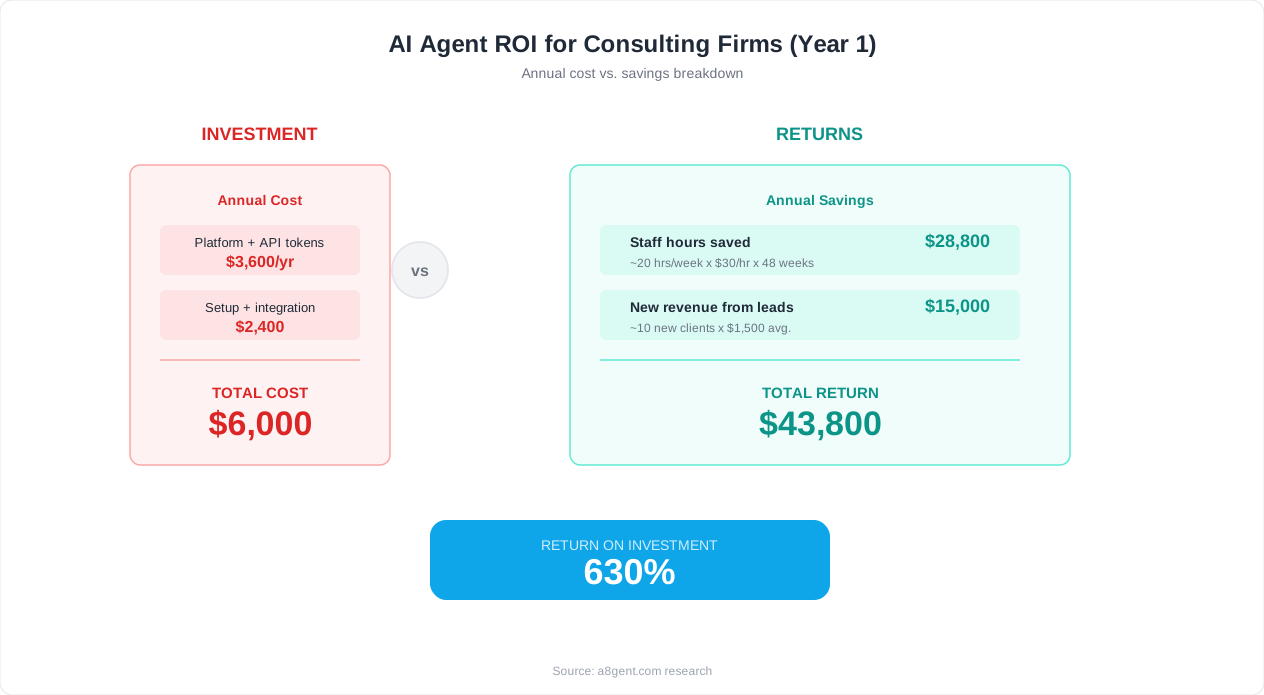
AI agents produce structured first drafts of client deliverables based on your research findings, analysis outputs, and strategic frameworks. Feed the agent your engagement's key findings, strategic recommendations, and supporting data - and it produces a comprehensive document following your firm's structure and style guidelines. The draft includes executive summaries, section narratives, recommendation frameworks, implementation roadmaps, and appendices. Senior consultants then elevate this draft, adding proprietary insights, sharpening recommendations, and ensuring strategic coherence - work that takes 30-40% of the time previously required to build from scratch.
Data Visualization and Formatting
AI agents handle the formatting burden that consumes disproportionate consultant time. They generate charts and visualizations from your data, ensure consistent formatting across hundreds of slides or pages, apply brand guidelines automatically, and produce multiple output formats (executive summary, detailed report, board presentation) from the same underlying content. The hours previously spent on pixel-perfect slide formatting are eliminated entirely.
Quality Assurance and Consistency
One of the most valuable AI agent capabilities for deliverables is quality assurance. The agent checks for: internal consistency (do numbers in the executive summary match detail sections?), logical coherence (do recommendations flow from findings?), completeness (are all standard sections addressed?), citation accuracy (are data points properly sourced?), and brand compliance (formatting, terminology, visual standards). These checks catch errors that human reviewers miss during time-pressured final reviews.
Multiple Audience Versions
A common consulting challenge is producing deliverables for multiple audiences - a detailed report for the project team, an executive summary for the C-suite, a board presentation, and an implementation guide for operations teams. AI agents generate these variants from a single source, adjusting detail level, technical language, and emphasis for each audience. What previously required creating 3-4 separate documents from scratch becomes a single comprehensive deliverable with automated audience-specific versions.
Iterative Refinement
Client feedback often requires significant deliverable revisions - restructuring sections, incorporating new data, adjusting recommendations based on stakeholder input. AI agents handle these iterations rapidly, maintaining consistency across the entire document even when substantial sections are reworked. A change to one recommendation's scope automatically ripples through the implementation timeline, resource requirements, and budget sections without manual updating.
Building Your Deliverable Engine
Create deliverable templates for each engagement type your firm handles. Define the standard structure, quality criteria, formatting guidelines, and output specifications. Feed in examples of your best past deliverables as style references. Configure the agent on Autonoly to produce first drafts when research and analysis phases complete, and set up review workflows that route drafts to the appropriate senior consultant. The result is a deliverable production engine that maintains your firm's quality standards while operating at 3-4x the speed of manual production.
Knowledge Management: Your Firm's Institutional Memory
Every consulting firm has the same problem: institutional knowledge lives in people's heads, scattered documents, and forgotten email threads. When a consultant leaves, their expertise walks out the door. When a new engagement mirrors one from two years ago, no one remembers the details. AI agents solve this by creating a living knowledge system that captures, organizes, and surfaces your firm's accumulated expertise.
Automatic Knowledge Capture
AI agents passively capture knowledge from your firm's daily operations without requiring consultants to do additional documentation work. They extract key insights from engagement deliverables, identify methodologies and frameworks from proposal documents, capture client feedback and lessons learned from project retrospectives, and organize everything into a searchable knowledge base. The consultant who developed a brilliant approach to retail transformation pricing does not need to write a separate knowledge article - the AI extracts and indexes that methodology from the deliverable itself.
Intelligent Knowledge Retrieval
Instead of consultants spending hours searching shared drives for relevant past work, AI agents surface relevant knowledge proactively. Starting a retail transformation engagement? The agent automatically surfaces: past retail engagements with outcomes, relevant frameworks your firm has developed, industry data from previous research, expert consultants within your firm who have relevant experience, and potential pitfalls identified in similar past projects. This happens without anyone asking - the AI recognizes the context and delivers relevant institutional knowledge.
Expert Identification and Collaboration
In larger consulting firms, knowing who has expertise in a specific area is surprisingly difficult. AI agents map expertise across your organization by analyzing engagement histories, deliverable contributions, proposal wins, and specialization patterns. When a consultant needs input on healthcare IT integration, the AI identifies the three people in the firm with the most relevant experience - even if they are in different offices or practice areas. This invisible expertise matching accelerates collaboration and prevents knowledge silos.
Client Intelligence
For ongoing client relationships, AI agents maintain comprehensive client intelligence profiles. They track every interaction, deliverable, recommendation, and outcome across all engagements with a client. When you prepare for a quarterly review or pitch additional work, the agent provides a complete picture of the relationship: what you delivered, what recommendations were implemented, what outcomes resulted, what the client values most, and where expansion opportunities exist. This institutional memory transforms client relationship management from individual heroics into systematic excellence.
Methodology Evolution
Your firm's methodologies should evolve based on engagement outcomes. AI agents track which approaches produced the best client outcomes, identify patterns in what works versus what does not across similar engagements, and suggest methodology refinements based on accumulated evidence. This creates a virtuous cycle: every engagement makes your firm's methodologies slightly better, compounding into significant competitive advantages over years.
Implementation Strategy
Use Dust to build knowledge management systems that sit on top of your existing document repositories (Google Drive, SharePoint, Notion, Confluence). The AI indexes everything, extracts key knowledge, and makes it searchable and surfaceable. Combine with Autonoly for workflow automation that triggers knowledge capture at natural engagement milestones. Within 3-6 months, your firm will have a knowledge system that makes every consultant more effective by giving them access to the firm's entire accumulated expertise. Use our AI Stack Builder to design the ideal knowledge management architecture for your firm's size and practice areas.
Client Communication and Project Management
Consulting relationships depend on communication. Clients want to feel informed, in control, and confident that their engagement is progressing well. But consultants are often so busy doing the work that client communication becomes sporadic, reactive, or formulaic. AI agents maintain excellent client communication without consuming consultant bandwidth.
Automated Status Reporting
AI agents generate weekly or bi-weekly status reports automatically by pulling from project management tools, time tracking systems, and deliverable progress. Instead of a consultant spending 1-2 hours every week writing status updates, the AI produces a polished report that covers: work completed since last update, key findings or insights generated, upcoming activities and milestones, any risks or blockers requiring client attention, and updated timeline projections. The consultant reviews for 10 minutes, adds any strategic commentary, and sends. Client communication goes from sporadic and inconsistent to reliable and comprehensive.
Meeting Preparation and Follow-Up
Before every client meeting, the AI agent prepares a briefing that includes: agenda items based on engagement status, recent client communications to reference, open action items from previous meetings, key decisions needed from the client, and relevant context from the broader engagement. After meetings, it drafts follow-up communications with action items, decisions documented, and next steps clearly outlined. This preparation and follow-up discipline makes every client interaction more productive and professional.
Stakeholder-Specific Communication
Different client stakeholders need different communication styles and detail levels. The project sponsor wants strategic progress and budget status. The project team wants tactical details and upcoming requirements. The executive committee wants high-level outcomes and risk flags. AI agents maintain communication threads tailored to each stakeholder's preferences and information needs, ensuring everyone feels appropriately informed without requiring consultants to craft multiple versions of every update.
Proactive Issue Communication
When AI agents identify potential issues - a deliverable milestone at risk, a scope question that needs clarification, or a dependency on client input that is overdue - they draft proactive communications for consultant review. This prevents the common consulting failure of issues festering until they become crises. Clients appreciate early warning and collaborative problem-solving far more than last-minute surprises, and AI agents ensure these proactive communications happen consistently.
Project Coordination
For engagements involving multiple workstreams or team members, AI agents handle coordination logistics: scheduling internal team syncs, tracking cross-team dependencies, ensuring deliverable handoffs happen on time, and flagging when parallel workstreams are creating inconsistencies that need resolution. This coordination layer reduces the project management overhead that typically consumes 15-20% of engagement hours.
Setting Up Communication Automation
Configure AI communication agents on Autonoly by connecting your project management tools, defining reporting templates for each engagement type, and setting communication cadences. The AI handles routine communications automatically while routing strategic or sensitive communications to consultants for personal handling. The result is best-in-class client communication at a fraction of the effort, driving higher client satisfaction scores, stronger relationships, and more repeat business.
Implementation Roadmap for Consulting Firms
Implementing AI agents in a consulting firm requires a phased approach that builds confidence and capability progressively. Here is a proven 90-day roadmap that minimizes disruption while maximizing early wins.
Phase 1: Foundation (Days 1-14)
Start with research automation and proposal support - the two areas with the fastest ROI and lowest risk. Choose 2-3 upcoming engagements as pilots. Set up an AI research agent by defining research brief templates for your common engagement types and connecting relevant data sources. Set up a proposal agent by feeding in your 15-20 best past proposals, standard templates, and case study library. Assign one tech-comfortable consultant as the internal champion who will learn the tools deeply and support others. The goal for Phase 1 is simple: demonstrate that AI-drafted research and proposals are at least 80% as good as human-produced first drafts, delivered in 90% less time.
Phase 2: Expansion (Days 15-45)
Based on Phase 1 results, expand to deliverable production and knowledge management. Configure deliverable templates for your standard engagement types. Begin indexing your document repository for knowledge management. Train additional consultants on using AI-drafted research and proposals effectively. Establish quality review processes that leverage AI output while maintaining your firm's quality standards. Measure time savings and track consultant satisfaction with the new workflows. The goal for Phase 2 is operational: AI agents are producing first drafts for all research, proposals, and deliverables across at least 50% of active engagements.
Phase 3: Integration (Days 46-90)
In this phase, AI agents become integral to your operating model rather than optional tools. Implement client communication automation. Roll out knowledge management firm-wide. Refine templates and workflows based on 45 days of experience. Develop firm-specific quality criteria for AI output. Begin adjusting pricing and scoping to reflect your enhanced productivity. Create training materials for new consultants joining the firm. The goal for Phase 3 is strategic: your firm operates at a fundamentally higher level of efficiency, and AI agents are as natural as email in your daily work.
Change Management Considerations
Consulting firms face unique change management challenges with AI adoption. Senior partners may resist tools that seem to devalue experience. Junior consultants may fear being replaced. Mid-level consultants may worry that efficiency gains will just mean more utilization pressure. Address these directly: senior consultants become more valuable as editors and strategic thinkers (AI handles drafting, humans add wisdom). Junior consultants accelerate their learning by reviewing AI output rather than doing tedious manual research. And efficiency gains should flow to quality improvement and work-life balance - not just more billable hours.
Measuring Success
Track these metrics monthly: proposal win rate (target: +20-40% improvement), average time from RFP to proposal submission (target: -60%), consultant hours per deliverable (target: -40-60%), client satisfaction scores (target: +15-25%), knowledge reuse rate (how often past insights inform current work), and revenue per consultant (target: +30-50% within 12 months as utilization and win rates improve).
Getting Started Today
Take our assessment to identify which consulting workflows in your firm are ready for immediate AI automation. Then use the AI Stack Builder to design your firm's optimal AI agent architecture based on your practice areas, team size, and current tooling.
The Future of AI-Augmented Consulting
The consulting industry is at an inflection point. Firms that embrace AI agents are not just becoming more efficient - they are redefining what consulting can deliver. Understanding where this is heading helps you invest wisely today while positioning for tomorrow's opportunities.
From Hours to Outcomes
The billable hour model is dying. When AI agents can do in hours what previously took days, charging by the hour becomes untenable - and unnecessary. Forward-thinking firms are shifting to outcome-based pricing: clients pay for strategic recommendations, implementation roadmaps, and measurable business improvements rather than for the hours spent producing them. AI makes this shift possible because firms can deliver outcomes profitably even with dramatically compressed timelines. The firms that make this pricing transition first will attract clients who are tired of paying for process and want to pay for results.
Democratization of Consulting Quality
AI agents are leveling the playing field between boutique firms and global consultancies. A 5-person firm with strong AI automation can produce research depth, deliverable quality, and proposal polish that previously required 50-person analyst teams. This does not eliminate the value of large firms (their networks, brand credibility, and implementation capacity remain advantages), but it dramatically narrows the gap in intellectual output quality. Boutique firms with deep expertise and AI augmentation will increasingly win engagements against larger competitors on quality, speed, and value.
Real-Time Strategic Advisory
As AI agents become more sophisticated, consulting will shift from periodic engagement-based work toward continuous strategic advisory. AI agents continuously monitor your client's market, competitors, and regulatory environment - surfacing strategic insights in real-time rather than in quarterly reports. The consultant becomes a strategic interpreter and advisor who contextualizes AI-generated intelligence, rather than a researcher who gathers and compiles information. This model is more valuable to clients and more intellectually rewarding for consultants.
Predictive Strategy
AI agents are beginning to move beyond analysis of what happened toward prediction of what will happen. By processing vast amounts of market data, competitive signals, and macroeconomic indicators, they can generate strategic scenarios with probability assessments. Consulting engagements will increasingly focus on helping clients navigate predicted futures rather than just understanding the current landscape. This predictive capability creates engagement types that did not previously exist and adds enormous value to client relationships.
The Human Premium
Paradoxically, AI agents increase the value of distinctly human consulting capabilities: relationship building, executive coaching, organizational politics navigation, creative strategy, and change leadership. As AI handles research, analysis, and production, the consultant's irreplaceable value becomes their judgment, wisdom, relationships, and ability to influence human organizations through trust and credibility. The best consultants of 2026 and beyond will be those who leverage AI for maximum intellectual leverage while developing their uniquely human capabilities.
Preparing Your Firm
The firms that will thrive in this future are investing now in three areas: technology infrastructure (AI tools and workflows), consultant development (training people to work effectively with AI and develop uniquely human skills), and business model innovation (experimenting with outcome-based pricing, continuous advisory models, and new engagement types that AI enables). Start with the free assessment to understand your firm's current automation readiness, then build your roadmap using the AI Stack Builder to design the right technology foundation for your firm's future.
FAQ
Will clients feel they are paying for AI output rather than genuine consulting expertise?
Clients pay for outcomes and strategic value - not for the production method. A brilliant market analysis is equally valuable whether it took 40 hours of manual research or 4 hours of AI-assisted work. The key is transparency: let clients know you use AI tools to accelerate research and production, and emphasize that senior consultants validate, refine, and add proprietary strategic insight. Most clients prefer faster delivery and appreciate firms that invest in modern tools.
How do we protect client confidentiality when using AI tools?
Use enterprise AI platforms that offer data isolation, no-training guarantees, and SOC 2 compliance. Configure AI agents to process client data within your security perimeter rather than sending it to public APIs. Anonymize client-specific details in prompts where possible. Review your MSA language regarding technology tools. Many platforms like Autonoly offer private deployment options specifically designed for consulting firm confidentiality requirements.
Which consulting practice areas benefit most from AI agents?
Strategy and market research practices see the fastest ROI because their work is research-intensive. Operations and transformation consulting benefits heavily from deliverable automation and project management support. Due diligence practices gain enormous value from automated data analysis and document review. Technology consulting benefits from knowledge management and methodology reuse. Even highly relationship-driven practices like executive advisory benefit from research automation and client intelligence.
Will AI agents replace junior consultants and eliminate entry-level roles?
The role changes, but the need does not disappear. Junior consultants shift from data gathering and slide formatting to AI output validation, client interaction, and accelerated learning. They develop strategic thinking faster because they spend more time on analysis and less on manual research. Firms that eliminate junior roles entirely lose their talent pipeline. Smart firms redefine junior roles as 'AI-augmented analysts' who produce 3-4x the output of traditional analysts while developing skills faster.
How long before we see ROI from implementing AI agents?
Most consulting firms see measurable ROI within 30-45 days. The first proposal produced with AI assistance typically saves 15-20 hours of combined effort. At consulting labor rates of $150-$300/hour, that single proposal saves $2,250-$6,000. By day 90, firms typically report 40-60% reduction in non-billable production hours across active engagements. Platform costs of $200-$500/month are recouped within the first week of use.
Can AI agents handle industry-specific consulting that requires deep domain expertise?
AI agents excel at synthesizing publicly available domain knowledge and applying frameworks consistently. They handle industry research, regulatory analysis, and market data brilliantly. Where they need human augmentation is in proprietary insights, relationship-based intelligence, and nuanced judgment calls specific to a client context. The optimal approach: AI handles the 70% of domain work that involves information synthesis, and consultants add the 30% that requires genuine expertise and judgment.
What is the best way to train consultants who are resistant to using AI tools?
Start with skeptics' pain points rather than technology features. Find the consultant who complains most about proposal deadlines and show them AI-drafted proposals. Find the one drowning in research and demonstrate automated synthesis. Peer demonstration from early adopters is 10x more effective than top-down mandates. Set a 30-day trial period where resistant consultants try AI for one engagement with no pressure. Most resistance evaporates once people experience the time savings personally.
How do we maintain our firm's distinctive voice and methodology when using AI?
Train AI agents on your firm's best work: past deliverables, proposals, and publications that exemplify your voice and approach. Define style guides, methodology frameworks, and terminology standards that the AI follows. Review and refine AI output consistently to maintain standards. Over time, the AI learns your firm's distinctive approach and produces output that is indistinguishable from human-written content following your methodology. The key is investing upfront in teaching the AI your firm's specific style.