AI Agents for Agencies: Automate Client Work Without Losing Quality (2026)
Agencies are using AI agents to handle client deliverables, reporting, and campaign management at scale - without sacrificing the quality that clients pay premium rates for. Here is how to automate agency operations while keeping your competitive edge.
10+ years shipping production ML across TensorFlow, PyTorch, AWS, and GCP. Ships every A8gent agent before it becomes a lesson. GitHub
- Agencies using AI agents for routine deliverables report 40-60% capacity increases without additional hires - allowing them to take on more clients or reduce overwork without compromising output quality.
- The key to maintaining quality with AI automation is building human review checkpoints into every client-facing workflow - AI handles 80% of the work while your team ensures the final 20% meets your standards.
- Client reporting is the highest-ROI automation for most agencies - AI agents that pull data, generate insights, and format reports save 5-8 hours weekly per account manager with minimal quality risk.
- Agencies should start automating internal operations (scheduling, time tracking, resource allocation) before client deliverables - this builds confidence and skill before AI touches anything clients see.
- Transparent communication with clients about AI usage builds trust rather than eroding it - most clients care about results quality and speed, not whether humans or AI performed specific subtasks.
The Agency Automation Dilemma: Scale vs Quality
Every agency owner faces the same fundamental tension: clients want more output, faster turnaround, and lower prices - while your team is already stretched thin producing quality work. Hiring more people solves the capacity problem but destroys margins. Raising prices risks losing clients. And cutting corners on quality is a death sentence in a relationship-driven business where your reputation is everything.
AI agents offer a genuine path through this dilemma - but only if implemented correctly. The agencies thriving with AI in 2026 are not replacing their talent with robots. They are augmenting their teams with AI that handles the repetitive, time-consuming portions of client work while humans focus on strategy, creativity, and relationship management. The result is more capacity without more headcount, faster delivery without sacrificing quality, and higher margins without raising prices.
But the agencies struggling with AI have made a common mistake: they tried to automate client-facing deliverables completely, without quality gates, and clients noticed. AI-generated reports with generic insights. AI-written content that missed brand voice. AI-managed campaigns that made decisions a human would never make. These failures eroded trust and, in some cases, cost agencies their best clients.
The difference between AI success and failure in agency work comes down to workflow design - specifically, knowing which parts of client work benefit from AI speed and which require human judgment, then building workflows that leverage both appropriately. This guide shows you exactly how to make that distinction and build AI-augmented operations that scale your agency without compromising what makes you valuable to clients.
Whether you run a digital marketing agency, a creative studio, a PR firm, a web development shop, or a consulting practice, the principles are the same: automate the repetitive foundation, apply human expertise where it matters, and build systems that let you serve more clients at the quality level that earned their trust in the first place. Take our agency assessment to identify your highest-impact automation opportunities based on your specific service offerings and team structure.
We spoke with 15 agency owners who have successfully integrated AI agents into their operations over the past year. Their combined experience - including both successes and failures - informs every recommendation in this guide. These are not theoretical possibilities but proven approaches delivering real results in real agencies today.
Client Reporting: The Highest-ROI Agency Automation
If you automate one thing in your agency this month, make it client reporting. Every agency owner we interviewed identified reporting as their single highest-return AI automation - because it combines massive time consumption with relatively low quality risk when implemented correctly.
Why Reporting Is the Perfect Starting Point
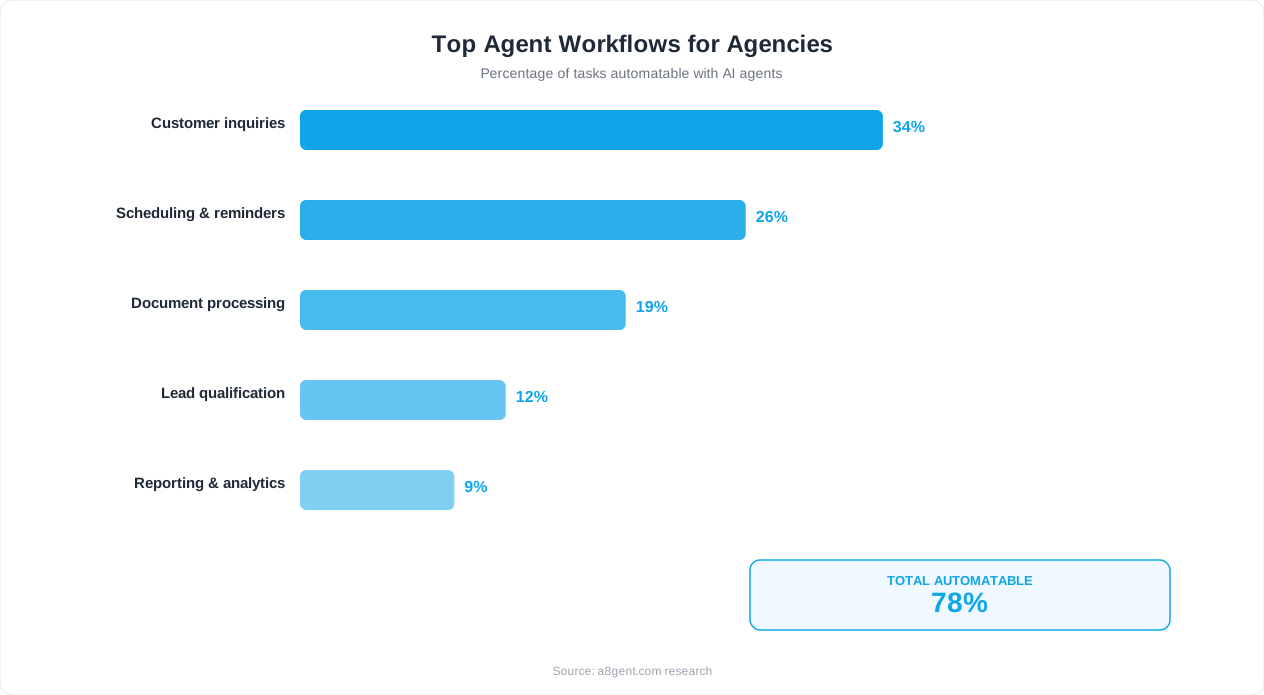
Client reporting is fundamentally a data synthesis task: pull numbers from platforms, identify meaningful trends, translate data into insights, and format everything professionally. AI agents excel at exactly this pattern - gathering structured data, analyzing it for patterns, generating natural language summaries, and producing formatted outputs. Unlike creative work where subjective quality is paramount, reporting quality is measurable: are the numbers accurate, are the insights relevant, is the format professional? These are verifiable criteria that make AI output easy to quality-check quickly.
The AI Reporting Workflow
A typical automated reporting workflow uses multiple connected agents. Agent 1 pulls data from analytics platforms, ad accounts, CRM systems, and any other data sources relevant to the client. Agent 2 compares current period data against previous periods and goals, identifying significant changes, anomalies, and trends. Agent 3 generates narrative insights explaining what happened and why, including recommended actions based on the data patterns. Agent 4 formats everything into the client's preferred report template with proper branding, charts, and structure. The entire sequence runs automatically on your reporting schedule - weekly, bi-weekly, or monthly - and drops finished draft reports into your review queue.
The Critical Human Layer
Notice the word "draft" above. The most successful agencies treat AI-generated reports as drafts that require human review before delivery. This review takes 10-15 minutes per report (versus 2-4 hours building from scratch) and catches the occasional AI misinterpretation, adds strategic context that only a human familiar with the client relationship would know, and ensures the narrative tone matches your agency's voice. This human-in-the-loop approach delivers 80-90% time savings while maintaining the quality standard clients expect.
Results from Real Agencies
A 12-person marketing agency managing 25 client accounts reduced their reporting time from 40+ hours monthly to under 8 hours - freeing their account managers for strategic work and client conversations that actually grow relationships. A 5-person SEO agency automated weekly ranking reports that previously consumed an entire team member's Monday morning, reclaiming 15+ hours monthly for actual optimization work. These are not exceptional cases - they represent typical results for agencies with well-configured reporting automation.
The tools that handle this best include Autonoly for AI-powered insight generation and Clearscope for content performance reporting specifically. Use our AI stack builder to design the optimal reporting automation setup for your agency's specific platform mix and client types.
Content Production at Scale: AI Without Losing Brand Voice
Content agencies face a specific challenge with AI automation: clients pay for distinctive writing, original thinking, and brand-aligned messaging. Generic AI content is the opposite of what they are buying. Yet the research, outlining, first-drafting, and editing stages of content production contain enormous efficiency gains if automated correctly.
The Research and Brief Generation Stage
AI agents dramatically accelerate the research phase of content production. Instead of a writer spending 45-60 minutes researching a topic before writing, an AI agent compiles relevant data, competitive content analysis, keyword opportunities, and structured outlines in minutes. This gives your writers a comprehensive brief that would have taken them an hour to assemble - and they can start writing from an informed position immediately. Agencies report 30-40% reduction in total content production time from research automation alone, with zero quality impact because the creative writing still happens manually.
First Draft Generation with Brand Voice Training
The controversial territory: using AI for first drafts of client content. Agencies succeeding here invest significant upfront time training AI on each client's brand voice, preferred terminology, content style, and communication standards. This training - feeding the AI 10-20 examples of approved client content and defining explicit voice guidelines - takes 2-3 hours per client initially but pays dividends across hundreds of future content pieces. A well-trained AI produces first drafts that capture 70-80% of the client's voice, which skilled writers then refine to 100% in significantly less time than writing from scratch.
The Editing and Optimization Layer
AI agents handle mechanical editing tasks exceptionally well: checking for consistency with style guides, verifying SEO optimization, ensuring proper formatting, checking links, and flagging potential compliance issues. These tasks consume 15-20% of a content editor's time and are entirely automatable without quality risk. The agent flags issues; a human makes the final decision on each flag. This ensures nothing slips through while eliminating the tedious checking process.
Scaling Without Proportional Hiring
The combined effect - automated research, AI-assisted first drafts, automated mechanical editing - means a content agency can increase output by 40-60% without proportional headcount increases. A team producing 30 articles monthly can reach 45-50 with the same writers, because each writer spends less time on non-creative tasks and more time on the high-value creative work that defines quality. The writers work at capacity on the work they are best at (creative writing, strategic thinking, brand interpretation) while AI handles what they are overqualified for (data gathering, formatting, link checking).
Quality Safeguards That Protect Client Relationships
The agencies maintaining quality build three safeguards into content workflows. First, every piece receives human creative review before delivery - no exceptions, regardless of how good the AI draft looks. Second, monthly quality audits compare AI-assisted content performance against fully human-produced content to verify no quality degradation over time. Third, clear client communication about their process (more on this later) ensures expectations align. Assess your content workflow to identify which stages offer the highest automation potential for your specific service model.
Campaign Management: AI Agents Handling Day-to-Day Optimization
Managing advertising campaigns across multiple platforms for multiple clients is one of the most time-intensive agency activities - and one where AI agents deliver substantial improvements in both efficiency and performance when properly configured.
Automated Performance Monitoring and Alerting
Instead of manually checking campaign performance across Google Ads, Meta Ads, LinkedIn, and other platforms multiple times daily, AI agents continuously monitor all campaigns and surface only what needs human attention. An agent checks performance metrics against defined thresholds (cost per acquisition above target, daily spend exceeding budget, conversion rate dropping below baseline) and alerts the relevant team member with context and recommended action. This eliminates hours of dashboard-watching while ensuring nothing important goes unnoticed for more than minutes. The agent does not make changes - it identifies situations requiring human decision-making and brings them to attention with supporting data.
Budget Pacing and Reallocation Recommendations
AI agents excel at the mathematical aspects of campaign management: tracking budget pacing across accounts, identifying underspending and overspending campaigns, calculating optimal reallocation based on performance data, and modeling projected outcomes of different budget scenarios. What previously required spreadsheet analysis and manual calculation happens continuously and automatically. Your media buyers receive daily summaries showing which budgets need adjustment and why, with specific reallocation recommendations they can approve or modify in seconds rather than calculating from scratch in minutes.
Creative Testing and Rotation Automation
AI agents manage the mechanical aspects of creative testing - scheduling new creative variants into rotation, pausing underperforming ads that meet statistical significance thresholds for poor performance, and generating performance comparison reports across creative variants. For agencies running dozens of creative tests across multiple client accounts simultaneously, this automation prevents the common failure of letting poor-performing creative run too long simply because nobody checked. The agent handles the data monitoring; your creative team focuses on producing the next winning creative based on learned patterns.
Cross-Platform Coordination
Many agencies struggle with coordinating campaign activities across platforms - ensuring messaging consistency, managing frequency caps across channels, and understanding cross-platform attribution. AI agents that pull data from multiple platforms into unified views and identify cross-platform patterns save significant analysis time. Rather than checking each platform independently, your team receives integrated performance views that show how channels work together (or conflict) for each client's campaigns.
What AI Should NOT Decide Autonomously
Critical distinction: AI agents should monitor, alert, and recommend - but major decisions should require human approval for client campaigns. Do not let AI automatically pause campaigns, make significant budget changes, or modify targeting without human sign-off. The downside risk of an AI making a wrong autonomous decision on a client's ad spend far outweighs the time saved by removing human approval. Configure your agents to operate within narrow autonomous bands (small bid adjustments within defined limits) while escalating anything significant for human approval. Autonoly supports this approval-gated workflow pattern, making it practical to get AI speed with human oversight.
Internal Agency Operations: Automate Before Client Work
Before automating client-facing deliverables, smart agency owners automate their internal operations. Internal automation carries zero client risk, builds your team's comfort with AI tools, and often delivers immediate capacity gains by eliminating administrative overhead that drains billable hours.
Resource Allocation and Scheduling
AI agents that monitor team workloads, project timelines, and upcoming deadlines can identify scheduling conflicts before they become crises. When a new project comes in, an agent analyzes current team capacity, skill requirements, and deadline constraints to recommend optimal assignment - considering factors like who has bandwidth, who has relevant experience, and whether accepting the project creates downstream conflicts. This does not replace management judgment but eliminates the hours spent manually reviewing calendars, capacity spreadsheets, and project timelines to make staffing decisions.
Time Tracking and Profitability Analysis
Agencies live and die by profitability per client and per project. AI agents that automatically aggregate time tracking data, compare actual hours against estimates, flag projects trending toward unprofitability, and generate weekly profitability summaries save operations managers significant analysis time while surfacing problems earlier. A common pattern: an agent identifies when a project has consumed 80% of budgeted hours while being only 50% complete, alerting the project manager to address scope or efficiency before the project becomes a loss.
Client Communication and Follow-Up
Internal to the agency, AI agents manage the administrative aspects of client communication: drafting meeting agendas based on project status, generating follow-up emails after calls with action items, sending reminder sequences for pending client approvals, and maintaining communication logs. These tasks consume significant account manager time and are highly automatable. The agent drafts; the account manager reviews and personalizes in seconds. This ensures consistent client communication cadence even during busy periods when follow-ups would otherwise slip.
New Business and Proposal Support
When responding to RFPs or creating proposals, AI agents accelerate the process by pulling relevant case studies from your portfolio, drafting proposal sections based on the prospect's requirements, generating competitive positioning based on the specific competitors mentioned, and formatting final documents. What typically takes 4-8 hours of proposal writing becomes 1-2 hours of review and customization. For agencies responding to multiple RFPs monthly, this automation directly impacts revenue by enabling more responses without additional hours.
Knowledge Management and Onboarding
Agencies constantly onboard new team members and need institutional knowledge accessible. AI agents that maintain searchable knowledge bases, answer team questions about processes and client preferences, and generate onboarding guides for new hires from existing documentation reduce the knowledge-transfer burden on senior staff. Instead of interrupting experienced team members with repetitive questions, new hires query an AI that has been trained on agency processes, client briefs, and standard operating procedures.
These internal automations build your team's confidence with AI tools in a low-risk environment, creating familiarity and trust before you extend automation to client-facing work. Build your agency's AI stack starting with internal operations and expanding outward as capabilities and confidence grow.
Quality Control Frameworks: Keeping Standards While Scaling
The agencies successfully using AI share one critical practice: they build quality control into their workflows as mandatory checkpoints, not optional afterthoughts. Here are the frameworks that prevent AI automation from degrading the work quality that clients pay premium rates to receive.
The Three-Tier Review System
Tier 1 - Automated Quality Checks: AI agents verify mechanical quality factors automatically. Content meets word count requirements, formatting is correct, links work, brand guidelines are followed, SEO parameters are met, data is accurately pulled from source systems, and outputs match template requirements. These checks catch obvious errors without consuming human time and prevent embarrassing mechanical mistakes from reaching clients.
Tier 2 - Peer Review: A team member who did not produce the work reviews it with fresh eyes. For AI-assisted deliverables, this means a human reviewing AI-generated content for accuracy, appropriate tone, strategic relevance, and anything that feels generic or off-brand. Peer review catches the subtler quality issues that automated checks miss - insights that are technically correct but not useful, tone that is professional but not aligned with the client's voice, or recommendations that are generic rather than specific to the client's situation.
Tier 3 - Strategic Review: Senior team members or account directors review deliverables through a strategic lens before client delivery. Does this work advance the client's goals? Does it demonstrate our expertise and justify our fees? Is there anything that could damage the relationship or our reputation? This tier catches quality issues that neither automated checks nor peer review address - the strategic alignment that only someone with deep client context can evaluate.
Quality Metrics and Feedback Loops
Measurement prevents quality drift. Track: client satisfaction scores per deliverable type (are AI-assisted deliverables rated equally to fully human ones?), revision request rates (are clients asking for more revisions on AI-assisted work?), performance outcomes (does AI-assisted content/campaigns perform as well as human-produced?), and time-to-approval (are clients approving AI-assisted work as quickly?). If any metric degrades, investigate immediately - catching quality issues through data prevents them from accumulating into client dissatisfaction.
Client-Specific Quality Profiles
Different clients have different quality expectations and sensitivity to AI involvement. Build explicit quality profiles for each client documenting: their voice and tone requirements, topics or approaches to avoid, historical feedback patterns (what they have praised and criticized), approval process preferences, and their awareness and comfort level with AI assistance. AI agents configured with client-specific quality profiles produce dramatically better first drafts than those using generic settings.
The 80/20 Rule of AI Quality
Accept that AI produces 80% quality at 20% of the time cost. Your team's job is elevating that 80% to 100% - which takes 20% of the time compared to producing from scratch. This math works: 20% of the time for the AI draft plus 20% of the time for human refinement equals 40% of the original time for 100% quality output. The mistake is expecting AI to produce 100% quality directly. It cannot, and designing workflows that assume it can leads to quality failures that damage client relationships.
Build your quality framework before scaling AI usage across client accounts. Our assessment tool helps you identify which deliverable types in your agency carry the highest quality risk from automation and where to build the strongest review gates.
Talking to Clients About AI: Transparency That Builds Trust
One of the most anxiety-producing questions for agency owners considering AI automation: "Do I tell my clients?" The answer, based on agencies that have navigated this successfully, is a clear yes - but how you communicate matters enormously.
Why Transparency Wins
Clients inevitably discover that their agency uses AI. If they discover it themselves - through detecting AI patterns in content, hearing about it from another source, or noticing faster turnaround times - the narrative becomes "they were hiding something." If you proactively communicate it, the narrative becomes "they are innovating to serve us better." The same fact (AI assistance in deliverables) carries completely different emotional weight depending on whether you disclosed it or concealed it. Multiple agency owners reported that proactive disclosure actually strengthened client relationships by demonstrating transparency and forward-thinking investment in service quality.
How to Frame the Conversation
Frame AI usage around client benefits, not agency efficiency. Instead of "we use AI to reduce our costs," say "we have invested in AI tools that allow us to deliver faster turnaround, more frequent reporting, and deeper analysis without increasing your costs." Instead of "AI writes your first drafts," say "our team uses AI-assisted research and drafting tools that give our writers more time to focus on creative strategy and brand voice refinement." The framing is not dishonest - it is choosing which truth to lead with. Clients care about what they receive, not your internal processes.
What Clients Actually Care About
In our conversations with agency owners, the consistent finding was that clients care about three things: quality (is the work as good or better?), results (are outcomes improving?), and value (am I getting appropriate value for what I pay?). Almost no clients objected to AI usage when all three criteria were met. Objections arose only when quality visibly declined, when clients felt they were paying human rates for AI work without corresponding value, or when disclosure happened retroactively after trust was already damaged.
Pricing Conversations in the AI Era
The most sensitive sub-question: should AI efficiency savings reduce client prices? There is no universal answer, but successful agencies handle this by offering enhanced value at existing prices rather than reducing prices. You now deliver weekly reports instead of monthly (same price, more value). You now include competitive analysis with content briefs (same price, additional deliverable). You now turn projects around in 3 days instead of 5 (same price, better speed). This approach maintains your margins while giving clients legitimate additional value that justifies pricing stability.
Handling the "Am I Paying for AI Work?" Objection
If a client questions whether they should pay the same rates when AI does some of the work, redirect to outcomes: "The expertise you are paying for is in knowing what to automate, how to configure it for your specific brand, and when to override AI recommendations with strategic judgment. The tools have changed, but the expertise and outcomes you receive have not - in fact, the additional analysis and speed we now deliver exceeds what was previously possible at any price point." This is the same argument that photographers made when switching from film to digital, or that designers made when switching from manual to digital design. The tool changes; the expertise does not.
Agencies that handle this communication well report that AI transparency becomes a competitive advantage - prospects specifically choose them because they demonstrate innovation and willingness to invest in modern tools that benefit clients. Tools like Clearscope even provide client-facing dashboards that make AI-assisted optimization visible and valued.
Your Agency AI Implementation Roadmap: Month by Month
Based on the experience of agencies that have successfully integrated AI, here is a proven implementation timeline that minimizes risk while building capability progressively.
Month 1: Internal Operations Only (Zero Client Risk)
Start exclusively with internal automation. Set up AI-powered time tracking analysis, automate your team scheduling and resource allocation recommendations, implement AI-assisted proposal drafting for new business, and automate internal communication summaries and action item extraction from meetings. This month builds your team's comfort with AI tools without any risk to client relationships. It also delivers immediate time savings - typically 8-12 hours weekly across the team - that validate the investment and create enthusiasm for expansion.
Month 2: Client Reporting Automation (Low Risk, High Impact)
Implement AI-powered reporting for your most straightforward accounts first. Choose 3-5 clients with standard reporting needs and build automated report generation with human review. Run both manual and AI reporting in parallel for 2 weeks to verify quality parity. Once confirmed, switch to AI-generated reports with human review for those accounts and measure time savings. Expected result: 60-80% reduction in reporting time for those accounts, with equal or better report quality due to more consistent data analysis.
Month 3: Content and Creative Support (Moderate Risk, High Value)
Extend AI to content research, brief generation, and first-draft creation - with mandatory human creative review on every piece. Start with your highest-volume content types (blog posts, social media, email newsletters) where you have the most examples for AI training. Build client-specific brand voice profiles and test AI-assisted content against your quality standards. Maintain human-only production for sensitive or high-visibility content until you have confidence in the AI-assisted quality level.
Month 4-5: Campaign Management Assistance (Strategic Value)
Deploy AI agents for campaign monitoring, performance alerting, and optimization recommendations. Your media team receives AI-generated daily briefings on campaign performance with flagged issues and suggested actions. Human decision-making remains required for all significant changes. This does not reduce headcount - it amplifies your team's ability to manage more accounts effectively by eliminating manual data checking in favor of intelligent alerting.
Month 6: Scale and Optimize (Full Integration)
By month six, evaluate results across all implemented automations. Measure: total time saved, quality metrics, client satisfaction scores, and revenue impact (additional clients served or improved margins). Double down on what works, adjust or remove what does not, and identify the next wave of automation opportunities. Most agencies find that month-six results justify expanding their AI investment significantly because the proof is in their own data.
Getting Started Today
Your first action: take our agency assessment to identify which specific workflows in your agency offer the highest automation ROI with the lowest risk. Then explore our AI stack builder to design the optimal tool combination for your agency's size, services, and technical capability. The agencies that started this process six months ago are now serving 40-60% more clients with the same team - and their competitors are still discussing whether to begin. Do not be the agency that waits until AI-augmented competitors have already captured your growth market.
Related reads for services firms: AI agents for consulting firms and automating proposal writing.
FAQ
Will clients leave if they find out we use AI for their work?
No - if quality and results remain strong and you communicate proactively. Agencies that disclosed AI usage transparently report strengthened client relationships, not damaged ones. Clients care about output quality, turnaround speed, and value received. If AI helps you deliver better on all three, disclosure becomes a positive differentiator. Clients leave when quality drops or when they feel deceived - not because a tool changed.
Which agency tasks should never be automated with AI?
Strategic recommendations that significantly impact client business direction, crisis communication and sensitive PR situations, final creative approval on high-visibility campaigns, relationship management and difficult client conversations, and any task where an AI error could cause legal, financial, or reputational damage to the client. These require human judgment, empathy, and accountability that AI cannot provide.
How much can an agency realistically save with AI automation?
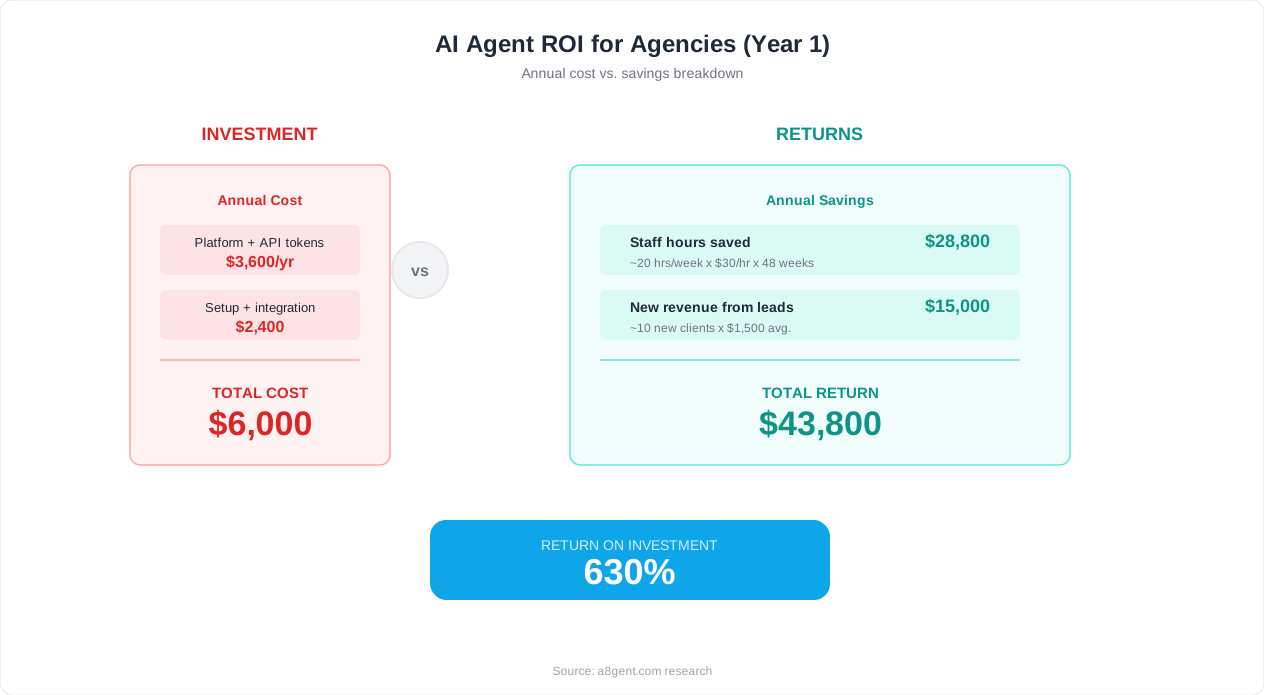
Most agencies save 15-25 hours per team member monthly after full implementation (month 4-6). For a 10-person agency, that translates to 150-250 hours monthly - equivalent to 1-1.5 additional full-time employees worth of capacity. In revenue terms, this means either serving 30-50% more clients at existing margins, or maintaining current client loads with significantly improved margins and reduced team stress.
What is the best AI tool for agency reporting automation?
Autonoly offers the best balance of AI-powered insight generation and ease of setup for agencies. For agencies with technical team members, n8n provides maximum customization at lower cost. The optimal choice depends on your reporting complexity, platform mix, and team technical comfort. Most agencies benefit from combining a general AI agent platform with platform-specific reporting tools.
Should we reduce client pricing since AI lowers our costs?
Not necessarily. The recommended approach is enhancing value at existing prices - delivering more frequent reports, faster turnaround, additional analysis, or expanded scope while maintaining pricing. This preserves your margins while giving clients genuine additional value. If competitive pressure requires price reductions, ensure you understand the full cost of AI implementation (tools, setup time, ongoing management) before adjusting pricing.
How do we maintain brand voice consistency across AI-generated content?
Invest 2-3 hours per client building brand voice profiles: collect 10-20 approved content examples, define explicit voice characteristics (formal vs casual, technical vs accessible, serious vs playful), list prohibited terms and preferred alternatives, and document client feedback patterns. Feed these to your AI tools as system prompts. Then maintain mandatory human review by someone who knows the client's voice before any content is delivered.
Can small agencies (under 5 people) benefit from AI agents?
Yes - small agencies often benefit proportionally more because each person wears multiple hats and time pressure is intense. A 3-person agency automating reporting, content research, and proposal drafting can reclaim 20-30 hours monthly across the team, which might represent the difference between turning away new clients and comfortably taking them on. Start with one high-impact workflow and expand as you see results.
What happens when AI makes a mistake on client work?
This is why human review checkpoints are non-negotiable. When AI makes a mistake (and it will - expect 10-20% of outputs to need correction), your review process catches it before it reaches the client. Build your workflow assuming errors will happen and design review stages accordingly. If a mistake does reach a client, handle it as you would any team error - acknowledge, correct, and improve the process to prevent recurrence.