
AI Agents for Digital Marketing Agencies: The Complete Guide (2026)
Digital marketing agencies are using AI agents to scale client work, improve margins, and deliver better results - without hiring more staff. This complete guide covers which agents to deploy, where they deliver the most value, and how to implement them without disrupting your current operations.
10+ years shipping production ML across TensorFlow, PyTorch, AWS, and GCP. Ships every A8gent agent before it becomes a lesson. GitHub
- Digital marketing agencies that adopt AI agents in 2026 are handling 40-60% more client work per team member without sacrificing quality or burning out their staff.
- The highest-ROI agent deployments for agencies are content creation and repurposing, client reporting automation, SEO research and optimization, and ad copy generation and testing.
- Successful agencies deploy AI agents as force multipliers for their existing team rather than staff replacements - the winning model is fewer but more skilled humans guided by multiple AI agents.
- Client communication about AI usage matters: position it as enhanced capability and faster delivery rather than cost reduction, and most clients respond enthusiastically.
- Start with one department or service line, prove the efficiency gains over 30 days, then systematically expand to other areas of your agency operations.
Why 2026 Is the Tipping Point for Agencies and AI
Digital marketing agencies face a brutal squeeze in 2026. Client expectations keep rising - they want more channels covered, faster turnaround, better results, and transparent reporting. But budgets are not growing proportionally, and talented marketers are expensive and hard to retain. The math simply does not work anymore with traditional staffing models. You cannot deliver premium service across SEO, paid media, content, social, email, and analytics for every client without either burning out your team or accepting razor-thin margins.
This is exactly why AI agents have become the defining competitive advantage for forward-thinking agencies. Not as a future possibility - as a present reality. Agencies deploying AI agents today are handling significantly more client work per team member, delivering results faster, and maintaining healthy margins while competitors struggle with the cost-quality-scale triangle that has always constrained service businesses.
The numbers tell the story. Agencies using AI agents report handling 40-60% more client accounts per team member, reducing content production time by 70%, cutting reporting hours by 80%, and improving campaign optimization speed by 50%. These are not marginal improvements - they fundamentally change the economics of running an agency.
But here is the crucial nuance that many agency owners miss: this is not about replacing your team with AI. The agencies seeing the best results are using AI agents to amplify human capability, not eliminate it. Your strategists still craft the big-picture approach. Your creatives still ensure brand consistency. Your account managers still maintain client relationships. The AI agents handle the volume, the repetition, the research, and the execution - freeing your humans to do the thinking and relationship work that justifies premium pricing.
This guide is specifically for digital marketing agency owners and operators who want to understand where AI agents deliver the most value, which tools to implement, and how to roll them out without disrupting current client work. Whether you run a 5-person boutique or a 50-person full-service agency, the principles and recommendations apply. Take our free assessment to get personalized recommendations for your specific agency model, or read on for the complete playbook.
Where AI Agents Deliver the Highest ROI for Agencies
Not all agency tasks benefit equally from AI automation. Some workflows see 10x efficiency gains while others barely improve. After studying dozens of agency implementations, here are the areas ranked by return on investment - start at the top and work your way down.
1. Content Creation and Repurposing (Highest ROI)
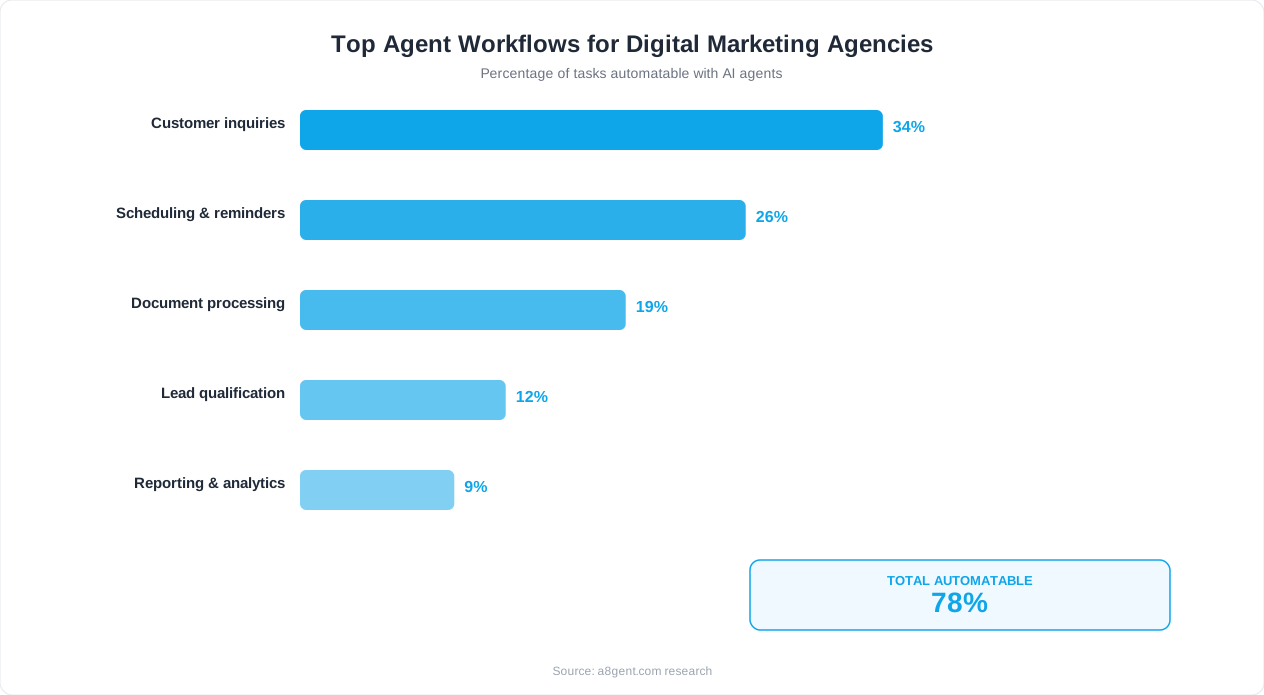
Content is the lifeblood of digital marketing, and it is also the biggest time sink. AI agents transform your content operation by generating first drafts of blog posts from briefs or outlines, repurposing one piece of content into 15-20 formats (blog to social posts, email snippets, ad copy, video scripts), writing meta descriptions and SEO titles at scale, producing client newsletter content, and creating variation after variation of ad copy for testing. A single content agent can produce the raw output equivalent of 2-3 junior content writers. Your senior team then edits, refines, and ensures brand voice consistency - working with material rather than starting from blank pages. Agencies report 60-75% time reduction in content production without quality degradation.
2. Client Reporting (Second Highest ROI)
We covered this in depth in our operations guide, but it bears repeating: automated reporting saves 8-12 hours per week for the average agency while often improving insight quality. The AI pulls data, identifies patterns, generates narrative analysis, and delivers formatted reports on schedule. Your team reviews rather than creates - a fundamentally different and more efficient use of their time.
3. SEO Research and Optimization
AI agents excel at SEO tasks that are research-heavy and pattern-dependent: keyword clustering and opportunity analysis, competitor content gap identification, technical SEO audit interpretation and prioritization, content optimization recommendations, and internal linking suggestions. What used to require a dedicated SEO analyst spending hours in spreadsheets now happens in minutes. The agent identifies opportunities and your strategist decides which ones to pursue.
4. Ad Copy and Creative Testing
Paid media campaigns live and die by creative variation. AI agents generate dozens of ad copy variations, headline options, and call-to-action alternatives for A/B testing - a task that previously bottlenecked on a copywriter's bandwidth. They can also analyze historical performance data to identify patterns in what works (urgency language, specific benefit claims, certain emotional appeals) and bias new variations toward those proven patterns.
5. Lead Generation and Sales Support
For agencies still doing their own business development, AI agents handle prospect research, personalized outreach, follow-up sequences, and meeting scheduling. This frees your principals and business development team from the grind of cold outreach while maintaining the personalized approach that wins agency clients.
Use our AI stack builder to design the right combination of tools for your specific agency services and team structure.
AI Agents for Agency Content Production
Content production is where most agencies see the fastest and largest impact from AI agents. Here is how to set up a content operation that produces 3-5x more output without proportionally increasing your team or sacrificing the quality your clients expect.
The AI-Augmented Content Workflow
The most effective agency content workflow in 2026 follows this pattern: human strategist creates the content calendar and brief (what to write, who it is for, what it should achieve), AI agent produces the first draft based on the brief plus research it conducts independently (competitor content, keyword data, audience insights), human editor refines the draft for voice, accuracy, and strategic alignment, AI agent handles formatting, SEO optimization, meta data, and content repurposing into other formats, and human gives final approval before publishing.
This workflow means your humans spend time on strategy and quality - the high-value activities - while the AI handles the volume and production aspects. The result is more content, produced faster, at consistent quality.
Recommended Tools for Agency Content
Autonoly excels for agencies that need coordinated content workflows across multiple clients. You set up content agents for each client with their unique brand voice, style guidelines, and topic preferences. The agent remembers previous content, avoids repetition, and maintains consistency across pieces. For agencies managing 10+ client content calendars, this coordination capability is essential.
Clearscope is the go-to for SEO-driven content specifically. Its AI analyzes top-ranking content for your target keywords and provides real-time optimization guidance. For agencies where organic traffic growth is a core deliverable, Clearscope ensures every piece of content has maximum ranking potential. The combination of AI content generation plus Clearscope optimization produces content that both reads well and performs in search results.
Content Repurposing at Scale
This is perhaps the single highest-leverage application of AI agents for agencies. One 2,000-word blog post can become: 10-15 social media posts tailored to different platforms, an email newsletter segment, a script for a short video, 3-4 ad copy variations, an infographic outline, a client-facing summary, and a FAQ section for the website. Manually repurposing to this extent is impractical - it would take hours per blog post. An AI agent handles it in minutes, instantly multiplying the value of every piece of content your team produces.
Quality Control at Scale
The concern every agency has: "Will AI-generated content maintain our quality standard?" The answer depends on your process. Agencies that use AI as a first-draft tool and apply human editing consistently report quality that meets or exceeds their previous fully manual output - because editors work with material rather than producing from scratch, they can focus entirely on quality rather than splitting attention between creation and refinement. Build a simple review checklist: brand voice alignment, factual accuracy, strategic alignment with brief, and SEO optimization. Apply it to every piece before client delivery.
AI Agents for Client Communication and Management
Beyond deliverable production, agencies spend enormous time on client communication: emails, status updates, meeting preparation, proposal writing, and relationship management. AI agents reduce this overhead while actually improving the client experience through faster response times and more consistent communication.
Automated Status Updates
Clients want to know what is happening with their accounts between formal reports. AI agents can generate and send brief weekly status updates by pulling data from your project management system (tasks completed, in progress, and upcoming), recent performance highlights from analytics platforms, and any notable activities or results worth celebrating. These updates take zero team time to produce but give clients the visibility they crave. Configure the agent to flag weeks where there is genuinely nothing notable to report, and skip rather than sending empty updates that annoy clients.
Email Response Drafting
Client emails that ask routine questions - "When will the blog post be published?" "Can you send me last month's metrics?" "What's the status of the landing page?" - consume account manager time disproportionate to their importance. An AI agent integrated with your project management and analytics tools can draft accurate responses to these questions instantly. Your account manager reviews the draft (10 seconds) and sends, rather than spending 5 minutes pulling information and composing a response. For agencies receiving 20-50 client emails daily, this saves 1-2 hours of account management time.
Meeting Preparation
Before every client meeting, someone needs to pull recent data, identify talking points, note any issues or wins, and prepare an agenda. An AI agent handles this preparation automatically: it generates a brief document with current KPIs versus goals, notable changes since the last meeting, items requiring client decisions, and suggested discussion topics. Your strategist reviews this briefing (5 minutes) rather than preparing it from scratch (30-45 minutes). The improvement in meeting quality is noticeable because preparation is consistent rather than rushed.
Proposal and Pitch Generation
New business proposals are high-stakes documents that require significant time investment. AI agents accelerate proposal creation by researching the prospect's current marketing (website analysis, social presence, ad library review), generating competitive landscape summaries, drafting strategy sections based on your agency's proven frameworks, and formatting everything into your proposal template. A proposal that previously took 4-6 hours to create can be reduced to 1-2 hours of strategic refinement once the AI produces the foundation.
Client Satisfaction Monitoring
AI agents can analyze the tone and content of client communications to flag potential satisfaction issues before they become churn risks. If a client's emails become shorter, less enthusiastic, or start asking more pointed questions about results, the agent alerts the account team to proactively address concerns. This early warning system is impossible to maintain manually across a large client base but trivial for an AI agent monitoring all incoming communications. Take our assessment to identify which client management automations would deliver the most value for your specific agency structure.
AI Agents for Agency Operations and Finance
The back office of an agency - time tracking, resource allocation, invoicing, capacity planning - often receives the least attention when it comes to automation. Yet these operational inefficiencies silently erode margins and create the chaos that leads to missed deadlines, scope creep, and team burnout. Here is how AI agents bring order to agency operations.
Resource Allocation and Capacity Planning
One of the hardest problems in agency management is knowing who has bandwidth and who is overloaded. AI agents connected to your project management and time tracking tools can monitor team capacity in real-time, predict upcoming bottlenecks based on project timelines and historical task durations, and recommend resource reallocation before deadlines are at risk. Instead of discovering on Thursday that a designer is overloaded for Friday's deadline, you get an alert on Monday that the current workload trajectory suggests intervention is needed. This proactive approach prevents the fire drills that burn out your best people.
Automated Invoicing and Revenue Tracking
For agencies billing by the hour or by deliverable, invoicing involves pulling time data, matching it against client agreements, calculating amounts, generating invoices, and tracking payments. AI agents automate this entire chain: they monitor completed work against scope agreements, generate invoices at the appropriate intervals, send them to clients with professional formatting, track payments, and send follow-up reminders for outstanding balances. For agencies with 20+ clients, this eliminates 4-8 hours of monthly administrative work while improving cash flow through consistent, timely invoicing.
Scope Creep Detection
Scope creep is the silent margin killer in agencies. AI agents monitoring project activity can detect when work is exceeding agreed-upon scope: more revisions than included, additional deliverables being produced without change orders, or hours tracking significantly above budget for a project. The agent alerts the account team before the overage becomes significant, enabling a conversation about additional charges or scope adjustment while the relationship is still positive - not after you have already eaten thousands in unbilled work.
Hiring and Contractor Management
As your agency grows, AI agents assist with workforce management: screening freelancer applications, matching contractor skills to project requirements, tracking contractor availability and performance, and managing the onboarding process for new team members. For agencies that rely on a bench of freelancers for overflow work, having an agent that knows who is available, who excels at what, and who has capacity transforms contractor management from chaotic to systematic.
Financial Forecasting
AI agents with access to your pipeline, active client data, and historical patterns can generate revenue forecasts that help you make better business decisions. They can predict which months will be tight based on contract renewal dates, identify clients at risk of churning based on engagement patterns, and recommend proactive business development timing. This turns your agency from reactive (scrambling when revenue dips) to proactive (addressing issues before they impact cash flow).
Build your complete agency operations stack using our AI stack builder tool - it recommends the specific combination of tools that work together for agencies at your size and service model.
The 90-Day Implementation Plan for Agency AI Adoption
Implementing AI agents across an agency requires a structured approach. Going too fast creates chaos and resistance from your team. Going too slow means competitors capture the efficiency advantage while you deliberate. Here is a proven 90-day rollout plan that balances speed with stability.
Days 1-7: Assessment and Selection
Audit your agency's current time allocation. Where does your team spend hours on repetitive work? Rank opportunities by time savings potential and implementation complexity. Select one area to pilot - we recommend content production or reporting because they deliver visible results quickly with manageable risk. Choose your tools based on our recommendations above or use our assessment tool for a personalized suggestion.
Days 8-21: Pilot Deployment
Deploy your chosen AI agent for one service area with one or two clients. Do not announce this to clients - simply use the AI to augment your existing workflow and measure the results. Track: time saved, quality of output (compared to your previous manual standard), team feedback, and any issues or limitations discovered. Have your best person in that area oversee the pilot and provide feedback to refine the agent's instructions.
Days 22-35: Refinement and Expansion
Based on pilot results, refine your agent configuration to address issues discovered. Once quality is consistently meeting your standard, expand to all clients in that service area. Document the workflow so other team members can operate it. Start identifying your second deployment area.
Days 36-60: Second and Third Deployments
Roll out AI agents in your second highest-ROI area (likely the one you did not choose first - reporting or content). Apply lessons learned from the pilot to accelerate setup. Begin the pilot for a third area. At this point, your team is developing familiarity with AI-augmented workflows and resistance typically decreases as they experience the time savings firsthand.
Days 61-90: Integration and Optimization
Connect your deployed agents so they share information and feed each other. Content agents inform social agents. Reporting agents feed strategy discussions. Client communication agents draw from project management data. This integration phase is where compound efficiency gains emerge - each individual agent becomes more valuable as it connects to others. Measure overall agency capacity: how many more clients could you serve with the same team? How much faster is deliverable turnaround? What is the impact on margins?
Team Communication Throughout
Frame AI adoption as skill amplification, not job threat. The message to your team should be: "AI handles the production work so you can focus on strategy, creativity, and client relationships - the work that is more fulfilling and more valuable." Most agency professionals welcome AI when they experience how it eliminates the tedious parts of their job. The ones who resist typically fear replacement - address this directly with clear communication about how their role evolves rather than disappears.
Use our AI stack builder to map out your complete implementation plan with specific tool recommendations for each phase.
Future-Proofing Your Agency: What Comes Next
Agencies that adopt AI agents in 2026 are not just solving today's efficiency problems - they are positioning themselves for the fundamental shifts coming to the marketing industry over the next two to three years. Here is what is on the horizon and how to prepare.
The New Agency Model: Fewer Humans, Higher Value
The agency model is evolving toward smaller teams of senior strategists and relationship managers supported by extensive AI agent infrastructure. A 5-person agency in 2027 will likely deliver what required a 15-person team in 2024. This does not mean agencies shrink - it means the same team serves more clients at higher margins, or reinvests efficiency gains into premium services that justify higher fees. The agencies that thrive will be those whose humans focus exclusively on irreplaceable activities: strategy, creativity, empathy, and trust-building.
Client Expectations Will Rise Dramatically
As AI agents become common across the industry, clients will expect the benefits as baseline rather than premium. Real-time reporting, instant creative variations for testing, overnight content production, and proactive strategy recommendations will shift from "nice to have" to "table stakes." Agencies without AI infrastructure will simply be unable to meet these expectations at viable price points. The window to adopt without competitive pressure is closing - within 12 months, client RFPs will likely include questions about your AI and automation capabilities.
New Service Offerings Enabled by AI
AI agents enable services that were previously uneconomical at agency scale. Hyper-personalized content programs where every prospect receives unique content. Real-time campaign optimization that adjusts creative and targeting hourly rather than weekly. Predictive analytics that forecast results before campaigns launch. Comprehensive competitive monitoring across dozens of competitors. These services command premium pricing because they deliver measurably better results - and they are only viable with AI infrastructure in place.
The Data Advantage Compounds
Agencies deploying AI agents now are accumulating a data advantage that grows over time. Every campaign, every piece of content, every client interaction teaches your AI systems what works in your specific markets and verticals. An agency with 18 months of AI-analyzed performance data can make predictions and recommendations that a newcomer starting today simply cannot match. This institutional AI knowledge becomes a genuine competitive moat.
Your Immediate Action Plan
Do not wait for the perfect moment or the perfect tool. The agencies winning in 2026 started imperfectly 6-12 months ago and iterated from there. Your next steps:
- Take the free assessment to identify your highest-value starting point
- Choose one area and deploy within the next two weeks using the 90-day plan above
- Build your agency's AI stack systematically using our stack builder tool
- Track results meticulously so you can communicate AI's value to your team and clients
The question is not whether AI agents will transform digital marketing agencies. That is already happening. The question is whether your agency will be among the leaders who capture the efficiency gains and market position available right now, or among the followers trying to catch up when the advantage has already been claimed. Start this week.
FAQ
Should I tell my clients that I use AI agents?
This is a strategic decision, not an ethical obligation (assuming deliverable quality is maintained). Many agencies disclose AI use as a competitive advantage - positioning it as advanced capability that delivers faster results. Others do not disclose because the output quality matches human work. If clients ask directly, always be honest. The trend is toward transparency, and most clients respond positively when AI is framed as enhanced service delivery.
Will AI agents replace agency employees?
Not wholesale - but roles will evolve. Junior production roles (entry-level content writers, data pullers, basic designers) are most impacted. Senior roles focused on strategy, client relationships, and creative direction become more valuable as AI handles execution. The winning model is smaller teams of higher-skilled professionals supported by AI agents. Invest in upskilling your team for strategic work rather than protecting production roles.
How do I maintain brand voice consistency across AI-generated content?
Create detailed brand voice documentation for each client and configure your AI agents with these guidelines. Include example paragraphs, tone descriptors, vocabulary preferences, and off-limits language. Test with 10-15 outputs and refine instructions until the voice is right. Once configured, AI agents maintain voice more consistently than rotating team members because they never forget the guidelines or have off days.
What is the minimum team size to benefit from AI agents?
Even solo agency owners benefit immediately - AI agents are arguably most impactful for one to three person agencies where the owner is doing everything. There is no minimum team size. A solopreneur using AI agents for content, reporting, and client communication can serve 10-15 clients at a level that previously required 3-4 people. The ROI scales regardless of agency size.
How much should an agency budget for AI tools?
Plan for $200 to $500 per month for a comprehensive AI agent stack at a small agency (5-15 clients). This typically includes a primary platform like Autonoly ($100-200), a content optimization tool like Clearscope ($50-150), and a social media tool like Buffer ($50-100). The ROI benchmark is 5-10x - if your tools cost $400 monthly, they should save at least $2,000 in team time or enable $4,000 in additional client capacity.
What is the biggest risk of using AI agents in an agency?
Over-reliance without quality checks. The most common failure pattern is an agency deploying AI-generated content without adequate human review, leading to factual errors, brand voice drift, or generic output that damages client relationships. The solution is mandatory human review checkpoints - especially for client-facing deliverables - and regular quality audits comparing AI output against your established standards.
Can AI agents handle client accounts in different industries?
Yes. Configure separate agent instances or profiles for different client industries with relevant context: terminology, audience characteristics, competitive landscape, and industry best practices. Most platforms support multi-client configurations where each client has unique settings. The AI adapts its knowledge and communication style per client. Agencies managing diverse portfolios find this especially valuable compared to expecting team members to context-switch between industries.
How long until an agency sees ROI from AI agent investment?
Most agencies report positive ROI within the first two to four weeks of deployment. Content production automation typically shows immediate time savings (day one). Reporting automation pays back during the first reporting cycle (end of first month). The full compound benefits - where multiple agents working together create systemic efficiency - typically emerge around the 60 to 90 day mark as integrations mature and team proficiency grows.
AI Agents for Social Media Management
Social media management for agencies is a unique challenge: you are maintaining distinct brand voices across multiple clients, each with different platforms, audiences, and posting schedules. AI agents handle this complexity elegantly when configured properly. Here is the complete approach to AI-powered social media management at agency scale.
Per-Client Social Agents
The most effective setup creates a distinct agent configuration for each client with their specific brand voice, content pillars, visual style preferences, hashtag strategy, and audience demographics. When the agent generates content for Client A (a playful D2C brand), it sounds completely different from Client B (a professional B2B services firm). This per-client configuration takes 30-60 minutes to set up initially but saves countless hours thereafter because you never have to manually adjust tone - the agent knows each brand intimately.
Platform-Specific Optimization
Good social media AI does not just post the same thing everywhere. It adapts content for each platform's requirements and best practices: LinkedIn posts are longer, more professional, and insight-driven. Instagram captions are visual-forward with strategic hashtag placement. Twitter (X) posts are concise, conversational, and designed for engagement. Facebook content emphasizes community and shareability. Your AI agent should understand these platform distinctions and automatically adapt when repurposing content across channels.
Recommended Tool: Buffer with AI
Buffer has evolved into a genuinely powerful AI-enhanced social media platform for agencies. Its AI generates post ideas based on trending topics in your clients' industries, writes platform-optimized copy, suggests optimal posting times based on each client's historical engagement data, and handles scheduling across all platforms. The agency plan allows managing multiple brands from a single dashboard with team collaboration features. For agencies managing 5-20 client social accounts, Buffer offers the best balance of AI capability and operational simplicity.
The Content Calendar Automation
Maintaining content calendars across multiple clients is organizational overhead that AI agents eliminate. Set up your agent to generate a month's worth of post ideas and drafts based on each client's content pillars, upcoming events, seasonal themes, and industry trends. Your social media manager reviews the calendar, approves or adjusts individual posts, and the scheduling happens automatically. This transforms the social media management role from content creation (low-value, time-intensive) to strategic oversight and community engagement (high-value, relationship-driven).
Engagement and Community Management
Beyond content creation, AI agents can handle initial engagement tasks: responding to common comments, thanking new followers, identifying comments that need human attention (complaints, opportunities, PR risks), and compiling engagement reports. Set clear rules about what the agent handles autonomously versus what gets escalated. Most agencies allow autonomous responses for simple interactions (thank you replies, emoji reactions, basic information answers) and escalate anything requiring judgment or strategy to the human team.
For agencies managing both organic social and paid social for clients, the synergy is powerful: AI agents identify which organic posts perform best, and that intelligence feeds directly into paid creative decisions. This data-driven creative loop improves paid performance while making organic strategy more intentional. Use our marketing agent recommendations to explore the full range of social media tools available for agencies.