7 AI Agents Your Competitors Are Already Using (2026)
Discover the 7 AI agents that top-performing businesses are deploying right now for sales, marketing, support, and operations. Practical breakdown with pricing, use cases, and ROI data.
10+ years shipping production ML across TensorFlow, PyTorch, AWS, and GCP. Ships every A8gent agent before it becomes a lesson. GitHub
- AI agents are no longer experimental - 67% of mid-market companies now use at least one autonomous AI tool in daily operations.
- No-code platforms like Autonoly and n8n let non-technical teams deploy AI workflows in days, not months.
- AI sales agents like 11x.ai and Clay are generating qualified pipeline at 1/10th the cost of traditional outbound teams.
- AI support agents like Intercom Fin resolve 60-80% of tickets without human intervention, cutting response times from hours to seconds.
- The ROI gap between companies using AI agents and those that don't is widening every quarter - early adoption compounds over time.
Your Competitors Aren't Waiting - And Neither Should You
Here's what changed in the last 12 months: AI agents went from "interesting experiment" to "competitive necessity." A recent Gartner study found that 67% of mid-market companies now deploy at least one autonomous AI agent in their daily operations. That's up from 23% in 2024.
This isn't about chatbots or basic automation anymore. The AI agents your competitors are using can research prospects, write personalized outbound sequences, resolve support tickets, optimize content for search engines, manage social media calendars, and orchestrate multi-step workflows - all without human intervention.
The businesses winning right now aren't necessarily bigger or better-funded. They're the ones that identified which repetitive, high-volume tasks drain their team's time and deployed the right AI agent to handle them. A 5-person marketing team with the right AI stack now outperforms a 15-person team doing everything manually.
In this guide, we break down 7 specific AI agents that are actively being used by high-performing companies across sales, marketing, support, and operations. For each one, you'll get: what it actually does, a real use case, pricing, and who it's best for.
Not sure which agents fit your business? Start with our free AI readiness assessment to identify where you'll see the fastest ROI. Or use the agent comparison tool to stack these options side by side.
Let's look at what's actually working in 2026.
1. Autonoly - No-Code Workflow Automation That Actually Scales
What it does: Autonoly is a no-code AI workflow automation platform that lets non-technical teams build, deploy, and manage multi-step AI agents through a visual drag-and-drop interface. Think of it as the bridge between "we need AI" and "we can actually implement AI" - without hiring a machine learning engineer.
Unlike basic automation tools that follow rigid if/then rules, Autonoly's agents use LLMs to make contextual decisions at each step. They can read documents, extract data, make judgment calls, route work to the right people, and adapt their behavior based on outcomes. The platform handles everything from simple data entry automation to complex multi-department workflows.
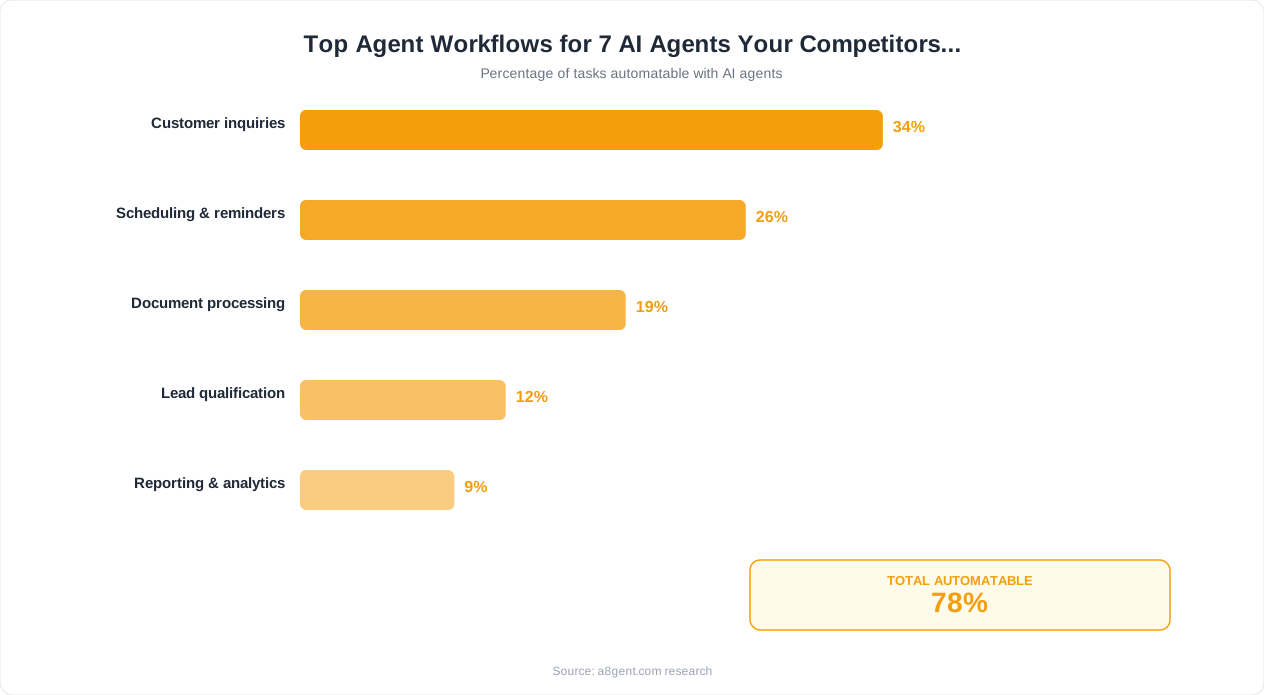
Real use case: A 200-person logistics company used Autonoly to automate their invoice processing workflow. Previously, a team of 4 spent 6 hours daily matching invoices to purchase orders, flagging discrepancies, and routing approvals. After deploying an Autonoly agent, 89% of invoices are processed automatically in under 2 minutes. The team now only handles edge cases and exceptions - about 45 minutes of work per day total.
Pricing: Starts at Free-Free-$49/month for small teams (up to 1,000 agent runs/month). Business plans run $199-499/month depending on volume and complexity. Enterprise pricing is custom. All plans include a 14-day free trial.
Best for: Operations teams, finance departments, and any business function with high-volume repetitive processes that require some degree of judgment (not just mechanical rule-following). Particularly strong for companies in the 50-500 employee range that need automation but don't have dedicated engineering resources to build custom solutions.
If you're exploring no-code automation options more broadly, our guide on AI workflow automation use cases covers the full landscape. You can also calculate your projected ROI based on your specific workflow volumes.
Explore the full Autonoly agent profile for integration details, user reviews, and setup guides.
2. Clay - AI-Powered Lead Enrichment and Outbound at Scale
What it does: Clay is an AI agent platform built specifically for go-to-market teams that need to research prospects, enrich lead data from 75+ sources, and build hyper-personalized outbound sequences - automatically. It combines data enrichment, AI research, and campaign execution into a single workflow.
What makes Clay different from traditional enrichment tools is the AI research layer. It doesn't just pull firmographic data from databases - it actively reads company websites, recent news, LinkedIn posts, job listings, and SEC filings to build a contextual profile of each prospect. Then it uses that context to generate personalized messaging that references specific, relevant details about the prospect's business.
Real use case: A B2B SaaS startup with a 3-person sales team used Clay to replace what previously required a team of 5 SDRs and a data researcher. They built a workflow that identifies companies hiring for specific roles (buying signal), enriches decision-maker contacts, researches each company's tech stack and recent initiatives, then generates personalized email sequences. Result: their reply rate jumped from 2.1% to 8.7%, and they booked 3.4x more qualified meetings per month - with fewer people.
Pricing: Free tier available (100 credits/month). Starter at Free-$149/month (2,000 credits). Explorer at $349/month (10,000 credits). Pro at $800/month (50,000 credits). Each enrichment or AI action costs 1-5 credits depending on complexity.
Best for: B2B sales teams doing outbound prospecting, growth teams that need to scale personalized outreach without proportionally scaling headcount, and revenue operations teams looking to consolidate their data enrichment stack. Particularly effective for companies selling to mid-market or enterprise where personalization directly impacts conversion rates.
For a broader look at AI in the sales pipeline, see our roundup of the best AI agents for sales automation. Compare Clay against other outbound tools using our agent comparison tool.
View the full Clay agent profile for integration options and performance benchmarks.
3. 11x.ai - Your AI Sales Development Representative
What it does: 11x.ai builds fully autonomous AI sales agents - most notably "Alice," an AI SDR that handles the entire top-of-funnel sales process. Alice identifies target accounts, researches prospects, crafts personalized outreach, handles replies, qualifies leads through conversation, and books meetings directly on your sales team's calendars. She works 24/7, across time zones, in multiple languages.
What separates 11x.ai from email automation tools is the conversational intelligence. Alice doesn't just send sequences and hope for replies. She engages in multi-turn email and LinkedIn conversations, answers prospect questions about your product, handles objections, and makes real-time decisions about when to push for a meeting versus when to nurture. She learns from your best-performing reps' patterns and adapts her approach based on what's converting.
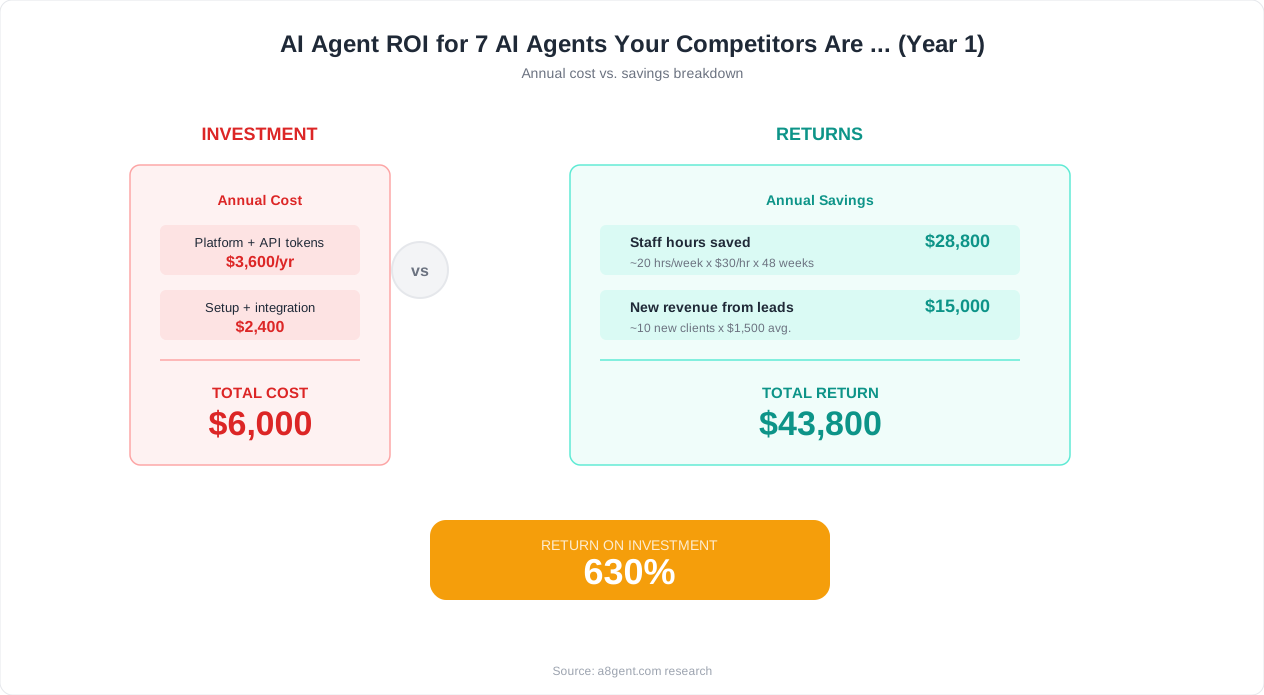
Real use case: A cybersecurity company with a $45K ACV product deployed Alice to supplement their 8-person SDR team. Within 60 days, Alice was generating 40% of their qualified pipeline. She sent 15,000+ personalized touches per month (impossible for a human team), maintained a 12% reply rate, and booked an average of 47 qualified meetings per month. Cost: roughly equivalent to one senior SDR's fully-loaded compensation. Output: equivalent to 4-5 SDRs.
Pricing: 11x.ai uses outcome-based pricing that scales with your pipeline. Plans typically start around $5,000/month and scale based on volume of prospects contacted and meetings booked. They offer pilot programs for teams wanting to test before committing to annual contracts.
Best for: B2B companies with average deal sizes above $20K that rely on outbound sales and want to scale pipeline without proportionally scaling SDR headcount. Especially strong for companies selling into multiple verticals or geographies where a human team would need significant ramp time. Not ideal for companies with deal sizes under $5K where the unit economics don't support the platform cost.
Considering an AI sales rep? Our ROI calculator can model the cost-per-meeting comparison against your current SDR team. Also explore related options in our AI SDR use case guide.
See the complete 11x.ai agent profile for implementation timelines and case studies.
4. Intercom Fin - AI Customer Support That Resolves, Not Deflects
What it does: Intercom Fin is an AI support agent that resolves customer issues end-to-end - not just suggests articles or deflects to FAQ pages. Fin ingests your entire knowledge base, product documentation, past conversation history, and internal procedures, then uses that context to have natural conversations with customers and take real actions: processing refunds, updating account settings, escalating complex issues with full context, and following your exact support playbooks.
The critical distinction is resolution versus deflection. Traditional chatbots aim to reduce ticket volume by pointing customers to self-service resources. Fin aims to actually solve the problem in the conversation. It can access customer account data, execute actions through integrations with your tools (Stripe, Shopify, Salesforce, etc.), and apply your business rules automatically. When it can't resolve an issue, it escalates to a human with a full summary and suggested resolution - saving the agent significant triage time.
Real use case: An e-commerce brand processing 2,000+ support tickets daily deployed Fin across chat and email. Within 30 days, Fin was autonomously resolving 71% of incoming conversations - handling order status inquiries, processing returns, applying discount codes, updating shipping addresses, and answering product questions. Average resolution time dropped from 4.2 hours to 45 seconds for Fin-resolved tickets. Their human support team went from fighting a never-ending queue to focusing exclusively on complex, high-value interactions.
Pricing: Fin is priced at $0.99 per resolution (you only pay when Fin successfully resolves a conversation without human handoff). For a company resolving 1,000 conversations/month with Fin, that's roughly $990/month - significantly less than the cost of additional support agents needed to handle that volume. Volume discounts apply at scale.
Best for: SaaS companies, e-commerce brands, and any business with high support volume where a significant percentage of inquiries are repetitive and resolvable with access to the right information and account actions. Particularly strong for companies already using Intercom as their support platform (zero migration needed) but also works as a standalone deployment.
Learn more about AI in support workflows in our AI customer support use case guide. Take our free assessment to see if your support operation is ready for AI agent deployment.
Review the full Intercom Fin agent profile for setup requirements, supported integrations, and resolution rate benchmarks.
5. n8n - Open-Source AI Automation for Technical Teams
What it does: n8n is an open-source workflow automation platform that lets you build AI agent workflows with full control over your data, hosting, and logic. It connects to 400+ apps and services, supports custom code nodes (JavaScript/Python), and now includes native AI agent capabilities - meaning you can build autonomous workflows that use LLMs to make decisions, process unstructured data, and handle complex multi-step tasks.
What makes n8n different from closed platforms: you can self-host it (critical for companies with strict data sovereignty requirements), you own your workflows completely, there's no per-execution pricing that explodes at scale, and you can extend it with custom nodes. The AI agent nodes support multiple LLM providers (OpenAI, Anthropic, local models), tool use, memory, and multi-agent orchestration. For technical teams that want automation without vendor lock-in or per-run costs, n8n is the go-to choice.
Real use case: A healthcare technology company needed to automate their clinical document processing but couldn't send patient data to third-party AI services (HIPAA compliance). They self-hosted n8n on their private cloud, connected it to a locally-hosted LLM, and built an agent workflow that extracts structured data from clinical notes, cross-references it against their database, flags inconsistencies for review, and routes completed records to the appropriate department. Processing time went from 12 minutes per document (manual) to 90 seconds (automated), with a 96% accuracy rate on extraction.
Pricing: Self-hosted community edition is completely free (unlimited workflows, unlimited executions). n8n Cloud starts at $24/month (2,500 executions). Pro Cloud is $60/month (10,000 executions). Enterprise plans with dedicated support and advanced features are custom-priced. The free self-hosted option makes n8n one of the most cost-effective automation platforms available.
Best for: Technical teams and developer-led organizations that want maximum control over their automation stack. Companies with data privacy requirements that prevent using cloud-only tools. Startups and SMBs that need powerful automation but can't afford per-execution pricing at scale. Teams already comfortable with APIs and basic scripting who want to build rather than buy their AI workflows.
For a detailed comparison of automation platforms, see our workflow automation guide or use the agent comparison tool to evaluate n8n against alternatives like Autonoly and Make.
Explore the full n8n agent profile for community resources, template workflows, and hosting guides.
7. Clearscope - AI SEO Content Optimization That Drives Rankings
What it does: Clearscope is an AI-powered content optimization platform that analyzes top-ranking pages for any target keyword and gives you a data-driven blueprint for creating content that ranks. It goes beyond basic keyword suggestions - it uses NLP to understand the topics, entities, questions, and content structures that search engines associate with a given query, then scores your content against those signals in real-time as you write or edit.
The AI agent capabilities extend into content workflow automation: it monitors your existing content library for ranking decay (pages losing positions), automatically identifies optimization opportunities, generates specific recommendations for each page, and can even draft content briefs for new articles based on keyword gaps in your coverage. For content teams publishing at volume, Clearscope turns SEO from a manual research process into an AI-guided system.
Real use case: A SaaS company with 200+ blog posts was seeing steady organic traffic decline despite publishing 8 new articles per month. They deployed Clearscope to audit their entire content library. The AI identified 47 high-potential articles that had decayed in rankings and generated specific optimization recommendations for each. Over 90 days, their content team updated 32 of those articles using Clearscope's guidance. Result: organic traffic increased 67%, 18 articles moved from page 2 to page 1, and monthly organic signups increased by 41% - all from optimizing existing content, not creating new pages.
Pricing: Essentials at $189/month (100 content reports/month). Business at $399/month (unlimited reports, additional features). Enterprise is custom with API access and advanced integrations. The pricing is justified for content-heavy businesses: ranking one additional page on page 1 for a commercial keyword typically generates more value per month than the entire annual subscription cost.
Best for: Content marketing teams, SaaS companies relying on organic growth, agencies managing SEO for multiple clients, and any business where organic search is a primary revenue channel. Especially valuable for companies with existing content libraries that are underperforming - the optimization ROI is typically faster and higher than creating new content from scratch. Less relevant for businesses in niches with very low search volume or those not relying on content-driven acquisition.
For a full overview of AI in content marketing, check our AI content marketing use case guide. Take the AI readiness assessment to evaluate whether your content operation is ready for AI-powered optimization.
See the complete Clearscope agent profile for integration options, scoring methodology details, and content team workflows.
Getting Started: Pick One Agent, Prove the ROI, Then Expand
You don't need to deploy all 7 of these agents at once. In fact, trying to do everything simultaneously is the most common reason AI adoption stalls in mid-market companies. The businesses that succeed with AI agents follow a pattern: pick one high-impact, high-volume workflow, deploy an agent, measure the results, then use that proven ROI to justify expanding to additional use cases.
Step 1: Identify your highest-leverage opportunity. Look for tasks that are repetitive, time-consuming, and currently handled by people who should be doing higher-value work. Common starting points: lead research and outbound (Clay or 11x.ai if you're in B2B sales), customer support (Intercom Fin if ticket volume is high), or internal workflow automation (Autonoly or n8n for operations). Our AI readiness assessment can help you pinpoint exactly where to start based on your business profile.
Step 2: Run a focused pilot. Most of these platforms offer free trials or pilot programs. Set clear success metrics before you start: response time reduction, cost per lead, tickets resolved without human intervention, hours saved per week. Run for 30-60 days with a defined scope. Don't try to automate every edge case on day one - start with the 80% of scenarios that are straightforward and expand from there.
Step 3: Measure and expand. Once you have concrete numbers - "Fin resolved 65% of tickets in month one, saving us $12,000 in support costs" - you have the internal ammunition to roll out additional agents. Use the ROI calculator to model potential returns for your next deployment.
Step 4: Build your AI stack deliberately. The most effective deployments integrate multiple agents that complement each other. Clay enriches leads that 11x.ai then contacts. Buffer distributes content that Clearscope optimized. Autonoly or n8n orchestrate handoffs between systems. Think of it as building a team of specialists, not deploying isolated tools.
The gap between AI-adopting companies and everyone else is widening every quarter. The compound effect means that businesses deploying agents today won't just be ahead - they'll be increasingly unreachable by competitors that wait. The good news: you don't need a massive budget or a technical team to start. You need one focused decision and 30 days to prove the value.
Ready to find your starting point? Compare these agents side by side, take the free readiness assessment, or browse our full AI agents course for a structured implementation roadmap.
FAQ
How much do AI agents cost for a small business?
Costs vary widely depending on the tool and usage. Entry points start as low as $6/month (Buffer) or completely free (n8n self-hosted). Mid-range tools like Autonoly (free to start, paid plans from $49-499/month) and Clay ($149-800/month) scale with usage. Premium AI agents like 11x.ai start around $5,000/month but replace multiple full-time hires. Most businesses start with one tool in the $50-200/month range and expand based on proven ROI. Use our <a href='/tools/roi-calculator'>ROI calculator</a> to model costs against potential savings for your specific situation.
Do I need technical skills to deploy AI agents?
Not for most tools on this list. Autonoly, Clay, Buffer, Clearscope, 11x.ai, and Intercom Fin are all designed for non-technical users with visual interfaces and guided setup. n8n is the exception - it's built for technical teams comfortable with APIs and basic scripting. If you want no-code deployment, start with Autonoly for workflows, Clay for sales, or Buffer for social media. Our <a href='/tools/ai-agent-readiness-quiz'>readiness assessment</a> evaluates your team's technical capacity and recommends tools that match.
How long does it take to see results from AI agents?
Most businesses see measurable results within 2-4 weeks. Support agents like Intercom Fin can show resolution rate improvements within days of deployment. Sales tools like Clay and 11x.ai typically need 30-60 days to build pipeline and prove meeting-booking rates. Workflow automation (Autonoly, n8n) delivers time savings immediately once workflows are built - usually a 1-2 week setup period. SEO tools like Clearscope show ranking improvements in 30-90 days due to the nature of search engine indexing.
Can AI agents replace my team members?
AI agents are best deployed as force multipliers, not direct replacements. They handle the repetitive, high-volume portions of a role so your team can focus on strategy, relationship building, and complex problem-solving that requires human judgment. A realistic expectation: one person plus an AI agent can produce the output of 3-5 people doing everything manually. Most companies that deploy AI agents successfully don't reduce headcount - they scale output significantly with the same team or reallocate people to higher-value work.
Are AI agents secure enough for business data?
Enterprise-grade AI agents (all tools on this list) comply with SOC 2 Type II, GDPR, and industry-specific standards. Data handling varies: cloud tools process data on their servers (encrypted, with contractual data handling agreements), while self-hosted options like n8n keep all data within your infrastructure. For regulated industries (healthcare, finance), n8n's self-hosted deployment or enterprise plans from vendors like Intercom (which offer data residency options) are typically required. Always review each vendor's security documentation and request a DPA before deployment.
What's the difference between AI agents and traditional automation tools like Zapier?
Traditional automation tools follow rigid if/then rules - they can only handle scenarios you explicitly program. AI agents use large language models to make contextual decisions, handle unstructured data (emails, documents, conversations), and adapt to situations they haven't been explicitly programmed for. A Zapier workflow breaks when it encounters an unexpected email format. An AI agent reads the email, understands the intent, and takes appropriate action. The tradeoff: AI agents cost more per execution but handle far more complex scenarios. For a deeper comparison, see our guide on <a href='/use-cases/workflow-automation'>AI agents vs. traditional automation</a>.
Which AI agent should I deploy first?
Start with the workflow that currently costs you the most time or money relative to its complexity. For most businesses: if you're drowning in support tickets, start with Intercom Fin. If sales pipeline is your bottleneck, start with Clay or 11x.ai. If your team wastes hours on repetitive internal processes, start with Autonoly. If content marketing drives your growth but isn't ranking, start with Clearscope. The key is choosing one area where you can measure clear before/after impact within 30-60 days. Take our <a href='/tools/ai-agent-readiness-quiz'>free assessment</a> for a personalized recommendation.
Can I use multiple AI agents together?
Yes, and the most successful deployments do exactly that. AI agents work best as a coordinated system: Clay enriches prospect data that 11x.ai uses for outreach. Clearscope optimizes content that Buffer distributes on social media. Autonoly or n8n orchestrate data flows between specialized tools. Start with one agent, prove the ROI, then add complementary tools. Most platforms offer native integrations with each other or connect through workflow tools like n8n and Autonoly. Our <a href='/tools/compare-agents'>comparison tool</a> shows which agents integrate well together.