
AI Agents for Marketing Teams: Automation Playbook (2026)
A practical playbook for marketing teams deploying AI agents in 2026. Covers content research, social scheduling, email personalization, ad copy, and reporting automation - with specific tool recommendations and ROI benchmarks.
10+ years shipping production ML across TensorFlow, PyTorch, AWS, and GCP. Ships every A8gent agent before it becomes a lesson. GitHub
- Marketing teams using AI agents for content research and first-draft creation report 55-70% faster content production cycles, though human editing remains essential for brand voice and factual accuracy.
- The highest-ROI marketing automation use case is email personalization - agents that customize subject lines, body copy, and send times based on behavioral data consistently deliver 25-40% higher open rates.
- Social media scheduling agents work best when given a content calendar framework and brand voice guidelines, not when asked to create strategy from scratch.
- AI ad copy agents excel at generating variations for A/B testing - teams running agent-generated ad variants typically test 5-10x more variations than manual teams, finding winning copy faster.
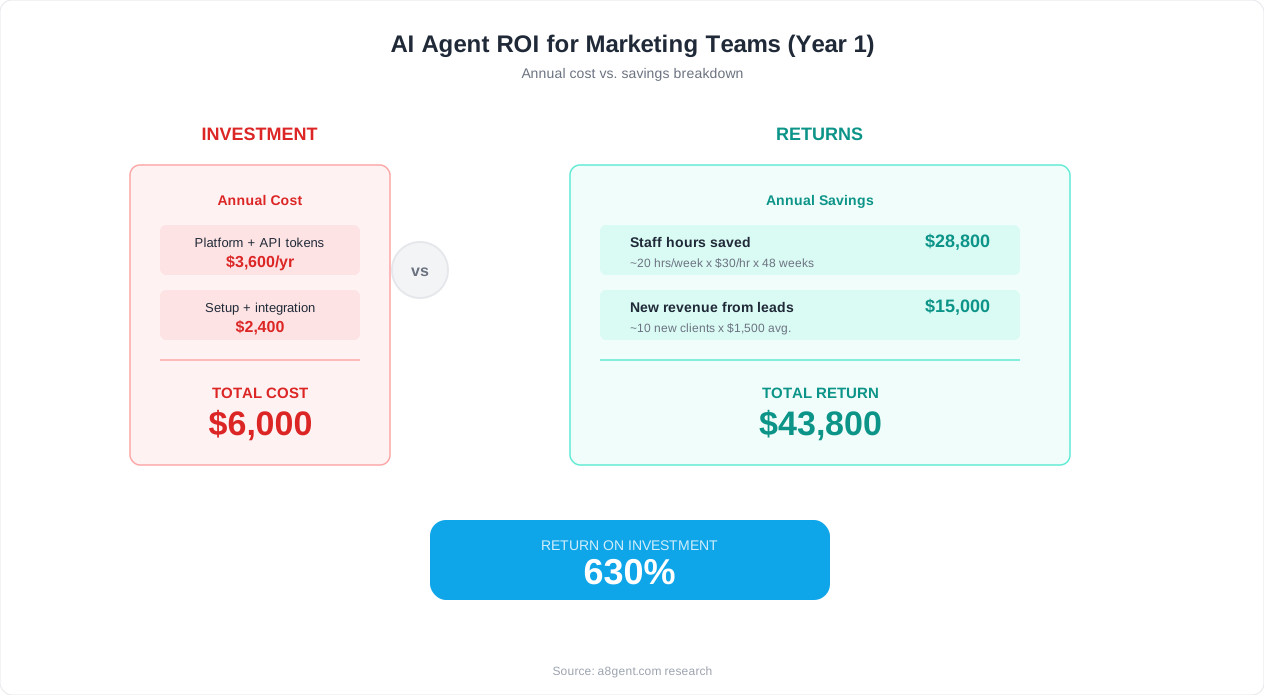
- The average marketing team recovers the cost of AI agent tooling within 6-8 weeks through time savings alone, before accounting for performance improvements.
The Marketing AI Agent Landscape in 2026
Marketing teams have more AI agent options in 2026 than any other business function. This is both a blessing and a problem. The sheer number of tools - from full-platform solutions like HubSpot's AI features to specialized agents for individual tasks - makes it difficult to know where to start and easy to overspend on overlapping capabilities.
The landscape breaks down into five functional categories, each with different maturity levels and ROI potential:
1. Content Research and Creation - the most mature category. Agents can research topics, analyze competitor content, generate outlines, write first drafts, and optimize for SEO. The technology is reliable enough for first-draft generation but still requires human editing for brand voice, factual accuracy, and strategic alignment. ROI potential: high, primarily through time savings on the research and drafting phases.
2. Social Media Management - moderately mature. Agents can repurpose content across platforms, suggest posting schedules based on engagement data, draft post copy, and monitor mentions. The limitation is strategic judgment - agents can execute a social strategy but can't design one. ROI potential: medium-high, primarily through consistency and time savings.
3. Email Marketing - highly mature and the highest-ROI category for most teams. Agents excel at personalizing email content based on subscriber behavior, optimizing send times, generating subject line variations, and segmenting audiences. The data-driven nature of email marketing plays to AI's strengths. ROI potential: very high, through both time savings and measurable performance improvements.
4. Advertising - moderately mature. Agents can generate ad copy variations, suggest audience targeting adjustments, and automate bid management. The limitation is creative strategy - breakthrough creative concepts still come from humans. ROI potential: high for teams running paid campaigns at scale, lower for teams with modest ad budgets.
5. Reporting and Analytics - emerging but improving rapidly. Agents can pull data from multiple platforms, generate summary reports, identify trends, and flag anomalies. This category has high potential but currently requires careful setup to ensure data accuracy. ROI potential: medium, primarily through time savings on manual report compilation.
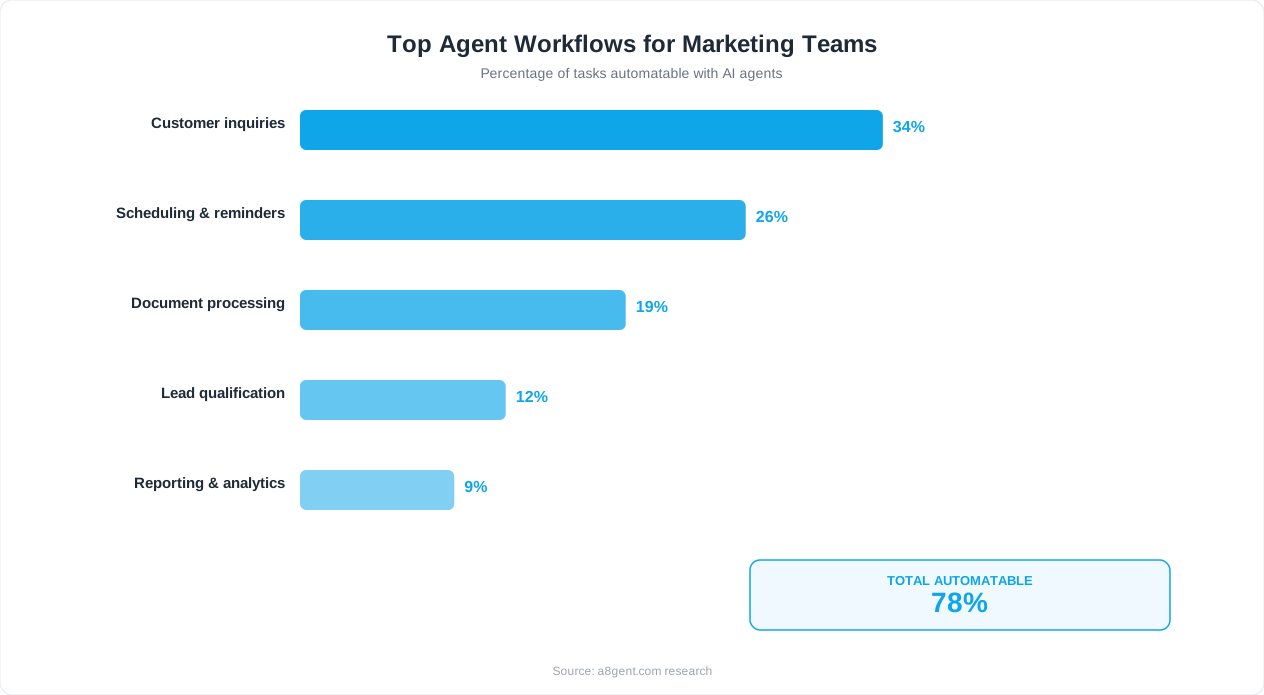
The key insight for marketing managers is that you don't need to automate everything at once. Start with the category that addresses your team's biggest bottleneck. If your team spends 15 hours per week compiling reports, start there. If content production is the constraint, start with content research and first drafts. Use the ROI Calculator to estimate the savings for each category based on your team's specific time allocation.
Let's walk through each category in detail, with specific workflows, tool recommendations, and implementation guidance.
Content Research and First-Draft Creation
Content production is the most time-consuming activity for most marketing teams, and it's where AI agents deliver the most immediate value. The key is understanding exactly where agents fit in the content workflow and where they don't.
Where agents excel:
- Topic research: An agent can analyze search trends, competitor content, audience questions (from platforms like Reddit, Quora, and industry forums), and keyword data to identify content opportunities. What takes a human researcher 3-4 hours - analyzing 50+ competitor articles, extracting key themes, identifying gaps - takes an agent 10-15 minutes.
- Outline generation: Given a topic, target keyword, and audience profile, agents produce structured outlines that cover the necessary subtopics. The output typically needs human refinement (reordering sections, adding unique angles), but it eliminates the blank-page problem.
- First-draft writing: Agents can produce 1,500-3,000 word drafts that are structurally sound and factually reasonable (though verification is always required). The draft serves as raw material for a human editor, not a finished product.
- SEO optimization: Agents can analyze existing content and suggest improvements for keyword placement, meta descriptions, header structure, internal linking, and readability scores.
Where agents struggle:
- Original insights based on proprietary data or unique experience
- Brand voice nuance - agents can approximate your tone but rarely nail it without extensive fine-tuning
- Strategic content decisions - which topics to prioritize, what angle to take, how to differentiate from competitors
- Factual claims about recent events, specific product details, or industry-specific technical accuracy
Recommended workflow:
Here's a content production workflow that balances agent efficiency with human quality:
Step 1 - Agent: Research brief. Provide the agent with a broad topic area. It returns: top 10 keyword opportunities with search volume, competitor content analysis (what's been covered, what's missing), audience questions from forums and "People Also Ask" data, and a recommended angle. Time: 15 minutes (vs. 3-4 hours manual).
Step 2 - Human: Strategic decision. Review the brief, select the specific topic and angle, define the target audience and desired action, and approve the keyword target. Time: 15-20 minutes.
Step 3 - Agent: Detailed outline. Based on the approved direction, generate a section-by-section outline with key points for each section, suggested word counts, and internal linking opportunities. Time: 5 minutes (vs. 45-60 minutes manual).
Step 4 - Human: Outline refinement. Adjust the outline - add unique angles, remove irrelevant sections, reorder for narrative flow. Time: 10-15 minutes.
Step 5 - Agent: First draft. Write the full draft based on the approved outline. Time: 10-15 minutes (vs. 4-8 hours manual).
Step 6 - Human: Edit, fact-check, and brand-align. This is where human value is highest. Verify all factual claims, inject original insights and proprietary data, adjust tone and voice, add examples and case studies from real experience. Time: 1-2 hours.
Total time with agent: 2-3 hours. Total time without agent: 8-14 hours. That's a 60-75% reduction in content production time, with quality maintained because humans handle the parts that require judgment.
For teams ready to set up this workflow, the Marketing Campaign AI Agent comes pre-configured with content research and drafting capabilities tailored for marketing teams.
Tool recommendations for content: For research, tools built on Claude or GPT-4-class models deliver the best results for long-form content analysis. For SEO optimization, Clearscope and SurferSEO both offer AI-assisted optimization. For end-to-end content workflows, consider platforms that integrate research, drafting, and SEO in a single pipeline rather than using separate tools for each step.
Email Personalization at Scale
Email personalization is where AI agents deliver the most measurable ROI for marketing teams. The reason is simple: email performance is highly data-driven, the feedback loop is fast (you know within 48 hours if a subject line works), and the personalization opportunities are vast but tedious to execute manually.
Most marketing teams personalize emails at a basic level - first name in the subject line, company name in the body. AI agents enable behavioral personalization: customizing content based on what the recipient has done, not just who they are. This is the difference between "Hi Sarah" and an email that references the specific product page Sarah visited, addresses the objection that typically arises at her stage of the buying journey, and arrives at the time she's most likely to open it.
The four layers of AI email personalization:
Layer 1 - Subject line optimization: Agents generate 5-10 subject line variations for each email campaign, optimized for different segments. You A/B test the top performers and let data determine the winner. Teams using AI-generated subject line variants see 20-35% higher open rates compared to a single human-written subject line, simply because they're testing more variations and finding what resonates with each segment.
Layer 2 - Body copy personalization: Beyond mail merge fields, agents can customize the email body based on the recipient's industry, company size, previous interactions, and stage in the buying journey. A prospect who downloaded a pricing guide gets an email about ROI and case studies. A prospect who read a technical blog post gets an email about implementation details and integrations. Same campaign, personalized messaging at the paragraph level.
Layer 3 - Send time optimization: AI agents analyze each recipient's historical open patterns and schedule delivery for their individual optimal time. This goes beyond "send on Tuesday at 10am" to "send to Sarah at 7:45am because she opens emails during her commute, and send to Mark at 1:15pm because he checks email after lunch." This individual-level timing typically improves open rates by an additional 10-15% on top of content personalization.
Layer 4 - Sequence adaptation: For nurture sequences and drip campaigns, agents can adapt the next email in the sequence based on how the recipient interacted with previous emails. Did they open but not click? The next email leads with a different hook. Did they click a specific link? The next email goes deeper on that topic. Did they not open the last two emails? The agent tries a different subject line format or suggests removing them from the sequence to protect sender reputation.
Implementation approach:
Don't try to implement all four layers at once. Start with Layer 1 (subject line testing) because it requires the least setup and produces measurable results within a week. Then add Layer 2 (body personalization) for your highest-value email campaigns. Layers 3 and 4 require deeper platform integration and should come after you've validated the approach with simpler personalization.
Tool recommendations for email:
- HubSpot AI: If you're already on HubSpot, their built-in AI features handle subject line generation, send time optimization, and basic content personalization. The integration is seamless since the behavioral data is already in the platform.
- Klaviyo: Best for e-commerce teams. Strong behavioral personalization based on purchase history, browse behavior, and predicted lifetime value. The AI features are particularly good at product recommendations within emails.
- Custom agent + your ESP: For teams wanting maximum flexibility, build a custom agent (using Claude or GPT-4 via API) that generates personalized email content and feeds it to your existing email service provider. This requires more technical setup but gives you full control over personalization logic.
Measuring email personalization ROI:
Track these metrics before and after implementing AI personalization:
- Open rate by segment (expect 20-35% improvement)
- Click-through rate (expect 15-25% improvement)
- Conversion rate from email (expect 10-20% improvement)
- Time spent creating email campaigns (expect 40-60% reduction)
- Unsubscribe rate (should decrease as content becomes more relevant)
Use the ROI Calculator to estimate the revenue impact of these improvements based on your current email metrics and list size. For most teams, the ROI calculation is compelling enough to justify immediate implementation.
Ad Copy Generation and A/B Testing at Scale
Paid advertising is a volume game. The team that tests the most variations, learns the fastest. Traditional ad teams create 3-5 copy variations per campaign and test them over weeks. AI-powered teams generate 20-50 variations in minutes, test aggressively, and find winning combinations faster. The result is lower cost-per-acquisition and higher return on ad spend.
How AI agents transform ad copy workflows:
Variation generation: Give an agent your product value proposition, target audience profile, and 3-5 examples of your best-performing ads. It generates dozens of variations across different angles: pain point focused, benefit focused, social proof focused, urgency focused, question-based, and story-based. Each variation maintains your brand guidelines while exploring different emotional triggers and structural approaches.
The volume advantage is dramatic. A human copywriter might produce 10 quality ad variations in a day. An agent produces 50 in an hour. The human variations might be individually better crafted, but the agent's volume means you'll find unexpected winners - angles and phrasings that a human wouldn't have tried but that resonate with the audience. The data decides, not subjective preference.
Platform-specific adaptation: Each ad platform has different constraints and best practices. A Google Search ad requires tight character limits and keyword integration. A Facebook ad needs a hook in the first line and a clear call-to-action. A LinkedIn ad should emphasize professional outcomes and credibility. Agents can take a core message and adapt it for each platform's requirements, producing ready-to-upload creative for multi-platform campaigns.
Performance-based iteration: After the first round of testing, agents can analyze which variations performed best and generate new variations that combine the winning elements. High click-through rate on "Save 40% on..." headlines? Generate 10 more variations with percentage-based savings hooks. Strong conversion from social-proof copy? Generate variations with different proof points. This iterative approach accelerates the optimization cycle from weeks to days.
Practical workflow for ad copy agents:
Step 1: Brief the agent with your campaign objective, target audience, key value propositions, and brand voice guidelines. Include 5-10 examples of past high-performing ads with their metrics. This context helps the agent understand what "good" looks like for your specific brand and audience.
Step 2: Generate 30-50 variations across different angles and formats. Don't filter at this stage - let quantity drive the exploration. You can ask the agent to organize variations by angle type (pain point, benefit, social proof, etc.) for easier review.
Step 3: Human review and shortlisting. This is where experienced marketers add value - selecting the 10-15 most promising variations based on brand fit, strategic alignment, and creative instinct. Discard anything that's off-brand or could be misinterpreted.
Step 4: Launch A/B tests with the shortlisted variations. Set statistical significance thresholds before launching (typically 95% confidence) and let the data run without premature conclusions.
Step 5: Feed results back to the agent for the next iteration. "These three angles performed best. Generate 15 new variations that combine the winning elements: urgency + social proof, urgency + specific savings, social proof + question format."
Tool recommendations for ad copy:
- For Google Ads: Google's Performance Max campaigns already include AI-generated ad suggestions. Layer a custom agent on top for higher-quality initial creative and more systematic variation testing.
- For Meta Ads: Meta's Advantage+ creative tools handle some automation, but agent-generated copy input significantly improves the quality of variants the platform tests.
- For multi-platform campaigns: Use a centralized agent to generate core messaging, then platform-specific prompts to adapt for each channel. The Marketing Campaign AI Agent handles this multi-platform adaptation workflow out of the box.
ROI benchmark: Marketing teams we've worked with report 15-30% lower cost-per-acquisition after implementing AI-driven ad copy testing, primarily because they test more variations and reach statistical significance faster. For a team spending $10,000/month on ads, a 20% CPA reduction represents $2,000/month in savings or equivalent additional conversions - this pays for the entire AI agent tooling stack with a single use case.
Automated Reporting and Analytics
Marketing reporting is one of the most universally disliked tasks in the profession. It's essential - stakeholders need to understand performance - but it's repetitive, time-consuming, and pulls marketers away from the creative and strategic work they were hired to do. The average marketing team spends 8-12 hours per week on reporting: pulling data from multiple platforms, compiling it into spreadsheets, creating charts, writing narrative summaries, and distributing reports to stakeholders.
AI agents can reduce that to 1-2 hours per week of review and refinement.
What agent-powered reporting looks like:
Data aggregation: The agent connects to your marketing platforms (Google Analytics, ad platforms, email tools, social dashboards, CRM) via APIs or integration platforms like Zapier or Make. It pulls the relevant metrics on a scheduled basis - daily, weekly, or monthly depending on your reporting cadence. This eliminates the manual export-and-combine step that often takes 2-3 hours per report.
Narrative generation: Instead of just presenting numbers in a dashboard, the agent writes a narrative summary that explains what happened and why it matters. "Website traffic increased 18% week-over-week, driven primarily by a 42% increase in organic search traffic to the blog. The top-performing post was 'How to...' which generated 3,200 visits. Paid traffic was flat, with Google Ads CPCs increasing 8% in the B2B segment. Email open rates improved 5% following the subject line testing we implemented last week." This narrative takes a human 30-45 minutes to write. The agent produces it in seconds, and it only needs a quick review for accuracy and context the agent might miss.
Anomaly detection: This is where agents add value beyond time savings. The agent compares current metrics to historical baselines and flags significant deviations. "Email bounce rate increased from 1.2% to 3.8% this week - investigate list quality." "Conversion rate on landing page X dropped 40% since Tuesday - check for technical issues." Humans reviewing dashboards often miss these signals, especially when they're looking at dozens of metrics. The agent monitors everything and surfaces only what needs attention.
Stakeholder-specific formatting: Different stakeholders need different views. The CMO wants strategic KPIs and trend lines. The content team lead wants traffic and engagement by article. The sales team wants lead volume and quality metrics. Instead of creating three separate reports manually, configure the agent to generate role-specific summaries from the same underlying data. Each stakeholder gets exactly the information they need in the format they prefer.
Implementation steps:
Step 1: Audit your current reporting process. What data sources do you pull from? What metrics do stakeholders actually use (not just what you report)? How long does each report take to create? This audit usually reveals that 30-40% of reported metrics are never read - eliminate them.
Step 2: Set up data connections. Use Zapier, Make, or direct API integrations to feed platform data to your agent. Start with your top 3 data sources (typically Google Analytics, your primary ad platform, and your email tool). You can add more later.
Step 3: Create report templates with example narratives. Show the agent 3-4 examples of well-written report summaries so it understands your preferred format, detail level, and communication style. Include examples of good anomaly callouts.
Step 4: Run parallel reports for 2-3 weeks. Generate agent reports alongside your manual reports. Compare them side by side. Refine the agent's instructions wherever the output doesn't meet your standards.
Step 5: Transition to agent-generated reports with human review. The agent generates the report, a team member reviews it for 15-20 minutes (checking accuracy, adding context, adjusting narrative), and distributes it.
ROI on reporting automation: If your team spends 10 hours per week on reporting and you reduce that to 2 hours of review, you've freed up 8 hours per week - that's 400+ hours per year. At an average marketing professional's loaded hourly cost, that's $20,000-40,000 annually in recaptured time, redirected toward strategy, creative, and campaign optimization. Use the ROI Calculator to plug in your team's specific numbers.
90-Day Implementation Roadmap
Here's a practical 90-day roadmap for marketing teams adopting AI agents. This assumes a team of 3-8 people with moderate technical comfort and a budget of $500-2,000/month for tools.
Days 1-14: Foundation
- Complete the ROI Calculator to identify your highest-impact use case
- Audit current workflows: document how your team spends time across content, social, email, ads, and reporting
- Select your first use case based on the ROI analysis (most teams start with content research/drafting or email personalization)
- Set up your AI agent platform accounts and integrations
- Establish baseline metrics for the selected use case (current time spent, current performance metrics)
Days 15-30: First Use Case Deployment
- Build your first agent workflow with detailed prompts, examples, and quality criteria
- Run 10-15 test cases and compare agent output to manual output
- Refine prompts based on test results - most teams iterate 3-5 times before reaching acceptable quality
- Begin parallel operation: run the agent alongside manual processes
- Track time savings and quality metrics daily during this phase
Days 31-45: Optimization and Confidence Building
- Analyze two weeks of parallel operation data
- Identify and fix remaining quality gaps - usually specific edge cases the initial prompts didn't cover
- Transition to agent-primary workflow with human review (the agent does the work, a human checks it, rather than doing it manually and comparing)
- Begin training the full team on the first use case if only a subset was involved in the pilot
- Document the workflow, prompts, and review criteria for team reference
Days 46-60: Second Use Case
- Select your second use case based on updated ROI analysis (learning from the first deployment often changes priorities)
- Apply lessons learned from the first deployment - you'll be 2-3x faster this time
- Build, test, and iterate the second workflow
- Cross-train team members so multiple people can manage each workflow
Days 61-75: Scale and Integration
- Connect workflows where possible - content creation feeding social repurposing, campaign data feeding reporting
- Begin third use case deployment
- Set up automated quality monitoring to catch agent performance degradation early
- Conduct first formal ROI review with leadership, comparing baseline to current performance
Days 76-90: Maturity and Expansion Planning
- Three use cases running in production with measured results
- Team is independently managing agent workflows without constant support
- Compile 90-day results report: time savings, performance improvements, cost analysis, team satisfaction
- Plan next quarter's use cases based on data, not assumptions
- Evaluate whether current tools are sufficient or if platform changes are needed for planned expansions
What success looks like at 90 days:
- 3 active agent workflows in production
- 15-25 hours per week of recaptured team capacity
- Measurable performance improvements in at least one area (email open rates, content production speed, reporting accuracy)
- 80%+ of team actively using at least one agent workflow
- Clear roadmap for next quarter's expansion
For teams wanting structured guidance through this process, the AI Agent Bootcamp provides a facilitator-led version of this roadmap with weekly check-ins, troubleshooting support, and access to a community of other marketing teams going through the same journey. It compresses the learning curve significantly - most bootcamp teams reach the 90-day milestone 2-3 weeks ahead of self-guided teams.
The marketing teams that succeed with AI agents share one trait: they treat it as an ongoing capability, not a one-time project. The technology improves quarterly, new use cases emerge as the team builds confidence, and the compounding time savings free up capacity for higher-value strategic work. Start with one use case, prove the value, and let momentum carry you forward.
FAQ
Which marketing task should we automate with AI agents first?
Start with the task that's highest volume and lowest risk. For most teams, this is either content research and first-draft creation (high time savings, errors are caught during editing) or reporting automation (extremely repetitive, errors are easy to spot in review). Email personalization offers the highest ROI but requires more setup. Use the ROI Calculator to compare options based on your team's specific time allocation.
How much should a marketing team budget for AI agent tools?
Expect to spend $200-800/month for a team of 3-8 people, covering AI platform subscriptions, integration tools (Zapier/Make), and any specialized marketing AI tools. The tools typically pay for themselves within 6-8 weeks through time savings alone. Start with a minimal stack - one AI platform and one integration tool - and add specialized tools only when you've validated the use case.
Will AI agents replace marketing team members?
AI agents replace tasks, not people. The tasks they replace are the repetitive, time-consuming ones that most marketers dislike anyway: data compilation, first-draft writing, report formatting, ad variation generation. The skills that become more valuable are strategy, creative direction, brand stewardship, and customer insight - the uniquely human capabilities that AI can't replicate. Teams that adopt AI agents well typically don't shrink; they produce more output with the same headcount.
How do we maintain brand voice when using AI agents for content?
Three techniques work best: (1) Include 5-10 examples of on-brand content in your prompts as few-shot examples, (2) Create a brand voice guide document that the agent references - including specific words to use and avoid, sentence length preferences, and tone guidelines, (3) Always have a human editor review agent output before publication. The agent handles volume and structure; the human ensures brand consistency. Most teams find that after initial calibration, 80-85% of agent output is on-brand with only minor edits needed.
What metrics should we track to measure marketing AI agent ROI?
Track three categories: efficiency (hours saved per week, cost per content piece, time from brief to publication), performance (email open rates, ad click-through rates, content engagement metrics, conversion rates), and quality (error rate in agent output, percentage of outputs requiring major edits, stakeholder satisfaction with reports). Compare all metrics to your pre-agent baseline. Most teams see the biggest improvements in efficiency (40-60% time reduction) with moderate performance gains (15-30% on key metrics).
Social Media Scheduling and Content Repurposing
Social media is a grind. Most marketing teams know what they should be posting - the problem is finding the time to actually create, schedule, and monitor content across 3-5 platforms consistently. AI agents solve the consistency problem by handling the repetitive execution while humans focus on strategy and engagement.
The three social media tasks agents handle best:
1. Content repurposing: This is the highest-value social media automation. You create one piece of pillar content (a blog post, podcast episode, webinar, or report), and the agent transforms it into platform-specific social posts. A single 2,000-word blog post can generate: 5-8 LinkedIn posts (key insights, statistics, actionable tips), 10-15 Twitter/X posts (quotes, one-liners, thread ideas), 3-4 Instagram carousel scripts, 2-3 short-form video scripts for TikTok/Reels, and a newsletter excerpt. Without an agent, repurposing one blog post takes 2-3 hours. With an agent, it takes 20-30 minutes of generation plus 15-20 minutes of human review and refinement.
The critical success factor is providing the agent with detailed platform-specific guidelines. A LinkedIn post that reads like a tweet will underperform. Give the agent explicit instructions for each platform: character limits, tone (professional for LinkedIn, conversational for Twitter), formatting conventions (line breaks in LinkedIn, hashtag usage on Instagram), and what type of content performs best on each platform for your audience.
2. Scheduling optimization: AI agents analyze your historical engagement data to recommend optimal posting times for each platform and content type. Buffer and Hootsuite both offer AI-powered scheduling features. The data-driven approach typically improves engagement rates by 15-25% compared to posting at fixed times, because it accounts for audience timezone distribution, day-of-week patterns, and content-type preferences that humans might not notice.
3. Community monitoring and initial response: Agents can monitor social mentions, categorize them (positive, negative, question, spam), and draft initial responses for human review. This ensures that customer questions don't sit unanswered for hours because nobody was monitoring the feed. The agent drafts a response based on your FAQ database and brand guidelines, a human reviewer approves or edits it, and the response goes out quickly. For high-volume accounts receiving 50+ mentions per day, this can reduce response time from hours to minutes.
Tool recommendations for social media:
Implementation workflow:
Start with content repurposing for a single platform - whichever one drives the most business results for you. Build the repurposing prompt with 5-10 examples of your best-performing posts as few-shot examples. Test for two weeks, refine the prompt based on performance data, then expand to additional platforms one at a time.
A common mistake is automating all platforms simultaneously. Each platform has different norms, audiences, and content formats. The prompt that produces great LinkedIn posts will produce terrible TikTok scripts. Treat each platform as a separate workflow with its own agent instructions, examples, and quality criteria.
For a comprehensive setup guide, the AI Agent Bootcamp includes a dedicated module on social media automation with ready-made prompt templates for each major platform.