How to Price AI Automation Agency Projects in 2026
Pricing AI automation projects is one of the biggest challenges for new agencies. This guide covers discovery pricing, project scoping, setup fee ranges, monthly retainers, value-based pricing frameworks, and real examples from agencies billing $2K to $15K per project.
10+ years shipping production ML across TensorFlow, PyTorch, AWS, and GCP. Ships every A8gent agent before it becomes a lesson. GitHub
- AI automation agency projects typically fall into three pricing tiers: Starter ($2K-$5K one-time), Growth ($5K-$10K setup plus $500-$1,500/month retainer), and Enterprise ($10K-$25K setup plus $1,500-$5,000/month retainer).
- Value-based pricing consistently outperforms hourly billing for AI agencies - frame your price as a percentage of the measurable value you deliver, typically 10-20% of the client's annual savings or revenue gain.
- Discovery sessions should always be paid ($500-$1,500) and include a detailed audit, recommendation report, and implementation roadmap that the client keeps regardless of whether they proceed with you.
- Monthly retainers are where AI agencies build sustainable recurring revenue - position them as optimization, monitoring, and expansion services rather than just maintenance.
- The biggest pricing mistake new AI agencies make is undercharging on the first project to win the client, then struggling to raise prices later. Start with value-based pricing from day one.
The AI Automation Agency Pricing Landscape in 2026
The AI automation agency market has matured significantly since the initial wave of agencies launched in 2024. Early agencies could charge premium prices simply because they understood tools that businesses did not. In 2026, clients are more educated, competition is fiercer, and pricing needs to be strategic rather than arbitrary. Understanding the current landscape is essential for setting prices that win projects while maintaining healthy margins.
The market has segmented into three distinct tiers based on the complexity and scope of services offered:
Tier 1: Workflow Automation Agencies ($2K-$5K per project)
These agencies focus on straightforward automation builds - connecting existing tools with AI capabilities, building chatbots, automating email sequences, and creating basic AI workflows using no-code platforms like Make, n8n, or Zapier. Projects typically take 1 to 3 weeks and involve a single process or workflow. The client base is primarily small businesses with 5 to 50 employees. Margins at this tier run 60 to 70 percent because the technical complexity is low and most work uses platforms with per-seat costs rather than significant infrastructure expenses.
Tier 2: AI Agent Implementation Agencies ($5K-$15K per project)
This is the sweet spot for most AI automation agencies in 2026. These agencies build multi-step AI agent systems that handle complex workflows - lead qualification funnels, customer support systems with escalation logic, content generation pipelines with human review, and sales automation stacks. Projects take 3 to 8 weeks and often involve custom integrations, training on client-specific data, and iterative testing. Clients are typically businesses with 20 to 200 employees that have validated their need for AI but lack the internal expertise to build it. Margins run 50 to 65 percent.
Tier 3: Custom AI Solution Agencies ($15K-$50K+ per project)
At the top end, agencies build bespoke AI systems - custom-trained models, complex multi-agent architectures, industry-specific AI applications with compliance requirements, and deep integrations with enterprise systems. Projects take 2 to 6 months and involve significant development, testing, and security work. Clients are mid-market to enterprise companies with $10M+ in revenue. Margins are 40 to 55 percent due to higher labor costs for specialized talent.
Most agencies reading this guide will operate primarily in Tier 2, occasionally taking Tier 1 projects as entry points and growing select clients into Tier 3 engagements. The pricing strategies in this guide focus on Tier 1 and Tier 2 because these represent the largest opportunity for agencies entering or growing in the market.
For a quick estimate of what you should charge for a specific project, use our AI Agency Pricing Calculator to model different scenarios based on project complexity, client size, and your target margins.
Pricing Your Discovery and Scoping Phase
The discovery phase is where most new agencies leave money on the table. They offer free consultations, free audits, and free proposals - then wonder why 80 percent of prospects ghost them after receiving detailed recommendations. The fix is simple: charge for discovery from day one.
Why Paid Discovery Works
Charging for discovery accomplishes three things simultaneously. First, it filters out tire-kickers and price-shoppers who have no real intention of buying. A prospect willing to pay $750 for a discovery session is 5 to 8 times more likely to proceed with implementation than one who only wants free consultations. Second, it positions you as an expert rather than a vendor. Doctors charge for diagnostics before treatment; you should charge for assessment before implementation. Third, it creates a deliverable that has standalone value - even if the client chooses not to proceed, they walk away with a professional audit and roadmap they can use.
Discovery Session Pricing Tiers
- Quick Assessment ($500-$750): A 60 to 90 minute session where you review the client's current workflows, identify 3 to 5 automation opportunities, and provide a written summary with prioritized recommendations. Best for small businesses considering their first AI agent. Deliverable: 3-5 page PDF report.
- Comprehensive Audit ($1,000-$1,500): A 2 to 4 hour deep dive that includes workflow mapping, tool inventory, data assessment, team interviews, and a detailed implementation roadmap with phased timelines and budget estimates. Best for businesses with multiple departments or complex existing systems. Deliverable: 10-15 page report with workflow diagrams and ROI projections.
- Strategic Roadmap ($2,000-$3,000): A full-day or multi-day engagement that covers everything in the comprehensive audit plus competitive analysis, technology stack recommendations, team training assessment, and a 6 to 12 month AI transformation roadmap. Best for mid-market companies planning a significant AI investment. Deliverable: 20-30 page strategic document.
The Discovery-to-Project Bridge
Here is the approach that converts discovery sessions into implementation projects at the highest rate: offer to credit the discovery fee toward the implementation project. If a client pays $1,000 for a comprehensive audit and then signs a $7,000 implementation project, apply the $1,000 as a credit so their total is $7,000, not $8,000. This eliminates the "I already paid for the assessment" objection and creates a natural incentive to continue working with you. About 60 to 70 percent of paid discovery clients convert to implementation projects when you use this credit structure.
Structuring the Discovery Deliverable
Your discovery report should follow this format to maximize conversion:
- Current State Assessment: Document exactly how the client currently handles the workflows you are proposing to automate. Include time estimates, pain points, and error rates. This shows you understand their business.
- Opportunity Analysis: Identify 3 to 5 specific automation opportunities ranked by ROI and implementation difficulty. For each, provide estimated time savings, cost savings, and implementation timeline.
- Recommended Implementation Plan: Detail the specific solution you would build, the tools and platforms involved, the timeline, and the investment required. This naturally leads into a proposal discussion.
- Quick Wins: Include 2 to 3 things the client can do immediately, even without your help. This builds trust and demonstrates expertise. Counter-intuitively, giving away some value for free makes clients more likely to hire you for the bigger items.
For a downloadable discovery session template and proposal framework, check out our AI Automation Proposal Template.
Project Pricing Models: Fixed, Hourly, and Value-Based
There are three fundamental pricing models for AI automation projects. Each has its place, but value-based pricing is the one that consistently produces the best results for both agencies and clients. Here is when to use each and how to implement them.
Hourly Pricing ($100-$250/hour)
Hourly pricing makes sense in exactly two situations: when the scope is genuinely impossible to estimate upfront (rare), or when you are doing ongoing optimization work where the client wants granular visibility into how time is spent. For everything else, avoid hourly pricing. It creates misaligned incentives - the client wants you to work faster while you are rewarded for taking longer. It also caps your earnings based on time rather than value. If you build an agent in 10 hours that saves a client $50,000 per year, billing $2,000 for that work at $200/hour is absurd. Typical hourly rates in the AI automation space range from $100 to $150 for junior implementation work, $150 to $200 for senior implementation and architecture, and $200 to $300 for strategic consulting and complex custom builds.
Fixed Project Pricing ($2K-$15K per project)
Fixed pricing is the most common model and works well for clearly scoped projects. The key to profitable fixed pricing is thorough scoping during discovery. Your price should account for three components:
- Base implementation cost: Your estimated hours multiplied by your internal hourly target. For example, a project you estimate at 30 hours with a target of $150/hour has a base cost of $4,500.
- Complexity buffer: Add 20 to 30 percent for unexpected complications, integration issues, and scope refinement. That $4,500 becomes $5,400 to $5,850.
- Value premium: If the project delivers significant measurable value, add a value premium of 15 to 25 percent. If that $5,400 project saves the client $3,000/month, your final price might be $6,500 to $7,000.
Always define the scope explicitly in your proposal. List exactly what is included, what is not included, and what triggers a change order. The number one cause of unprofitable fixed-price projects is scope creep - clients adding "just one more thing" until the project doubles in size at the original price.
Value-Based Pricing (10-20% of Annual Value Delivered)
This is the model that separates thriving AI agencies from struggling ones. Instead of pricing based on your costs, you price based on the value the client receives. Here is the framework:
- During discovery, quantify the measurable value your solution will deliver. This includes labor cost savings (hours saved times hourly cost), revenue increases (faster lead response, higher conversion rates), error reduction (cost of mistakes eliminated), and scalability value (ability to handle growth without proportional cost increases).
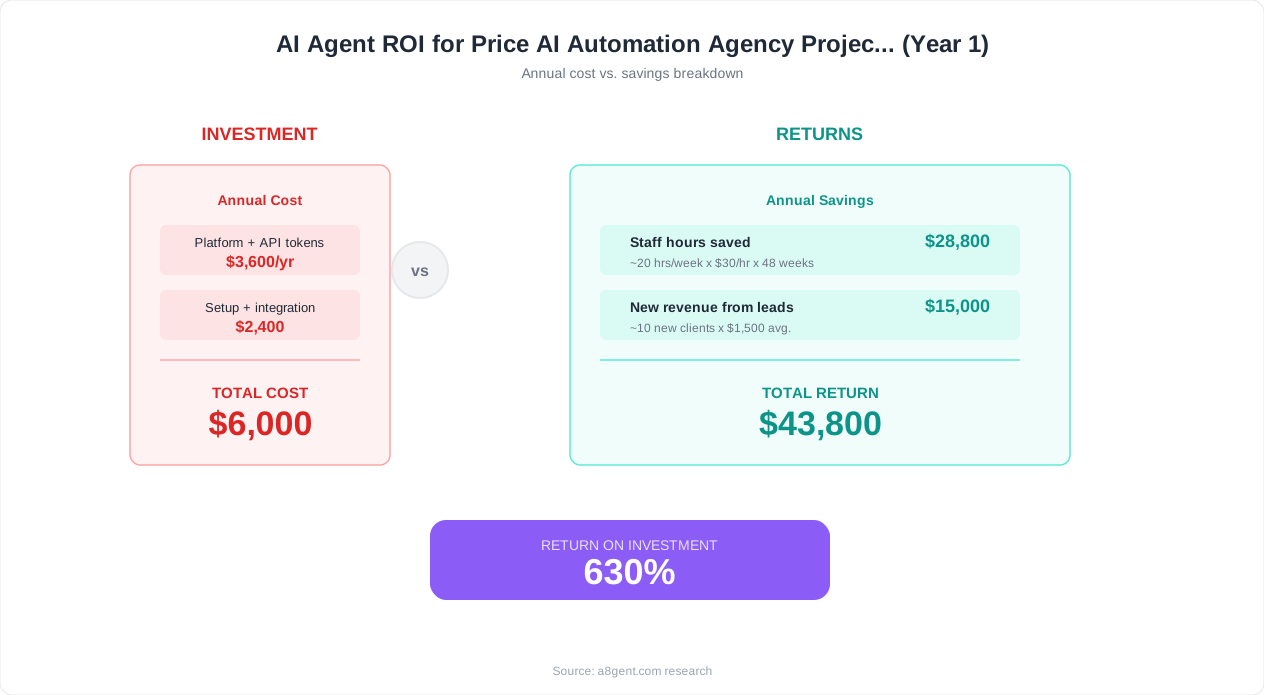
- Calculate the total annual value. For example: 20 hours/week saved times $30/hour equals $31,200/year in labor savings, plus $15,000/year in reduced errors, plus $20,000/year in increased conversions from faster response times. Total annual value: $66,200.
- Price your project at 10 to 20 percent of the first-year value. For the example above, that is $6,620 to $13,240. The client still captures 80 to 90 percent of the value, making it an easy yes, while you are compensated fairly for the impact you create.
Value-based pricing requires confidence in your discovery process and the ability to clearly articulate ROI to clients. Practice the conversation until you can explain the value calculation naturally. Our AI Agents for Agencies Course includes role-play exercises and scripts for value-based pricing conversations.
Monthly Retainer Pricing and Recurring Revenue
One-time project fees pay the bills, but monthly retainers build a sustainable agency. The most successful AI automation agencies generate 40 to 60 percent of their revenue from recurring retainers. Here is how to structure and price them.
 pricing-guide-flow.svg" alt="Price AI Automation Agency Projects in 2026 - analysis" width="1264" height="695" style="width:100%;height:auto;border-radius:12px;margin:24px 0;" loading="lazy" />
What Retainers Should Include
Position your retainer as three distinct value components, not just "maintenance":
- Monitoring and Maintenance (40% of retainer value): Active monitoring of agent performance, uptime, error rates, and response quality. Weekly performance reports. Prompt updates when the client's products, services, or policies change. Bug fixes and platform updates. This is the baseline that justifies ongoing billing.
- Optimization (35% of retainer value): Monthly analysis of agent performance data to identify improvement opportunities. A/B testing different prompts, workflows, and escalation rules. Expanding the agent's knowledge base based on new questions and edge cases. Improving accuracy and reducing escalation rates over time. This is where you demonstrate ongoing value beyond just "keeping things running."
- Strategic Expansion (25% of retainer value): Quarterly roadmap reviews to identify new automation opportunities. Priority access to new features and capabilities. Consulting on how AI tools are evolving and what the client should consider next. This keeps the relationship strategic rather than purely operational.
Retainer Pricing Tiers
- Essential ($500-$1,000/month): Covers monitoring and basic maintenance for 1 to 2 agents. Includes up to 4 hours of optimization work per month. Weekly automated performance reports plus one monthly review call. Best for small businesses with simple agent deployments.
- Growth ($1,000-$2,500/month): Covers monitoring, optimization, and expansion planning for 2 to 5 agents. Includes 8 to 12 hours of optimization and development work per month. Weekly performance reports plus bi-weekly strategy calls. Includes one new agent or workflow build per quarter at no additional charge. Best for growing businesses actively expanding their AI capabilities.
- Scale ($2,500-$5,000/month): Full-service AI operations management for 5+ agents. Includes 15 to 25 hours of dedicated work per month. Real-time monitoring dashboards, weekly strategy calls, and quarterly roadmap sessions. Priority support with 4-hour response time for critical issues. Includes two new agent builds per quarter. Best for mid-market clients with complex, multi-department AI deployments.
Transitioning Projects into Retainers
The natural transition point is project completion. During the final week of any implementation project, present the retainer as part of the handoff conversation: "Your agent is live and performing well. Here is what happens next - over the coming weeks and months, it will need knowledge base updates as your business evolves, performance optimization based on real usage data, and monitoring to catch issues before they affect customers. Our Essential retainer covers all of this for $750/month." Frame it as the logical next step, not an upsell. The conversion rate from project to retainer is typically 50 to 70 percent when you position it correctly during project wrap-up rather than as a separate sales conversation later.
Retainer Profitability
Retainers should be your highest-margin service. A well-managed $1,500/month retainer requires approximately 6 to 8 hours of actual work per month once the systems are stable - that is an effective rate of $187 to $250/hour. The key is efficient monitoring systems. Set up automated alerts for agent errors, performance drops, and anomalies so you are not spending hours manually checking dashboards. Most of your retainer hours should go toward optimization and value-adding work, not routine monitoring.
Real Pricing Examples: 5 AI Automation Projects
Theory is useful, but real examples are better. Here are five actual AI automation agency projects with detailed pricing breakdowns. Names and identifying details have been changed, but the numbers and scope are representative of real engagements.
Example 1: Dental Practice Email and Scheduling Agent ($3,200)
- Client: 8-person dental practice, 40 appointment requests and inquiries per day via email and web form.
- Scope: AI agent that handles appointment booking, rescheduling, cancellation, insurance verification questions, and basic FAQs. Integrated with their practice management software and Google Calendar.
- Build time: 18 hours over 2 weeks.
- Pricing rationale: The practice was paying a part-time receptionist $1,800/month primarily for phone and email management. The agent handles 65% of inquiries autonomously, saving approximately $1,170/month. Priced at roughly 3 months of savings.
- Retainer: $500/month for monitoring, knowledge base updates, and monthly optimization.
Example 2: E-Commerce Customer Support System ($7,500)
- Client: Online retailer with 25 employees, 200+ support tickets per day across email and chat.
- Scope: Multi-channel AI support agent handling order status inquiries, return and exchange requests, product questions, and shipping issues. Integrated with Shopify, Gorgias, and their returns platform. Included escalation workflows for complex issues and VIP customers.
- Build time: 40 hours over 4 weeks.
- Pricing rationale: The client had 3 full-time support agents at a combined cost of $12,000/month. The AI agent handles 60% of tickets, effectively replacing 1.8 headcount worth of work - $7,200/month in value. Priced at approximately one month of value delivered, or 13% of first-year savings.
- Retainer: $1,500/month including ongoing optimization, seasonal product catalog updates, and expansion to social media channels.
Example 3: Real Estate Lead Qualification Pipeline ($5,800)
- Client: Real estate team of 12 agents generating 300+ leads per month through online advertising.
- Scope: AI agent that responds to new leads within 2 minutes via email and SMS, asks qualifying questions (budget, timeline, location preferences, pre-approval status), scores leads, and routes qualified prospects to the appropriate agent with full context. Integrated with their CRM (Follow Up Boss) and advertising platforms.
- Build time: 30 hours over 3 weeks.
- Pricing rationale: Previously, 40% of leads went uncontacted for over 24 hours, and the team's lead-to-appointment rate was 8%. After implementation, 100% of leads received a response within 2 minutes and the appointment rate increased to 14%. The additional appointments generated an estimated $6,000/month in commission revenue. Priced at approximately one month of incremental revenue.
- Retainer: $1,000/month for lead script optimization, seasonal messaging updates, and performance analytics.
Example 4: Marketing Agency Client Reporting ($4,500)
- Client: Digital marketing agency managing 35 client accounts.
- Scope: AI agent that pulls data from Google Analytics, Google Ads, Meta Ads, and SEMrush weekly, generates narrative client reports with insights and recommendations, and distributes them via email. Each report previously took 45 to 60 minutes to create manually.
- Build time: 25 hours over 2 weeks.
- Pricing rationale: 35 reports times 50 minutes equals approximately 29 hours per week, or $4,350/month in labor at $37.50/hour. Priced at roughly one month of savings. The agent produces reports in 2 to 3 minutes each with 85% accuracy on first draft, requiring only a quick human review.
- Retainer: $750/month for new client onboarding, report template refinements, and platform integration updates.
Example 5: Accounting Firm Document Processing ($12,000)
- Client: Accounting firm with 45 employees processing 2,000+ documents per month during tax season.
- Scope: AI document processing pipeline that extracts data from receipts, invoices, W-2s, and 1099s, categorizes transactions, flags anomalies, and populates their tax preparation software. Included custom training on the firm's specific document formats and categorization rules. Required compliance review for data handling.
- Build time: 65 hours over 6 weeks.
- Pricing rationale: During tax season, the firm hired 6 temporary data entry staff at a total cost of $36,000 for the 3-month season. The AI system handles 75% of document processing, reducing temp hiring to 2 staff - a savings of $24,000 per season. Priced at 50% of first-season savings.
- Retainer: $2,000/month (reduced to $1,000/month off-season) for ongoing optimization, new document type training, and regulatory compliance updates.
Writing Proposals and Handling Pricing Objections
Your proposal is the document that converts a prospect into a client. A well-structured proposal eliminates ambiguity, builds confidence, and makes the price feel like a natural conclusion rather than a surprise. Here is the format that consistently converts at 40 to 50 percent for AI automation agencies.
Proposal Structure
- Executive Summary (1 paragraph): Restate the client's challenge in their own words, then describe the outcome your solution delivers. Focus on business results, not technical details. Example: "Your team currently spends 25+ hours per week handling appointment scheduling and confirmations, leading to missed bookings and inconsistent follow-up. We will implement an AI scheduling agent that handles 70% of this workload autonomously, freeing your team to focus on patient care while reducing no-shows by 30%."
- Current State Analysis (half page): Demonstrate that you understand their situation in detail. Include specific numbers from your discovery session - hours spent, current costs, error rates, missed opportunities. This shows the work you did during discovery was thorough.
- Proposed Solution (1 page): Describe what you will build in clear, non-technical language. Include a visual workflow diagram if possible. List the specific tools and platforms involved. Explain how it integrates with their existing systems. Be specific about what the AI agent will and will not handle.
- Implementation Timeline (half page): Break the project into phases with clear milestones and deliverables. Include the shadow mode testing period. Specify what you need from the client at each phase (access to systems, knowledge base content, review time).
- Investment and ROI (1 page): Present the price alongside the expected return. Use a simple table: Investment vs. Monthly Value vs. Annual Value vs. Payback Period. When the client sees a $5,000 investment next to $36,000 in annual savings, the price objection largely disappears.
- Terms and Next Steps (half page): Payment terms (typically 50% upfront, 50% at completion), what happens if the project scope changes, your retainer offering for post-launch support, and a clear call to action with a deadline.
Handling Common Pricing Objections
"That is more expensive than we expected." Response: "I understand. Let me walk through the math again - your team currently spends [X hours] on this process at a cost of [$Y/month]. Our solution delivers [$Z/month] in savings. The project pays for itself in [N weeks]. What budget range were you considering, and I can adjust the scope to fit while still delivering meaningful results."
"We found someone who will do it for half that price." Response: "There are certainly less expensive options available. The difference typically comes down to two things: the depth of customization and the ongoing support. Our price includes [specific differentiators: thorough testing, shadow mode period, knowledge base training, 30-day support]. I would encourage you to ask the other provider specifically about their testing process, what happens when something breaks after launch, and whether the quote includes training the agent on your specific data."
"Can we start with a smaller scope and see how it goes?" Response: "Absolutely - that is actually what I recommend. We can start with [reduced scope] for [$reduced price], get it running successfully, and expand from there. I have outlined what that phased approach would look like in the proposal."
"We need to think about it." Response: "Of course. To help with your decision, I have included a 7-day guarantee - if the agent does not hit [specific performance target] within 30 days of going live, I will continue working at no additional cost until it does. I will follow up on [specific date] - does that work for your timeline?"
Download our complete AI Automation Proposal Template with customizable sections, ROI calculation worksheets, and example language for every section.
Scaling Your Pricing as Your Agency Grows
Your pricing should evolve as your agency matures. The rates that make sense when you are building your portfolio are different from the rates you should charge once you have case studies and a reputation. Here is a practical roadmap for scaling your pricing over your first 18 months.
Months 1-6: Foundation Pricing
When you are building your first 3 to 5 case studies, price at the lower end of market rates - not because your work is worth less, but because speed to portfolio is your most important goal. Offer Tier 1 projects at $2,000 to $3,500 and Tier 2 projects at $4,000 to $7,000. Prioritize clients who will give you detailed testimonials, allow you to share results publicly, and serve as references. Each successful project is worth more in marketing value than the additional revenue you could have charged. But do not work for free or at a loss - that sets expectations you cannot sustain and attracts clients who do not value professional services.
Months 7-12: Confidence Pricing
With 5+ completed projects and documented results, raise your prices by 25 to 40 percent. Your proposals now include case studies showing real results: "We built a similar system for [industry peer] that reduced their support costs by $4,200/month." This social proof justifies higher prices. Tier 1 projects move to $3,000 to $5,000 and Tier 2 projects to $6,000 to $10,000. Introduce value-based pricing for larger engagements. Start declining projects that are not profitable at your new rates - this is psychologically difficult but essential for sustainable growth.
Months 13-18: Premium Positioning
By now, you should have 10+ case studies, strong testimonials, and a clear specialization. Raise prices another 20 to 30 percent and begin positioning as a specialist rather than a generalist. Agencies that specialize in a specific industry (healthcare, real estate, e-commerce) or use case (sales automation, customer support, operations) consistently command 30 to 50 percent higher prices than generalists. Your retainer portfolio should now generate predictable monthly revenue, reducing the pressure to win new projects at any price.
Productized Services: The Scalability Play
As you complete more projects, you will notice patterns - you are building similar agents for similar clients with similar needs. This is the opportunity to create productized services: pre-built agent templates that you customize for each client rather than building from scratch. A productized AI support agent for dental practices, for example, can be deployed in 1 to 2 weeks instead of 4 because 70 percent of the work is already done. You can offer this at $3,500 - lower than a custom build - while your actual cost is only 8 to 10 hours of customization work. That is an effective rate of $350 to $437/hour. Productized services let you serve more clients, maintain consistent quality, and improve margins simultaneously.
Building Your Pricing Confidence
The most common barrier to charging what you are worth is not market conditions - it is internal confidence. Here are three practices that help:
- Track your ROI data religiously. When you know that your average project delivers $48,000 in annual value, charging $8,000 feels entirely reasonable.
- Talk to your peers. Join AI agency communities and share pricing data. Most agency owners discover they are undercharging relative to their peers.
- Practice the pricing conversation. Rehearse stating your price and explaining the value until it feels natural. The number one tell that you are undercharging is hesitation or apologizing when you present the price.
For a comprehensive guide to building and growing an AI automation agency - including pricing, sales, fulfillment, and scaling - enroll in our AI Agents for Agencies Course, which covers every aspect of the business from your first client to your first $50K month.
FAQ
Should I charge hourly or fixed prices for AI automation projects?
Fixed pricing is better for most projects because it aligns incentives - the client knows their total investment upfront, and you are rewarded for efficiency rather than hours spent. Use hourly pricing only for genuinely unpredictable work like ongoing optimization or consulting. Value-based pricing (10-20% of annual value delivered) is the gold standard once you are confident in quantifying ROI during discovery.
How much should I charge for my first AI automation project?
For your first 3-5 projects, price at the lower end of market rates: $2,000-$3,500 for simple workflow automations and $4,000-$7,000 for multi-step AI agent implementations. Do not work for free, but prioritize building your portfolio with clients who will provide testimonials and references. After 5+ completed projects with documented results, raise prices by 25-40%.
How do I justify my pricing to clients who think AI tools are cheap?
The tools are cheap - the expertise is not. Clients can buy Make or n8n subscriptions themselves for under $100/month, but they are paying you for the knowledge to design effective workflows, avoid common pitfalls, integrate with their existing systems, and ensure the solution actually works in production. Frame it clearly: the AI tool costs $100/month, but without proper implementation it delivers zero value. Your $5,000-$10,000 fee is what turns a $100 tool into $50,000 of annual savings.
What is the best retainer pricing structure for AI automation agencies?
Structure retainers around three components: monitoring/maintenance (40% of value), optimization (35%), and strategic expansion (25%). Price tiers at $500-$1,000/month for basic monitoring of 1-2 agents, $1,000-$2,500/month for active optimization of 2-5 agents, and $2,500-$5,000/month for full-service management of 5+ agents. Retainers should be your highest-margin service - a well-managed $1,500/month retainer typically requires only 6-8 hours of actual work.
Should I offer a money-back guarantee on AI automation projects?
A performance guarantee is more effective than a money-back guarantee. Instead of promising a refund, guarantee specific results: 'If the agent does not achieve 70% autonomous handling within 30 days, we will continue working at no additional cost until it does.' This demonstrates confidence without creating financial risk for your agency. It also reframes the conversation from 'will this work?' to 'how well will this work?' which is a much easier objection to handle.