AI Agents for E-commerce: Automate Orders, Returns and Support (2026)
E-commerce businesses face relentless operational demands - processing orders, handling returns, answering customer questions, managing inventory, and personalizing marketing. AI agents can take over these repetitive workflows, letting you scale without proportionally growing your team. Here is the complete 2026 playbook.
10+ years shipping production ML across TensorFlow, PyTorch, AWS, and GCP. Ships every A8gent agent before it becomes a lesson. GitHub
- AI agents can handle 70-85% of e-commerce customer support inquiries autonomously - including order status, returns, and product questions - delivering instant responses 24/7.
- Automated order processing agents reduce fulfillment errors by 60-80% and cut processing time from minutes per order to seconds, enabling you to handle volume spikes without overtime.
- Returns and exchanges are the most labor-intensive e-commerce workflow - AI agents can process standard returns end-to-end without human involvement, reducing costs by 50-70%.
- Personalization agents analyze purchase history and browsing behavior to deliver targeted product recommendations and marketing messages that increase average order value by 15-30%.
- Start with customer support automation (highest volume, clearest ROI), then expand to order processing and returns within 30-60 days for maximum operational impact.
Why E-commerce Operations Are Perfect for AI Agent Automation
Running an e-commerce business in 2026 means managing a constant stream of operational tasks that scale directly with your order volume. Every new customer means another potential support inquiry. Every order means processing, fulfillment coordination, and tracking updates. Every product return means authorization, shipping labels, inventory updates, and refund processing. Every marketing campaign means segmentation, personalization, scheduling, and performance analysis.
This operational load is why so many e-commerce businesses plateau. The founder who started by handling everything personally hires their first support rep at 50 orders per day, needs a small team by 200 orders per day, and faces serious staffing challenges at 500-plus orders per day. Each hire adds cost, management complexity, training overhead, and quality variability. The operational machine eats revenue that could fund growth, marketing, or product expansion.
AI agents break this pattern because they scale without proportional cost increases. An AI support agent that handles 100 customer conversations per day handles 500 or 1,000 per day at essentially the same cost. An order processing agent that verifies 50 orders handles 500 orders with the same speed and accuracy. The operational bottleneck disappears, and you can grow revenue without growing operational overhead at the same rate.
E-commerce is particularly well-suited to AI agents for several reasons. First, the tasks are highly repetitive - the same questions get asked, the same return flows get triggered, the same order confirmations get sent, hundreds of times per day. Second, the data is structured - orders have clear fields, products have defined attributes, customers have purchase histories. Third, the volume is high enough to justify automation even for small stores. And fourth, speed matters - customers expect instant responses and next-day resolution, making 24/7 automated processing a competitive advantage rather than a luxury.
In this guide, we will cover exactly how e-commerce businesses are using AI agents in 2026 across every operational area: customer support, order processing, returns and exchanges, inventory management, and marketing personalization. For each area, you will learn what to automate, which tools to use, and how to measure ROI. Take our free assessment to get a personalized automation roadmap for your store's specific size, platform, and pain points.
Automating E-commerce Customer Support With AI Agents
Customer support is where most e-commerce businesses start with AI agents - and for good reason. It is typically the highest-volume operational function, the most repetitive, and the one where response speed directly impacts customer satisfaction and retention. In e-commerce, support inquiries cluster predictably around a small number of topics: where is my order, how do I return this, is this item in stock, what size should I get, and can I change my order.
Intercom Fin has become the leading AI support agent for e-commerce businesses because it was built specifically for this use case. Connect it to your Shopify, WooCommerce, or BigCommerce store, your shipping carrier accounts, and your knowledge base. It instantly handles the questions that make up 70-85 percent of your support volume.
Here is what automated e-commerce support looks like in practice. A customer messages "Where is my order?" at 11 PM on a Saturday. The AI agent instantly looks up their order using their email, checks the shipping carrier's API for real-time tracking status, and responds within seconds: "Your order #4521 shipped yesterday and is currently in transit. Based on the carrier's tracking, it should arrive by Tuesday. Here's your tracking link." No human involved. No wait time. The customer gets exactly what they needed instantly.
For product questions, the agent pulls from your product descriptions, FAQ content, size guides, and even customer reviews to provide detailed, accurate answers. "What's the difference between the Pro and Standard version?" gets a comprehensive comparison drawn from your product data. "Will this fit a 6-foot-tall person?" draws from your size chart and customer feedback. These responses are personalized to the specific product and question, not generic deflections.
For issues that require human judgment - complaints about product quality, complex multi-order situations, angry customers who need empathy - the agent recognizes the situation and escalates seamlessly. But crucially, it passes the full context to your human team: order history, previous interactions, the specific issue, and a suggested resolution. Your team spends 30 seconds getting up to speed instead of 5 minutes investigating.
The financial impact for a mid-size e-commerce store processing 200 orders per day is substantial. If you currently handle 80 support tickets per day at an average handling time of 8 minutes, that is nearly 11 hours of labor daily - more than one full-time position. An AI agent handling 75 percent of those tickets instantly saves you 8 hours per day or roughly $2,000-3,000 per month in labor costs, while simultaneously improving response times from hours to seconds. Customers are happier and costs are lower - that is a rare combination in business.
Explore our e-commerce automation guide for platform-specific setup instructions and integration details for Shopify, WooCommerce, and other major e-commerce platforms.
AI Agents for Order Processing and Fulfillment Coordination
Order processing seems simple in theory - customer places an order, you ship it. In practice, every e-commerce operator knows it is far more complex. Orders need verification (is the payment legitimate? is the address valid?). They need routing (which warehouse? which carrier? standard or expedited?). They need coordination (is the item in stock at the fulfillment location? are there special handling instructions?). And they need monitoring (did it ship on time? is the carrier experiencing delays?).
AI agents automate the entire flow from order placement to delivery confirmation. Here is what a fully automated order processing pipeline looks like:
Step 1: Order Verification
When an order comes in, the agent runs fraud checks (matching shipping and billing addresses, checking order history for the customer, flagging unusual patterns), validates the address against postal databases, confirms inventory availability, and checks for any special conditions (coupon validity, promotional rules, bulk order policies). Orders that pass all checks proceed automatically. Flagged orders queue for human review with a specific reason noted - reducing manual review volume by 80-90 percent.
Step 2: Intelligent Routing
The agent determines the optimal fulfillment path based on multiple factors: which warehouse has the item in stock, which location minimizes shipping distance and cost, which carrier offers the best rate for the delivery speed promised, and whether any items in a multi-product order should be combined or split. This optimization, done for every single order, saves meaningful shipping costs at scale - typically 5-15 percent per order when routing is optimized versus default logic.
Step 3: Fulfillment Coordination
The agent generates pick lists, packing instructions, and shipping labels. It communicates with your warehouse management system or third-party logistics (3PL) provider automatically. It sends the customer an immediate order confirmation and a follow-up with tracking information once the item ships. All of this happens without human intervention for standard orders.
Step 4: Exception Management
When something goes wrong - an item is out of stock, the carrier reports a delay, the customer requests a change - the agent handles routine exceptions automatically. Out of stock? Suggest alternatives to the customer or offer to backorder with an estimated date. Carrier delay? Proactively notify the customer before they have to ask. Address correction needed? Reach out to the customer for confirmation. Only truly complex exceptions reach your team.
The operational improvement is dramatic. Manual order processing typically takes 3-5 minutes per order. At 200 orders per day, that is 10-17 hours of daily labor. An AI agent processes orders in seconds, handles exceptions for 70-80 percent of cases automatically, and reduces your manual processing to only the truly complex 20-30 percent. Combined with reduced errors (humans mistype addresses, select wrong products, and miss special instructions - agents do not), the quality and speed improvements compound over time.
Platforms like Autonoly integrate with major e-commerce platforms and logistics providers to build these end-to-end order processing workflows without custom development. Take our assessment to understand which order processing elements would deliver the biggest impact for your specific store and fulfillment setup.
Automating Returns and Exchanges: The Biggest Time Sink in E-commerce
Returns are the operational nightmare of e-commerce. Industry average return rates range from 15-30 percent depending on category (apparel is closer to 30 percent, electronics closer to 15 percent). Each return involves multiple steps: the customer requests a return, someone reviews the reason and approves or denies, a shipping label gets generated, the item comes back, someone inspects it, inventory gets updated, and the refund gets processed. For a store handling 200 orders per day with a 20 percent return rate, that is 40 returns to process daily - each taking 8-15 minutes of human time.
AI agents can handle 75-85 percent of returns entirely autonomously, reducing this massive time sink to a manageable workload of only the genuinely complex cases. Here is how automated returns processing works:
The Customer-Facing Flow
A customer wants to return a pair of shoes that does not fit. Instead of emailing your support team and waiting for a response, they interact with your AI returns agent - either through chat on your site, via email, or through a self-service returns portal. The agent asks the reason for return, confirms it falls within your return policy (purchased within 30 days, item unworn, original packaging), and immediately generates a prepaid return label. The customer has their label in 60 seconds instead of 24-48 hours. For exchanges, the agent checks if the desired size is in stock and offers to ship it immediately or upon receipt of the return.
The Back-End Flow
Once the return is initiated, the agent tracks the return shipment, updates your inventory system to expect the incoming item, and processes the refund according to your policy (immediately upon return initiation, upon carrier scan, or upon warehouse receipt - configurable). When the item arrives back at your warehouse, the agent updates inventory counts automatically and closes the loop with a confirmation email to the customer.
Handling Edge Cases
Not all returns are straightforward. Items outside the return window, damaged goods, items without tags, high-value items requiring inspection - these need judgment. The AI agent identifies these cases and routes them to your team with full context: the customer's history (are they a loyal repeat customer or a serial returner?), the specific issue, and a recommended action based on your policies. Your team makes the judgment call and the agent executes whatever they decide.
Reducing Returns in the First Place
Beyond processing returns faster, AI agents can reduce return rates. A pre-purchase agent that helps customers choose the right size, color, or variant prevents the most common return reason - "not what I expected." Post-purchase agents that send proactive usage tips (how to break in new shoes, how to style a jacket, how to set up a device) reduce returns driven by buyer's remorse or confusion. Some e-commerce businesses report 10-20 percent reductions in return rates from these preventive agents alone.
The cost savings from automating returns are immediate and significant. If processing each return manually costs $8-12 in labor time and you handle 40 returns per day, that is $320-480 daily or $7,000-10,000 monthly. Automating 80 percent of returns reduces that to $1,400-2,000 monthly - a saving of $5,000-8,000 per month that goes directly to your bottom line. Our e-commerce guide includes step-by-step setup instructions for returns automation on major platforms.
AI Agents for Inventory Management and Marketing Personalization
Beyond the core operational workflows of support, orders, and returns, AI agents deliver powerful value in two additional areas that drive e-commerce growth: intelligent inventory management and marketing personalization.
Inventory Intelligence
Running out of stock on a popular item costs revenue. Overstocking ties up capital and leads to markdowns. Traditional inventory management relies on manual forecasting - spreadsheets, gut feel, and hoping your seasonal estimates are right. AI agents bring continuous, data-driven intelligence to this challenge.
An inventory agent monitors your stock levels in real time, analyzes sales velocity patterns, tracks seasonal trends, and factors in external signals (upcoming promotions, competitor stockouts, market trends). It generates automatic reorder alerts when stock is projected to run out, calculates optimal order quantities based on lead times and demand forecasts, and flags slow-moving inventory that might need markdown or promotional attention.
For businesses with multiple sales channels (your website, Amazon, retail partners), inventory agents synchronize stock levels across all channels in real time. No more overselling because your website did not reflect a sale that happened on Amazon 30 minutes ago. No more manually updating quantities across platforms after every order. The agent maintains a single source of truth and pushes updates everywhere simultaneously.
Marketing Personalization at Scale
Every e-commerce business knows that personalized marketing outperforms generic blasts. But true personalization - recommending the right product to the right person at the right time through the right channel - requires processing more data than any human team can handle manually. AI agents make one-to-one personalization possible at any scale.
A marketing personalization agent analyzes each customer's purchase history, browsing behavior, email engagement, and demographic data. It then generates individualized product recommendations, email content, and promotional offers. Instead of sending one email blast to your entire list, the agent creates unique variations tailored to each customer's interests, purchase stage, and preferences.
The results are measurable and significant. E-commerce businesses using AI-powered personalization report 15-30 percent increases in average order value from product recommendations, 25-40 percent higher email click-through rates from personalized content, and 10-20 percent improvements in conversion rates on product pages with AI-driven recommendations. These are not marginal gains - they compound to meaningful revenue increases.
Abandoned cart recovery is another area where AI agents excel. Instead of sending a generic "You left something in your cart" email, an AI agent crafts a personalized recovery message based on the specific products, the customer's purchase history, and their past response patterns. Some customers respond to urgency ("Only 3 left in stock"), others to social proof ("2,000 customers love this product"), others to incentives ("Here's 10% off to complete your order"). The agent learns which approach works for each customer segment and optimizes automatically.
Autonoly and Intercom Fin both offer e-commerce-specific capabilities for inventory intelligence and marketing automation. Take our assessment to discover which combination of tools addresses your store's highest-priority needs.
Integrating AI Agents With Your E-commerce Platform
The practical question every e-commerce operator asks is: will this work with my store? The answer in 2026 is almost certainly yes. AI agent platforms have built robust integrations with every major e-commerce platform, payment processor, shipping carrier, and marketing tool. Here is what integration looks like for the most popular stacks.
Shopify Integration
Shopify's app ecosystem and API make it one of the easiest platforms to connect with AI agents. Support agents like Intercom Fin integrate natively - install the app, connect your store, and the agent immediately has access to order data, product information, customer history, and your knowledge base. Order processing agents connect through Shopify's Order API to manage fulfillment workflows. Returns agents integrate with Shopify's returns system and your shipping carrier accounts. Setup typically takes 1-2 hours for a basic configuration and a week to fully optimize.
WooCommerce Integration
WooCommerce's open-source nature and REST API provide flexible integration options. Workflow platforms like Autonoly connect to WooCommerce through API keys and webhooks, enabling real-time order processing, inventory updates, and customer communication. The self-hosted nature of WooCommerce also means you can use self-hosted agent platforms like n8n for businesses with strict data residency requirements.
Multi-Channel Integration
Most e-commerce businesses sell on multiple channels - their own website plus Amazon, eBay, Etsy, or retail marketplaces. AI agents can orchestrate across all channels simultaneously. An inventory agent keeps stock synchronized. A support agent handles inquiries regardless of which channel they come from. An order processing agent applies consistent verification and routing logic whether the order originated on your site or a marketplace.
Payment and Shipping Integrations
AI agents connect to Stripe, PayPal, and other payment processors for refund processing and payment verification. They integrate with major carriers (USPS, UPS, FedEx, DHL) for rate comparison, label generation, and tracking. They connect to 3PL providers for fulfillment coordination. These integrations are pre-built in most agent platforms - you authorize access and the agent handles the rest.
Marketing Tool Integrations
Your AI marketing and personalization agents connect to Klaviyo, Mailchimp, Omnisend, or whatever email platform you use. They integrate with your ad platforms for retargeting audiences. They connect to your review platform for social proof automation. They sync with your SMS marketing tool for multi-channel campaigns. The more connected your agent is, the more contextual and effective its actions become.
Getting Started Without Overwhelm
You do not need to connect everything at once. Start with the minimum integrations for your first use case. If starting with support automation, connect your e-commerce platform (for order data) and your support tool. That is it. Add integrations progressively as you expand to order processing, returns, inventory, and marketing. Each integration takes 15-30 minutes through pre-built connectors. Our e-commerce guide includes platform-specific integration checklists to ensure you connect the right tools in the right order.
Measuring ROI: What E-commerce AI Automation Actually Delivers
Let us get concrete about what AI agents deliver financially for e-commerce businesses. The following figures are based on aggregated data from businesses processing between 100 and 2,000 orders per day in 2026. Your results will vary based on your specific situation, but these benchmarks give you realistic expectations.
Customer Support ROI
A store processing 300 orders per day typically handles 90-120 support tickets daily. At an average handling time of 7 minutes and a labor cost of $25 per hour fully loaded, monthly support labor costs approximately $5,500-7,500. An AI agent handling 75 percent of tickets at a platform cost of $300-500 per month saves $3,800-5,200 monthly - a 10-15x return on the tool cost. Additionally, customer satisfaction typically improves because response times drop from hours to seconds.
Order Processing ROI
Manual order verification and routing at 300 orders per day consumes 15-25 hours of weekly labor ($1,500-2,500 monthly). An AI agent automates 80 percent of this, reducing labor needs to 3-5 hours weekly for exception handling. Monthly savings: $1,100-2,000. Beyond direct savings, automated processing reduces fulfillment errors (wrong items shipped, incorrect addresses) which cost $15-50 each to resolve - preventing even 20 errors per month saves an additional $300-1,000.
Returns Processing ROI
At a 20 percent return rate on 300 daily orders, you process 60 returns per day. Manual processing at 10 minutes each costs approximately $4,500 monthly in labor. Automating 80 percent of returns saves $3,600 monthly. The faster processing also improves customer satisfaction and repeat purchase rates - customers who get instant return labels are 22 percent more likely to repurchase than those who wait days for a response.
Marketing Personalization ROI
This is the hardest to measure precisely but often the highest-value category. If AI-driven personalization increases average order value by 15 percent on a store averaging $75 per order and 300 orders per day, that is an additional $3,375 per day or $101,250 per month in revenue. Even at conservative margins, this dwarfs the cost of any AI platform. Abandoned cart recovery agents typically recover 10-20 percent of abandoned carts - at 70 percent cart abandonment rates, that is significant recaptured revenue.
Total ROI Example
For our example store processing 300 orders per day with $75 average order value:
- Monthly AI agent costs (all tools combined): $1,000-2,000
- Monthly labor savings (support + orders + returns): $8,500-12,500
- Monthly revenue increase (personalization + recovered carts): $5,000-15,000
- Net monthly benefit: $11,500-25,500
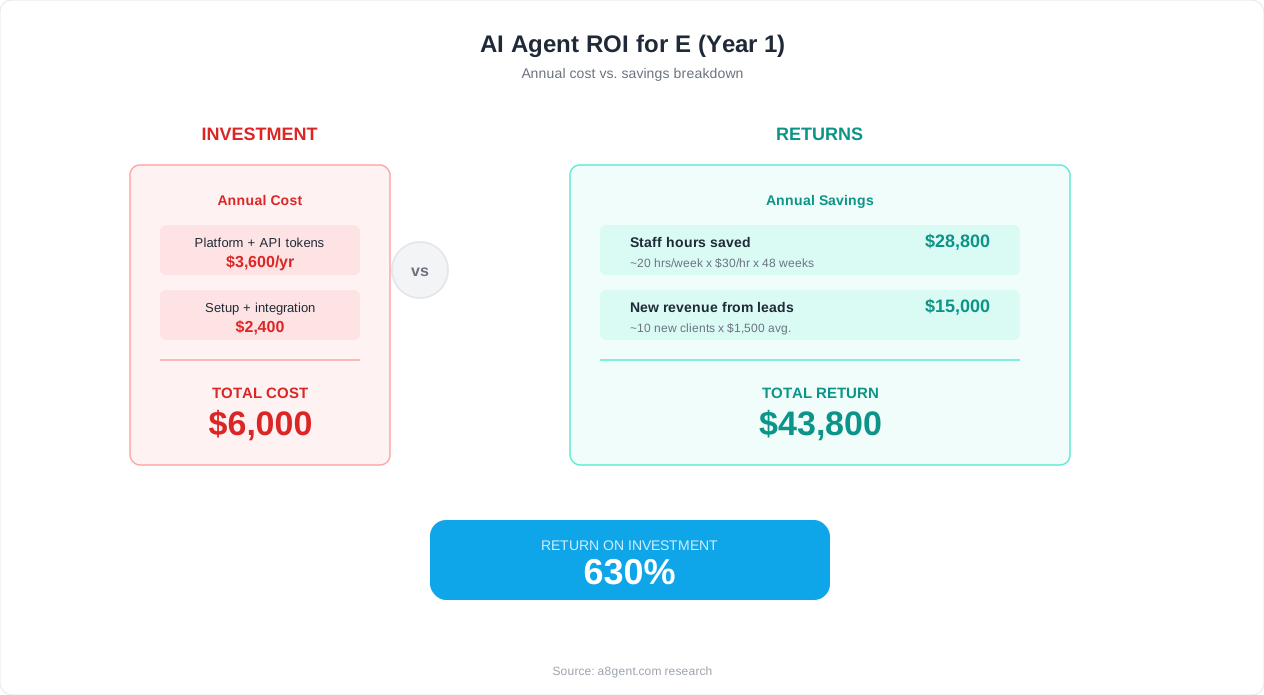
- ROI: 575-1,275 percent
These are not exceptional results - they are typical for e-commerce businesses that systematically deploy AI agents across their operations. The key is starting with the highest-volume area (usually support), proving ROI within 30 days, then expanding to adjacent workflows. Take our assessment to get a customized ROI projection based on your store's specific metrics - order volume, average order value, current team size, and operational pain points.
Your E-commerce AI Automation Roadmap: Where to Start
You understand the potential. Now let us build your implementation roadmap. The e-commerce businesses that succeed with AI agents follow a specific sequence designed for quick wins, minimal disruption, and compounding benefits. Here is the proven path.
Week 1-2: Deploy Customer Support Automation
Start here because support is your highest volume, most repetitive operational function with the clearest ROI. Connect Intercom Fin or a similar AI support agent to your store. Upload your FAQ content, product information, and shipping policies as the knowledge base. Run the agent in supervised mode for one week - reviewing its responses, correcting mistakes, and filling gaps in your knowledge base. By end of week two, let it handle routine queries autonomously. You will see immediate time savings and customer satisfaction improvements.
Week 3-4: Add Returns Automation
With support running smoothly, add automated returns processing. Configure your return policy rules (eligible timeframes, conditions, exceptions). Connect the agent to your shipping carrier for label generation and your payment processor for refund execution. Start with standard returns (straightforward reason, within policy, no special circumstances) and let the agent handle those end-to-end. Route edge cases to your team with full context. This alone saves 2-4 hours per day for a mid-size store.
Week 5-8: Implement Order Processing Automation
Once support and returns are humming, turn to order processing. Deploy an order verification and routing agent through Autonoly or a similar workflow platform. Start with verification only - let the agent flag suspicious orders and validate addresses while humans still handle routing decisions. After validating accuracy for two weeks, enable automated routing and fulfillment coordination for standard orders. Keep human oversight for high-value orders and flagged exceptions.
Month 3-4: Add Inventory Intelligence and Marketing
With core operations automated, invest in growth-driving agents. Deploy inventory monitoring with automated reorder alerts and cross-channel synchronization. Set up marketing personalization - product recommendations, abandoned cart recovery, and personalized email content. These take longer to optimize because they depend on accumulating customer behavior data, but they deliver the highest long-term ROI through increased revenue per customer.
Month 5-6: Optimize and Expand
By now you have a full AI operations stack. Spend this phase optimizing - reducing agent escalation rates, improving response quality, fine-tuning inventory forecasts, and A/B testing marketing approaches. This is also when you connect your agents to each other: your support agent shares customer sentiment data with your marketing agent, your order processing agent feeds fulfillment data to your inventory agent, and your returns agent informs your product team about quality issues.
The Bottom Line
E-commerce is one of the most automation-friendly business models because of its high transaction volume, repetitive workflows, and structured data. The businesses that automate their operations in 2026 do not just save time and money - they create a fundamentally different customer experience: instant support, seamless returns, proactive communication, and personalized shopping. That experience becomes a competitive moat that is difficult for manually-operated competitors to match. Start with our assessment to get your personalized roadmap, or explore our e-commerce guide for detailed implementation instructions specific to your platform.
FAQ
Which e-commerce platform integrates best with AI agents?
Shopify has the most mature integration ecosystem for AI agents due to its extensive API and app store. WooCommerce offers the most flexibility for custom integrations. BigCommerce, Magento, and other platforms all have strong API support. The specific AI agent platforms we recommend (Intercom Fin, Autonoly) integrate with all major e-commerce platforms, so your platform choice should not limit your automation options.
Can AI agents handle customer support for fashion and apparel stores?
Yes - fashion and apparel is one of the strongest use cases because support volume is high and queries are predictable (sizing questions, return policies, shipping times, style advice). AI agents can provide personalized size recommendations based on customer measurements, suggest styling options based on previous purchases, and handle the high volume of returns typical in fashion e-commerce.
How do AI agents handle angry or frustrated customers?
Well-configured AI agents detect negative sentiment and escalate to human agents for emotionally charged situations. For moderate frustration (shipping delays, minor issues), AI agents can offer immediate solutions (refunds, replacements, discounts) that often resolve the situation faster than waiting for a human. The key is configuring clear escalation rules and empowering the agent to offer meaningful solutions, not just apologies.
Will AI agents work with my dropshipping business model?
Yes. AI agents are especially valuable for dropshipping because they can coordinate between your store, suppliers, and customers automatically. They handle order routing to the correct supplier, tracking synchronization across multiple shipping carriers, and customer communication about delivery timelines - all workflow that is particularly complex and time-consuming in dropshipping businesses.
How do AI agents handle product returns that fall outside my standard policy?
You configure rules for what the agent can handle autonomously and what requires human judgment. Standard returns within policy guidelines are processed automatically. Edge cases - items outside the return window, damaged goods, customers requesting exceptions - are escalated to your team with full context and a recommended action based on the customer's value and history. You maintain control over all judgment calls.
Can AI agents help reduce my e-commerce return rate?
Yes. Pre-purchase AI agents that help customers choose the right size, color, or variant prevent returns caused by mismatched expectations - the number one return reason. AI-powered product descriptions, recommendation quizzes, and virtual try-on assistance have been shown to reduce return rates by 10-20 percent. Post-purchase agents sending usage tips and setup guidance further reduce returns from confusion or buyer's remorse.
What is the minimum order volume where e-commerce AI automation makes sense?
Customer support automation delivers clear value starting at 20-30 orders per day (generating 8-15 daily support inquiries). Order processing and returns automation become worthwhile at 50-plus orders per day. Marketing personalization benefits any list size but shows measurable revenue impact with 1,000-plus active customers. Even small stores benefit from support automation due to the low cost and dramatic time savings.
How long before I see ROI from AI agents in my e-commerce store?
Support automation delivers measurable ROI within the first week - fewer tickets requiring human time from day one. Returns automation shows clear savings within two weeks. Order processing improvements compound over the first month. Marketing personalization typically takes 30-60 days to accumulate enough data for meaningful revenue impact. Total payback on all tools combined is typically achieved within 30-45 days.