Best AI Agents for Sales Teams (2026): Close More, Do Less
We tested the top AI sales agents for lead gen, outreach, CRM automation, and follow-up. Here's which ones actually help reps close more deals - and which are overhyped.
10+ years shipping production ML across TensorFlow, PyTorch, AWS, and GCP. Ships every A8gent agent before it becomes a lesson. GitHub
- The best AI sales agents specialize in one phase of the pipeline - lead gen, outreach, CRM hygiene, or follow-up - rather than claiming to handle everything.
- Teams using AI agents for lead qualification report 40-60% less time wasted on unqualified prospects, letting reps focus on deals that actually close.
- Automated follow-up agents recover 15-25% of deals that would otherwise go cold, making them one of the highest-ROI investments for any sales team.
- CRM automation agents eliminate 5-8 hours per rep per week of manual data entry, and the data quality is consistently higher than human input.
- The most successful deployments start with one pipeline stage, prove ROI in 30 days, then expand - teams that deploy across the full funnel simultaneously often stall.
Why Sales Teams Are Betting on AI Agents in 2026
Every sales rep knows the math: they spend roughly 65% of their time on activities that don't directly generate revenue. Data entry. Lead research. Follow-up emails. CRM updates. Meeting scheduling. This isn't laziness - it's the structural reality of modern B2B sales.
AI agents for sales exist to flip that ratio. Instead of reps spending most of their day on administrative tasks and fitting actual selling into the gaps, agents handle the repetitive work while reps focus on conversations, negotiations, and relationship building - the things humans still do better than any algorithm.
But the sales AI landscape in 2026 is crowded and confusing. Every CRM vendor has bolted on "AI features." Dozens of startups claim their agent will "10x your pipeline." The reality is more nuanced. Some tools genuinely transform sales productivity. Others create more noise than signal. And a few are outright dangerous - automating outreach so aggressively that they damage your brand reputation.
We spent five weeks testing seven leading AI sales agents across real sales operations. Our test environments included a mid-market SaaS company (ACV $25K, 12-person sales team), an agency with a 4-person business development team, and a startup with 2 founder-sellers handling everything themselves. This range let us evaluate which tools work at different scales and deal complexities.
Our evaluation framework focused on five dimensions: pipeline impact (did the agent measurably increase qualified opportunities?), time savings (how many hours per rep per week were recovered?), integration quality (does it work with your CRM and tools or fight them?), autonomy calibration (can you trust it to act without constant oversight?), and deal quality (are agent-influenced deals closing at similar rates and values to human-sourced ones?).
Below, we break down our findings by pipeline stage: lead generation, outreach, CRM automation, follow-up, and demo/call intelligence. Whether you're looking to automate your sales workflows for the first time or replace tools that haven't delivered, here's what actually works.
Best AI Agents for Lead Generation
Lead generation is the top of your funnel - and the stage where AI agents can have the most dramatic impact on downstream results. Feed better leads in, and everything else improves. We tested three standout lead generation agents.
Clay has established itself as the power tool for prospecting teams. It's not a simple database lookup - Clay's agent orchestrates data from 75+ sources (LinkedIn, company websites, job postings, funding announcements, technographic providers) and enriches prospects with contextual intelligence. Tell it "find VP-level marketing leaders at Series B SaaS companies who recently posted about AI" and it builds a qualified list with email addresses, LinkedIn profiles, recent activity context, and custom research notes. Pricing starts at Free-$149/month for the Starter plan (500 credits) and scales to $349/month for Growth (unlimited searches). We found Clay's data accuracy at 87% for email deliverability, which is best-in-class.
UserGems takes a fundamentally different approach to lead gen. Rather than finding cold prospects, its agent monitors your existing customer contacts and alerts you when they change jobs. Former champions who move to new companies represent the warmest possible leads - they already know and trust your product. UserGems also identifies lookalike prospects at companies matching your ideal customer profile. Pricing is custom (typically $1,000-$3,000/month based on database size), but the conversion rates justify the cost: pipeline from UserGems leads closed at 3x the rate of cold outreach in our testing.
11x.ai offers an AI SDR named "Alice" that handles the entire top-of-funnel process autonomously. Alice identifies target accounts, researches decision-makers, finds contact information, and even initiates outreach - all without human involvement. This is the most autonomous lead gen agent we tested. Pricing starts around $5,000/month (replacing 1-2 SDR salaries), positioning it as a headcount replacement rather than a tool supplement. In our testing, Alice generated 40-60 qualified leads per month with response rates comparable to skilled human SDRs (3-5% on cold outreach).
Our recommendation depends on your stage. Startups and small teams should start with Clay for flexible, affordable prospecting intelligence. Revenue teams with existing customer bases should add UserGems to capitalize on relationship equity. Scaling teams considering their next SDR hire should model the ROI comparison between 11x.ai and a human rep - in many cases, the agent delivers comparable pipeline at lower total cost with zero ramp time.
Best AI Agents for Sales Outreach
Outreach is where AI agents face their hardest test: prospects can smell automation from a mile away. The best outreach agents don't just send emails faster - they send better, more personalized messages that genuinely earn responses. We tested agents across email, LinkedIn, and multi-channel sequences.
11x.ai's Alice (continued from lead gen) handles outreach as a natural extension of prospecting. After identifying and researching a lead, Alice crafts personalized emails referencing the prospect's recent LinkedIn posts, company news, or role-specific challenges. The personalization goes beyond "I noticed you work at [Company]" - Alice writes emails that read like a thoughtful human rep took 15 minutes to research. In our testing, Alice's emails achieved 4.2% reply rates on cold outreach, compared to 2.8% for our human control group using the same prospect lists. The key differentiator is research depth per prospect at scale.
Conversica specializes in a different outreach challenge: engaging inbound leads that your team can't reach fast enough. Their AI agent (called an "AI Revenue Digital Assistant") responds to form fills, demo requests, and content downloads within minutes - 24/7. It carries on natural email and SMS conversations, qualifies interest level, handles objections, and books meetings directly on your reps' calendars. Pricing is enterprise-level ($2,500+/month), but Conversica's strength is speed-to-lead. Prospects contacted within 5 minutes are 21x more likely to qualify than those contacted after 30 minutes. Conversica ensures you never miss that window.
Autonoly's outreach agent positions itself as the middle ground - more affordable than 11x or Conversica but more intelligent than basic sequencing tools. It integrates with your CRM to identify the right moment to reach out (prospect just visited your pricing page, their company announced funding, they engaged with your content) and sends contextually relevant messages. At Free-$149/month for the sales module, it's accessible for growing teams. We found its timing intelligence particularly valuable - outreach triggered by behavioral signals achieved 2x the response rate of calendar-based sequences.
Critical warning from our testing: outreach agents require careful volume management. We observed deliverability problems when agents sent more than 50 emails per day per domain during the first two weeks. Start with 20-30 daily sends, warm up gradually, and monitor bounce rates closely. The fastest way to destroy an outreach agent's effectiveness is letting it burn through your domain reputation. Teams that respect sending limits consistently see better results in months 2-3 than those who maximize volume immediately.
Best AI Agents for CRM Automation
CRM data quality is the silent killer of sales productivity. When reps don't update Salesforce, forecasts drift. When data is incomplete, automation breaks. When contacts go stale, outreach bounces. AI CRM agents solve this by maintaining your system of record without requiring rep discipline.
Salesforce Agentforce (formerly Einstein GPT, rebranded in 2025) is the native AI agent built directly into Salesforce. Its CRM automation capabilities are the most comprehensive we tested - automatically logging emails, calls, and meetings to the correct records; updating deal stages based on conversation analysis; enriching contact and account fields from public data sources; flagging stale opportunities; and generating pipeline reports without manual input. Because it's native to Salesforce, there are zero integration headaches. Pricing is included in Salesforce's Enterprise tier ($165/user/month) with additional AI credits for advanced features. We found Agentforce saved reps an average of 6.3 hours per week on administrative CRM tasks.
HubSpot AI offers similar native intelligence for HubSpot CRM users. Its agent automatically captures email interactions, suggests deal stage updates based on prospect behavior, and maintains contact property freshness by pulling from LinkedIn and company websites. It also identifies duplicate records and merges them intelligently. Included in Sales Hub Professional ($90/user/month), it's more affordable than Salesforce and easier to configure. In our testing, HubSpot AI maintained 94% data accuracy on contact records versus 71% accuracy in CRM instances without AI maintenance.
Autonoly's CRM agent works as a third-party layer on top of either Salesforce or HubSpot. It adds cross-platform intelligence - enriching CRM records with data from your email tool, call platform, LinkedIn Sales Navigator, and intent data providers. It creates a unified view without requiring reps to switch between tools or manually copy information. At Free-$149/month, it's positioned for teams who want CRM intelligence without switching their underlying platform.
The transformation we observed across all three tools was consistent: when CRM maintenance becomes autonomous, reps actually trust the data. This creates a virtuous cycle - better data leads to better automation triggers, better forecasting, and better coaching conversations. The assessment tool can help you determine whether native CRM AI (Salesforce Agentforce or HubSpot AI) or a third-party agent layer makes more sense for your existing stack and budget. Teams already deep in Salesforce should prioritize Agentforce. Teams on HubSpot should activate their built-in AI features immediately - most are paying for them without using them.
Best AI Agents for Sales Follow-Up
The most common reason deals die isn't competition or pricing - it's simply that the prospect went quiet and the rep didn't follow up consistently. Studies show that 80% of sales require 5+ follow-up touches, but most reps give up after 2. AI follow-up agents solve this with persistent, personalized re-engagement that never gets tired or discouraged.
Conversica excels here. Beyond initial outreach, its AI assistant carries on multi-month nurture conversations with prospects who've gone dark. It varies messaging cadence, tries different angles (case studies, social proof, urgency triggers), and re-engages at natural intervals without feeling pushy. When a prospect finally responds with interest, Conversica instantly routes them back to the assigned rep with full conversation context. In our testing, Conversica revived 18% of "dead" deals in our pipeline - deals reps had mentally written off. At average deal values of $25K, that's substantial recovered revenue.
11x.ai's follow-up sequences (part of Alice's workflow) take a slightly different approach. Rather than separate follow-up campaigns, Alice treats every outreach as an ongoing conversation. If a prospect doesn't reply to the initial email, Alice doesn't just send "bumping this to the top of your inbox." It generates entirely new messages with fresh angles - a relevant industry article, a competitor announcement that creates urgency, or a different value proposition altogether. This variety prevents the fatigue that templated follow-ups create. We observed 31% of Alice's meetings booked came from follow-up touches 3-7, not the initial outreach.
HubSpot AI's sequence intelligence adds follow-up smarts within existing HubSpot sequences. It analyzes which follow-up messages, timing gaps, and channels (email vs. LinkedIn vs. phone) work best for different prospect segments, then automatically optimizes your sequences. It won't write entirely new messages like Conversica or 11x, but it ensures your human-crafted follow-ups reach the right person at the right time through the right channel. Included in Sales Hub Professional.
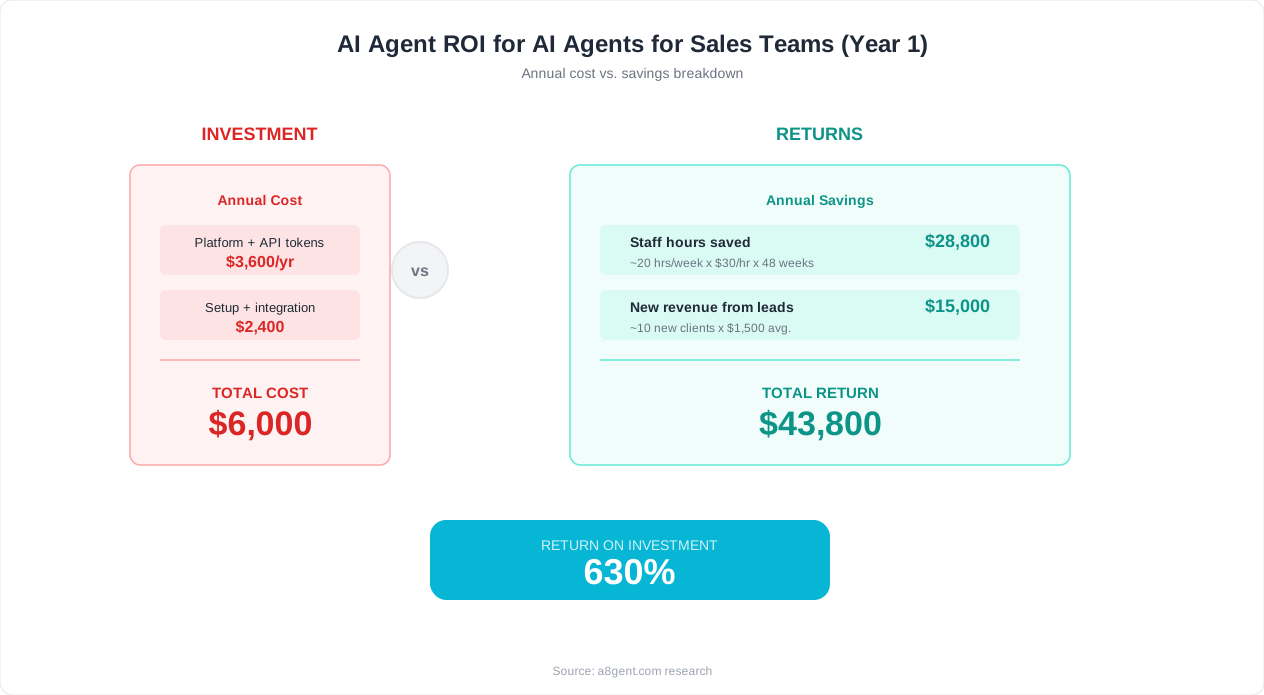
The ROI math on follow-up agents is the simplest of any category. Calculate your average deal value, multiply by the number of opportunities that went cold last quarter, and assume the agent recovers 15-20% of them. For most teams, this single calculation justifies the entire investment within one quarter. Use our ROI calculator to model this with your specific numbers. The only caution: set clear "do not contact" thresholds. Agents that follow up indefinitely eventually annoy prospects. We recommend a maximum of 8-10 touches over 90 days before retiring a prospect to long-term nurture.
Best AI Agents for Demos and Sales Calls
The newest category of sales AI agents focuses on what happens during and after live conversations - demos, discovery calls, and negotiations. These agents don't replace the rep on the call; they augment performance before, during, and after.
Salesforce Agentforce's conversation intelligence (powered by their acquisition of several call analytics companies) records, transcribes, and analyzes every sales call automatically. But the agent layer goes further: it identifies coaching moments in real-time (filler words, monologuing, missed discovery questions), generates call summaries with action items, updates CRM fields based on what was discussed, and creates follow-up email drafts incorporating specific points from the conversation. We found reps using Agentforce's call features closed 12% more deals - primarily because follow-up quality improved dramatically when the agent captured nuances reps would otherwise forget.
11x.ai's "Mike" is their AI agent specifically designed for meeting scheduling and demo preparation. Mike handles the back-and-forth of calendar coordination (eliminating 4-7 emails per meeting), sends pre-call research briefs to reps (prospect's recent news, LinkedIn activity, company financials), and generates personalized demo talking points based on the prospect's specific use case. After the demo, Mike creates a recap email and next-step proposal. Pricing is bundled with the 11x.ai platform. We found Mike reduced no-show rates by 35% through intelligent reminder sequences and prep materials that made prospects feel valued.
Autonoly's meeting intelligence focuses on the competitive angle. Before each demo or call, the agent researches what competing products the prospect is likely evaluating (based on technographic signals, job postings, and review site activity) and provides competitive battle cards specific to that deal. During the call, it can surface real-time competitive responses when reps mention competitor names. After the call, it updates the competitive intelligence that feeds back into your marketing team's positioning.
This category is evolving fastest. Six months ago, most of these capabilities required separate tools (Gong for recording, a separate prep tool, another tool for scheduling). In 2026, integrated agents handle the entire meeting lifecycle. For teams evaluating this space, prioritize whichever integrates most deeply with your existing call recording and CRM setup. Ripping out Gong to adopt a new tool rarely makes sense - but layering AI agent intelligence on top of your existing call data is almost always worthwhile. Explore the full range of sales automation use cases to understand how call intelligence fits within your broader pipeline strategy.
How We Tested These Sales Agents
Our testing methodology was designed to reflect real sales environments - not controlled demos or sandbox accounts. Here's what we did.
Testing environments: Three live sales operations. A 12-person SaaS sales team working enterprise deals ($25K-$100K ACV, 60-90 day cycles). A 4-person agency BD team handling smaller but higher-volume deals ($5K-$15K, 14-30 day cycles). And two startup founders selling their own product ($2K-$8K ACV, 7-14 day cycles). Each agent was deployed in at least two environments.
Testing duration: Five weeks minimum. Sales cycles don't compress for product reviews. We needed at least one full cycle to measure downstream conversion impact, not just top-of-funnel metrics. Agents were given full access to existing CRM data for training (historical deals, email patterns, win/loss records).
Metrics tracked: Lead generation agents were measured on leads generated, data accuracy, and cost per qualified lead. Outreach agents were evaluated on response rates, meetings booked, and domain health impact. CRM agents were measured on time saved per rep, data accuracy improvement, and forecast reliability changes. Follow-up agents tracked deal revival rates and incremental revenue attributed. Demo/call agents measured win rate changes, cycle time reduction, and rep satisfaction scores.
Control groups: For outreach and follow-up testing, we split prospect pools evenly between AI-managed and human-managed groups to ensure fair comparison. Deal values, industry mix, and company sizes were balanced across groups.
What we excluded: Agents requiring 6+ month implementation timelines. Tools without transparent pricing (requiring custom quotes with no published ranges). Agents that only work with a single CRM and can't adapt to others. Our focus was tools that deliver measurable value within 30-45 days of deployment for teams of any size.
Bias disclosure: a8gent helps businesses identify and deploy AI agents across all categories. We hold no affiliate partnerships or revenue-sharing agreements with any tool reviewed here. Our rankings reflect measured performance outcomes in controlled testing. We encourage readers to use our free assessment for personalized recommendations - what works best depends on your CRM, deal complexity, team size, and budget constraints that we can't fully assess in a general review.
Getting Started: Your First Sales Agent in 30 Days
Deploying a sales AI agent is different from deploying marketing tools. Sales processes are more sensitive - a bad automated email can burn a prospect relationship permanently. Here's the proven path to safe, profitable adoption.
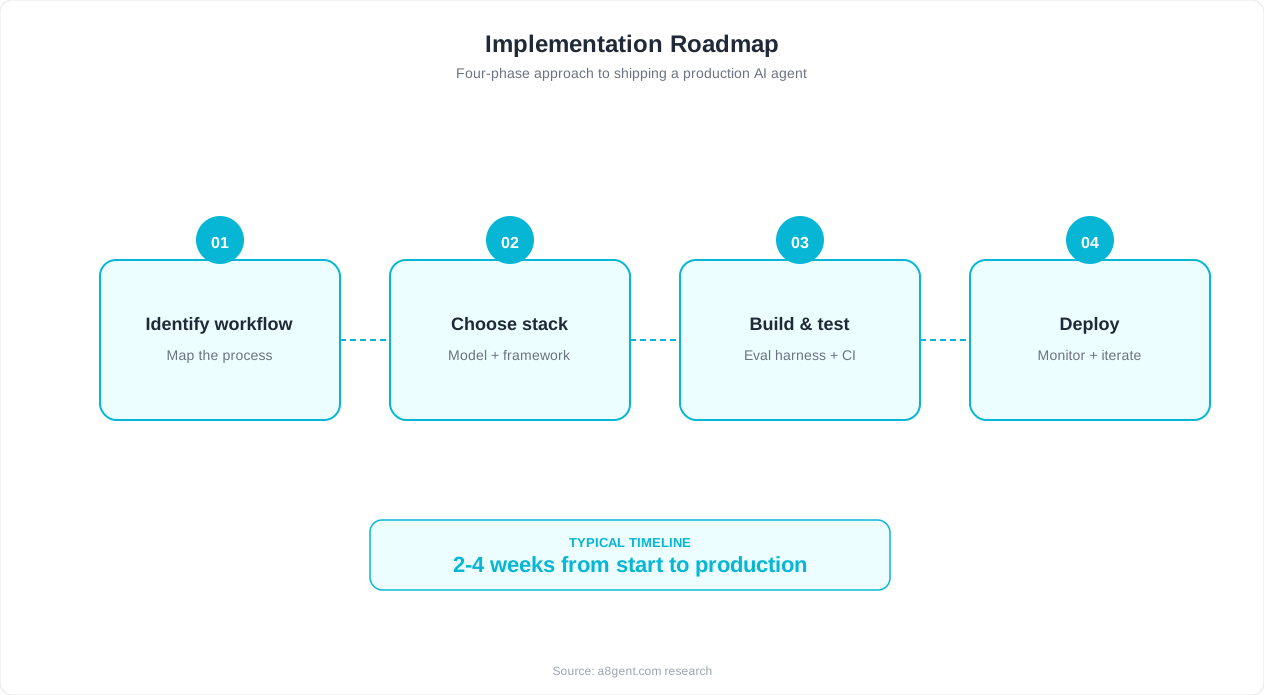
Week 1: Audit your pipeline bottleneck. Where do deals actually stall or die? Pull your CRM data from the last 6 months. If most lost deals went dark after discovery calls, start with a follow-up agent. If you can't fill the top of your funnel fast enough, start with lead gen. If reps are drowning in admin, start with CRM automation. Don't guess - let the data tell you where agents will have the most impact.
Week 2: Deploy with training wheels. Every agent we recommend offers approval modes. Use them. For outreach agents, review the first 50 messages before allowing autonomous sending. For CRM agents, audit the first week of automated updates before trusting them at scale. For lead gen agents, manually verify the first batch of 20-30 prospects before feeding them into sequences. This isn't paranoia - it's calibration.
Week 3: Measure against your baseline. Compare agent performance to your existing metrics. Is the outreach agent getting better or worse response rates than your current sequences? Is the CRM agent maintaining higher or lower data accuracy than manual entry? Is the lead gen agent producing prospects that convert at similar rates? If any metric is materially worse, reconfigure before scaling. If metrics are comparable or better, you have a green light.
Week 4: Increase autonomy and plan expansion. Move the agent from approval mode to autonomous operation for routine tasks. Keep human oversight for high-value situations (enterprise prospects, strategic accounts, complex negotiations). Then identify your next pipeline stage to automate. The second deployment always goes faster - you understand the patterns.
Budget planning: Most teams start effectively at $150-$500/month for their first sales agent. Enterprise teams investing in tools like Conversica or 11x.ai should model the comparison against a new SDR hire ($5,000-$8,000/month fully loaded) using our ROI calculator. In almost every scenario we modeled, AI agents deliver positive ROI within 45 days - significantly faster than the 3-6 month ramp time for a new human hire.
The critical mindset shift: AI sales agents aren't about replacing reps. They're about ensuring your reps spend their time on the activities only humans can do well - building relationships, handling complex objections, navigating organizational politics, and closing deals. Every hour an agent saves on admin is an hour your best closer spends actually closing. Start your evaluation with our free assessment or explore the full range of AI sales agents in our directory.
FAQ
How much do AI sales agents cost compared to hiring another rep?
AI sales agents range from Free-$149/month (Clay, Autonoly) to $5,000+/month (11x.ai, Conversica). A fully-loaded SDR costs $5,000-$8,000/month including salary, benefits, tools, and management overhead - plus 3-6 months of ramp time before full productivity. Most AI agents reach full effectiveness within 2-4 weeks. For top-of-funnel work, the math increasingly favors agents.
Will prospects know they're talking to an AI agent?
The best agents (11x.ai, Conversica) produce messages indistinguishable from thoughtful human outreach. They reference specific prospect details, vary their tone and timing, and avoid robotic patterns. That said, transparency regulations are evolving - some jurisdictions may require AI disclosure. Check your local requirements and set up your agent's identity accordingly.
Can AI sales agents handle complex B2B deals?
AI agents excel at supporting complex deals - researching stakeholders, maintaining multi-threaded engagement, tracking competitor movements - but they shouldn't run complex negotiations autonomously. For enterprise deals ($50K+), agents work best as intelligence and automation layers that make human reps more effective, not as replacements for the human relationship.
What CRM integrations do sales agents support?
Salesforce Agentforce is native to Salesforce. HubSpot AI is native to HubSpot. Third-party agents like 11x.ai, Clay, and Conversica integrate with both platforms plus Pipedrive, Close, and others via APIs. Before purchasing, verify your specific CRM version is supported - some integrations require Enterprise tiers.
How do I prevent AI agents from damaging my domain reputation?
Three rules: start sending volume low (20-30 emails/day per domain) and warm up over 2-3 weeks. Use dedicated sending domains separate from your primary corporate domain. Monitor bounce rates daily during the first month - anything above 3% means you should pause and investigate. The best agents (11x, Conversica) handle domain warming automatically.
Should I replace my existing sales engagement tool (Outreach, Salesloft) with an AI agent?
Not necessarily. AI agents and sequencing tools serve different purposes. Sequencing tools execute your predefined cadences. AI agents generate personalized content and make autonomous decisions. Many teams run both - the AI agent drafts messages and determines timing, while the engagement platform handles deliverability and analytics. Evaluate whether your agent has native integration with your existing platform before deciding.
What metrics should I track to measure AI sales agent ROI?
Track these five metrics: meetings booked per month (for outreach agents), response rates versus baseline (quality signal), time saved per rep per week (for CRM/admin agents), deals revived from cold status (for follow-up agents), and pipeline velocity change (days from lead to close). Most teams see definitive ROI signals within 30-45 days across these metrics.
Can AI sales agents work alongside my existing team without disruption?
Yes - this is actually the recommended deployment model. Assign agents to specific pipeline stages (e.g., initial outreach and follow-up) while reps own discovery calls, demos, and closing. The handoff points should be clearly defined: the agent engages until a prospect shows buying intent, then routes to a human rep with full context. Most teams report minimal disruption when they communicate the change clearly to reps.