AI Agents for Education and Tutoring: Grading, Scheduling and Student Support (2026)
AI agents help educators automate grading, manage complex scheduling, and provide 24/7 student support - giving teachers and tutors back 10-15 hours per week to focus on actual teaching, mentoring, and curriculum development.
10+ years shipping production ML across TensorFlow, PyTorch, AWS, and GCP. Ships every A8gent agent before it becomes a lesson. GitHub
- AI grading agents reduce assessment time by 70-85% for objective and semi-structured assignments while providing detailed, consistent feedback to every student - something impossible when teachers grade 150+ papers manually under time pressure.
- Scheduling automation eliminates the coordination chaos of tutoring businesses and educational programs by managing student availability, instructor capacity, room assignments, and rescheduling without back-and-forth communication.
- 24/7 student support agents answer routine questions about assignments, deadlines, policies, and course content instantly - reducing the email burden on educators while ensuring students get help when they need it rather than waiting days for a response.
- Tutoring businesses gain the most from AI agents because they combine the scheduling complexity of service businesses with the personalized communication needs of education - both areas where AI delivers 60-80% time savings.
- AI agents do not replace the human connection that makes great teaching effective - they handle the administrative overhead that prevents teachers and tutors from spending time on the mentoring, inspiration, and personalized instruction that actually drives learning outcomes.
Why Educators Are Drowning in Admin (And How AI Agents Help)
Teachers did not become teachers to grade papers until midnight, manage scheduling spreadsheets, or answer the same email questions 50 times per semester. Tutors did not start tutoring businesses to spend half their time on invoicing, calendar management, and parent communication instead of actual tutoring. Yet for most educators, administrative tasks consume 40-60% of their working hours - time directly stolen from the teaching, mentoring, and curriculum development that actually helps students learn.
The numbers are striking. The average teacher spends 7-10 hours per week on grading alone. Tutoring businesses report that scheduling management, client communication, and invoicing consume 15-20 hours per week for a solo operator. University instructors with large lecture courses spend more time managing logistics (attendance, office hours, assignment submissions, grade disputes) than they spend on research or individualized student support. Something is fundamentally broken when the administrative scaffolding of education consumes more energy than the education itself.
AI agents offer a genuine solution - not by replacing the human elements that make education powerful, but by eliminating the mechanical elements that waste educator time. Grading objective and semi-structured assignments, managing scheduling complexity, answering routine student questions, sending reminders and follow-ups, tracking student progress, and coordinating communication with parents or administrators - these are tasks that AI performs faster, more consistently, and more reliably than overwhelmed humans trying to handle them alongside actual teaching.
The impact is transformative. Educators who implement AI automation report gaining back 10-15 hours per week. That time goes directly into what matters: more detailed lesson planning, more individualized student attention, more creative teaching approaches, and - critically - better work-life balance that prevents the burnout driving talented people out of education.
For tutoring businesses specifically, AI agents solve the operational bottleneck that prevents scaling. A solo tutor can only see so many students before administrative overhead becomes unmanageable. With AI handling scheduling, communication, progress tracking, and invoicing, a single tutor's operational capacity doubles. A tutoring company with 5-10 tutors can operate with the coordination sophistication of a much larger organization without hiring administrative staff.
In this guide, we cover the three highest-impact areas for AI agents in education: grading automation, scheduling management, and student support. For each, we explain what AI handles, what stays human, how to implement it practically, and what results to expect. Take our free assessment to identify which parts of your education workflow are ready for AI automation today.
AI Grading: Faster Feedback, Better Learning
Grading is education's great time thief. A high school teacher with 5 classes of 30 students grading a single essay assignment faces 150 papers. At 10 minutes per paper (a generous minimum for thoughtful feedback), that is 25 hours of grading for one assignment. When multiple assignments are due simultaneously - as they inevitably are - grading quality suffers, feedback becomes superficial, and turnaround stretches to weeks. Students receive feedback too late to learn from it, and teachers burn out from endless paper stacks. AI grading agents break this cycle.
What AI Can Grade Effectively
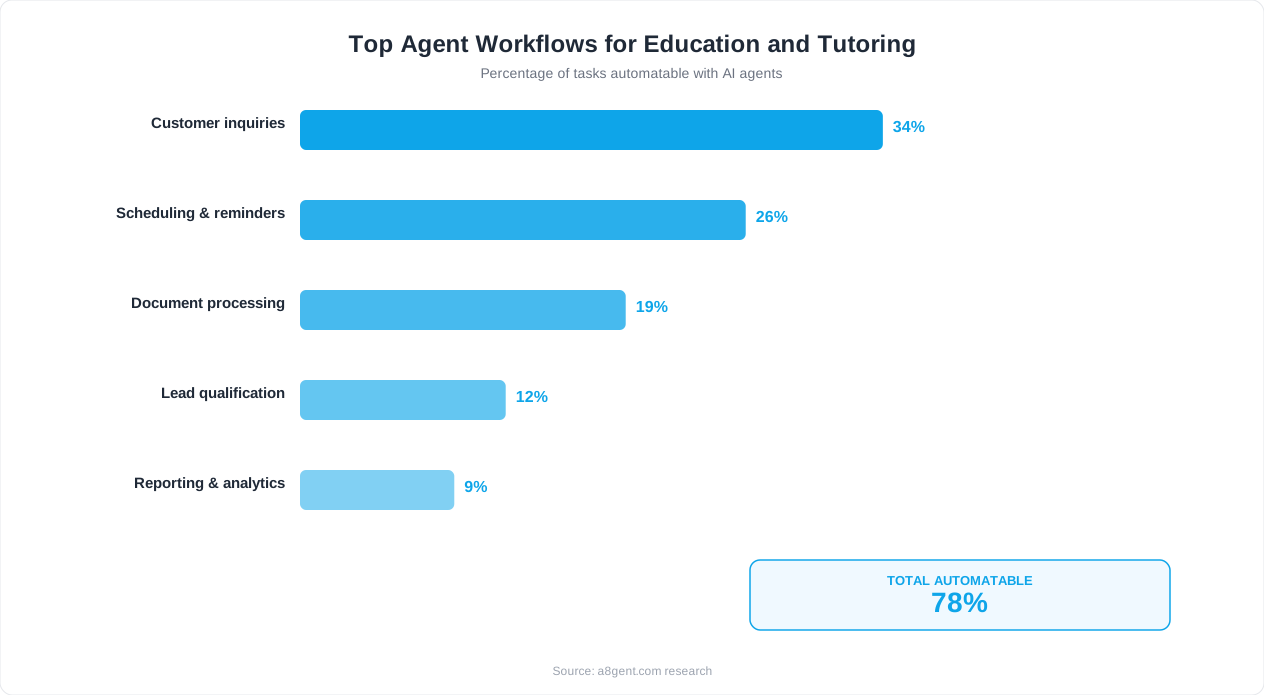
AI excels at grading: multiple choice and short answer questions (100% automatable), mathematical calculations and problem sets (95% automatable with work-shown analysis), structured writing assignments with clear rubrics (80% automatable with human review of edge cases), code assignments (90% automatable with test-case execution and style analysis), lab reports and structured analyses (75% automatable), and participation and engagement metrics (fully automatable from LMS data). For these assignment types, AI delivers grades and feedback in minutes rather than days.
How AI Feedback Works
Modern AI grading goes far beyond marking answers right or wrong. For a math problem set, the AI identifies exactly where the student's reasoning diverged from the correct approach, explains the conceptual error, and suggests practice problems targeting that specific gap. For a structured essay, it evaluates thesis clarity, evidence use, logical structure, and writing mechanics - providing specific, actionable feedback on each dimension. For code assignments, it identifies logical errors, suggests optimization approaches, and compares the student's approach against best practices with explanations.
Consistency That Humans Cannot Match
Human grading is inherently inconsistent. Research shows that the same essay graded by the same teacher at different times can receive scores varying by 15-20%. Grading quality deteriorates throughout a batch - the 100th paper gets less attention than the 10th. Unconscious biases (handwriting quality, name recognition, halo effects from previous assignments) influence scores. AI grading eliminates these inconsistencies: every student's work is evaluated against identical criteria with identical attention, regardless of submission order, time of day, or the grader's fatigue level.
Immediate Feedback Loop
The learning science is clear: feedback is most effective when delivered immediately after the attempt. When students submit work and receive detailed feedback within minutes rather than weeks, they can identify and correct misconceptions while the material is still fresh. This rapid feedback loop transforms assignments from summative checkboxes into genuine learning opportunities. Students can iterate, resubmit, and demonstrate improvement - impossible when feedback arrives two weeks later when the class has moved on.
What Stays Human
AI grading has clear boundaries. Creative writing that rewards voice and originality, subjective artistic expression, oral presentations, collaborative project assessment, and assignments designed to evaluate critical thinking through novel problem-solving all benefit from human evaluation. The optimal approach: AI handles the 60-70% of assignments that have clear criteria, freeing human educators to provide deep, thoughtful evaluation on the 30-40% that genuinely require human judgment.
Implementation
Set up grading automation on Autonoly by defining rubrics for each assignment type, connecting your LMS or submission system, and configuring feedback templates that match your teaching voice. The AI grades submissions as they arrive, stores results for your review, and delivers feedback to students once you approve. Most educators start with objective assignments (quizzes, problem sets) and expand to structured writing as they build confidence in the AI's feedback quality. Pair with Intercom Fin for student-facing support that answers questions about grades and feedback automatically.
Scheduling Automation: End the Calendar Chaos
Scheduling in education and tutoring is uniquely complex. Unlike a doctor's office (one provider, fixed hours), education scheduling involves: multiple students with different availability patterns, multiple instructors with varying schedules, room or resource constraints, recurring sessions that change seasonally, frequent rescheduling due to illness or conflicts, and coordination with parents who control younger students' schedules. Managing this manually consumes enormous time and inevitably produces errors, double-bookings, and missed sessions.
Tutoring Business Scheduling
For tutoring businesses, scheduling is often the operational bottleneck that limits growth. A solo tutor managing 20-30 recurring students spends 5-8 hours per week on scheduling tasks: confirming weekly sessions, handling cancellations and rescheduling, accommodating new student availability, managing waitlists for popular time slots, and coordinating makeup sessions. AI scheduling agents handle all of this: students or parents book available slots through a self-service interface, the AI manages cancellations and automatically offers makeup options, waitlisted students are notified when preferred slots open, and recurring schedule changes are accommodated without manual intervention.
Academic Program Scheduling
Educational programs face different complexity: course sections that must not overlap for students in the same program, instructor availability constraints, room capacity and equipment requirements, lab section coordination with lecture timing, and exam scheduling that avoids conflicts. AI agents solve these constraint-satisfaction problems far more effectively than humans working with spreadsheets. They generate optimal schedules that maximize resource utilization while respecting all constraints, and they adapt quickly when variables change (instructor availability shifts, enrollment numbers exceed room capacity).
Automated Reminders and Attendance
No-shows and forgotten sessions waste educator time and student money. AI agents send personalized reminders at appropriate intervals (24 hours and 1 hour before sessions), confirm attendance, and automatically trigger rescheduling workflows when cancellations occur with sufficient notice. They track attendance patterns, identifying students who are frequently missing sessions (a signal that something may be wrong) and flagging this for educator attention. For paid tutoring, they enforce cancellation policies consistently - applying late-cancellation fees or credits without awkward manual enforcement.
Group Session Coordination
Group tutoring, study groups, and workshop sessions add another layer of complexity: enough students must be available simultaneously to justify the session, the content must be appropriate for all attendees, and scheduling must account for group dynamics. AI agents manage group formation based on skill level, scheduling compatibility, and learning objectives. They coordinate group session times by identifying availability overlap across participants and handle the cascade of changes when one group member reschedules.
Season and Schedule Transitions
Education scheduling has natural transition points: semester starts, summer schedule changes, holiday breaks, and exam periods. Each transition requires rebuilding schedules from scratch as availability changes. AI agents manage these transitions proactively: soliciting updated availability before transition dates, generating new schedules that accommodate changes while maximizing continuity, communicating new schedules to all parties, and handling the cascade of conflicts that inevitably arise during transitions.
Getting Started
Build scheduling automation on Autonoly by defining your scheduling parameters (session types, durations, instructor capacity, room constraints), connecting calendar systems, and configuring self-service booking for students or parents. Explore support automation for handling scheduling-related questions that students and parents commonly ask. Most tutoring businesses have scheduling automation operational within one week, immediately eliminating 5-10 hours of weekly administrative time.
24/7 Student Support: Instant Answers, Always Available
Students have questions at all hours - the night before an assignment is due, on weekends when they are studying, or during breaks between classes when they have 5 minutes but cannot visit office hours. In traditional education, these questions either wait for the next class or office hours (by which time the student has moved on or found incorrect answers elsewhere) or they flood the educator's inbox creating a backlog that takes hours to clear. AI support agents solve both problems simultaneously.
Routine Question Handling
The vast majority of student questions fall into predictable categories: assignment clarification (what exactly is due, what format, what length), deadline confirmation (when is it due, can I get an extension), policy questions (how are late submissions handled, what is the grading weight), course logistics (where is class meeting this week, what should I prepare), and resource location (where is the reading, how do I access the lab). AI agents answer these questions instantly by drawing from your syllabus, assignment descriptions, policies, and course materials. The 80% of student emails that have straightforward answers get resolved in seconds rather than days.
Content-Related Support
Beyond logistics, AI agents provide meaningful academic support. A student stuck on a math concept at 11 PM can ask the AI agent for an explanation, receive a clear breakdown with examples, and continue their work - rather than abandoning the problem until they can reach the instructor during business hours. The AI draws from course materials, textbook content, and supplementary resources to provide explanations aligned with what the instructor has taught. It does not give away homework answers but guides students through problem-solving approaches.
Assignment Guidance Without Giving Answers
One of the most valuable and nuanced capabilities is providing assignment guidance without doing the work. A student writing an essay can ask "Am I on the right track with my thesis?" and receive feedback on thesis clarity and scope without the AI writing the thesis for them. A student debugging code can describe their error and receive hints about where to look without getting the solution. This Socratic approach - asking guiding questions, pointing toward relevant concepts, providing hints rather than answers - replicates the best tutoring practices at scale.
Parent Communication
For K-12 tutoring and education programs, parent communication is a significant time investment. Parents want to know: how is my child progressing, what should they practice at home, is the session schedule confirmed, how should they prepare for upcoming tests. AI agents provide parents with progress summaries, upcoming session reminders, suggested home practice activities, and answers to routine questions - all automatically generated from session notes, assessment results, and scheduling data. Educators communicate strategic updates personally while routine information flows automatically.
Escalation to Human Support
Not every question should be handled by AI. Emotional distress signals, academic integrity concerns, accommodation requests, grade disputes that require judgment, and complex situations that need human empathy should route to the educator or appropriate support personnel. AI agents are configured to recognize these situations - certain keywords, sentiment patterns, or topic categories trigger immediate escalation with context provided to the human responder. The AI handles volume; humans handle sensitivity.
Building Your Support Agent
Configure student support on Intercom Fin for sophisticated conversational support, or use Autonoly for workflow-based support that integrates with your scheduling, grading, and communication systems. Feed in your syllabus, course materials, policies, and common Q&A pairs. The AI learns your teaching style and communication preferences, delivering support that feels consistent with your classroom presence. Most educators report eliminating 70-80% of routine email within the first week of deployment.
Student Progress Tracking and Personalized Learning
Every student learns differently and progresses at their own pace. The ideal educational experience adapts to individual needs - but with 30 students per class or 40 tutoring clients per week, individualized attention is nearly impossible without AI support. AI agents track progress continuously, identify patterns, and enable personalized approaches that transform learning outcomes.
Continuous Assessment Beyond Grades
Traditional progress tracking reduces student performance to a sequence of grades. AI agents build richer progress profiles: concept mastery levels across specific skills and topics, learning velocity (how quickly new concepts are absorbed), engagement patterns (which formats and approaches produce the best results), struggle indicators (concepts that require repeated attempts), and strength areas (where the student exceeds expectations). This multidimensional view enables educators to intervene precisely where each student needs help most.
Early Warning Systems
AI agents identify at-risk students before they fail. By analyzing patterns - declining assignment quality, increasing late submissions, reduced engagement with course materials, dropping attendance, or sudden performance changes - the AI flags students who may be struggling before they reach crisis point. This early identification enables proactive intervention: a check-in conversation, additional resources, adjusted expectations, or referral to support services. Catching problems at week 3 rather than week 10 is the difference between a student succeeding and a student failing or dropping out.
Personalized Learning Pathways
For tutoring businesses and adaptive education programs, AI agents design individualized learning pathways. Based on assessment results and progress data, the AI identifies: which concepts are mastered and can be skipped or reviewed quickly, which concepts need intensive focus and practice, what prerequisite gaps exist that are blocking progress on current material, and what learning formats (visual, problem-based, reading, discussion) produce the best results for each student. Tutors receive session preparation guides that optimize every minute of face-to-face time.
Progress Reporting
Generating meaningful progress reports for students, parents, and administrators is time-consuming when done manually. AI agents produce these automatically: weekly progress summaries highlighting achievements and areas for focus, monthly comprehensive reports with trend analysis, semester reports that demonstrate growth against defined learning objectives, and custom reports for parent conferences or administrative review. Each report draws from the rich data captured through continuous assessment, presenting insights that would be impossible to compile manually at scale.
Adaptive Difficulty and Pacing
For self-paced educational content and practice exercises, AI agents adjust difficulty in real-time based on student performance. A student mastering concepts quickly receives more challenging material that keeps them engaged rather than bored. A struggling student receives additional scaffolding, simpler examples, and more practice opportunities at the current level before advancing. This adaptive approach maximizes learning efficiency for every student regardless of their starting level or learning pace.
Implementation for Educators
Set up progress tracking on Autonoly by connecting your grading data, LMS activity logs, attendance records, and assessment results. Define the learning objectives and competency frameworks for your subject area. The AI builds student profiles automatically from incoming data and generates actionable insights for each session. For tutoring businesses, this becomes a powerful differentiator - parents see detailed progress data that demonstrates the value of your services far more effectively than occasional verbal updates.
Running a Tutoring Business: Complete Operational Automation
Tutoring businesses face a unique operational challenge: they combine the scheduling complexity of a service business, the personalized communication needs of education, the billing complexity of recurring subscriptions with variable usage, and the relationship management demands of working with both students and parents. AI agents handle the entire operational layer, enabling tutors to focus exclusively on teaching.
Client Acquisition and Onboarding
When a new inquiry comes in (from your website, referral, or marketplace), AI agents manage the entire client acquisition flow: responding to initial inquiries within minutes with relevant information, collecting student details and learning goals, conducting an initial assessment to determine appropriate level and starting point, recommending a package or schedule, processing enrollment paperwork and payment setup, and scheduling the first session. This process - which typically takes 3-5 days of back-and-forth with a busy tutor - completes in hours with AI orchestration.
Session Preparation and Follow-Up
Before each tutoring session, AI agents prepare the tutor: summarizing last session's content and outcomes, highlighting areas where the student struggled, suggesting focus areas and exercises for this session based on progress data, and noting any parent communications or concerns since the last session. After sessions, the AI prompts the tutor for brief notes (5 minutes maximum), updates the student's progress profile, and sends parents a session summary if configured. This preparation and follow-up cycle takes minutes instead of the 30-45 minutes per student that manual preparation requires.
Billing and Payment Management
Tutoring billing is surprisingly complex: recurring monthly packages, per-session payments, package credits that expire, family discounts, makeup session tracking, cancellation fee enforcement, and seasonal rate changes. AI agents manage the complete billing cycle: generating invoices based on sessions completed, applying credits and discounts correctly, sending payment reminders, processing makeup session credits, and flagging accounts with outstanding balances. This eliminates the awkward tutor-turned-collections-agent dynamic that damages client relationships when billing is managed manually.
Multi-Tutor Coordination
Tutoring companies with multiple tutors face coordination challenges: matching students with appropriate tutors based on subject expertise and teaching style, managing tutor capacity and availability, redistributing students when a tutor leaves or reduces hours, and maintaining consistent quality across different tutors. AI agents optimize tutor-student matching based on defined criteria, manage capacity across the team, and ensure operational continuity when staffing changes occur. They also identify when a student-tutor match is not working (declining progress, engagement signals) and suggest reassignment proactively.
Growth Without Proportional Admin Growth
The fundamental promise of AI agents for tutoring businesses is that operational complexity does not scale proportionally with student volume. A tutor managing 20 students with AI automation spends the same administrative time as one managing 40 students - because the AI scales perfectly while human administrative capacity does not. This means growth is limited only by teaching capacity, not by operational overhead. A 5-tutor company can operate with the administrative sophistication of a 50-tutor organization without a single administrative hire.
Setting Up Your Tutoring Operations
Build your complete tutoring operations on Autonoly: client onboarding workflows, scheduling automation, session preparation, progress tracking, billing management, and parent communication - all connected into a seamless operational system. Add Intercom Fin for student and parent self-service support that answers questions about schedules, policies, progress, and billing without requiring your attention. Most tutoring businesses achieve full operational automation within 2-3 weeks of setup, immediately reclaiming 15-20 hours per week for actual teaching.
Implementation Guide for Education Professionals
Implementing AI agents in education requires sensitivity to the learning environment and the trust relationships between educators, students, and parents. Here is a practical implementation roadmap that delivers results while maintaining the human-centered values that make education meaningful.
Phase 1: Start with Administrative Automation (Week 1-2)
Begin with the purely administrative tasks that have no pedagogical component: scheduling management, routine communication (reminders, logistics, policy answers), and attendance tracking. These tasks have clear right answers, low risk of negative impact if something goes wrong, and immediate time savings that build confidence. Set up scheduling automation first - the time savings are immediate and visible. Then add routine communication handling to eliminate the repetitive email burden.
Phase 2: Add Grading Support (Weeks 2-4)
Start grading automation with your most objective assignments: quizzes, problem sets, and structured exercises with clear rubrics. Run AI grading in parallel with your manual grading for 2-3 assignments to calibrate accuracy. Compare AI grades and feedback against your own - you will typically find 85-95% agreement, with differences usually occurring in edge cases where reasonable educators would disagree. Once calibrated, let the AI handle first-pass grading while you review and approve. Expand to more complex assignments as confidence builds.
Phase 3: Deploy Student Support (Weeks 3-5)
Launch AI student support with a limited scope: answering logistical questions (deadlines, policies, resources), providing course material clarification, and handling scheduling requests. Monitor the AI's responses for accuracy and appropriateness during the first week. Expand to content-related support once you are confident in response quality. Always maintain clear escalation paths for questions that need human educator attention - academic integrity issues, emotional concerns, or complex situations.
Phase 4: Progress Tracking and Personalization (Weeks 5-8)
Once grading data flows through the system, activate progress tracking and personalized recommendations. This phase requires enough data to generate meaningful patterns - typically 4-6 weeks of grading data per student. Configure early warning thresholds based on your experience (what patterns predict students who will struggle?). Begin receiving session preparation recommendations that incorporate individual student progress data.
Communication with Students and Parents
Transparency builds trust. Let students know that AI tools assist with grading, scheduling, and support - and explain the benefits (faster feedback, 24/7 availability, more consistent experience). Assure them that human educators review consequential assessments and that AI support escalates to humans when situations require judgment. For parents, emphasize that AI handles administrative coordination while their child's actual education remains human-delivered and human-supervised.
Measuring Impact
Track these metrics: time spent on administrative tasks (target: -60-80%), grading turnaround time (target: same-day for objective assignments), student question response time (target: under 5 minutes for routine questions), student satisfaction with support availability, student learning outcomes (are faster feedback loops improving performance?), and educator satisfaction and burnout indicators. Most educators report feeling the difference - more energy for teaching, more enjoyment of their work, better work-life balance - within 30 days of full implementation.
Getting Started
Take our assessment to identify which education workflows in your practice are ready for immediate AI automation, then explore support automation to understand how AI student support integrates with your teaching approach.
The Future of AI-Augmented Education
AI agents are not just automating current educational processes - they are enabling approaches to learning that were previously impossible. Understanding where education technology is heading helps educators and tutoring businesses invest wisely while preparing for transformative changes in how learning happens.
Truly Personalized Learning at Scale
The holy grail of education has always been personalized instruction - every student receiving teaching tailored to their specific needs, pace, and learning style. This was previously possible only through one-on-one tutoring, making it accessible to few. AI agents are making personalized learning possible within group settings. Each student receives adapted content, pacing, and practice that matches their individual profile, while still benefiting from group learning dynamics. The instructor orchestrates and enriches the learning experience while AI handles the differentiation that would be impossible to manage manually across 30 students.
Continuous Adaptive Assessment
The traditional model of periodic testing (midterms, finals, unit tests) is being replaced by continuous assessment woven into the learning experience itself. AI agents assess understanding through every interaction - practice problems, questions asked, content engagement patterns, and collaborative contributions. Students receive real-time feedback on their understanding level without the anxiety of formal testing. Educators see continuous performance data rather than point-in-time snapshots. This shift makes assessment a learning tool rather than a judgment event.
AI as Teaching Assistant
AI agents will increasingly serve as intelligent teaching assistants that extend an educator's reach. During a lecture, the AI might identify students who appear confused (based on questions or engagement signals) and send them supplementary explanations in real-time. During independent practice, it might provide hints to struggling students while offering extension challenges to those who finish early. During group work, it might facilitate collaboration and ensure equitable participation. The educator remains the conductor; AI extends their bandwidth across every student simultaneously.
Predictive Education Planning
AI agents will increasingly support proactive education planning: predicting which students are likely to struggle with upcoming material based on prerequisite mastery patterns, recommending curriculum sequencing changes based on aggregate student performance data, identifying content gaps in existing materials, and forecasting resource needs based on enrollment trends and student performance patterns. This intelligence transforms educational planning from intuition-based to data-informed while preserving educator judgment in final decisions.
The Evolving Role of Educators
As AI handles more administrative and routine instructional tasks, the educator's role evolves toward higher-value activities: designing learning experiences, providing emotional and motivational support, facilitating discussion and debate, mentoring individual students through challenges, and creating the culture of curiosity and intellectual courage that no AI can replicate. The best educators of the future will be those who leverage AI for maximum instructional efficiency while developing their uniquely human capability to inspire, challenge, and connect with students.
Preparing for This Future
Educators and tutoring businesses that build AI automation foundations today are positioning themselves for these future capabilities. The data collected through current automation - student progress patterns, learning preferences, content effectiveness - becomes the foundation for increasingly sophisticated personalization and prediction. Start with the practical automation covered in this guide and grow toward the transformative possibilities as technology matures. Take the assessment to begin your journey from administrative overwhelm to AI-augmented educational excellence.
FAQ
Will AI grading be accurate enough for high-stakes assessments?
For objective and semi-structured assessments (problem sets, short answer, structured essays with clear rubrics), AI grading accuracy matches or exceeds human consistency. For high-stakes assessments like final exams, use AI as a first-pass grader with mandatory human review of the final scores. This gives you the speed benefit while maintaining human oversight for consequential decisions. Many educators find that AI's consistency actually improves grading fairness compared to human grading that deteriorates over long grading sessions.
How do I prevent students from using the AI support agent to cheat on assignments?
Configure the support agent with clear boundaries: it provides conceptual explanations and hints but does not solve specific assignment problems. It asks guiding questions rather than giving direct answers. For active assignments, the agent knows which problems are assigned and refuses to solve them directly, instead pointing students toward relevant concepts and examples. This mirrors good tutoring practice - helping students understand how to approach problems without doing the work for them.
Will parents accept AI communication instead of direct teacher contact?
Position AI communication as additional support, not replacement of human contact. AI handles routine information (schedule confirmations, progress updates, policy answers) so that when parents do speak with the educator, the conversation is substantive rather than logistical. Most parents prefer getting instant answers to routine questions over waiting 2-3 days for an educator to respond. Maintain direct communication channels for concerns, celebrations, and nuanced discussions.
Is AI grading fair to students with non-standard writing styles or learning differences?
AI grading can be configured to accommodate different learning needs: adjusted rubrics for students with accommodations, alternative assessment formats, and explicit instructions to evaluate content over form for students with writing-related disabilities. The key advantage is that these accommodations are applied consistently for every assessment - unlike human graders who may forget or inconsistently apply accommodations across large grading batches. Document accommodation configurations and review AI treatment of accommodated students regularly.
How much does AI automation cost for a solo tutor or small tutoring business?
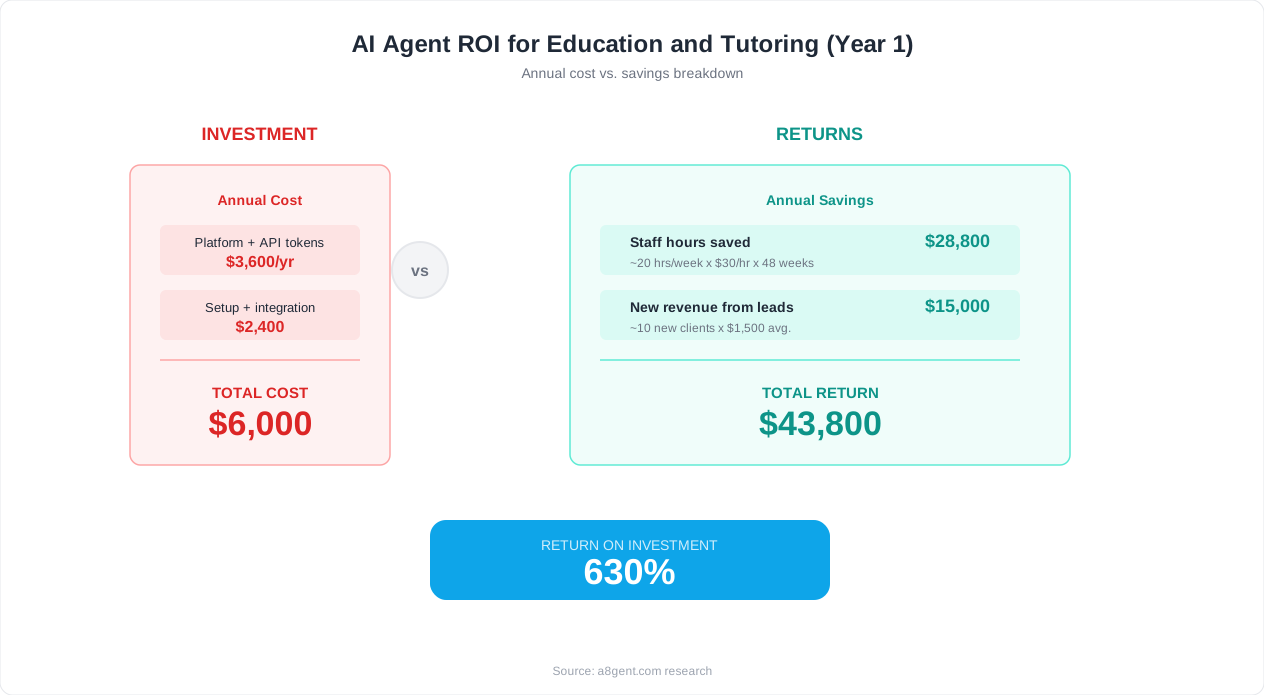
Platforms like Autonoly start at $79-Free-$149/month for small businesses, covering scheduling, communication, and basic automation. For a solo tutor billing $50-$100/hour who saves 10-15 hours per week in administrative time, that is $500-$1,500/week of reclaimed teaching capacity for under $40/week in platform costs. The ROI is immediate and dramatic - most tutors recoup their investment within the first week by converting administrative time into additional billable sessions or improved work-life balance.
Can AI agents handle the scheduling complexity of a multi-subject tutoring center?
Yes, and this is actually where AI scheduling excels. Multi-subject centers have complex constraints: tutor specializations, room assignments, back-to-back session optimization for students taking multiple subjects, and cross-subject coordination. AI agents solve these constraint-satisfaction problems far more effectively than human schedulers using spreadsheets. They generate optimal schedules in minutes and adapt instantly when variables change - a capability that becomes essential as tutoring centers grow beyond 10-15 tutors.
What data privacy considerations exist when using AI with student information?
For K-12 education in the US, FERPA compliance is mandatory - ensure your AI platform has a signed data processing agreement, processes data within the US, and does not use student data for model training. For COPPA compliance with students under 13, parental consent is required. In the EU, GDPR requires explicit consent and data minimization. Choose platforms with SOC 2 compliance and clear data handling policies. Most education-focused AI platforms are already designed for these requirements.
How do I maintain my personal teaching style when AI handles student communication?
Train the AI on your actual communications: provide 20-30 examples of how you typically respond to common questions, your tone preferences, phrases you use, and boundaries you maintain. Most platforms allow you to define communication style guidelines that the AI follows. Review AI responses for the first 1-2 weeks and refine where needed. Students should feel that communications are consistent with your classroom presence - warm, professional, encouraging, or whatever style defines your approach.