AI Agents for Healthcare Clinics: Scheduling and Patient Communication (2026)
Learn how AI agents help healthcare clinics automate patient scheduling, reduce no-shows, and improve communication. A practical guide for clinic owners covering HIPAA compliance, tools, and implementation steps.
10+ years shipping production ML across TensorFlow, PyTorch, AWS, and GCP. Ships every A8gent agent before it becomes a lesson. GitHub
- Healthcare clinics lose $150,000-$300,000 annually from patient no-shows averaging 18-23% - AI scheduling agents with smart reminders reduce no-shows to 5-8%, recovering significant revenue without adding staff.
- Front desk staff spend 60-70% of their time on phone calls for scheduling, rescheduling, and routine inquiries - AI handles these conversations 24/7, letting staff focus on in-person patient care and complex tasks.
- AI patient intake automation collects forms, insurance verification, and health history before appointments, reducing average check-in time from 15 minutes to under 3 minutes while improving data accuracy.
- All recommended AI tools are HIPAA-compliant with Business Associate Agreements, end-to-end encryption, and audit logging - meeting or exceeding the security standards of traditional practice management systems.
- Implementation starts at Free-$149/month for solo practices and delivers measurable ROI within 2-3 weeks through no-show reduction and recovered staff time alone.
Why Healthcare Clinics Are Turning to AI Agents
Healthcare clinics face a perfect storm of operational pressures in 2026. Reimbursement rates continue tightening while operational costs rise. Staff shortages - particularly front desk and administrative personnel - force remaining team members to handle increasing workloads. Patient expectations for digital convenience, shaped by their experiences with retail and banking, now extend to their healthcare interactions. And through it all, providers must maintain the quality of care that patients deserve and regulators require.
The operational reality for a typical 3-5 provider clinic is sobering. Front desk staff field 80-150 phone calls per day, with 60-70% being scheduling or rescheduling requests and routine questions (hours, directions, insurance acceptance, prescription refill status). Each call averages 4-6 minutes, consuming 6-10 hours of staff time daily on conversations that follow predictable patterns and could be handled by AI. Meanwhile, patients calling during peak hours encounter hold times or voicemails - and 30% of those callers don't call back, representing lost appointments and revenue.
No-shows compound the problem. The average healthcare clinic experiences 18-23% no-show rates, meaning one in five scheduled appointments results in an empty slot that generates zero revenue while blocking other patients from access. For a clinic generating $500 per appointment slot, a 20% no-show rate on 40 daily appointments means 8 empty slots - $4,000 lost per day, $80,000 per month, nearly a million dollars annually. This is perhaps the single most addressable revenue problem in healthcare operations.
AI agents address these challenges through automated scheduling, intelligent reminder sequences that dramatically reduce no-shows, patient communication that operates 24/7, and intake workflows that eliminate paper forms and reduce check-in friction. The tools available in 2026 are specifically designed for healthcare - HIPAA-compliant by architecture, integrated with common EHR and practice management systems, and configured for the unique communication requirements of medical practices.
The clinics that implement AI now are achieving a compound advantage: lower no-show rates mean more patients seen per day, automated scheduling means more appointment slots filled, reduced phone burden means happier staff with lower turnover, and digital intake means faster patient flow through the office. Together, these improvements can increase effective clinic revenue by 15-25% without adding providers or extending hours.
Take our free AI readiness assessment to evaluate your clinic's specific opportunities - it identifies which operational bottlenecks will deliver the fastest return when automated, along with estimated revenue impact based on your patient volume and no-show rates.
Smart Scheduling: Fill Every Slot, Reduce Every Gap
Clinic scheduling is far more complex than simply matching patients to available time slots. Effective scheduling must account for appointment types (new patient visits require longer slots than follow-ups), provider preferences and specialties, equipment or room requirements, insurance authorization status, patient preferences for time of day and day of week, and the spacing needed between appointment types for provider preparation. Manual scheduling that considers all these variables requires experienced staff making dozens of micro-decisions per hour.
AI scheduling agents handle this complexity effortlessly while simultaneously being available 24/7 for patient self-scheduling. When a patient calls, texts, or visits your website to book an appointment, the AI engages conversationally: understanding the reason for visit, matching it to the appropriate appointment type and duration, identifying available slots that match the patient's preferences, confirming insurance acceptance, and completing the booking - all within a 2-3 minute interaction that would take a front desk staff member the same time but without consuming their attention from in-person patients.
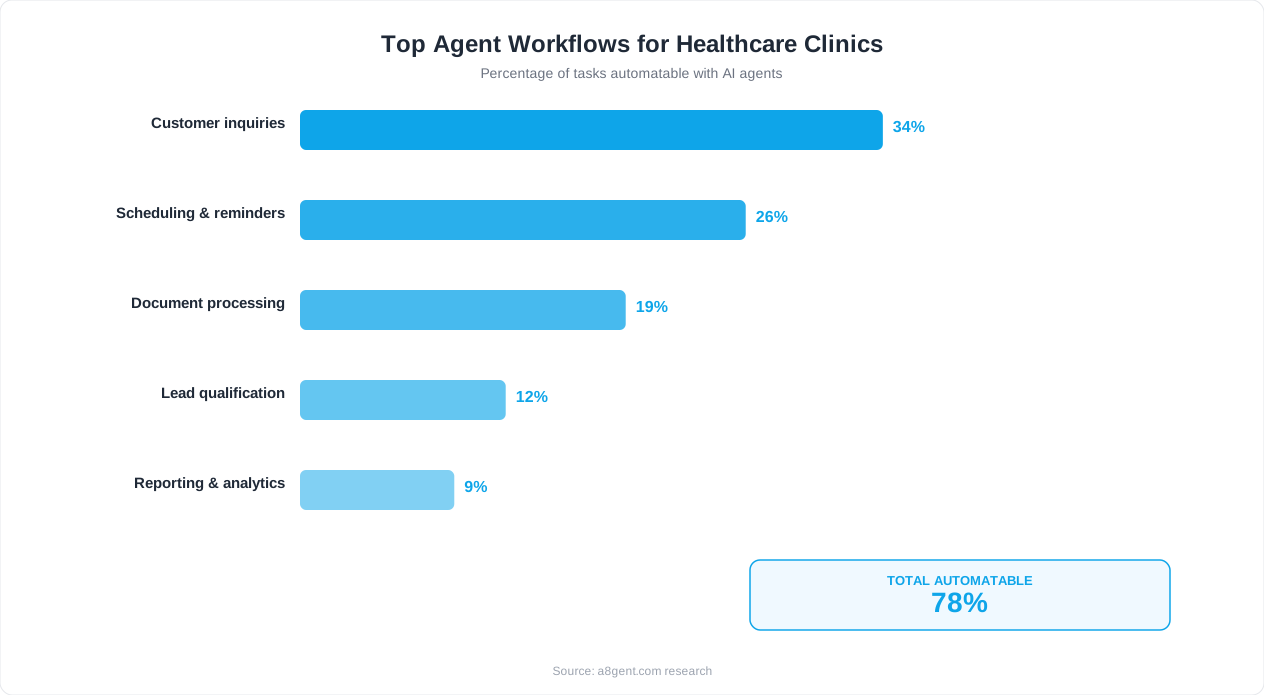
The 24/7 availability is transformative for patient access. Industry data shows that 40% of appointment booking attempts happen outside office hours - evenings, weekends, and early mornings when working patients have time to manage their healthcare logistics. Without AI, these patients encounter voicemail, procrastinate on calling back during business hours, and often delay care. AI scheduling captures these patients immediately, converting intent into booked appointments before the moment passes.
Intelligent slot optimization is where AI scheduling outperforms even experienced human schedulers. The AI maintains awareness of the full schedule and makes real-time decisions that maximize productivity: suggesting a slot that fills a gap between two existing appointments rather than creating isolated bookings, grouping similar appointment types to minimize provider context-switching, and holding premium slots (Monday mornings, for example) for high-value appointment types rather than filling them with routine follow-ups that could go anywhere.
Waitlist management through AI fills last-minute cancellations that would otherwise become empty revenue-zero slots. When a cancellation occurs, the AI immediately contacts waitlisted patients in priority order (by wait time, urgency, and scheduling flexibility), offers the newly available slot, confirms the booking, and updates the schedule - often filling the slot within minutes of the cancellation. Manual waitlist management rarely achieves this speed because staff are busy with other tasks when cancellations arrive.
Autonoly's healthcare scheduling workflows integrate with major EHR and practice management systems (Epic, Athenahealth, eClinicalWorks, DrChrono, NextGen, Kareo) so that AI-scheduled appointments appear in your existing system exactly as if staff had entered them. No parallel systems, no double entry, no workflow disruption for clinical staff.
Reducing No-Shows: From 20% to Under 8%
No-show reduction is the single highest-ROI intervention for most healthcare clinics, and AI makes a 60-70% reduction achievable through intelligent, personalized reminder sequences that go far beyond a generic "Don't forget your appointment" text message. Understanding why patients no-show - and how AI addresses each cause - reveals why the improvement is so dramatic.
Patients miss appointments for several distinct reasons: they genuinely forgot (addressable with reminders), they can't get time off work or find childcare (addressable with rescheduling ease), they feel better and don't think they need the visit (addressable with health education messaging), they're anxious about the visit (addressable with preparation and expectation-setting), or they face transportation or financial barriers (addressable with resource connection). A one-size-fits-all reminder addresses only the first category. AI addresses all of them.
The AI reminder sequence operates over multiple touchpoints: 7 days before the appointment (initial confirmation with easy reschedule option), 3 days before (preparation information specific to the appointment type - fasting requirements, what to bring, what to expect), 24 hours before (final confirmation with one-tap confirm/reschedule/cancel options), and 2 hours before (day-of logistics - parking information, check-in instructions, reminder to arrive 10 minutes early for paperwork). Each message is personalized with the patient's name, provider name, and appointment-specific details.
The reschedule option is critical. Many no-shows aren't patients who don't want to come - they're patients who can't make this specific time but feel guilty about canceling or find the rescheduling process too cumbersome. AI makes rescheduling frictionless: a single tap opens available alternatives, and the swap is completed in seconds. A patient who would have no-showed instead reschedules - preserving the patient relationship and creating an open slot that the waitlist can fill.
For patients who confirm but historically have high no-show rates (AI tracks individual no-show patterns), additional interventions are triggered: same-day morning reminder, offer of transportation assistance information, or direct phone confirmation. These targeted interventions focus intensive efforts on the patients most likely to no-show rather than applying the same approach to everyone.
The financial impact is straightforward to calculate. A clinic with 40 daily appointments and a 20% no-show rate loses 8 appointments per day. At $200 average revenue per visit, that's $1,600 daily or $32,000 monthly. Reducing no-shows to 8% (a realistic target with AI) recovers 4.8 appointments daily - $960/day or $19,200 monthly. Annual impact: approximately $230,000 in recovered revenue from a tool costing $149-399/month. Few investments in healthcare operations deliver this ratio of return to cost.
Explore how Intercom Fin handles patient-facing communications with the conversational quality that healthcare interactions require, or learn about broader communication automation in our AI for customer support guide.
Patient Intake: Digital Forms, Insurance Verification, and Faster Check-ins
The traditional patient intake process is a friction point that frustrates patients and consumes staff time disproportionate to its complexity. Patient arrives, receives a clipboard with 4-8 pages of forms, spends 15-20 minutes completing them in the waiting room, hands them to front desk staff who then spend 5-10 minutes entering the information into the EHR. The entire process takes 20-30 minutes per patient, creates data entry errors, and delays the clinical encounter. For a clinic seeing 40 patients daily, that's 13-20 hours of combined patient and staff time consumed by paper shuffling.
AI-powered digital intake eliminates this entire process. Days before the appointment (triggered by the confirmation sequence), patients receive a link to complete intake forms on their phone or computer. The forms are intelligent: they adapt based on appointment type, skip questions that are already answered in the patient's existing record, pre-fill information from previous visits, and use conversational formatting that feels less clinical than traditional medical forms. Completion rates for digital pre-visit intake reach 70-85% compared to the "show up and fill out paper" approach.
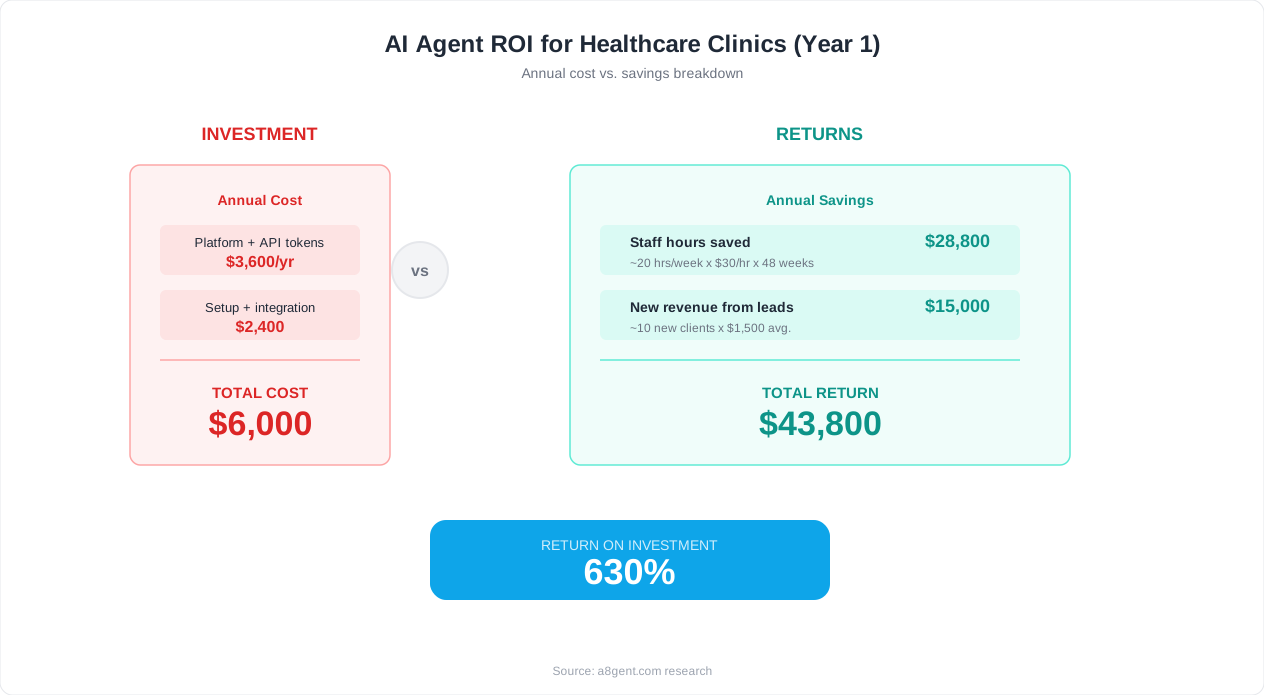
Insurance verification is handled simultaneously and automatically. When the patient submits their insurance information through digital intake, the AI verifies eligibility, confirms benefits relevant to the scheduled service, identifies copay and deductible amounts, and flags any authorization requirements - all before the patient walks through the door. Staff no longer spend time on phone hold with insurance companies for routine verifications. Issues are identified and resolved before the appointment rather than creating billing surprises after services are rendered.
For patients who complete digital intake, the check-in process at the clinic shrinks from 15 minutes to under 3 minutes: confirm identity, verify nothing has changed, collect copay, and proceed to clinical space. This transforms the patient experience from "arrive early, sit with a clipboard" to "arrive on time, walk right back." The improvement in patient satisfaction is immediate and measurable in online reviews and retention rates.
The data quality improvement matters for clinical and billing outcomes. AI-entered data eliminates handwriting interpretation errors, missing fields, and inconsistent formatting that plague paper forms. Structured digital intake ensures complete, accurate information flows into the EHR in the correct fields - reducing downstream billing rejections caused by registration errors and ensuring providers have accurate health history before the clinical encounter begins.
For clinics managing high patient volumes, AI intake also handles consent forms, HIPAA acknowledgments, and practice-specific questionnaires (PHQ-9 for mental health, pain scales, pre-surgical checklists) - delivering completed assessments to providers before they enter the exam room so clinical time is spent on care rather than paperwork. Autonoly provides healthcare-specific intake templates that comply with state and federal requirements while integrating directly with your EHR system.
Ongoing Patient Communication: Follow-ups, Results, and Care Coordination
Healthcare communication extends far beyond appointment scheduling. Patients need post-visit instructions, lab result notifications, medication reminders, referral coordination, preventive care outreach, and answers to health questions that arise between visits. Managing this communication volume manually is what drives healthcare staff burnout - the constant stream of phone calls, messages, and follow-up tasks that never ends.
AI communication agents handle the predictable, routine elements of patient communication while routing complex clinical questions to appropriate providers. Post-visit automated workflows deliver care instructions based on diagnosis and treatment plan, request satisfaction feedback at appropriate intervals, and prompt follow-up scheduling when indicated. Patients receive clear, timely information without waiting for staff to manually send each communication.
Lab result notification is a high-impact automation. Rather than patients calling anxiously for days or staff spending hours returning calls with normal results, AI delivers results through secure patient channels immediately upon provider review and release. Normal results get clear explanation messaging: "Your cholesterol panel came back within normal ranges. No changes to your current plan are needed. Your next lipid check is recommended in 12 months." Abnormal results are handled per provider-configured protocols: immediate provider notification, patient message requesting they schedule a follow-up, or urgent contact depending on severity.
Preventive care outreach ensures patients don't fall through the cracks on routine screenings, vaccinations, and wellness visits. The AI monitors patient records against preventive care guidelines (age-appropriate screenings, immunization schedules, chronic disease management intervals) and proactively reaches out when patients are due or overdue. A 50-year-old who hasn't had a colonoscopy gets an educational message and scheduling prompt. A diabetic patient overdue for their A1C gets a reminder with easy booking. This proactive outreach fills schedule gaps while improving quality metrics that affect reimbursement and accreditation.
Referral coordination - traditionally one of the most frustrating communication breakdowns in healthcare - benefits enormously from AI management. When a provider places a referral, the AI contacts the patient with specialist information, helps schedule the referral appointment, sends relevant records to the receiving practice, and follows up to confirm the appointment was kept. Referral completion rates, which typically hover around 50-70% due to coordination failures, can improve to 80-90% with AI management - directly impacting patient outcomes and downstream revenue from completed referral loops.
Intercom Fin provides healthcare communication capabilities with the conversational quality patients expect, while Autonoly handles the workflow automation connecting communications to EHR actions and scheduling systems. Together, they create a patient communication infrastructure that operates continuously without consuming clinical staff time. Learn more about communication automation strategies in our support and communication guide.
HIPAA Compliance and Data Security: Non-Negotiable Requirements Met
HIPAA compliance isn't optional - it's the baseline requirement for any technology touching patient health information. Clinics rightfully scrutinize AI tools more carefully than they would tools for non-regulated industries. The good news is that healthcare-specific AI platforms in 2026 are designed from the ground up to meet HIPAA requirements, often exceeding the security posture of the legacy systems clinics currently use.
Business Associate Agreements (BAAs) are the foundational legal requirement. Any AI vendor processing protected health information (PHI) must sign a BAA with your practice. Reputable healthcare AI platforms provide standardized BAAs as part of their onboarding process - if a vendor cannot provide a BAA, they cannot be used for patient-related workflows. This is non-negotiable and any platform recommended for healthcare use provides BAA execution during setup.
Technical safeguards required under HIPAA are implemented through: end-to-end encryption for all data in transit (TLS 1.3) and at rest (AES-256), unique user authentication and role-based access controls, automatic session timeouts, audit logging of all access to PHI (who accessed what, when, and why), secure backup and disaster recovery procedures, and penetration testing by independent security firms. These aren't aspirational features - they're verified through SOC 2 Type II audits and HITRUST CSF certification that healthcare AI vendors maintain.
Administrative safeguards include workforce training requirements (vendor staff handling your data receive HIPAA training), incident response procedures (notification protocols if a breach occurs), and regular risk assessments documented and available for your review. Your practice's responsibility is to configure access controls appropriately (limiting which staff members can access what patient information through the AI platform) and to maintain your own HIPAA policies that incorporate AI tool usage.
Data minimization is a principle that well-designed healthcare AI tools follow by default. The AI processes only the minimum PHI necessary for its function - a scheduling agent doesn't need to access clinical notes, a reminder system doesn't need to access lab results. Role-based data access means each AI workflow sees only the information required for its specific purpose, reducing exposure surface even in the unlikely event of a security incident.
For clinics evaluating AI vendors, the security checklist is straightforward: signed BAA, SOC 2 Type II certification, HITRUST CSF certification (preferred), documented data handling procedures, incident response plan, data residency options (US-only processing), and clear data retention and deletion policies. Autonoly maintains all required healthcare compliance certifications and provides compliance documentation packages that satisfy most auditor requirements. The AI readiness assessment includes a security requirements evaluation to ensure any recommended tools meet your practice's specific compliance obligations.
Tools, Pricing, and Your Implementation Plan
The healthcare AI market offers solutions at every price point, from solo practice budgets to multi-location health systems. Here's what's available in 2026 and a practical implementation plan that minimizes disruption while maximizing return.
Solo practice tier ($149-249/month): Covers appointment scheduling, smart reminders (no-show reduction), and basic patient communication. Integration with one EHR/PM system. BAA included. Best for solo providers or 2-provider practices looking to reduce phone call volume and no-show rates. Setup takes 2-3 hours with guided configuration.
Group practice tier ($349-699/month): Comprehensive automation including scheduling, reminders, digital intake, insurance verification, post-visit follow-up, and preventive care outreach. Multi-provider scheduling optimization, waitlist management, and patient satisfaction surveying. Integration with multiple systems. Best for 3-10 provider practices with established patient volumes looking for significant operational leverage.
Enterprise tier ($999-2,499/month): Full-stack clinical operations platform covering all functions plus referral management, multi-location coordination, population health outreach, and advanced analytics. Custom integrations, dedicated support, and implementation assistance. Best for large practices, urgent care networks, and multi-specialty groups with complex scheduling and communication requirements.
Implementation plan for most practices: Start with scheduling and no-show reduction (Week 1-2). These deliver the fastest, most easily measured ROI - you'll see no-show rates drop and appointment fill rates increase within days. Add digital intake (Week 3-4) once scheduling is stable, eliminating paper forms and reducing check-in times. Layer in patient communication automation (Month 2) for post-visit follow-up and preventive care outreach. This phased approach lets your staff adapt gradually and allows you to measure impact at each stage.
The critical success factor is choosing a platform that integrates natively with your existing EHR/PM system. If the AI creates a parallel workflow that staff must manage alongside their current system, adoption will fail. The AI must feed into and read from the same system your team already uses daily. Verify integration depth before committing - surface-level integration (just appointment pushing) is less valuable than deep integration (reading patient records, updating chart notes, triggering workflows based on clinical events).
For clinics currently losing $20,000-30,000 monthly to no-shows alone, even the solo practice tier delivers 10-20x return on investment. Combined with reduced phone call volume (saving 1-2 FTE worth of front desk time) and improved patient satisfaction driving retention and referrals, the financial case for healthcare AI is among the strongest of any industry.
Take the AI readiness assessment for a personalized recommendation based on your practice type, size, current EHR system, and primary operational challenges. Or explore Autonoly's healthcare templates to see specific workflows for your practice specialty - from primary care to dental to behavioral health to specialty practices.
Real-World Impact: What Clinics Are Experiencing
The theoretical benefits of healthcare AI are compelling, but the real-world results reported by clinics that have implemented these tools validate the promise with concrete numbers. Here's what practices across different specialties and sizes are experiencing after 3-6 months of AI implementation.
No-show reduction is the most consistent and dramatic improvement. Clinics implementing AI reminder sequences report no-show rates dropping from their baseline of 18-25% to 5-10% within 4-6 weeks. A family medicine practice with 120 daily appointments reduced no-shows from 22% to 7% - recovering 18 additional appointments per day. At their average reimbursement of $180 per visit, that's $3,240 in daily recovered revenue or approximately $65,000 monthly. Their AI tool costs $399/month - a 163x return on investment from no-show reduction alone.
Phone call volume reduction frees staff capacity for higher-value tasks. Practices report 40-55% reductions in inbound scheduling calls within the first month of AI scheduling deployment. For a practice receiving 120 calls daily, a 45% reduction means 54 fewer calls per day - saving approximately 4.5 hours of staff time at 5 minutes per call. That's more than half an FTE worth of capacity redirected to in-person patient care, complex insurance tasks, and practice development activities.
Patient satisfaction scores improve measurably. Practices track before-and-after satisfaction using post-visit surveys (also AI-automated). Common improvements: 30-40% reduction in complaints about wait times (faster check-in through digital intake), 50-60% reduction in complaints about communication (proactive updates instead of requiring patients to call), and 20-30% increase in "would recommend" scores. These satisfaction improvements drive Google review volume, online reputation, and new patient acquisition.
Staff satisfaction is an underappreciated benefit. Front desk teams consistently report higher job satisfaction when freed from constant phone interruptions. Turnover rates at practices using AI scheduling are 25-35% lower than at comparable practices without automation - a significant cost savings given that replacing and training a front desk employee costs $5,000-$10,000. Staff spend their time on meaningful interactions rather than repetitive phone conversations they could do in their sleep.
Revenue per provider increases through schedule optimization. AI doesn't just fill cancellations - it optimizes the mix of appointment types, duration, and spacing to maximize productivity. Providers report seeing 2-4 additional patients per day without feeling more rushed, because scheduling is better optimized and patient flow through the office is smoother without intake bottlenecks. At $150-300 per visit, that's $300-1,200 in additional daily revenue per provider.
The compounding effect over 6-12 months is significant. Clinics that maintain AI systems and continuously refine their workflows report 15-25% overall revenue increases from the combination of reduced no-shows, increased bookings, better optimization, improved retention, and enhanced reputation driving new patient acquisition. For a practice generating $2 million annually, a 20% improvement represents $400,000 in additional revenue - transformative for practice economics and reinvestment in patient care quality.
FAQ
Are AI scheduling tools HIPAA compliant?
Yes. Healthcare-specific AI scheduling tools are designed to meet HIPAA requirements including signed Business Associate Agreements, end-to-end encryption, audit logging, access controls, and secure data handling procedures. Reputable vendors maintain SOC 2 Type II certification and many hold HITRUST CSF certification. Always verify BAA availability and certification status before selecting a vendor - if they can't provide a BAA, they cannot be used for patient scheduling.
How much does AI scheduling cost for a small clinic?
Solo and small practices (1-3 providers) can implement AI scheduling with smart reminders for $149-249/month. This typically includes appointment booking, confirmation sequences, waitlist management, and basic patient communication. Compare this to the revenue recovered: reducing no-shows from 20% to 8% on 30 daily appointments at $180/visit recovers approximately $650/day or $13,000/month. Most practices achieve positive ROI within the first two weeks of implementation.
Will patients be comfortable interacting with AI for healthcare?
Research shows that 73% of patients prefer digital scheduling options over phone calls, and 68% want text-based reminders and communications from their healthcare providers. For routine interactions (scheduling, reminders, form completion, basic questions), patients generally prefer the speed and convenience of AI over waiting on hold. For clinical questions and sensitive discussions, AI routes to human staff seamlessly. The key is transparency - patients should know when they're interacting with AI versus a human team member.
Does AI scheduling integrate with my EHR system?
Yes. Modern healthcare AI platforms integrate with all major EHR and practice management systems including Epic (via MyChart), Athenahealth, eClinicalWorks, DrChrono, NextGen, Kareo, Practice Fusion, and AdvancedMD. AI-scheduled appointments appear in your existing system exactly as staff-scheduled appointments - same fields, same workflow, same visibility for clinical teams. Integration setup typically takes 30-60 minutes through guided API connection wizards.
How quickly will we see results after implementing AI scheduling?
No-show reduction is visible within the first week as reminder sequences begin reaching patients with upcoming appointments. Most clinics see a measurable drop in no-show rates within 7-10 days. Phone call reduction becomes apparent within 2-3 weeks as patients discover and adopt self-scheduling options. Full steady-state performance - including schedule optimization and waitlist management benefits - typically establishes within 4-6 weeks of implementation.
Can AI handle complex scheduling rules for multiple providers?
Yes. AI scheduling agents manage complex rules including provider-specific availability windows, appointment type duration requirements, equipment and room dependencies, buffer time between procedures, new patient slot allocation, same-day urgent visit handling, and provider absence/vacation management. The AI applies all rules simultaneously when presenting available options to patients - something that's difficult for human schedulers to manage mentally across multiple providers.
What happens when a patient needs to speak with a human?
AI agents are configured with clear escalation paths. When a patient requests a human, expresses distress, asks a clinical question beyond scheduling scope, or triggers any configured escalation condition, the AI transfers immediately to available staff with full conversation context. The staff member sees what the patient already communicated and can continue the interaction without requiring the patient to repeat information. During off-hours, the AI captures the request and routes it for priority human follow-up when the office opens.
Will AI reduce our need for front desk staff?
Most practices don't reduce front desk headcount - they redirect staff capacity. Instead of spending 70% of their time on phone scheduling, staff focus on in-person patient experience, complex insurance tasks, referral coordination, and other activities that require human judgment and empathy. The benefit isn't cost reduction through layoffs; it's capacity expansion without proportional hiring. Practices that are growing can handle 25-40% more patients with existing staff when AI handles routine phone and scheduling tasks.