AI Agents for Fitness Studios and Gyms: Automate Bookings and Retention (2026)
Discover how AI agents help fitness studios and gyms automate class bookings, reduce no-shows by 40%, improve member retention, and save 20-30 hours per week on administrative tasks.
10+ years shipping production ML across TensorFlow, PyTorch, AWS, and GCP. Ships every A8gent agent before it becomes a lesson. GitHub
- AI agents reduce fitness studio no-show rates by 35-45% through intelligent reminder sequences that adapt based on each member's history - sending reminders at optimal times via their preferred communication channel and offering easy reschedule options instead of just cancellation.
- Automating class bookings, waitlist management, and schedule changes with AI saves fitness studios 20-30 hours per week in front-desk administrative time - time that can be redirected to member experience, sales, or personal training consultations.
- Member retention improves by 15-25% when AI agents proactively reach out to members showing disengagement patterns (fewer visits, skipped classes, expired packages) with personalized re-engagement messages before they cancel - catching at-risk members weeks before traditional methods would notice.
- AI-powered conversational booking allows members to schedule classes, personal training sessions, and facility rentals through natural text message or web chat conversations at any hour - eliminating phone tag during business hours and capturing bookings that would otherwise be lost to inconvenience.
- Fitness studios deploying AI agents typically see full ROI within 10-14 days through the combination of reduced no-shows (recovered revenue), increased bookings (24/7 availability), and labor savings (fewer front-desk hours needed for routine scheduling tasks).
Why Fitness Studios Are Adopting AI Agents in 2026
Running a fitness studio or gym in 2026 means juggling a brutal combination of tasks that never stop: managing class schedules across multiple instructors, handling hundreds of booking requests per week, chasing no-shows, processing membership changes, answering the same questions about hours and pricing dozens of times per day, trying to re-engage members who are slipping away, and somehow also delivering the outstanding fitness experience that keeps people coming back.
Most studio owners and managers did not get into this business to spend their days on administrative logistics. They got into it because they love fitness, community, and helping people transform their lives. Yet the administrative burden consumes 25-40% of total operating hours in a typical studio - hours spent on tasks that are repetitive, rules-based, and frankly beneath the talent level of the people doing them.
AI agents eliminate that burden. Not partially. Not eventually. Right now, in 2026, AI agents handle class bookings conversationally through text and chat, send intelligent reminders that actually reduce no-shows (by 35-45%), manage waitlists automatically when spots open, re-engage at-risk members before they cancel, answer FAQ questions 24/7 without anyone touching the phone, and process schedule changes without a single manual entry. All of it happens in the background while your team focuses on what they do best: coaching, motivating, and creating community.
The studios that have adopted AI are not just saving time. They are outcompeting neighboring facilities that still require members to call during business hours, still lose revenue to no-shows, and still let at-risk members drift away unnoticed until the cancellation email arrives. When your competitor's studio responds to a booking inquiry at 10 PM in 30 seconds while yours waits until tomorrow morning, guess who gets the new member.
This guide covers everything a fitness studio owner needs to know about AI agents: which specific tasks to automate, how the technology works without any technical jargon, which platforms serve studios best, how much it costs compared to what it saves, and how to get started this week without disrupting your current operations.
If you want a quick assessment of which areas in your studio would benefit most from AI automation, take our free business assessment. It evaluates your current operations, class volume, and member count to recommend specific automation opportunities with projected savings. Now, let us explore what is possible.
Automating Class Bookings and Schedule Management
Booking management is the highest-volume administrative task in any fitness studio. Between new bookings, cancellations, reschedules, waitlist management, and schedule inquiries, a busy studio processes 200-500 booking-related interactions per week. Here is how AI agents handle each one without human intervention.
Conversational Booking
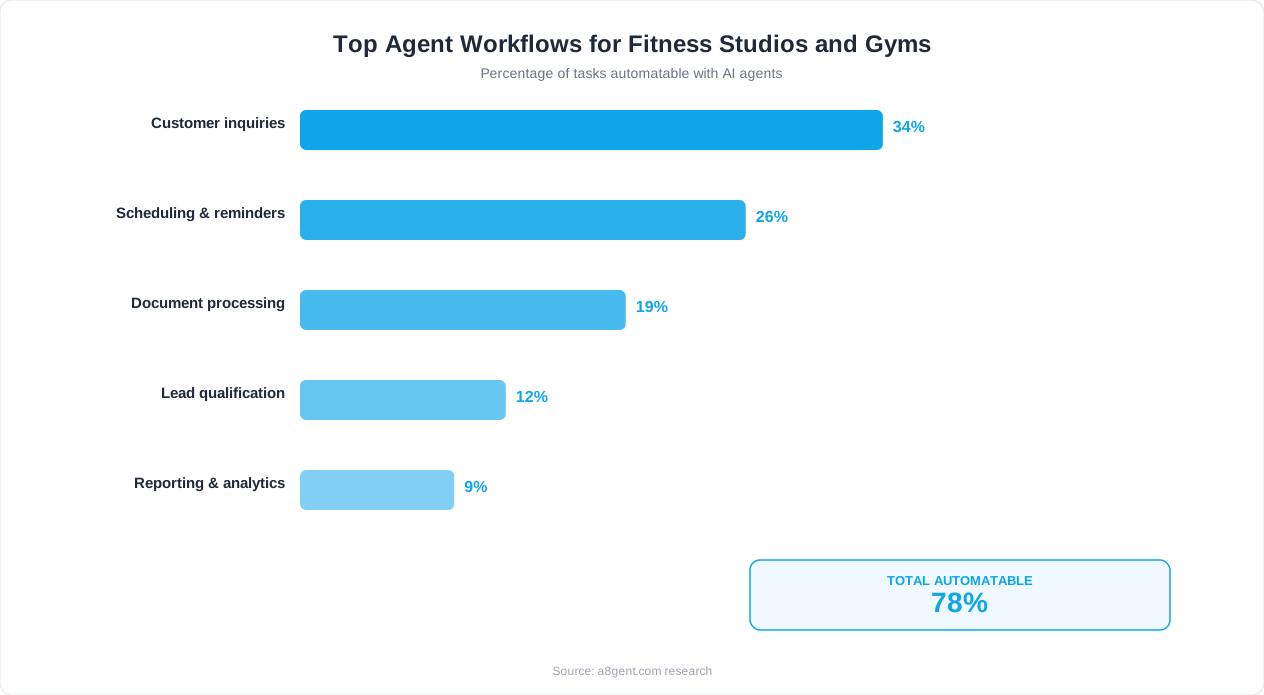
Instead of requiring members to log into an app, navigate a schedule grid, and select a class - or worse, call during business hours - AI agents let members book through natural conversation. A member texts "Can I get into the 6 AM spin class tomorrow?" and the AI responds: "You are confirmed for 6 AM Spin with Sarah tomorrow, Thursday. Your spot is reserved - see you there!" If the class is full: "The 6 AM Spin is currently full, but I have put you first on the waitlist. Would you like me to book you into the 7 AM Spin instead, or notify you if a spot opens?" This conversational approach removes all friction from booking. Members do not need to remember passwords, navigate interfaces, or wait for business hours. They simply ask for what they want and get it.
Intelligent Waitlist Management
When a member cancels a popular class, the AI immediately contacts the next person on the waitlist - via their preferred channel (text, email, or app notification). If that person does not respond within 30 minutes, it moves to the next person. No spots go unfilled because someone forgot to check their waitlist status. No staff member needs to make calls or send messages. The process happens automatically within minutes of a cancellation, maximizing class utilization and revenue.
Schedule Change Communication
When an instructor calls in sick or a class needs to be moved, the AI notifies all affected members immediately - not just with a generic announcement, but with personalized messages that include alternative options. "Hi Marcus, tomorrow's 5:30 PM Yoga with Jennifer is cancelled due to instructor illness. I can book you into 5:30 PM Yoga with David instead, or move you to Thursday's 5:30 PM with Jennifer. Which do you prefer?" This proactive communication prevents confusion, reduces frustrated phone calls, and demonstrates care for each member's schedule.
Multi-Location and Multi-Instructor Scheduling
For studios with multiple locations or instructors with varying availability, the AI manages complex scheduling logic that would take a human significant time. It knows instructor availability, room capacities, equipment needs, and member preferences - then handles bookings, conflicts, and changes across the entire operation without anyone creating spreadsheets or manually checking calendars. Members experience a simple "I want to take yoga Thursday evening" interaction while the AI handles all the complexity behind the scenes.
New Member Onboarding Bookings
When a new member joins, the AI guides them through their first bookings conversationally: recommending classes based on their stated goals and experience level, suggesting optimal class times based on their availability, and booking their first week of sessions with a personalized welcome. This guided booking experience increases first-week attendance (a critical retention factor) by 40-60% compared to leaving new members to figure out the schedule themselves.
Platforms like Autonoly and Lindy integrate with popular fitness scheduling systems (Mindbody, Glofox, ClubReady, Zen Planner) to manage bookings without requiring you to switch software. The AI connects to your existing system, reads availability, and processes bookings through the same backend - you just get a much more intelligent and accessible front-end for your members.
Reducing No-Shows by 35-45% With Intelligent Reminders
No-shows are the silent revenue killer in fitness studios. A class with 20 spots that averages 4 no-shows per session is losing 20% of its capacity value. At 15 classes per week, that is 60 lost spots weekly - spots that could have been filled from the waitlist if cancellations happened in advance. AI agents dramatically reduce no-shows through intelligent reminder systems that go far beyond a generic "reminder: you have class tomorrow" message.
Why Traditional Reminders Fail
A single reminder 24 hours before class reduces no-shows by only 10-15%. Why? Because the reminder arrives at a random time (when the person might be busy), on a channel they might not check, with a message that gives them no motivation to actually show up or easy option to reschedule. People ignore generic reminders. They do not ignore messages that feel personal and make it easy to take action.
How AI Reminders Work Differently
AI agents send reminders that are personalized, timed, and actionable. Timing optimization: the AI learns when each member is most likely to read and respond to messages. Early morning for some, lunch break for others, evening for the rest. It sends reminders when they will actually be seen and processed. Channel preference: some members respond to texts, others to app notifications, others to email. The AI identifies the channel with the highest engagement for each individual and prioritizes it. Personalization: "Hey Anna, you are in tomorrow's 6 AM HIIT - that will be your 3rd class this week, nice momentum! See you there?" feels very different from "Reminder: HIIT Class tomorrow at 6:00 AM." The personal touch creates psychological commitment that generic messages cannot.
The Two-Touch Reminder System
The most effective AI reminder pattern uses two touchpoints: one strategic reminder 18-24 hours before class (when there is still time to fill the spot if they cancel) and one motivational nudge 2-3 hours before (when they are deciding whether to actually get up and go). The first reminder focuses on logistics and easy rescheduling: "Confirmed for 6 AM HIIT tomorrow. If plans changed, just reply 'cancel' and I will free up your spot." The second reminder focuses on motivation: "Your HIIT class starts in 2 hours! Get that water bottle ready - Coach Mike has a great playlist lined up today." This two-touch approach addresses both logistical no-shows (people who forgot) and motivational no-shows (people who are on the fence).
Predictive No-Show Identification
AI agents identify members likely to no-show before it happens based on patterns: members who typically cancel same-day, members who have not checked in at the studio recently, members who booked during a time they rarely attend, or members who booked multiple classes in one day (often indicating aspirational over-booking). The AI sends these at-risk members an earlier, gentler check-in: "Hey, saw you are booked for 5:30 Power Yoga tomorrow - still planning to make it? If not, no worries, just let me know so I can open the spot for the waitlist." This preemptive approach converts many would-be no-shows into advance cancellations - preserving the member relationship while freeing the spot for someone who will use it.
Easy Cancellation and Rescheduling
Paradoxically, making it easier to cancel reduces no-shows. When the barrier to cancel is high (calling during business hours, navigating an app), people choose the path of least resistance: simply not showing up. When the AI makes cancellation a one-word text reply ("cancel") and immediately offers a reschedule option ("No problem! Want me to book you into Thursday's class instead?"), people cancel in advance rather than ghosting. Advance cancellations are not lost revenue - they are opportunities to fill spots from the waitlist. No-shows are lost revenue permanently.
The Revenue Impact
Let us calculate: a studio running 20 classes per week with an average of 3 no-shows per class loses 60 spots weekly. At an average per-class rate of $25, that is $1,500/week in lost utilization. Reducing no-shows by 40% recovers 24 of those spots weekly - $600/week or $2,400/month in recovered revenue from a combination of advance cancellations (allowing waitlist fills) and motivation-driven attendance increases. Against an AI agent cost of $99-$249/month, the ROI is 860-2,300%. This alone justifies the investment, and it is just one of many ways the AI adds value.
Proactive Member Retention: Catching At-Risk Members Before They Cancel
Acquiring a new gym member costs 5-10x more than retaining an existing one. Yet most fitness studios have no system for identifying and re-engaging members who are drifting toward cancellation - they only notice when the cancellation email arrives, by which point it is too late. AI agents change this by monitoring engagement patterns and intervening early, when the member can still be saved.
Identifying Disengagement Patterns
The AI continuously monitors each member's behavior and compares it to their personal baseline. A member who normally visits 4 times per week dropping to 2 visits is flagged. A member who always attended Tuesday evening classes suddenly missing three in a row is noticed. A member whose package is expiring without renewal activity is identified. A member who stopped opening emails and booking classes is highlighted. These are not arbitrary thresholds - the AI learns each member's normal pattern and detects meaningful deviations from it. A twice-per-week member dropping to once is concerning. A five-times-per-week member dropping to three might just be a busy week.
Personalized Re-Engagement Outreach
When the AI identifies an at-risk member, it reaches out with a message tailored to their situation - not a generic "we miss you!" blast that feels impersonal and desperate. For someone who missed their regular class: "Hey Taylor, noticed you have not been in for Tuesday yoga in a couple weeks. Everything okay? Schedule change? I can help you find a different time that works better if your Tuesdays got busy." For someone with declining frequency: "Hi Jordan, you crushed it last month with 16 visits! This month's at 4 so far - want me to book your usual slots for the rest of the week so they are locked in?" These messages feel like a caring check-in from someone who knows them, not a mass marketing automation.
Win-Back Before Cancellation
For members showing strong cancellation signals (no visits in 2+ weeks, expired packages, engagement score dropping rapidly), the AI escalates its approach - but still keeps it personal and respectful. It might offer a free class to come back and try, suggest a schedule change or class type change if their needs have evolved, or invite them to a community event that might re-spark their connection to the studio. The AI can also flag these high-risk members for a personal call from the studio manager - sometimes a genuine human conversation is what turns things around, and the AI ensures that call happens before it is too late rather than weeks after the cancellation.
Milestone and Achievement Recognition
Retention is not just about preventing negatives - it is about celebrating positives. AI agents track member milestones and send recognition messages automatically: "100th class today, amazing commitment!" or "6-month anniversary with us - and you have not missed a single week. Incredible." or "You have tried 8 different class types this month - love the variety!" These recognition moments create emotional connection to the studio and make members feel seen and valued. They cost nothing to send but contribute significantly to the sense of community that keeps members renewing month after month.
Referral Prompting at Peak Satisfaction
The AI identifies moments of peak member satisfaction - after completing a challenge, hitting a fitness milestone, or during a period of high attendance frequency - and prompts referrals at these optimal moments. "You have been on fire this month - 12 classes! Know anyone who would love this energy? Share your referral link and you both get a free week." Referral prompts at peak satisfaction convert 3-5x higher than random referral requests because the member is genuinely enthusiastic about their experience at that moment.
Retention Data and Insights
Beyond individual interventions, the AI provides studio owners with retention insights: which class types correlate with highest retention, which time slots have the most at-risk members, which instructors drive the strongest member loyalty, and which onboarding patterns predict long-term membership. These insights inform business decisions - scheduling, instructor development, marketing - that improve retention at the structural level rather than just the individual outreach level. For support-related issues that arise from at-risk member conversations, explore how AI handles those interactions through our support use case examples.
24/7 Member Communication and FAQ Handling
Fitness studios receive a predictable set of questions dozens of times per day: What time does the studio open? How do I cancel my membership? What should I bring to my first class? Do you offer a free trial? How much are personal training sessions? Where do I park? What is your cancellation policy for classes? Is there a shower? Can I freeze my membership while I travel? These questions deserve good answers - but they do not require a human to answer them for the hundredth time.
Instant Answers at Any Hour
AI agents respond to these common questions immediately, 24/7, through whatever channel the member (or prospective member) chooses - text message, website chat, Instagram DM, Facebook Messenger, or email. A prospect browsing your website at 11 PM who asks "how much is membership?" gets an instant, helpful response instead of a form to fill out and wait for a callback. That instant response converts significantly better than "we will get back to you during business hours" - because the person's interest is at its peak right now, and by tomorrow they may have found another studio that answered immediately.
New Member Inquiry Handling
Prospective members asking about pricing, class types, trial offers, and membership options represent your highest-value conversations. The AI handles these inquiries conversationally: asking about their fitness goals, recommending appropriate membership types, explaining class offerings relevant to their interests, and guiding them toward a trial visit or sign-up. It answers objections naturally ("Is it okay if I am a beginner?" - "Absolutely! Our fundamentals classes are designed specifically for beginners, and our coaches modify every exercise to your level.") and provides the personal attention that converts inquiries into memberships without requiring a staff member to be available at every moment.
Membership Management Conversations
Current members frequently need to manage their memberships: pause during vacation, downgrade or upgrade, update payment methods, or understand their billing. AI agents handle these conversations directly - processing holds, explaining options, and making changes in your management system - without requiring staff intervention. For a studio with 500 members, these administrative conversations can consume 10-15 hours per week of front desk time. The AI handles them in seconds, at any hour, without any attitude or frustration regardless of how many times the same question gets asked.
Class Information and Recommendations
Members exploring new class types want information: What is the intensity level? Do I need specific equipment? Is it suitable for someone with a knee issue? How long is it? What should I eat beforehand? AI agents answer these questions using your studio's specific class descriptions, instructor specialties, and frequently asked questions. They can even make personalized recommendations: "Based on your goals (building core strength) and your schedule (available evenings), I would recommend our Tuesday and Thursday Power Pilates classes with Sarah - they focus heavily on core and accommodate all fitness levels."
Multi-Language Support
For studios in diverse communities, AI agents communicate fluently in multiple languages without requiring multilingual staff. A member or prospect can write in Spanish, Mandarin, Portuguese, or any other common language and receive a natural, accurate response in that language. This removes a significant barrier for non-English-speaking community members who might otherwise feel unable to engage with your studio - expanding your addressable market without adding language-specific staff.
After-Hours Lead Capture
Research shows that 40-60% of fitness membership inquiries happen outside business hours - evenings, weekends, and early mornings when people are thinking about their health goals. Without AI, these inquiries wait in a queue until the next business day. By then, the prospect has cooled off or found another option. With AI, every after-hours inquiry gets an immediate, engaging response that guides the person toward booking a trial or visiting the studio. Studios report capturing 30-50% more new member leads simply from being available to respond when prospects are actually motivated to reach out.
Getting Started: Implementation Guide for Fitness Studios
Here is a practical, step-by-step guide for implementing AI agents in your fitness studio. You do not need technical skills, and the process can be completed in one focused afternoon with full results visible within the first week.
Step 1: Choose Your Starting Point (30 minutes)
Do not try to automate everything at once. Pick one high-impact area to start with. For most studios, the highest-ROI starting point is one of three options: booking and reminder automation (if no-shows are your biggest pain), new member inquiry handling (if lead conversion is your priority), or member retention outreach (if churn is your primary concern). Pick the one that would save you the most money or time this month and start there. You will add the others within 2-4 weeks once the first is running smoothly.
Step 2: Connect Your Systems (1-2 hours)
Connect your AI agent platform to your existing tools. Most platforms integrate directly with popular fitness management systems - Mindbody, Glofox, Zen Planner, ClubReady, and Gymdesk. The connection typically requires: logging into both platforms, authorizing the integration, mapping your data fields (classes, members, schedules), and testing with a sample booking. Also connect your communication channels: business phone number for SMS, website chat widget installation (usually one line of code that your website platform supports natively), and social media accounts if you want to handle DMs automatically.
Step 3: Configure Your AI's Knowledge Base (1-2 hours)
Give your AI agent the information it needs to answer questions accurately. Upload or input: your class schedule and descriptions, pricing and membership options, studio policies (cancellation, freeze, late arrival), frequently asked questions with approved answers, instructor bios and specialties, location and parking information, and trial/promotional offers currently active. The more complete this knowledge base, the more conversations the AI handles without needing human help. You can always add to it over time as new questions come up.
Step 4: Set Up Your Reminder Sequence (30-45 minutes)
Configure when and how reminders are sent. Recommended starting configuration: first reminder 18-24 hours before class (include easy cancel/reschedule option), second reminder 2-3 hours before class (motivational and logistical - "grab your mat and water bottle!"), and a waitlist notification immediately when a spot opens (with 30-minute acceptance window). Set the AI to learn member preferences over the first two weeks - it will optimize timing and channel automatically based on who responds to what.
Step 5: Test With Your Team (1 hour)
Before going live with members, have your team test every scenario: book a class via text, cancel via chat, ask common questions, simulate a new member inquiry, and trigger a reminder sequence. Check that responses sound natural, information is accurate, and the experience feels smooth. Fix anything that seems off. This testing phase prevents embarrassing errors once real members start interacting with the system.
Step 6: Soft Launch With Members (Week 1)
Announce the new booking/communication option to members gradually. Start by mentioning it to members at the front desk: "You can now book classes just by texting us - try it!" Add a note to your email newsletter and social media. Do not turn off human availability yet - let the AI handle what it can while your team monitors and reviews interactions. This overlap period builds your confidence in the system before relying on it fully.
Step 7: Monitor and Expand (Weeks 2-4)
After one week of live operation, review the AI's performance: how many interactions it handled, what percentage required human escalation, whether any responses were inaccurate, and what new questions came up that need adding to the knowledge base. Refine as needed, then add your second automation focus area. By week 4, most studios have booking, reminders, and FAQ handling running automatically with retention outreach launching shortly after.
For a platform recommendation tailored to your studio's size, scheduling software, and specific automation needs, use our free assessment tool. It recommends the best platform and configuration based on your answers about class volume, member count, and current tech stack.
Investment and Returns: What AI Costs a Fitness Studio
Let us talk numbers. Here is an honest breakdown of what AI agents cost for fitness studios and what you can expect in return. These figures are based on typical studios with 200-800 active members and 15-30 weekly classes.
Monthly Investment
AI agent platform subscription: $99-$249/month depending on member count and features. Most studios start with a basic plan ($99-Free-$149/month) that covers booking automation, reminders, and FAQ handling. Advanced plans ($199-$249/month) add retention analytics, multi-location support, and advanced personalization. Some platforms charge per-message above certain volumes, but most fitness studios stay well within included limits. Additional costs might include: SMS messaging fees ($0.01-$0.03 per message if not included in your plan) and integration middleware if your scheduling platform needs a Zapier/Make bridge ($20-Free-Free-$49/month). Total typical investment: $99-$299/month for a single-location studio.
Time Savings (Monthly)
Front desk booking management: 12-18 hours/month saved (booking, cancellation, and waitlist inquiries handled automatically). Reminder calls and texts: 8-12 hours/month saved (automated intelligent reminders replace manual outreach). FAQ and inquiry responses: 10-15 hours/month saved (common questions answered instantly without staff). Schedule change communication: 3-5 hours/month saved (affected members notified automatically). Member retention outreach: 5-8 hours/month saved (at-risk members identified and contacted without manual monitoring). Total typical time savings: 38-58 hours/month - equivalent to roughly one part-time front desk employee.
Revenue Impact (Monthly)
No-show reduction (35-45% fewer no-shows): For a studio losing 60 spots per week to no-shows at $25 average value, recovering 40% means 24 recovered spots weekly = $2,400/month in recovered utilization. After-hours lead conversion (30-50% more inquiries converted): If you receive 20 after-hours inquiries monthly and convert 5 additional ones to $150/month memberships = $750/month in new recurring revenue. Member retention improvement (15-25% reduction in cancellations): For a studio with 5% monthly churn on 400 members at $120/month average, reducing cancellations by 20% saves 4 members/month = $480/month in retained revenue (cumulative - this compounds every month). Total typical monthly revenue impact: $3,630+ in recovered or new revenue.
Net ROI Calculation
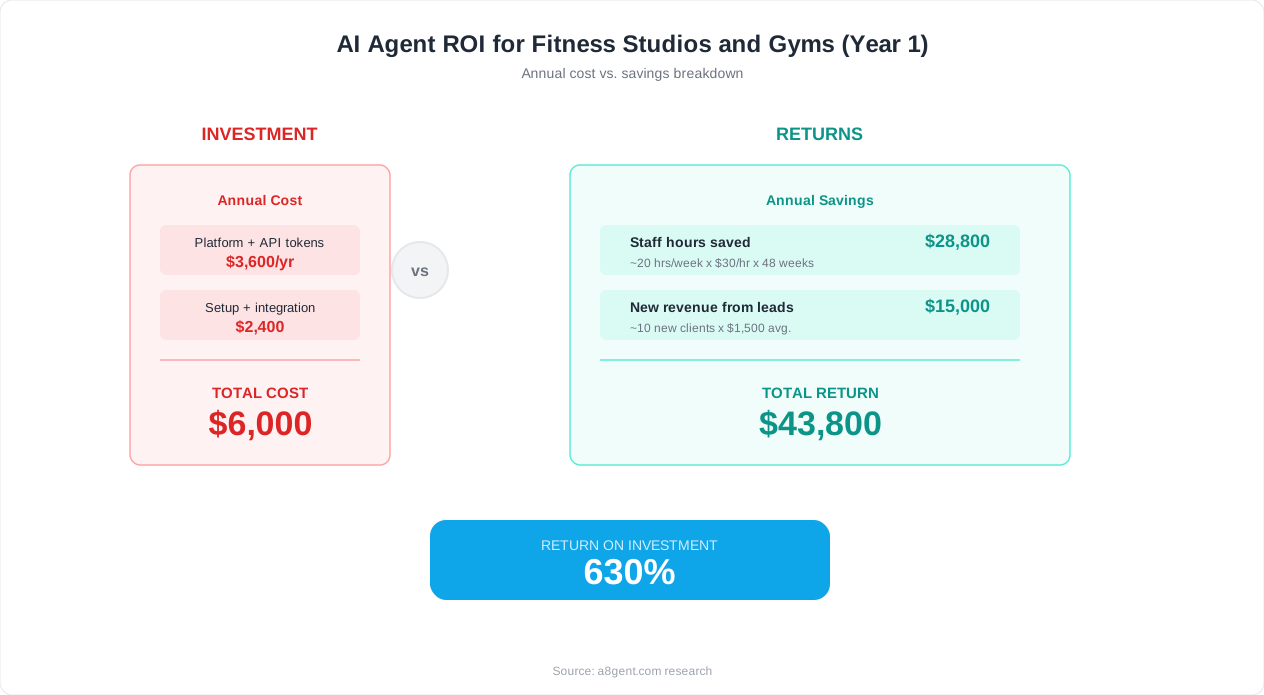
Monthly value created: $3,630 (revenue impact) + $1,140-$1,740 (time savings valued at $30/hour) = $4,770-$5,370/month. Monthly investment: $99-$299. Net monthly return: $4,471-$5,271. ROI: 1,500-5,300%. Payback period: 2-3 days (yes, days - the revenue impact from reduced no-shows alone covers the monthly cost within the first week).
Comparison to Alternatives
Hiring a part-time front desk person for the hours saved: $1,500-$2,500/month (and they cannot work 24/7, do not reduce no-shows through intelligent reminders, and cannot simultaneously handle unlimited concurrent conversations). Hiring a retention specialist: $3,000-$4,500/month (for one person who cannot monitor all members continuously and takes vacations). Using only manual processes: $0 direct cost but $3,630+/month in lost revenue and $1,140-$1,740/month in inefficient labor - total cost of inaction: $4,770-$5,370/month. The AI agent at $99-$299/month is not just the cheapest option - it is the most capable option for the specific tasks it handles.
Scaling Economics
As your studio grows (adding members, classes, or locations), the AI agent cost stays relatively flat while the value delivered scales proportionally. A studio growing from 400 to 800 members does not pay double for AI - the same subscription handles double the volume. This means your ROI improves as you grow, making AI agents the most scalable investment in your operational stack. The economics only become more favorable over time.
Beyond Bookings: Creative Uses of AI Agents in Fitness Businesses
Booking and retention are the bread and butter, but innovative studios are finding additional ways to use AI agents that create competitive advantages and member experiences their competitors cannot match.
Personalized Workout Recommendations
AI agents can learn each member's goals, preferences, history, and limitations - then proactively suggest classes, workshops, or training options aligned with their specific journey. "Based on your goal of running a 5K this fall and your current love of HIIT classes, you might want to try our Thursday Running Endurance class - it builds the exact cardio base you need." These recommendations feel like having a knowledgeable friend at the studio who remembers everything about you. They also drive class attendance by matching members with sessions they will genuinely enjoy and benefit from.
Challenge and Program Management
Studios that run member challenges (30-day attendance streaks, strength milestones, nutrition tracking) can use AI agents to manage the entire experience: sending daily check-ins, tracking progress, providing encouragement, answering questions about the challenge rules, and celebrating completions. This level of daily personalized engagement during a challenge would require dedicated staff time that most studios cannot afford. The AI makes high-touch challenge experiences scalable - and challenges are proven retention powerhouses that keep members engaged for months after completion.
Instructor Feedback Collection
After class, the AI can reach out to attendees for brief feedback: "How was today's HIIT with Coach Mike? Quick 1-5 rating?" followed by a one-question follow-up for low or high ratings. This constant stream of feedback helps you identify instructor issues early, recognize outstanding performance, and understand what your members actually value - without requiring manual survey management or chasing responses. Response rates to conversational AI requests are 3-4x higher than email surveys because the interaction is brief, timely, and feels natural.
Personal Training Sales and Scheduling
AI agents can identify members who might benefit from personal training (based on goals expressed in conversation, class attendance patterns, or direct inquiries) and introduce the option naturally: "I noticed you have been asking about form in your HIIT classes - our trainers offer one-on-one sessions that really help nail technique. Want me to tell you about options?" When a member expresses interest, the AI handles the entire scheduling conversation: showing trainer availability, explaining packages, booking a consultation, and confirming appointments. This turns personal training from a hard sell into a natural conversation, and studios report 20-40% increases in PT bookings when AI handles the discovery and scheduling.
Community Event Promotion
Workshops, social events, themed classes, and community gatherings drive retention but are hard to promote effectively. AI agents can identify which members would be most interested in specific events based on their preferences and history, then personally invite them through conversation. "Hey Alex, we are running a Saturday morning Yoga and Brunch event this weekend - right up your alley since you never miss a Saturday yoga class. Interested? I can save you a spot." This targeted, personal promotion fills events faster than mass emails and makes members feel individually valued rather than mass-marketed.
Nutrition and Wellness Support
For studios offering holistic wellness services (nutrition coaching, recovery sessions, supplements), AI agents can provide basic guidance and product recommendations between appointments. A member asking "what should I eat before a morning class?" gets an instant, helpful answer rather than waiting for their next nutrition appointment. This positions your studio as a comprehensive wellness resource and drives additional service revenue from members who discover offerings through natural conversation rather than hard promotion.
Staff Communication and Scheduling
AI agents are not just for member-facing tasks. Studios use them internally for: managing instructor substitute requests (AI finds available subs based on certification and availability), communicating schedule changes to staff, collecting and distributing class attendance data, and handling routine staff questions about policies, payroll dates, and procedures. This internal use saves managers 3-5 hours per week on team communication and coordination - time better spent on strategy, member experience, and business growth.
FAQ
What gym management systems do AI agents integrate with?
Most AI agent platforms integrate directly with popular fitness management systems including Mindbody, Glofox, Zen Planner, ClubReady, Gymdesk, WellnessLiving, and Mariana Tek. Integration typically takes 15-30 minutes through OAuth connections or API keys. If your specific system is not directly supported, middleware tools like Zapier or Make can bridge the connection. The AI reads your class schedules, member data, and booking status from your existing system - you do not need to switch software or re-enter data.
Will members find it impersonal to interact with an AI instead of a real person?
Research shows that 78% of fitness members prefer the convenience of instant text-based communication over calling or waiting for front desk availability. When properly configured with a warm, personalized tone that reflects your studio's personality, most members do not realize (or care) that they are interacting with AI - they just appreciate the instant response and easy booking experience. For members who prefer human interaction, the AI can always transfer them to a team member. The key is that AI handles routine requests instantly while humans are available for relationship-building and complex situations.
How long does it take to set up AI agents for a fitness studio?
Most studios can have a basic AI agent running within 3-4 hours of focused setup. This includes connecting your scheduling system, configuring the knowledge base with your studio information, setting up reminder sequences, and testing the booking flow. More complex setups involving retention programs, multi-location coordination, or advanced personalization might take 1-2 additional sessions. Many studio owners complete the initial setup in a single afternoon and then refine over the first 1-2 weeks based on real member interactions.
What if the AI makes a booking mistake or gives wrong information?
AI agents are configured with your actual schedule data and studio information, so errors are rare (under 2% for well-configured systems). However, safeguards include: confirmation messages for every booking that members can easily correct, daily reconciliation between the AI's actions and your scheduling system, ability for staff to override or correct any AI action, and escalation to humans when the AI is uncertain. Most 'mistakes' come from outdated information in the knowledge base rather than AI errors - keeping your schedule and policies current prevents the majority of issues.
Can AI agents help with membership sales and closing new members?
Yes - AI agents handle the entire inquiry-to-trial pipeline: answering questions about membership options, explaining pricing and what is included, overcoming common objections conversationally, scheduling trial classes or studio tours, and following up after the trial to guide toward sign-up. They cannot replicate the warmth of an in-person studio tour, but they excel at ensuring every inquiry gets a fast, thorough response and no prospective member falls through the cracks between initial interest and first visit. Studios report 25-40% increases in inquiry-to-trial conversion when AI handles the initial engagement.
How does AI reduce no-shows differently from regular reminder texts?
Regular reminder texts are one-size-fits-all: same message, same time, same channel for everyone. AI reminders are individualized: sent at the time each member is most responsive, via their preferred channel, with personalized content that creates psychological commitment, and including easy one-tap reschedule options. The AI also identifies likely no-shows proactively based on behavioral patterns and intervenes earlier with different messaging. This intelligent approach achieves 35-45% no-show reduction compared to 10-15% from generic reminders - a 3x improvement from the same basic concept, executed intelligently.
Is AI suitable for small studios with fewer than 100 members?
Absolutely. Smaller studios often see proportionally higher ROI because the owner or a single staff member is handling all administrative tasks. A studio with 75 members might save the owner 15-20 hours per week - hours that can be redirected to growing the business, improving programming, or simply enjoying work-life balance. At $99/month for the AI agent, even recovering 3-4 no-shows per month pays for the service. The technology scales down effectively because the per-member value remains consistent regardless of total studio size.
Can AI handle multiple class types and different booking rules?
Yes - AI agents handle complex scheduling logic including: different capacity limits per class type, prerequisite requirements (must complete Fundamentals before Advanced), equipment reservation for specific classes, different cancellation policies by class type, instructor-specific availability, membership-tier access restrictions, and package-based booking limits. You configure these rules once and the AI enforces them consistently - actually more reliably than human front desk staff who might forget an edge case or make exceptions inconsistently. The AI applies your rules perfectly every single time.