AI Agents for Restaurants: Orders, Reservations and Reviews (2026)
Discover how AI agents help restaurants automate order management, reservation handling, and review responses. A practical guide for restaurant owners covering tools, costs, and implementation without technical skills.
10+ years shipping production ML across TensorFlow, PyTorch, AWS, and GCP. Ships every A8gent agent before it becomes a lesson. GitHub
- Restaurants lose 15-25% of phone orders to missed calls during peak hours - AI phone and chat agents capture every order 24/7, increasing revenue by $2,000-8,000 monthly for a typical single-location restaurant.
- AI reservation management reduces no-shows by 30-45% through smart confirmation sequences, waitlist optimization, and dynamic booking rules that maximize table turnover without overbooking.
- Responding to online reviews within 24 hours increases repeat visit likelihood by 33% - AI agents craft personalized, on-brand responses to every review across all platforms in minutes rather than hours.
- Modern restaurant AI tools start at $79/month and require no technical skills, POS integration typically takes under an hour, and most owners see measurable results within the first two weeks.
- AI handles the operational tasks that consume 10-15 hours of manager time weekly - freeing leadership to focus on food quality, team development, and guest experience.
Why Restaurants Are Embracing AI Agents in 2026
Running a restaurant has always been one of the most operationally demanding businesses. But 2026 brings a specific set of pressures that make AI adoption not just beneficial but increasingly necessary for survival. Labor costs continue rising, with full-service restaurants now spending 35-40% of revenue on wages - up from 30% just three years ago. Customer expectations for instant digital interaction have skyrocketed. And the margin environment remains brutal: the average independent restaurant operates on 3-9% net profit margins where every inefficiency directly threatens viability.
The daily reality for a restaurant owner or manager looks like this: answering 40-80 phone calls per day (many during the lunch and dinner rushes when you can least afford the distraction), managing 20-50 reservation modifications, responding to the 3-7 new reviews that appeared overnight across Google, Yelp, and TripAdvisor, coordinating delivery platform orders from 3-4 different tablets, fielding questions about allergens, hours, and specials through text and social media DMs, and somehow still ensuring food quality and guest experience remain excellent.
These operational tasks are repetitive, high-volume, and follow predictable patterns - exactly where AI agents deliver the most value. A phone order follows a script: greeting, take the order, confirm items and modifications, provide total and pickup time. A reservation request requires checking availability, confirming party size and time, and sending confirmation. A review response requires reading the feedback, acknowledging the experience, and providing an appropriate response. All of these can be handled by AI with quality that matches or exceeds an overwhelmed staff member trying to manage multiple tasks simultaneously.
The restaurant industry's AI adoption has accelerated dramatically in the past year. What was once available only to large chains with six-figure technology budgets is now accessible to independent single-location restaurants at price points that make sense for their revenue levels. The tools are simpler, the integrations with common POS systems are pre-built, and the implementation no longer requires IT consultants or weeks of configuration.
Not sure where AI fits in your restaurant's operations? Take our free AI readiness assessment to identify which of your daily tasks will benefit most from automation. Below, we break down exactly how AI agents are transforming each aspect of restaurant operations.
Order Management: Never Miss a Call or Online Order Again
The phone rings during Friday dinner rush. Your hostess is seating a party of eight. Your expo is managing four tickets simultaneously. Your one available server is running drinks. Nobody can answer. The phone rings six times and goes to a voicemail that nobody will check until tomorrow. A $45 takeout order just walked to your competitor down the street.
This scenario happens 15-30 times per week at the average independent restaurant. Industry data shows that restaurants miss 20-35% of incoming calls during peak hours. At an average order value of $35-50, that's $500-1,500 per week in lost revenue - $26,000-$78,000 annually - from a single addressable problem. AI phone agents eliminate this loss entirely by answering every call, every time, regardless of how busy your floor staff are.
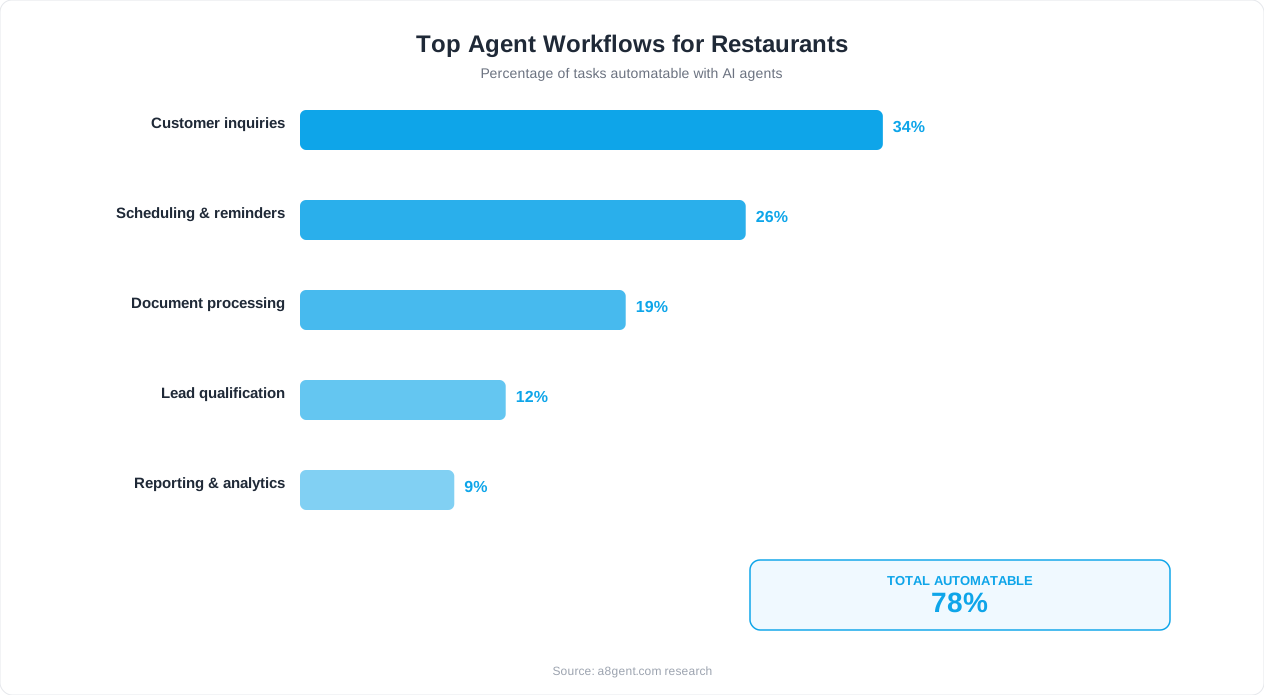
Modern AI phone agents for restaurants sound natural and conversational - not like the robotic voice systems of a decade ago. They greet callers with your restaurant's name, understand menu inquiries and complex modifications ("chicken tikka masala, extra spicy, substitute rice for naan"), process special requests, confirm allergen information from your database, calculate order totals, and provide accurate pickup times based on current kitchen queue depth. The caller experience is pleasant and efficient.
Beyond phone orders, AI agents unify order intake across all channels - phone, website, text message, social media DMs, and third-party delivery platforms - into a single stream that feeds your kitchen. No more juggling four delivery tablets plus a phone plus walk-in orders. The AI consolidates everything, routes each order to the appropriate preparation queue, and manages timing so pickup and delivery orders are ready at the correct moment without cluttering the kitchen during dine-in peaks.
For restaurants using multiple delivery platforms (DoorDash, Uber Eats, Grubhub), AI order management also handles the coordination headaches: accepting or declining orders based on current kitchen capacity, adjusting quoted prep times during rush periods, pausing platforms automatically when the kitchen is overwhelmed, and reactivating when capacity returns. This prevents the common scenario where a restaurant accepts more delivery orders than they can handle, resulting in late deliveries, bad ratings, and penalty fees.
Autonoly's restaurant workflow templates integrate with major POS systems (Toast, Square, Clover, Lightspeed) and delivery platforms to provide unified order management that your existing kitchen workflow can accommodate without disruption. Setup typically takes less than an hour with guided POS connection wizards.
Reservation Management: Fill Tables, Reduce No-Shows
Reservations seem simple on the surface - someone wants a table at a certain time, you check availability, confirm the booking. But effective reservation management is actually one of the most complex operational challenges in the restaurant industry. It's a dynamic optimization problem: maximize table occupancy (revenue per available seat hour) while minimizing wait times, accommodating preferences, handling modifications, and reducing no-shows that leave empty tables during prime hours.
No-shows are the most expensive reservation problem. Industry averages show 15-20% no-show rates for restaurants without confirmation systems. For a 100-seat restaurant doing 200 covers on a Friday night, a 20% no-show rate means 40 empty covers - $2,000-$4,000 in lost revenue on your highest-volume night. Multiply across the week and the annual impact is devastating for thin-margin businesses.
AI reservation agents attack no-shows through intelligent confirmation sequences that go far beyond a generic "Reminder: you have a reservation tomorrow" text. The AI sends personalized confirmations at optimal times (72 hours, 24 hours, and 3 hours before), adjusts messaging tone based on party size and occasion (a birthday dinner gets different messaging than a business lunch), and makes it effortless to confirm, modify, or cancel. When a cancellation occurs, the AI immediately notifies waitlisted parties and fills the slot - often within minutes rather than leaving the table empty.
Dynamic booking rules powered by AI optimize table allocation in ways that human hosts cannot manage mentally. The AI understands that a 2-top at 7:30 PM on Saturday is worth less than the 4-top that called requesting 7:15 - and can suggest alternative times to the smaller party while holding prime slots for larger groups. It learns your restaurant's patterns: which time slots fill naturally versus which need promotion, which party sizes create the most efficient table utilization, and which booking channels produce the most reliable guests.
Waitlist management is another area where AI dramatically outperforms manual systems. Instead of a hostess managing a clipboard while simultaneously greeting guests and answering phones, the AI maintains the waitlist digitally, sends accurate wait time estimates (updated in real time based on table turn speed), notifies guests when their table is ready via text, and automatically removes parties that don't respond - all without consuming a single second of staff attention.
For restaurants currently managing reservations through phone calls, manual notebooks, or basic platforms without AI capabilities, the transition to AI-powered reservation management typically reduces no-shows by 30-45% while increasing overall covers by 10-15% through better table optimization. That combination can add $3,000-$8,000 monthly to a mid-size restaurant's revenue. Learn more about customer communication automation in our AI for customer support guide.
Review Management: Protect Your Reputation on Autopilot
Online reviews directly determine whether new customers walk through your door. 94% of diners check reviews before choosing a restaurant, and a half-star improvement on Yelp correlates with a 19% increase in revenue during peak hours. Yet most restaurant owners treat review management as an afterthought - checking sporadically, responding when they happen to remember, and ignoring the growing backlog on platforms they don't check regularly.
The impact of this neglect is quantifiable. Restaurants that respond to reviews within 24 hours see 33% higher repeat visit rates compared to those that respond slowly or not at all. The reason is psychological: when a business acknowledges feedback (positive or negative), it signals that they care about the guest experience. That perception drives loyalty. Conversely, unanswered negative reviews sit publicly as uncontested narratives about your business, influencing every future potential customer who reads them.
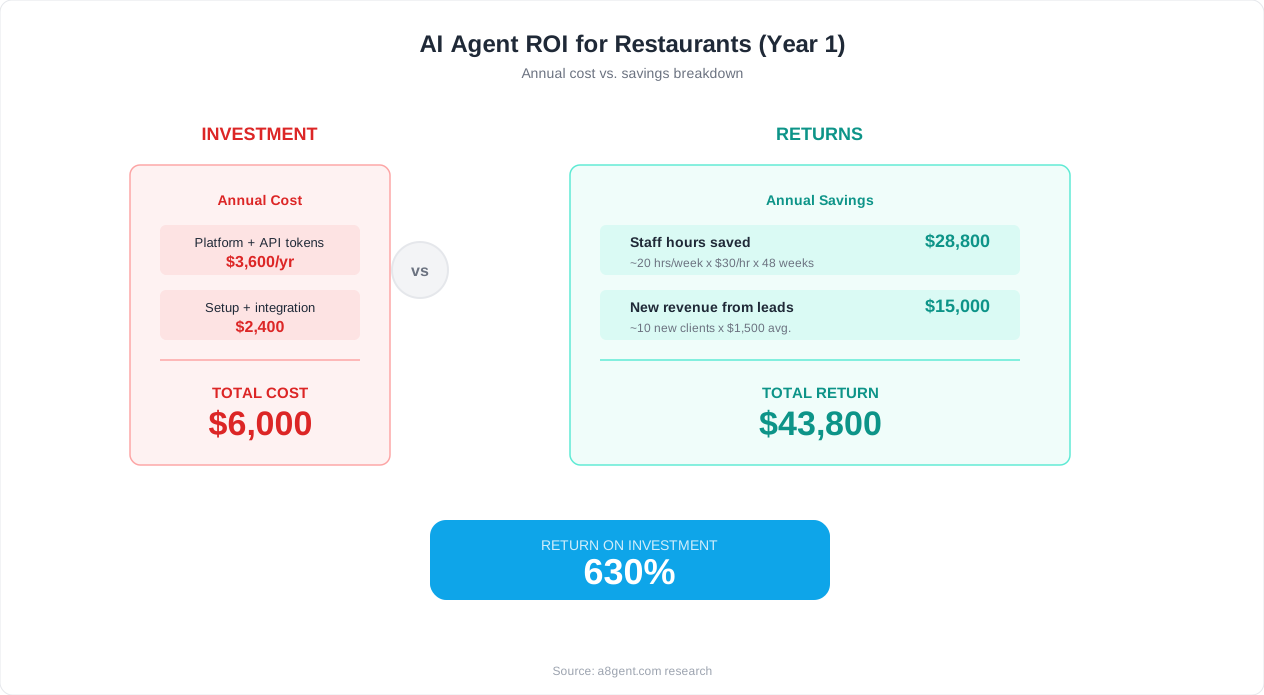
AI review management agents monitor all your review platforms simultaneously (Google Business Profile, Yelp, TripAdvisor, OpenTable, Facebook, DoorDash, Uber Eats) and generate personalized responses within minutes of a new review appearing. These aren't generic "Thank you for your feedback" responses - the AI reads the specific content of each review and crafts a contextual reply.
For positive reviews, the AI acknowledges specific items the guest mentioned ("So glad you enjoyed the short rib - it's our chef's personal favorite preparation"), reinforces the positive experience, and subtly encourages return visits or recommendations. For negative reviews, it acknowledges the concern empathetically, offers to make it right without being defensive, provides appropriate next steps (invitation to return, offer to discuss privately), and maintains your brand voice under pressure - something that's difficult for owners who feel personally attacked by criticism.
The AI also performs sentiment analysis across your review portfolio, identifying trending themes. If three reviews in one week mention slow service on Saturday nights, that's an operational insight you need to act on. If positive mentions of a new menu item are spiking, that validates your culinary direction. These patterns get surfaced to you in digestible summaries rather than requiring you to manually read and synthesize hundreds of reviews across multiple platforms.
For restaurants with multiple locations, review management at scale becomes particularly powerful. Each location maintains its own review response patterns and voice while benefiting from centralized monitoring and escalation rules. A one-star review mentioning food safety gets immediately escalated to ownership regardless of time of day. A four-star review with a minor service complaint gets handled automatically with appropriate empathy and a return incentive. The AI triages by severity so human attention goes where it matters most.
Staff Scheduling and Internal Communication
Restaurant scheduling is a weekly puzzle that consumes 5-8 hours of management time - and even the best manual schedules get disrupted by callouts, shift swap requests, and unexpected volume changes. AI scheduling assistants transform this from a dreaded weekly task into a largely automated process that adapts dynamically to changing conditions.
AI scheduling agents consider factors that would take a human manager hours to process simultaneously: labor law requirements (break intervals, overtime thresholds, minor work restrictions), employee availability and time-off requests, skill certifications (who can work the bar, who is trained on expo, who can handle banquet events), historical sales data by day and hour (predicting staffing needs based on expected volume), special events and holidays, employee preferences and fairness in shift distribution, and labor cost targets as a percentage of projected revenue.
The AI generates optimal schedules that balance all these constraints in minutes rather than hours. When conflicts arise - two servers requested the same Saturday off, a holiday creates unusual demand - the AI presents options with trade-off explanations rather than forcing the manager to discover and resolve every conflict manually. Published schedules are distributed automatically to staff via their preferred channels (text, app notification, email) with one-click confirmation.
Callout management is where AI scheduling truly shines during the chaotic reality of restaurant operations. A server texts at 3 PM that they can't make their 5 PM shift. The AI immediately identifies qualified replacement candidates based on availability, overtime status, and skill requirements. It sends shift offers to eligible team members in priority order, manages responses, and confirms the coverage - often resolving the situation before the manager even sees the original callout notification. No more frantic group texts or calling through a list of employees who don't answer.
Internal communication AI handles the constant stream of staff questions and operational updates that interrupt management throughout the day. Menu changes, 86'd items, specials updates, event details, schedule modifications, and policy reminders can all be communicated through AI-managed channels that confirm receipt and answer common follow-up questions without requiring management response for routine items.
The labor cost impact is significant. AI-optimized scheduling typically reduces labor costs by 3-7% through better alignment between staffing levels and actual demand - avoiding overstaffing during slow periods and understaffing during unexpected rushes. For a restaurant spending $40,000/month on labor, a 5% optimization represents $2,000/month in savings while simultaneously improving service quality through right-sized staffing. Explore operational efficiency strategies in our support and communication automation guide.
Marketing, Promotions, and Customer Retention
Most independent restaurants know they should be doing more marketing, but between running daily operations and managing staff, marketing consistently falls to the bottom of the priority list. The result: sporadic social media posts, infrequent email sends, and promotional strategies that amount to hoping regulars come back and new customers stumble in. AI marketing agents change this dynamic by running consistent, data-driven marketing campaigns that require minimal owner involvement once configured.
Email and text marketing automation is the highest-ROI starting point for restaurant marketing AI. The AI segments your customer database (built from reservations, online orders, and POS data) and sends targeted communications: birthday offers to guests approaching their birthday, win-back campaigns to regulars who haven't visited in 30+ days, new menu announcements to guests who previously ordered similar items, event invitations to customers who've attended past events, and loyalty rewards notifications as guests approach milestones.
The personalization goes beyond inserting a first name. AI marketing agents analyze ordering history to recommend items: "We noticed you love our seafood pasta - this weekend's special features fresh halibut in a similar preparation we think you'd enjoy." This type of contextual recommendation converts at 3-5x the rate of generic promotional emails because it demonstrates genuine knowledge of the guest's preferences.
Social media management through AI addresses one of the biggest marketing gaps for independent restaurants. The AI generates post content based on your current menu, specials, events, and food photography, maintaining a consistent posting schedule across Instagram, Facebook, and TikTok without requiring the chef or owner to remember to post between services. It responds to comments and DMs with your brand voice, answers operational questions (hours, reservation availability, menu inquiries), and escalates only genuine issues that need human attention.
Promotional strategy optimization is where AI adds intelligence beyond simple automation. Based on historical data - which promotions drove incremental visits versus cannibalizing regular spending, which day-parts need demand stimulation, which customer segments respond to discounts versus experience-based offers - the AI recommends and executes promotional campaigns that maximize incremental revenue rather than giving discounts to customers who would have come anyway.
For restaurants building their customer database and marketing infrastructure from scratch, Autonoly provides restaurant-specific marketing templates that integrate with your POS system to automatically build guest profiles from transaction data. Combined with the AI readiness assessment, you can identify which marketing channels and tactics will drive the most revenue for your specific restaurant type, location, and customer demographic.
Tools, Costs, and Getting Started
The restaurant AI tool market has consolidated around solutions designed specifically for food service operations. Unlike generic business automation tools that require significant customization for restaurant use, these purpose-built platforms understand the unique workflows, terminology, and integration requirements of the industry. Here's what's available at each price tier in 2026.
Starter tier ($79-149/month): Covers one or two core functions - typically AI phone answering combined with basic review management, or reservation management with confirmation sequences. Integration with one POS system included. Best for single-location restaurants looking to solve their biggest operational pain point without committing to full automation. Setup takes 1-2 hours and results are visible within days.
Growth tier ($199-399/month): Comprehensive automation covering phone orders, reservations, reviews, and basic marketing. Multi-platform integration (POS, delivery platforms, review sites, social media). Includes analytics dashboards showing revenue impact. Best for restaurants doing $50,000+ monthly revenue that want meaningful operational leverage. Setup takes 1-3 days with onboarding support.
Enterprise tier ($499-999/month): Full-stack restaurant operations platform covering all automation functions plus AI scheduling, inventory forecasting, and multi-location management. Custom integrations, dedicated support, and advanced analytics. Best for multi-location operators or high-volume single locations ($150,000+ monthly revenue). Setup takes 1-2 weeks with implementation assistance.
For most independent restaurants, the growth tier delivers the strongest ROI. A restaurant capturing $3,000/month in previously missed phone orders, reducing no-shows by 35% (adding $2,000/month in covers), and saving 12 hours of management time weekly on reviews and scheduling easily justifies a $300/month investment many times over.
Implementation advice for restaurant owners: Start with the function causing the most daily friction. If your biggest pain is missed calls during rush - start with AI phone ordering. If no-shows are killing your Friday nights - start with AI reservation management. If your online reputation is suffering from unanswered reviews - start there. Proving value in one area builds confidence to expand. Don't try to automate everything simultaneously during your busiest season.
The AI readiness assessment helps restaurant owners identify their highest-impact starting point based on current pain points, revenue level, and operational complexity. Autonoly's restaurant templates provide pre-configured workflows for each function that integrate with Toast, Square, Clover, Resy, OpenTable, and all major delivery platforms - getting you from signup to operational within hours rather than weeks.
What's Next: The Future of AI in Restaurant Operations
The AI capabilities available to restaurants today are just the beginning. Understanding where the technology is heading helps you make investment decisions that position your restaurant for long-term competitive advantage rather than just solving today's problems. Here's what's emerging and how forward-thinking restaurant owners are preparing.
Predictive demand forecasting is moving from enterprise chains to independent restaurants. AI that analyzes your historical sales data, local event calendars, weather patterns, seasonal trends, and even social media buzz to predict daily and hourly covers with 85-90% accuracy. This precision enables prep level optimization (reducing food waste by 20-30%), staffing that matches actual demand curves rather than rough estimates, and promotional timing that targets genuinely slow periods rather than accidentally discounting peak times.
Voice AI for drive-through and counter service is advancing rapidly. Already deployed in major fast-casual chains, this technology is approaching price points accessible to independent quick-service restaurants. An AI handles the ordering conversation at the drive-through or counter - capturing orders accurately, suggesting add-ons based on the order composition, and processing payment - while human team members focus on food preparation and quality. Early adopters report 15-20% increases in average order value from consistent, intelligent upselling that human staff perform inconsistently.
Kitchen operations AI is the next frontier. Computer vision systems that monitor plate presentation for consistency, track cook times for quality control, predict ticket completion times with precision that enables better guest communication, and identify when ingredients are running low before they're gone. These systems are currently in the $500-1,000/month range but falling rapidly as the technology matures and competition increases.
Guest personalization is evolving beyond basic order history into genuine preference learning. AI that remembers a guest always asks for extra napkins, prefers the corner booth, celebrates anniversaries at your restaurant in November, and brings clients who need quiet tables. This information, surfaced to servers and hosts at the moment of arrival, enables the kind of personalized hospitality that creates emotional loyalty - the feeling that "this restaurant knows me" that drives regular patronage.
The restaurants that will thrive in the next 3-5 years are those building their AI infrastructure now - starting with the operational basics (orders, reservations, reviews) and establishing the data collection habits that enable more advanced capabilities as they become available. Every order processed through AI, every reservation managed, every review responded to builds the data foundation that powers tomorrow's predictive and personalization capabilities.
Start building that foundation today with the AI readiness assessment, which evaluates not just your immediate automation opportunities but your long-term technology readiness. And explore Autonoly's evolving restaurant platform to see how current capabilities connect to the advanced features being developed for the near future.
FAQ
How much does AI automation cost for a single-location restaurant?
Entry-level restaurant AI tools start at $79-149/month for basic functions like phone ordering or review management. A comprehensive package covering orders, reservations, reviews, and basic marketing runs $199-399/month. Compare this to the revenue impact: capturing just 2-3 previously missed orders per day ($70-150/day) more than covers even the premium tier. Most restaurants see positive ROI within the first two weeks through captured revenue that was previously lost to missed calls and no-shows.
Will AI phone ordering confuse or frustrate my customers?
Modern restaurant AI phone agents are conversational and natural-sounding - significantly better than the robotic systems of a few years ago. They handle complex orders including modifications, allergen questions, and special requests. Most callers don't realize they're speaking with AI. For the small percentage who prefer human interaction, the AI can transfer to a staff member during business hours. Customer satisfaction scores for AI phone ordering typically match or exceed human-answered calls because the AI is patient, accurate, and never puts callers on hold.
Do I need to change my POS system to use restaurant AI tools?
No. Modern restaurant AI platforms integrate with all major POS systems (Toast, Square, Clover, Lightspeed, Aloha, Micros) through existing APIs. Orders taken by AI flow directly into your current POS and kitchen display system just like orders entered by staff. Setup requires connecting your POS account (usually a 10-15 minute process) and configuring your menu within the AI platform. Your kitchen workflow doesn't change - orders simply arrive from an additional source.
Can AI handle allergen questions and dietary restrictions accurately?
Yes, when your menu data is properly configured. AI agents reference your allergen database to answer questions about specific dishes, suggest alternatives for dietary restrictions, and flag potential allergen concerns during ordering. The key is maintaining accurate allergen and ingredient data in your system - the AI is only as accurate as the information it references. Most platforms make menu and allergen management simple with structured data entry and update prompts when menu items change.
How does AI review management handle fake or malicious reviews?
AI review agents flag reviews that appear fraudulent (no evidence of actual visit, review patterns suggesting competitor manipulation, or content that violates platform guidelines) for human review rather than responding automatically. For legitimate negative reviews, the AI crafts empathetic, professional responses that acknowledge concerns without admitting fault inappropriately. You can configure escalation rules so that severe reviews (one-star, mentions of health/safety) are immediately flagged for owner response rather than handled automatically.
Will AI replace my front-of-house staff?
No. AI handles the operational tasks that prevent your staff from delivering great hospitality - answering phones during rush, managing reservation logistics, processing routine orders. Your front-of-house team is freed to focus on in-person guest experience: greeting warmly, making recommendations, anticipating needs, handling special occasions, and resolving issues with emotional intelligence. The best restaurants use AI to make their human team more present and attentive, not to reduce headcount.
How quickly can I get restaurant AI set up and running?
Most restaurants get their first AI function (typically phone ordering or review management) running within 1-2 hours. The process involves: connecting your POS system, entering or importing your menu, configuring business hours and basic settings, and testing with a few sample orders or reviews. Full implementation across all functions (orders, reservations, reviews, marketing) typically takes 3-5 days with each function added sequentially. No technical skills are required - setup is guided with visual interfaces and pre-built restaurant templates.
Does restaurant AI work for different cuisine types and service models?
Yes. AI restaurant tools work across all cuisine types (Italian, Asian, Mexican, American, fine dining, casual, fast-casual) and service models (full-service, counter-service, delivery-only, food trucks). The AI adapts to your specific menu structure, ordering patterns, and operational workflow. A fine-dining establishment uses AI differently than a pizza shop - the former focuses on reservation optimization and guest personalization, while the latter emphasizes phone ordering speed and delivery coordination. The tools are configurable for your specific concept.