AI Agents for Insurance Agencies: Quotes, Claims and Renewals (2026)
Learn how AI agents are transforming insurance agencies by automating quote generation, claims processing, and policy renewals. A practical guide for agency owners covering tools, ROI, and step-by-step implementation.
10+ years shipping production ML across TensorFlow, PyTorch, AWS, and GCP. Ships every A8gent agent before it becomes a lesson. GitHub
- Insurance agencies spend 40-60% of staff time on repetitive administrative tasks like data entry, quote comparisons, and renewal follow-ups that AI agents can automate today without replacing human judgment on complex cases.
- AI-powered quote generation reduces average turnaround from 24-48 hours to under 10 minutes, preventing prospect drop-off and increasing bind rates by 25-40% for standard policy types.
- Claims intake automation with AI handles first notice of loss documentation, assigns severity scores, and routes claims to the right adjuster - cutting initial processing time from days to minutes.
- Renewal retention campaigns powered by AI agents achieve 85-92% retention rates compared to the industry average of 73%, by reaching out at optimal times with personalized coverage recommendations.
- Modern AI tools for insurance agencies start at $99/month and require no coding or IT staff, delivering typical ROI within 60-90 days through improved close rates and operational savings.
Why Insurance Agencies Are Perfectly Positioned for AI Automation
The independent insurance agency model faces a paradox in 2026. Customer expectations have shifted to instant digital experiences - they want quotes in minutes, claims updates in real time, and policy changes without waiting on hold. But most agencies still operate with small teams, manual workflows, and carrier systems that haven't been modernized in over a decade. The result is a growing gap between what customers expect and what agencies can deliver with human effort alone.
This isn't a minor operational issue. The average independent agency manages 800-2,000 policies with a team of 3-8 people. Each policy involves dozens of touchpoints per year: renewal notices, coverage reviews, endorsement requests, claims, billing questions, and certificate of insurance requests. Multiply those touchpoints across the full book of business and you quickly understand why agency staff spend their days on reactive tasks rather than growth activities like prospecting and cross-selling.
AI agents are particularly well-suited to insurance because the industry runs on structured data, documented processes, and regulatory guidelines that AI can learn and follow consistently. A quote request follows a predictable pattern: collect applicant information, match it against carrier appetite guides, run comparative rates, and present options. A claims intake follows another pattern: gather incident details, document damage, assign severity, and route to the appropriate handler. These are exactly the types of workflows where AI delivers the highest return.
The insurance industry has been slower to adopt AI than sectors like e-commerce or SaaS, largely because of compliance concerns and the relationship-driven nature of the business. But the tools available in 2026 have matured significantly. They work within existing compliance frameworks, maintain audit trails, and are designed to augment agency staff rather than replace them. The agencies that implement AI now are capturing a competitive advantage that compounds over time - faster quotes mean more bound policies, better follow-up means higher retention, and automated admin means staff can spend time on activities that actually grow revenue.
Not sure where AI fits in your agency's workflow? Take our free AI readiness assessment to identify which processes will deliver the fastest ROI when automated. Below, we break down exactly how AI agents handle each critical function of an insurance agency.
Automated Quote Generation: From Hours to Minutes
The quote process is where most agencies lose prospects before they ever have a chance to close them. A potential customer submits a request online at 8 PM. The agency doesn't see it until the next morning. A CSR manually enters the information into three carrier portals, waits for responses, builds a comparison spreadsheet, and emails it back 24-48 hours after the initial inquiry. By then, the prospect has received quotes from two online competitors and already bound a policy elsewhere.
AI agents eliminate this delay entirely. When a quote request arrives - whether through your website form, email, or phone system transcription - an AI agent can immediately parse the information, identify which carriers are the best fit based on the risk profile, submit applications through carrier APIs or rater integrations, and compile a comparison within minutes. The prospect receives a professional, multi-option quote presentation while they're still actively shopping.
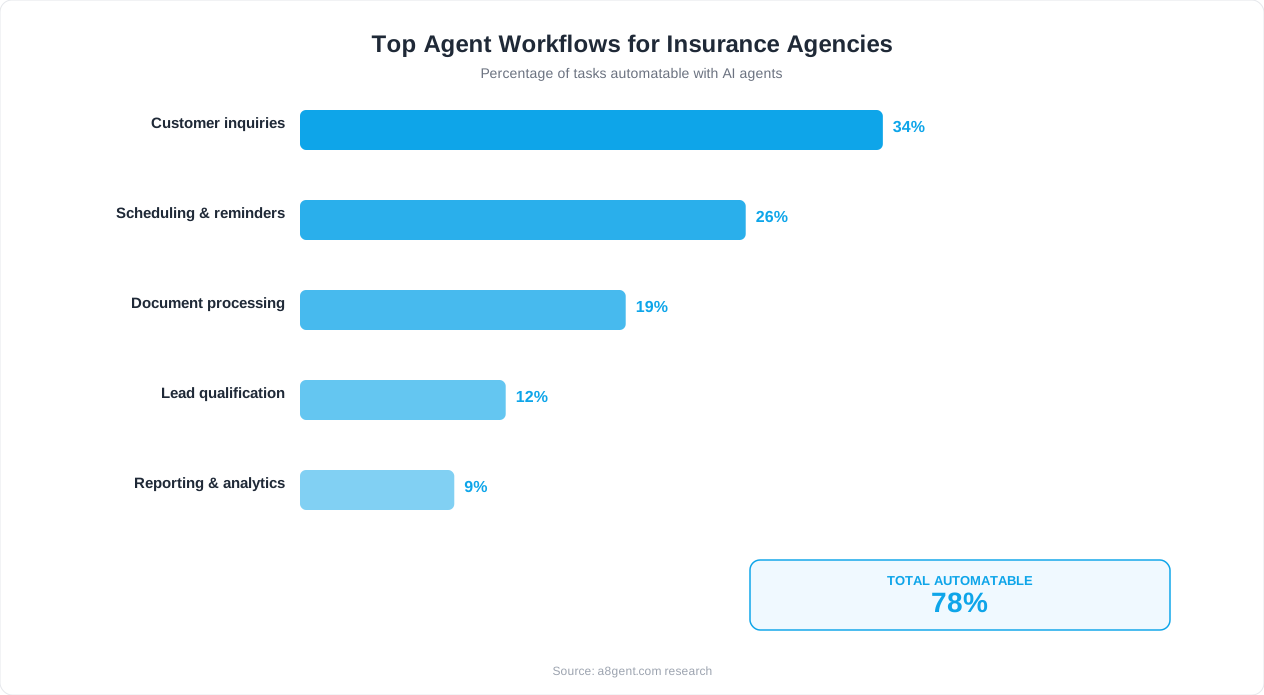
The impact on close rates is substantial. Agencies using AI-powered quoting report 25-40% increases in bind rates for standard personal lines and small commercial policies. The reason is simple: the fastest quote wins. When your agency responds in 8 minutes instead of 8 hours, you're the first professional recommendation the prospect sees. Speed creates the perception of competence and responsiveness that builds trust before the relationship even begins.
AI quote automation doesn't replace human expertise for complex commercial accounts or specialty risks. It handles the 60-70% of submissions that are standard and predictable - personal auto, homeowners, small BOP policies, workers comp for low-risk classes - while flagging complex risks for human review. This means your experienced producers spend their time on the accounts that genuinely need their expertise and generate the highest commissions, rather than spending hours on a straightforward homeowners quote.
The workflow typically integrates with your existing management system. Autonoly connects to major agency management systems and comparative raters, pulling applicant data and pushing completed quotes back into your workflows. The AI handles the data entry, carrier selection, and presentation formatting while your team focuses on the consultative conversation about coverage adequacy and risk management.
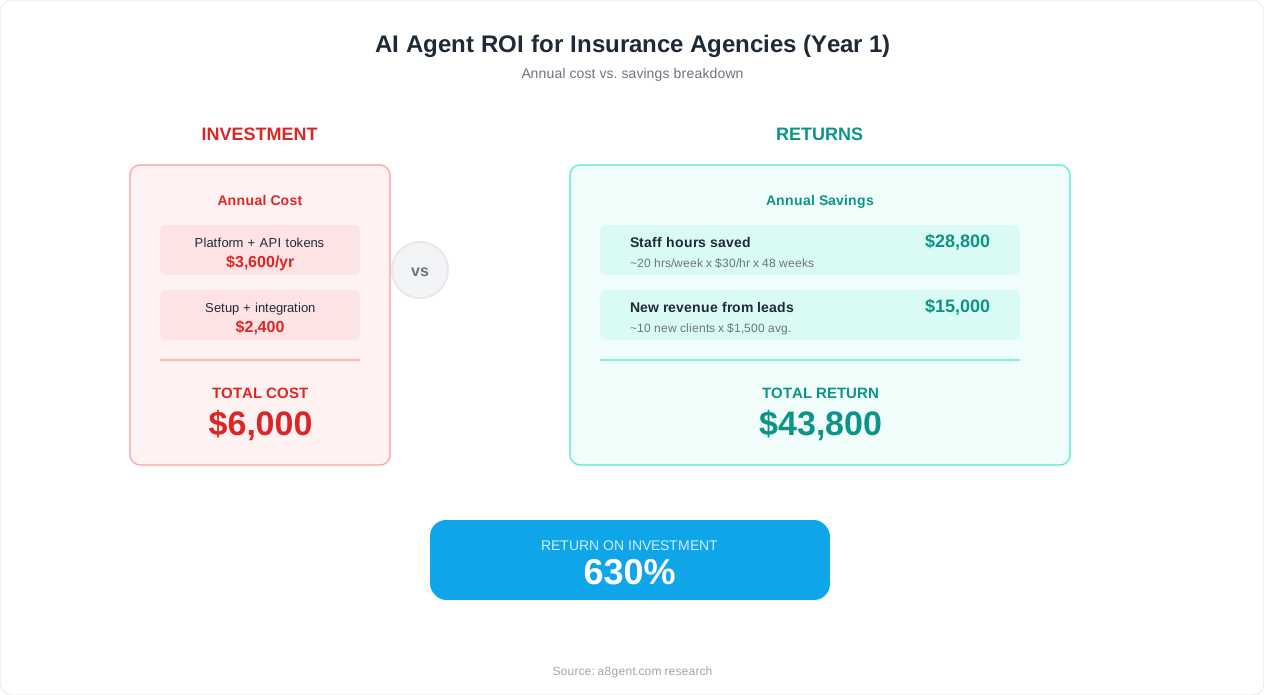
For agencies currently processing 50+ quote requests monthly, automated quoting typically saves 15-25 staff hours per week while simultaneously improving conversion rates. That combination of cost reduction and revenue improvement makes it one of the highest-ROI implementations for any insurance agency.
Claims Processing and Intake: First Notice of Loss in Minutes
Claims are the moment of truth for any insurance agency. It's when your client needs you most, and it's when your team is typically most overwhelmed. A major storm hits your coverage area on a Friday evening. By Monday morning, you have 47 voicemails, 23 emails, and a lobby full of stressed policyholders - all needing to file first notice of loss documentation. Your staff of three CSRs faces a week of 12-hour days just handling intake, while regular business operations grind to a halt.
AI agents transform claims intake from a bottleneck into a streamlined process that operates 24/7 regardless of volume spikes. When a policyholder reports a claim - by phone, email, web form, or text message - an AI agent handles the initial documentation: gathering incident details, confirming policy coverage, documenting damage with guided photo uploads, assigning an initial severity score, and routing the claim to the appropriate carrier or adjuster. The policyholder receives immediate acknowledgment and clear next steps, even at 2 AM on a Saturday.
The guided intake process actually improves documentation quality compared to frantic human note-taking during high-volume periods. AI agents ask consistent follow-up questions, ensure all required fields are completed, prompt for photo documentation at the right time, and capture details that stressed staff might miss when handling their fifteenth call of the morning. This completeness reduces back-and-forth with carriers and speeds up the overall settlement process.
Severity scoring is another area where AI adds significant value. Based on the reported details - damage type, estimated extent, policyholder history, and coverage limits - AI can triage claims by urgency. A minor fender bender gets processed through standard channels. A house fire with displacement needs is immediately escalated with emergency contacts and temporary housing assistance information provided to the insured within minutes of reporting.
For agencies acting as the intermediary between policyholders and carriers, AI also handles status tracking and proactive communication. Instead of policyholders calling your office daily asking "What's happening with my claim?" - consuming hours of staff time - an AI agent monitors claim status through carrier portals and pushes updates to policyholders automatically via their preferred channel. This single automation can reduce inbound call volume by 30-40% during active claim periods.
The combination of faster intake, better documentation, intelligent routing, and proactive communication transforms your agency from a reactive claims processor into a proactive client advocate. Explore how Autonoly's workflow automation connects your management system to carrier claim portals for end-to-end claims visibility, or learn more about improving operational efficiency with AI agents.
Renewal Management and Retention: Keep More Clients Automatically
Client retention is the single most important driver of agency profitability. Acquiring a new client costs 5-7x more than retaining an existing one, and each year a client stays, their lifetime value compounds through cross-sell opportunities, referrals, and reduced service costs. Yet the industry average retention rate hovers around 73% for personal lines - meaning agencies lose more than a quarter of their clients every year, often not because of price or service failures, but because of neglect during the renewal process.
The renewal cycle is a perfect candidate for AI automation because it's predictable, time-sensitive, and involves personalized communication at scale. Every policy has a known renewal date. The outreach sequence follows a consistent pattern. But the sheer volume - an agency with 1,500 policies has an average of 125 renewals per month - makes it impossible for a small team to give each one personalized attention manually.
AI agents manage the entire renewal lifecycle: identifying upcoming renewals 90 days out, running coverage reviews against current carrier offerings, comparing renewal premiums to market alternatives, generating personalized outreach that addresses each client's specific situation, scheduling review calls at optimal times, and following up persistently until the renewal is confirmed or a conversation happens. All automatically, for every single policy in your book.
The personalization is what makes AI renewal campaigns dramatically more effective than generic reminder emails. An AI agent that has access to your management system data can send a message like: "Hi Sarah, your homeowners policy renews on March 15. I noticed you added a deck last summer - let's make sure your dwelling coverage reflects that improvement. I've also found a carrier offering 15% better rates for homes with your new security system. Can we schedule 10 minutes this week to review your options?" Compare that to a generic "Your policy is up for renewal, please call our office" email.
Agencies implementing AI renewal management report retention rates of 85-92% - a 12-19 point improvement over industry average. On a 1,500-policy book, that improvement means retaining an additional 180-285 clients annually. At an average revenue of $800 per policy, that's $144,000-$228,000 in preserved annual commission income that would have otherwise walked out the door.
The AI doesn't just retain clients - it identifies cross-sell opportunities during the renewal conversation. A client renewing auto insurance gets a recommendation for an umbrella policy. A homeowner nearing the 5-year mark gets flood insurance education. These contextual recommendations convert at 15-25% because they arrive at a moment when the client is already thinking about their insurance needs. Our AI readiness assessment can help you evaluate how much revenue your agency is leaving on the table with manual renewal processes.
Customer Service and Communication: 24/7 Availability Without 24/7 Staff
Insurance clients have questions at inconvenient times. A business owner reviewing their coverage on Sunday afternoon. A driver involved in an accident at 11 PM needing to know their deductible. A homeowner discovering water damage on a holiday weekend wanting to know if they're covered. Traditional agency hours - 9 to 5, Monday through Friday - leave clients without answers exactly when they need them most.
AI-powered customer service agents provide immediate, accurate responses to the majority of client inquiries regardless of time, day, or volume. These aren't generic chatbots with scripted responses. Modern AI agents access your management system data to provide policy-specific answers: "Your auto deductible is $500 for collision and $250 for comprehensive. Your policy number is XYZ-123. Would you like me to start a claim or connect you with your agent when the office opens?"
The range of inquiries AI can handle autonomously covers roughly 70-80% of typical agency communication: policy information lookups (deductibles, limits, effective dates), certificate of insurance generation and delivery, billing inquiries and payment processing, coverage questions for common scenarios, claims status updates, policy change requests (address, vehicle, driver additions), renewal information and scheduling, and general insurance education questions.
For the 20-30% of inquiries that require human judgment - complex coverage questions, complaints, sensitive claims situations - the AI agent captures all relevant context, documents the client's question and emotional state, and routes to the appropriate team member with full background. When the human picks up the conversation, they don't need to ask the client to repeat anything. The AI has already gathered the information and identified the core issue.
The impact on operational efficiency is significant. Agencies report 40-60% reductions in inbound phone calls after implementing AI customer service, with client satisfaction scores actually improving because responses are faster and available around the clock. Staff members freed from routine inquiries can focus on relationship-building conversations, complex account reviews, and proactive outreach - activities that directly drive retention and revenue growth.
Certificate of insurance (COI) management deserves special mention because it's one of the highest-volume, lowest-value tasks in a commercial lines agency. AI agents can generate and deliver standard COIs automatically when clients or their business partners request them - no human involvement needed for straightforward certificates. For an agency issuing 200+ COIs monthly, this automation alone can save 20-30 hours of staff time. Learn how Autonoly handles multi-channel communication while maintaining compliance with insurance communication regulations.
Compliance, Documentation, and Audit Trails
Insurance is one of the most heavily regulated industries, and compliance concerns are often cited as the primary reason agencies hesitate to adopt AI. The fear is understandable: improper communication, missing disclosures, or inadequate documentation can result in errors and omissions claims, carrier appointment termination, or regulatory action. But the reality is that AI agents, when properly configured, are actually more compliant than human staff - because they never forget a required disclosure, never skip a documentation step, and maintain perfect audit trails.
Every interaction an AI agent handles is automatically logged with full detail: timestamp, channel, content of the communication, client response, and any actions taken. This creates comprehensive documentation that would be impossible to maintain manually. If a client later claims they weren't informed about a coverage exclusion, the AI's communication log provides clear evidence of what was communicated, when, and how the client responded. This level of documentation reduces E&O exposure significantly.
AI agents can be configured with state-specific compliance rules built into their communication templates. Required disclosures for your state are automatically included in relevant communications. Prohibited language is flagged before it reaches clients. Licensing requirements are respected - the AI never provides advice that crosses the line from information into unlicensed practice in states where that distinction matters. These guardrails are consistent and unfailing, unlike human staff who might occasionally forget a disclosure during a busy period.
For agencies subject to carrier audits, AI automation simplifies the process enormously. All client interactions, coverage discussions, and recommendations are documented in searchable, structured formats. When a carrier wants to verify that proper procedures were followed on a specific account, the data is immediately accessible rather than scattered across email inboxes, phone notes, and sticky pads on desks. Audit preparation that previously took days can be completed in hours.
Data security is handled through enterprise-grade encryption, role-based access controls, and data processing agreements that comply with state insurance data security regulations (like the NAIC Insurance Data Security Model Law adopted by most states). Client information processed by AI tools is isolated per agency, encrypted in transit and at rest, and not used for model training. Your clients' personal and financial information stays protected to the same standards - or higher - than traditional agency management systems.
The agencies that approach AI adoption thoughtfully actually strengthen their compliance posture rather than weakening it. The key is choosing platforms built for insurance specifically, with compliance features designed into the foundation rather than bolted on as an afterthought. Autonoly maintains insurance-specific compliance templates and state-by-state regulatory configurations that keep your automated communications within bounds. For a broader look at how AI handles operational compliance, see our operations automation guide.
Tools, Pricing, and What to Expect in 2026
The AI tool landscape for insurance agencies has matured significantly. In 2024, most solutions required custom development or enterprise contracts starting at $50,000+. In 2026, agencies of all sizes can access production-ready AI automation at price points that make sense for their book size and revenue. Here's what the market looks like today and what you should expect to invest.
For agencies just starting with AI, the entry point is $99-199/month for platforms that provide core automations: quote request handling, basic customer service responses, and renewal reminder sequences. At this tier, you're getting templates and pre-built workflows that work out of the box with minimal configuration. Setup typically takes 1-2 days, and most agencies see measurable time savings within the first week.
Mid-market solutions run $299-599/month and add deeper integrations with agency management systems (Applied Epic, Vertafore, HawkSoft, QQCatalyst), carrier portals, comparative raters, and accounting platforms. These solutions handle more complex workflows: multi-carrier quoting, claims intake with severity routing, full renewal lifecycle management, and COI automation. Setup takes 1-2 weeks with onboarding support, and full ROI typically materializes within 60-90 days.
Enterprise solutions for larger agencies and agency groups start at $1,000-2,500/month and provide full customization, dedicated support, carrier-specific integrations, and advanced analytics. These are appropriate for agencies with 5,000+ policies or complex commercial specialties that require customized underwriting workflows and carrier communication protocols.
When evaluating tools, prioritize these criteria: native integration with your existing management system (avoid anything requiring manual data transfer), insurance-specific compliance features (not generic business automation adapted for insurance), carrier connectivity for real-time quoting and claims status, multi-channel communication (email, text, phone, web chat), and transparent pricing without per-transaction fees that make costs unpredictable as your automation scales.
Autonoly serves insurance agencies across all tiers with modular pricing that lets you start with one workflow (like renewal management) and expand as you see results. Their insurance-specific templates are designed by former agency operators who understand the unique workflows, compliance requirements, and carrier relationships that make insurance different from other industries. The AI readiness assessment provides a personalized recommendation for which tools and tier match your agency's current size, complexity, and growth goals.
Getting Started: Your Implementation Roadmap
Implementing AI in your insurance agency doesn't require a massive technology overhaul or months of planning. The most successful implementations start small, prove value quickly, and expand based on results. Here's the practical roadmap that works for agencies of all sizes, based on patterns we've observed across hundreds of successful deployments.
Week 1-2: Start with one high-impact, low-risk workflow. For most agencies, this is either automated renewal outreach or after-hours customer service. These are ideal starting points because they're immediately measurable (retention rate improvement or after-hours inquiry response rate), they don't disrupt existing daytime workflows, and they demonstrate value to your team without requiring them to change their daily habits immediately. Connect the AI to your management system, configure your first workflow, and let it run alongside your existing process.
Week 3-4: Measure results and expand. You'll have data showing how many renewals received proactive outreach (and how many responded), or how many after-hours inquiries were handled without staff involvement. Use these numbers to build internal confidence and justify expanding to the second workflow. Typically, agencies add quote automation next because it has the most direct revenue impact - every faster quote response is a potential new client captured.
Month 2-3: Layer in claims intake automation and proactive cross-sell campaigns. By now, your team has adapted to AI handling certain tasks and trusts the technology. Claims intake automation during business hours requires more confidence because it touches sensitive client interactions. Cross-sell campaigns require management system integration to identify opportunities. Both build on the foundation established in the first month.
Month 4-6: Full workflow integration and optimization. At this stage, AI is handling the majority of routine interactions: quotes, renewals, COIs, status inquiries, basic policy questions, and claims intake. Your human team is focused on complex accounts, relationship conversations, new business development, and exception handling. You're measuring not just time saved but revenue impact: bind rate improvements, retention lifts, cross-sell conversion, and revenue per employee increases.
The agencies that struggle with AI implementation almost always make the same mistake: trying to automate everything at once. The complexity overwhelms staff, creates resistance, and makes it impossible to identify what's working and what isn't. Sequential implementation with clear measurement between stages avoids these pitfalls and builds momentum that sustains long-term adoption.
Ready to identify your agency's highest-impact starting point? The AI readiness assessment analyzes your current operations and recommends a specific implementation sequence based on your book size, staff capacity, and growth goals. Or explore Autonoly's insurance automation templates to see pre-built workflows designed for agencies exactly like yours.
FAQ
How much does AI automation cost for an independent insurance agency?
Entry-level AI tools for insurance agencies start at $99-199/month, covering basic automation like renewal reminders and after-hours responses. A comprehensive AI stack for a mid-size agency (1,000-3,000 policies) typically runs $299-599/month, including quote automation, claims intake, and full renewal lifecycle management. Compare this to hiring additional CSRs ($3,500-4,500/month each) or virtual assistants who lack insurance-specific knowledge. Most agencies recoup their AI investment within 60-90 days through improved bind rates and retention alone.
Will AI agents replace insurance agency staff?
No. AI agents handle the repetitive, administrative tasks that consume 40-60% of staff time - data entry, routine inquiries, status updates, and template communications. The value of experienced insurance professionals lies in complex risk assessment, coverage consulting, claims advocacy, and relationship trust. AI frees your team to do more of the high-value work that clients actually pay for and that generates higher commissions. Agencies using AI typically don't reduce headcount - they grow revenue per employee and improve service quality.
Is AI compliant with insurance regulations and data security requirements?
Yes, when you use insurance-specific platforms designed with compliance in mind. Proper AI tools maintain complete audit trails, include state-required disclosures automatically, respect licensing boundaries, and encrypt all client data per NAIC Insurance Data Security Model Law standards. In fact, AI often improves compliance because it never forgets a required disclosure or skips a documentation step. Always verify that your chosen platform provides data processing agreements, SOC 2 compliance, and insurance-specific regulatory configurations for your state.
Can AI handle complex commercial insurance quoting?
AI handles standard commercial lines effectively - BOP policies, workers compensation for common class codes, and standard GL. For complex commercial risks (large property schedules, specialty liability, excess layers), AI manages the intake and data organization while flagging for human underwriting review. The AI collects all necessary information, organizes submissions, identifies the most likely carrier matches, and prepares the submission package - but a human producer makes the final carrier selection and negotiates terms for complex accounts.
How long does it take to set up AI automation for my agency?
Most agencies get their first workflow running in 1-3 days and see measurable results within the first week. Full implementation across quotes, claims, renewals, and customer service typically takes 4-6 weeks with a phased approach. The key is starting with one high-impact workflow (usually renewal management or after-hours service), proving value, then expanding. No coding is required - modern platforms use visual configuration with pre-built insurance templates that connect to your existing management system.
What agency management systems does AI integrate with?
The major AI platforms for insurance integrate with all common agency management systems including Applied Epic, Vertafore AMS360/Sagitta, HawkSoft, QQCatalyst, EZLynx, NowCerts, and Agency Zoom. They also connect to comparative raters (EZLynx, PL Rater, TurboRater), carrier portals for real-time quoting and claims status, and communication tools (email, VoIP, text messaging platforms). <a href='/agents/autonoly'>Autonoly</a> provides native integrations for all major insurance platforms with setup wizards that guide you through connection without IT support.
Will clients know they're talking to an AI?
This depends on your preference and state regulations. Most agencies configure AI to be transparent (identifying as an automated assistant) while maintaining a warm, professional tone that reflects the agency's brand. Many clients actually prefer AI for routine requests - getting an instant COI at 9 PM is better than waiting until morning regardless of who provides it. For relationship-sensitive conversations, AI can gather information and then hand off to a human team member with full context so the personal touch is preserved where it matters most.
How does AI improve insurance agency retention rates?
AI improves retention through consistent, personalized outreach that human teams can't maintain at scale. It contacts every renewing client 90 days before expiration with coverage review recommendations, follows up at optimal intervals, identifies accounts at risk of non-renewal based on behavioral signals, and presents competitive alternatives before the client shops on their own. Agencies using AI renewal management report 85-92% retention rates versus the 73% industry average - a difference that translates to hundreds of thousands of dollars in preserved annual commission income.