AI Agents for Real Estate: Automate Listings, Follow-ups & Closings (2026)
Discover how AI agents are transforming real estate operations - from lead capture and automated follow-ups to listing syndication and transaction coordination. Practical guide with tools, pricing, and implementation steps.
10+ years shipping production ML across TensorFlow, PyTorch, AWS, and GCP. Ships every A8gent agent before it becomes a lesson. GitHub
- Real estate professionals spend 60-70% of their time on administrative tasks that AI agents can fully or partially automate - freeing them to focus on relationships and closings.
- AI-powered lead capture and qualification can respond to new inquiries in under 60 seconds (vs. the industry average of 5+ hours), increasing conversion rates by 3-5x.
- Automated drip campaigns with AI personalization maintain engagement across 12-18 month nurture cycles without manual effort, keeping agents top-of-mind when buyers are ready to act.
- Tools like Autonoly, Follow Up Boss, and kvCORE now offer AI-native features starting at $69/month that previously required custom development costing $50,000+.
- Transaction coordination AI reduces the average 47-step closing process to a managed checklist with automated reminders, document tracking, and deadline alerts - cutting admin time by 80%.
Why Real Estate Is Perfectly Suited for AI Agents
Real estate has a productivity problem that most agents know intimately but rarely quantify. The National Association of Realtors reports that the average agent spends just 33% of their working hours on revenue-generating activities - showing properties, negotiating deals, and building client relationships. The other 67% goes to administrative tasks: entering listings, sending follow-up emails, coordinating inspections, chasing paperwork, and updating CRMs.
That's not a minor inefficiency. For an agent earning $150,000 in gross commission income, it means roughly $100,000 worth of their time is spent on tasks that don't directly generate revenue. Multiply that across a 10-person brokerage and you're looking at $1 million in misallocated human capital annually.
AI agents are uniquely suited to solve this because real estate workflows are repetitive, high-volume, and follow predictable patterns - exactly the conditions where AI automation delivers the highest ROI. A new lead comes in, needs an immediate response, requires qualification questions, and then enters a nurture sequence. A listing needs photos uploaded, descriptions written, syndicated to 30+ platforms, and status updates pushed to clients. A transaction needs 47 discrete steps coordinated across buyers, sellers, lenders, inspectors, title companies, and attorneys.
Each of these workflows follows a template with variations. That's the sweet spot for AI: consistent enough for automation, variable enough that rigid rule-based tools break down. Modern AI agents handle the variability - reading an inquiry email, understanding intent, and crafting a contextual response - while maintaining the speed and consistency that humans simply cannot match at scale.
The real estate industry was slow to adopt AI compared to SaaS and e-commerce. But in 2026, the tools have matured to the point where a solo agent or small team can deploy AI automation without technical skills or a massive budget. Not sure where to start? Take our free AI readiness assessment to identify which parts of your real estate workflow will benefit most from automation.
Let's break down exactly how AI agents are being deployed across each stage of the real estate business.
Lead Capture and Qualification: Respond in Seconds, Not Hours
The single biggest revenue leak in real estate is slow lead response. MIT research shows that leads contacted within 5 minutes are 21x more likely to qualify than those contacted after 30 minutes. Yet the average real estate agent takes 5 hours and 19 minutes to respond to a new web inquiry. By then, the prospect has already contacted three other agents.
AI agents eliminate this gap entirely. When a lead submits a form on your website, texts a listing sign rider, or inquires through Zillow, an AI agent can respond within 30-60 seconds with a personalized message that acknowledges their specific interest and asks qualifying questions.
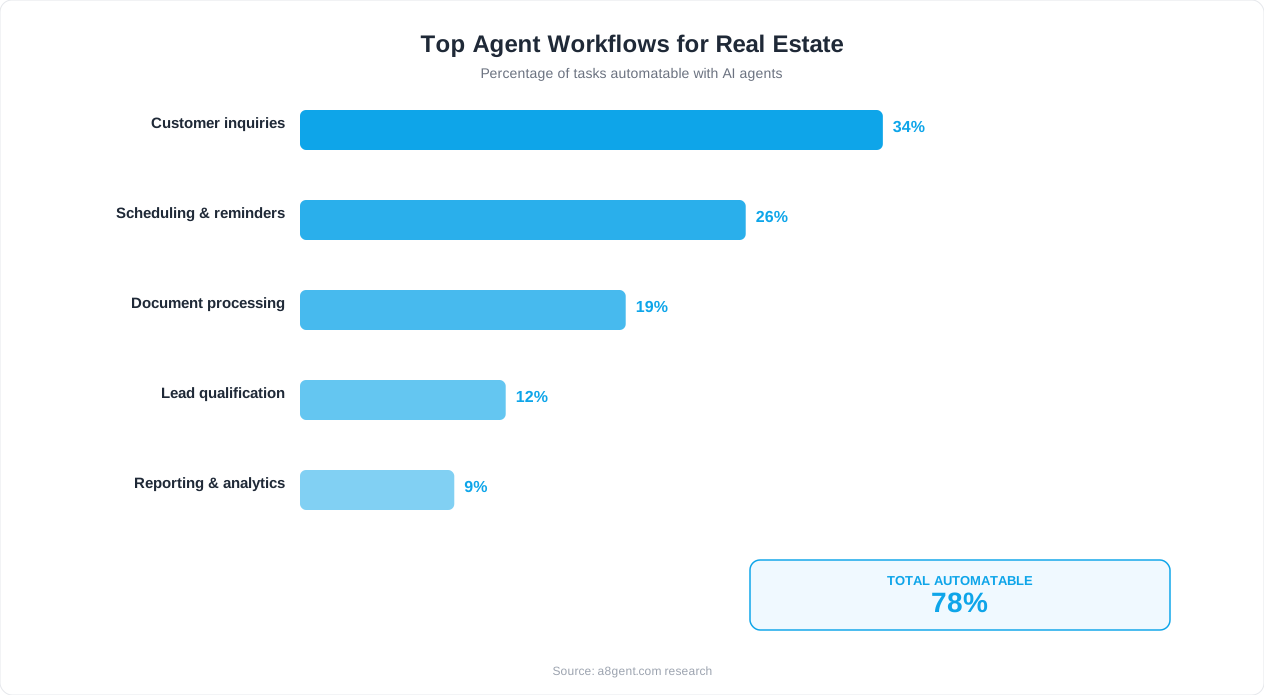
Here's what a modern AI lead capture workflow looks like: A prospect clicks "Schedule Showing" on a listing at 10:47 PM. Within 45 seconds, they receive a text message that references the specific property, confirms availability for a showing, and asks about their timeline and pre-approval status. The AI continues the conversation, answering common questions about the property (pulled from the MLS data) and qualifying the lead based on budget, timeline, and motivation level. By the time the agent checks their phone the next morning, they have a qualified lead with a showing scheduled on their calendar.
This isn't hypothetical. Teams using AI-powered instant response report 3-5x improvements in lead-to-appointment conversion rates. The math is straightforward: if you generate 100 leads per month and currently convert 3% to appointments, moving to 9-15% conversion through faster response means 6-12 additional appointments monthly - without spending an extra dollar on lead generation.
The qualification piece is equally critical. AI agents ask the right questions in a conversational way - Are you pre-approved? What's your timeline? Are you working with another agent? - and score leads based on responses. Hot leads get flagged for immediate human follow-up. Warm leads enter automated nurture. Cold leads get tagged and revisited quarterly. This ensures your human attention goes where it has the highest probability of generating commission.
Autonoly offers real estate-specific lead qualification templates that integrate with major IDX platforms and CRMs. You can explore how AI handles the full sales pipeline in our AI for sales use case guide.
Automated Follow-ups and Drip Campaigns That Feel Personal
The average home buyer takes 10-14 months from first search to closing. During that time, they need consistent touchpoints to stay engaged - market updates, new listing alerts, educational content, and periodic check-ins. Most agents lose 60-80% of their leads simply because they stop following up after the first few weeks. Not out of negligence, but because manually maintaining 200+ nurture relationships alongside active clients is physically impossible.
AI-powered drip campaigns solve this by maintaining personalized communication at scale over extended timeframes. Unlike old-school email drips that send the same generic message to everyone on a schedule, AI agents personalize based on behavior, preferences, and conversation history. A buyer who opened three emails about downtown condos gets content tailored to urban living. A family that viewed 4-bedroom homes in suburban school districts gets neighborhood comparison guides.
The personalization extends beyond just content selection. AI agents now write individual messages that reference previous conversations, acknowledge life events (job change, growing family), and adapt tone to match the prospect's communication style. To the recipient, it feels like their agent remembers them and is thinking about their needs - because the AI is tracking every signal and crafting responses accordingly.
A well-structured AI follow-up system includes: immediate response (within 60 seconds), a 3-message introductory sequence over the first week, weekly market updates personalized to their search criteria, monthly check-in messages that prompt for status updates, re-engagement sequences triggered by website visits or email opens, and anniversary or milestone messages for past clients. All running simultaneously across hundreds of contacts without a single manual send.
The ROI on follow-up automation is dramatic. Agents using AI-powered nurture sequences report that 25-35% of their closings come from leads that were 6+ months old - leads that would have been dead in a manual follow-up system. At an average commission of $12,000-$15,000 per transaction, even 2-3 additional closings per year from better follow-up pays for the entire AI tech stack many times over.
For teams building out their follow-up infrastructure, our guide on AI agents for sales automation covers the strategy behind effective nurture sequences. And if you're evaluating tools, the ROI calculator can model the impact of improved follow-up on your specific lead volume and conversion rates.
Listing Management and Syndication: Publish Once, Distribute Everywhere
Managing listings is one of the most time-consuming parts of a real estate business, especially for teams handling 20+ active listings simultaneously. Each listing requires: professional photo organization and enhancement, compelling description writing, MLS data entry, syndication to 30+ portals (Zillow, Realtor.com, Redfin, Homes.com, etc.), social media posts, email blasts to your buyer database, virtual tour setup, price change updates across all platforms, and status updates as the listing moves through stages.
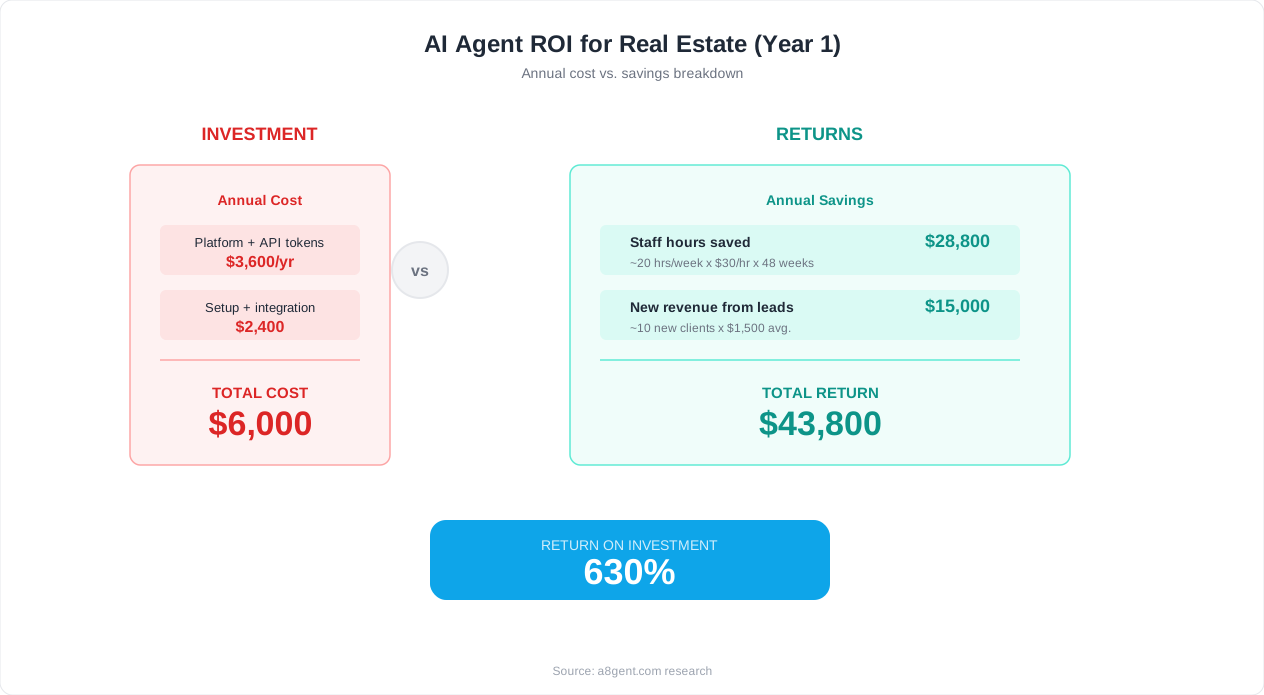
AI agents now handle the majority of this workflow. When you upload listing photos and basic property details, an AI agent can: automatically enhance and order photos for maximum impact, generate multiple description versions optimized for different platforms (MLS character limits differ from Zillow's format which differs from Instagram captions), push the listing to all syndication partners simultaneously, create social media content calendars with varied messaging across platforms, draft email announcements segmented by buyer preferences in your database, and generate virtual tour scripts or walkthrough narrations.
The description writing alone saves significant time. A good AI agent doesn't just list features - it crafts narratives that highlight lifestyle benefits, use neighborhood-specific language, and incorporate SEO keywords that drive organic traffic to your listing pages. One agent reported that AI-generated descriptions received 34% more saves on Zillow compared to their manually written descriptions, likely because the AI consistently incorporated high-engagement terms identified from platform data.
Syndication management becomes critical when you're making updates. A price reduction needs to propagate to every platform within hours. A status change from "Active" to "Pending" needs to update everywhere simultaneously to avoid confusion. AI agents handle this cascading update automatically - you change the price once in your system and the AI pushes it everywhere within minutes, confirming successful updates and flagging any platforms that need manual attention.
For brokerages with high listing volume, AI listing management typically saves 3-5 hours per listing over its lifecycle. At 50 listings per year, that's 150-250 hours recovered - equivalent to adding a part-time employee without the overhead. Autonoly's listing automation workflows connect directly to major MLS systems and syndication platforms through API integrations, letting you build custom listing pipelines that match your brokerage's specific process.
Transaction Coordination: From Contract to Close Without the Chaos
Transaction coordination is where deals die unnecessarily. The typical residential transaction involves 47 discrete steps, 15-20 different parties, and an average of 180 pages of documentation - all compressed into a 30-45 day window where one missed deadline can collapse the entire deal. Manual transaction coordination is error-prone, stressful, and expensive. Hiring a human transaction coordinator costs $350-$500 per file, and even the best ones occasionally miss details when managing 15+ simultaneous closings.
AI transaction coordinators transform this from a chaotic juggling act into a managed, systematic process. Once a contract is executed, an AI agent creates a timeline of every milestone and deadline - inspection contingency, appraisal deadline, loan commitment, title search, survey, HOA document delivery, final walkthrough, closing date - and actively manages each one.
Here's what AI transaction coordination looks like in practice: The agent receives notification that an inspection is scheduled for Tuesday at 2 PM. It automatically sends reminders to the buyer, confirms with the inspector, alerts the listing agent to arrange access, adds it to all relevant calendars, and creates a follow-up task to collect the inspection report within 24 hours. If the report doesn't arrive on time, the AI sends a polite follow-up to the inspection company and alerts the buyer's agent that the contingency deadline is approaching.
Document management is another massive efficiency gain. AI agents track which documents have been received, which are outstanding, and which need signatures. They send reminders to the appropriate parties, confirm receipt, organize files into the correct transaction folders, and flag discrepancies (missing signatures, incorrect dates, expired documents). Some AI transaction tools can even review documents for common errors - checking that names match across all paperwork, verifying that dollar amounts are consistent, and confirming that dates align with the contract timeline.
The financial impact is significant. Teams using AI transaction coordination report 40-60% fewer "fire drills" from missed deadlines, 80% reduction in administrative time per transaction, and measurably faster closings (3-5 days shorter on average) due to proactive deadline management. For a team closing 100 transactions per year, saving even $200 per transaction in coordinator costs and avoiding one or two deal failures from missed deadlines generates $25,000-$50,000 in annual value.
See how AI handles complex multi-step coordination workflows in our operations and sales automation guide. If you're managing high transaction volume, the ROI calculator can model your specific savings based on current volume and failure rates.
Client Communication: Keep Everyone Informed Without Burning Out
Real estate clients expect constant communication. A 2025 NAR survey found that the number one complaint buyers and sellers have about their agents is "poor communication" - cited by 43% of respondents as their primary frustration. Yet for agents managing 15-20 active clients alongside prospecting and administrative work, providing daily updates to every client is genuinely unsustainable without automation.
AI communication agents bridge this gap by generating and sending personalized updates at every meaningful milestone - without requiring the agent to write each message manually. When an appraisal comes back, the AI drafts a summary for the buyer explaining what it means for their deal. When a showing generates feedback, the AI compiles and delivers it to the seller within hours. When market data shifts in a client's target area, the AI sends a relevant update with context.
The communication isn't just outbound. AI agents also handle incoming client messages during off-hours and weekends. A buyer texting at 11 PM to ask about a property they just drove past gets an immediate response with listing details, comparable sales, and an offer to schedule a showing. The AI doesn't replace the agent relationship - it handles the informational requests that don't require human judgment while flagging anything that needs the agent's personal attention.
For sellers, AI communication agents provide regular market updates that keep listing clients informed and confident. Weekly reports showing web traffic to their listing, number of showings, feedback themes, and comparative market position give sellers the transparency they crave without requiring the agent to compile reports manually. When a price adjustment conversation is needed, the AI prepares the data package the agent needs to have a productive discussion.
Post-closing communication is equally important for referral generation. AI agents maintain relationships with past clients through birthday messages, home anniversary notes, local market updates, and periodic check-ins - all personalized based on the client's situation. This systematic approach to past-client nurture generates a consistent stream of referrals that most agents leave on the table because manual follow-up falls off after the first few months post-closing.
Teams implementing AI communication workflows report 35% improvement in client satisfaction scores and 2x increase in repeat/referral business over 18 months. Explore how AI communication fits into the broader client lifecycle in our AI agents course, which includes a module on real estate-specific implementation.
Best AI Tools for Real Estate in 2026: Autonoly, Follow Up Boss, kvCORE + AI
The real estate AI tool landscape has matured significantly in 2026. Here are the three platforms that consistently deliver the best results for agents and teams, based on user outcomes and integration depth.
Autonoly - Best for Custom Workflow Automation ($49-$499/month)
Autonoly stands out as the most flexible AI automation platform for real estate teams that want to build custom workflows without coding. Unlike purpose-built real estate CRMs, Autonoly lets you design multi-step AI agents that handle exactly your process - whether that's lead qualification, listing launch sequences, transaction milestone tracking, or client communication flows. It integrates with every major real estate CRM (Follow Up Boss, kvCORE, Sierra, Chime) through native connections and APIs. Real estate teams typically start with one workflow (usually lead response) and expand to 5-8 automations within 90 days. The visual builder means your admin or operations manager can create and modify workflows without developer involvement. Best for: teams that want full control over their automation logic and work with multiple tools that need orchestration.
Follow Up Boss + AI Features - Best for Lead Management ($69-$1,000/month)
Follow Up Boss has been the dominant real estate CRM for high-performing teams, and their 2026 AI additions make it a genuine AI agent platform. The AI features include: instant lead response via text and email with personalized messaging, smart lead routing based on AI-assessed quality and agent availability, automated follow-up sequences that adapt based on prospect behavior, conversation intelligence that analyzes call recordings and suggests next actions, and predictive lead scoring that identifies which contacts are most likely to transact in the next 90 days. Pricing starts at $69/month per user for the Grow plan, with AI features fully available on the Team plan at $499/month for up to 10 users. The platform handles 250+ lead source integrations natively. Best for: individual agents and teams up to 50 people who want lead management and AI follow-up in a single platform purpose-built for real estate.
kvCORE + AI - Best for Brokerages ($499-$2,500/month)
kvCORE (by Inside Real Estate) is the enterprise-grade platform that large brokerages use for end-to-end operations, and their AI layer - branded as "kvCORE AI" - adds autonomous agent capabilities across the entire platform. Key AI features include: behavioral AI that tracks website visitor behavior and triggers personalized outreach when buying signals are detected, AI-powered listing presentations that automatically pull comps and generate pitch materials, automated social media content creation and posting, smart campaigns that adjust messaging and timing based on engagement patterns, and AI transaction management that coordinates closing timelines. Pricing runs $499-$2,500/month depending on brokerage size and features, with per-user costs decreasing at scale. Best for: brokerages with 20+ agents that want a single platform handling everything from lead gen to closing, with AI built into every stage.
Not sure which tool fits your team? Use our AI readiness assessment to get a personalized recommendation based on your team size, budget, and specific pain points. You can also compare these tools against other options using the agent finder tool.
Getting Started: Your 30-Day AI Implementation Roadmap
Deploying AI agents in your real estate business doesn't require a massive overhaul. The most successful implementations start with one high-impact workflow and expand systematically. Here's a proven 30-day roadmap that works for solo agents and teams alike.
Week 1: Audit and Select (Days 1-7)
Start by tracking where your time actually goes for one week. Log every task: lead responses, follow-up emails, listing updates, showing coordination, document chasing, client updates. Most agents are shocked to discover they spend 15-20 hours per week on tasks that an AI agent could handle. Identify your highest-volume, most repetitive workflow - that's your starting point. For most agents, it's either lead response or follow-up sequences. Take the free AI readiness assessment to validate your instinct with data.
Week 2: Set Up and Configure (Days 8-14)
Choose your tool based on your priority workflow. For lead response: Follow Up Boss AI or Autonoly with a lead qualification template. For follow-up automation: any platform's drip campaign builder with AI personalization. For listing management: Autonoly with MLS integration. Set up the tool, connect it to your existing lead sources and CRM, and configure the initial workflow. Most platforms have real estate-specific templates that get you 80% of the way there - you just need to customize messaging to match your voice and local market.
Week 3: Test and Refine (Days 15-21)
Run the AI alongside your normal process for a week. Don't replace your existing workflow yet - let the AI handle new leads or a subset of your database while you continue your manual process for comparison. Monitor response quality, review AI-generated messages before they send (most platforms offer approval modes), and tune the system based on what you observe. Adjust messaging tone, qualification criteria, and timing based on initial results.
Week 4: Go Live and Measure (Days 22-30)
Once you're confident in the AI's output quality, let it run autonomously on your primary workflow. Measure everything: response time improvements, lead-to-appointment conversion rates, time saved per day, and client feedback. Most agents see 5-10 hours per week recovered in the first month. Document your results - you'll need this data to justify expanding automation to additional workflows in months two and three.
Beyond Day 30: Add one new AI workflow per month. A typical expansion path: Month 1 (lead response) → Month 2 (follow-up sequences) → Month 3 (listing management) → Month 4 (transaction coordination) → Month 5 (client communication and reviews). Within 6 months, you'll have a comprehensive AI operations layer that handles 60-70% of your administrative workload.
Ready to start? Use the ROI calculator to project your specific savings, browse the AI agents course for detailed implementation guides, or explore the Autonoly platform to see pre-built real estate templates in action.
FAQ
How much does AI automation cost for a real estate agent?
Entry-level AI tools for real estate start at $49-69/month (Autonoly starter plan or Follow Up Boss Grow). A comprehensive AI stack for a solo agent typically runs $150-300/month, covering lead capture, follow-up automation, and basic listing management. Teams of 5-10 agents should budget $500-1,500/month for platform licenses. Compare this to hiring a human assistant ($3,000-5,000/month) or transaction coordinator ($350-500 per file). Most agents recoup their AI investment with a single additional closing per quarter from improved lead follow-up. Use our <a href='/tools/roi-calculator'>ROI calculator</a> to model costs for your specific volume.
Will AI agents replace real estate agents entirely?
No. AI agents handle administrative and repetitive tasks - the 67% of an agent's time that doesn't directly generate revenue. The core value of a real estate agent is local market expertise, negotiation skills, emotional intelligence during high-stakes decisions, and relationship trust. AI makes agents more productive by removing the administrative burden, but it cannot replicate the human elements that clients pay for. The agents who thrive in 2026 and beyond are those who use AI to free up time for more client-facing, relationship-driven work.
Do I need technical skills to set up AI for my real estate business?
Not with modern tools. Platforms like Follow Up Boss, kvCORE, and <a href='/agents/autonoly'>Autonoly</a> are designed for non-technical users with visual interfaces, drag-and-drop builders, and pre-built real estate templates. Most agents get their first AI workflow running in 2-4 hours. If you can use a CRM and set up email templates, you have the technical skills needed. For more complex custom workflows, Autonoly's visual builder lets you create sophisticated multi-step automations without writing code. Take the <a href='/tools/ai-agent-readiness-quiz'>readiness assessment</a> to evaluate your team's technical capacity.
How do AI agents handle real estate compliance and fair housing laws?
Reputable AI platforms for real estate are built with compliance guardrails. They don't make decisions based on protected classes, they maintain audit trails of all communications, and they can be configured to include required disclosures in automated messages. However, you're still responsible for oversight. Best practices: review AI message templates for fair housing compliance before deployment, configure required disclaimer language in all outbound communications, regularly audit AI decisions for unintended bias, and maintain human oversight on any communication that touches pricing, terms, or client selection.
Can AI agents integrate with my existing MLS and CRM systems?
Yes. The major AI platforms for real estate integrate with virtually all common MLS systems (through RESO/RETS data feeds), popular CRMs (Follow Up Boss, kvCORE, Sierra, Chime, LionDesk, Real Geeks), IDX platforms (iHomefinder, Showcase IDX, idxbroker), and transaction management tools (Dotloop, SkySlope, Brokermint). <a href='/agents/autonoly'>Autonoly</a> connects through 200+ native integrations and supports custom API connections for proprietary systems. During setup, you'll connect your existing tools so the AI can read and write data across your full tech stack.
What's the difference between AI agents and regular CRM automation?
Traditional CRM automation follows rigid rules: if lead source = Zillow, send email template A on day 1, template B on day 3. AI agents use contextual understanding to make decisions dynamically. They read the lead's inquiry, understand what they're actually asking, and craft a relevant response. They detect when a lead's behavior changes (suddenly viewing luxury properties instead of starter homes) and adapt messaging accordingly. They handle unexpected situations - like a prospect asking a question your templates don't cover - by generating intelligent responses in real time. The difference: CRM automation handles predictable scenarios, AI agents handle real-world variability.
How quickly will I see ROI from AI automation in real estate?
Most agents see time savings immediately (5-10 hours per week within the first month). Revenue impact typically shows within 60-90 days as improved lead response generates more appointments and better follow-up converts more leads to closings. A single additional closing from improved follow-up (worth $8,000-15,000 in commission) more than covers an entire year of AI tool costs for most agents. Teams with higher lead volume see faster ROI because the AI's impact scales with volume - 500 leads per month with 5% better conversion produces more closings than 50 leads with the same improvement.
Is my client data safe with AI real estate tools?
Enterprise-grade real estate AI platforms maintain SOC 2 Type II compliance, encrypt data in transit and at rest, and provide data processing agreements (DPAs) that comply with state privacy laws. Your client data is not used to train AI models - it's used solely for your workflows and stored in isolated environments. For brokerages in states with strict data protection requirements (California's CCPA, for example), verify that your chosen platform supports data residency requirements and provides compliant opt-out mechanisms. Always review the vendor's security documentation and ask about their data retention policies before connecting client databases.