AI Agents for HR: Automate Employee Onboarding, Screening and Offboarding (2026)
AI HR agents automate the repetitive administrative work that buries HR teams - from screening candidates and onboarding new hires to managing offboarding - reducing process time by 60-80% while improving employee experience at every stage.
10+ years shipping production ML across TensorFlow, PyTorch, AWS, and GCP. Ships every A8gent agent before it becomes a lesson. GitHub
- AI onboarding agents reduce new hire time-to-productivity by 40-60% by automating document collection, system provisioning, training scheduling, and check-in communications - ensuring nothing falls through the cracks across the 50+ tasks in a typical onboarding workflow.
- Candidate screening with AI evaluates applicants against role-specific criteria consistently and immediately upon submission, reducing screening time from days to minutes while eliminating the inconsistency that occurs when overloaded HR teams review hundreds of applications.
- Offboarding automation ensures compliance and completeness by managing access revocation, equipment return, exit interviews, knowledge transfer, and benefits continuation communication - preventing the security risks and legal exposure that come from incomplete manual offboarding.
- Platforms like Autonoly allow HR teams to build custom onboarding, screening, and offboarding workflows without any technical skills - connecting to HRIS systems, email, calendar, and document management with simple point-and-click configuration.
- The biggest ROI from HR automation comes from consistency and compliance: AI agents ensure every employee gets the same thorough onboarding experience, every candidate gets fair screening, and every departure follows the complete offboarding protocol regardless of how busy the HR team is.
The HR Administrative Crisis (And Why AI Agents Are the Solution)
Human Resources professionals became HR professionals because they care about people. They want to create great workplace cultures, develop employee potential, resolve conflicts thoughtfully, and build organizations where people thrive. Instead, most HR teams spend 70-80% of their time on administrative tasks: processing paperwork, chasing signatures, scheduling meetings, sending reminders, updating systems, and managing the logistics of employee lifecycles from hire to departure.
The numbers are staggering. The average employee onboarding process involves 54 discrete tasks across multiple departments. A typical HR professional manages 30-50 onboarding cases per year alongside hundreds of other administrative responsibilities. Offboarding involves 30+ steps that must happen in the correct order within tight timelines. Candidate screening during active hiring periods means reviewing 100-300 applications per role while maintaining everything else. It is no surprise that things fall through the cracks.
When tasks fall through cracks in HR, the consequences are serious. A missed step in onboarding means a new hire sits idle for days waiting for system access - destroying their first impression of the company. A missed step in offboarding means a departed employee retains access to sensitive systems - creating security vulnerabilities and compliance violations. Inconsistent screening means qualified candidates get overlooked while unqualified ones advance - wasting everyone's time and introducing potential bias liability.
AI agents solve these problems by handling the administrative complexity with perfect consistency. They never forget a step, never miss a deadline, never let a task fall through the cracks, and never get overwhelmed by volume. They process paperwork instantly, send communications at exactly the right time, coordinate across departments automatically, and escalate issues that need human judgment.
This is not about replacing HR professionals. It is about liberating them from the 70-80% of their work that is purely administrative so they can focus on the 20-30% that requires genuinely human skills: empathetic conflict resolution, nuanced policy interpretation, creative culture building, and strategic workforce planning. AI handles logistics; humans handle people.
In this guide, we cover exactly how AI agents transform three critical HR processes - employee onboarding, candidate screening, and employee offboarding. For each, we explain what to automate, what to keep human, how to implement step by step, and what results to expect. Take our free assessment to identify which HR processes in your organization are ready for AI automation today.
Employee Onboarding Automation: From Chaos to Clockwork
Employee onboarding is where most companies fail their new hires - and where AI agents deliver the most dramatic improvement. A great onboarding experience reduces first-year turnover by 50% and accelerates time-to-productivity by 40-60%. Yet most onboarding processes are a chaotic mess of forgotten emails, delayed system access, and disorganized first weeks. AI agents turn onboarding into a seamless, consistent experience every single time.
Pre-Day-One Automation
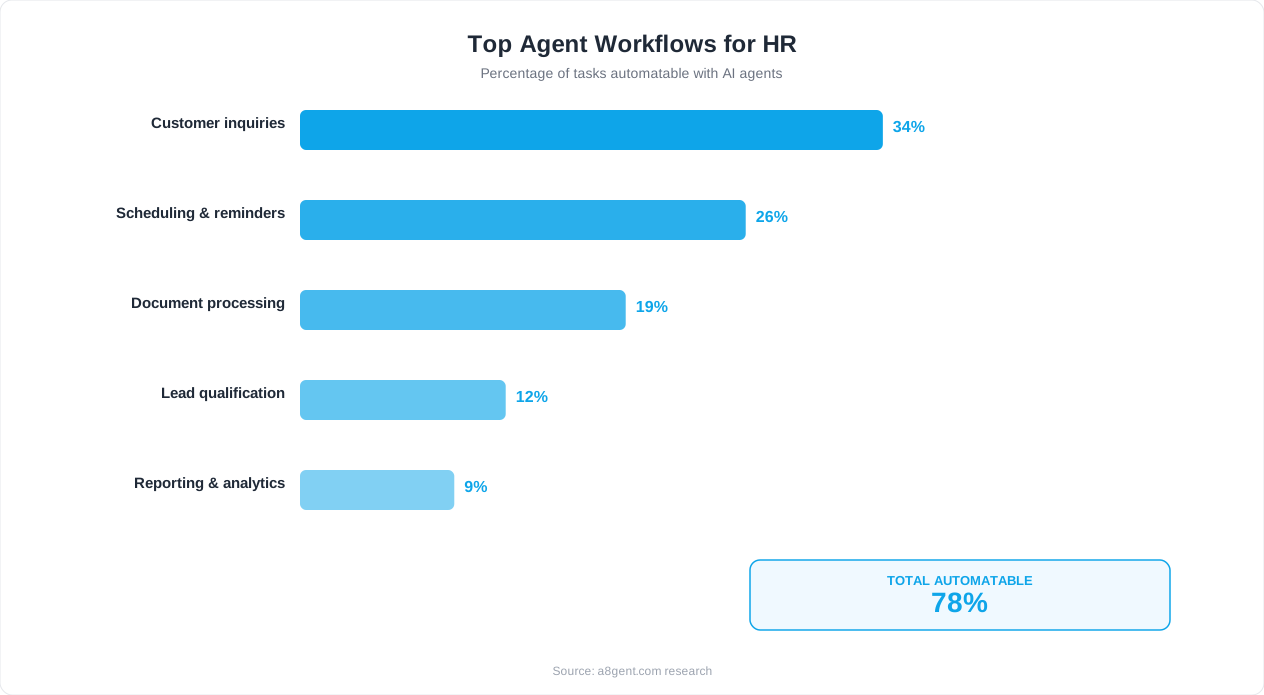
Onboarding starts the moment an offer is accepted - not on the first day. AI agents handle the entire pre-arrival workflow: sending welcome emails with first-day logistics, collecting required documents (tax forms, ID verification, direct deposit information, emergency contacts), triggering IT to provision equipment and system access, scheduling orientation sessions and team introductions, assigning a buddy or mentor, and sending periodic engagement communications to keep the new hire excited as their start date approaches. All of this happens automatically based on the offer acceptance trigger, with the AI adapting timelines based on the specific start date.
First Week Orchestration
The first week is critical for new hire engagement, and it involves coordination across multiple departments. The AI agent manages: Day 1 welcome checklist (badge, equipment, workspace, welcome kit), orientation schedule with automatic calendar invitations, introduction meetings with key team members and stakeholders, initial training module assignments and tracking, system access verification (confirming all provisioned access works), and daily check-in communications asking if the new hire needs anything. Each task is assigned to the responsible party, tracked to completion, and escalated if overdue.
30-60-90 Day Programs
Effective onboarding extends well beyond the first week. AI agents manage structured 30-60-90 day programs: scheduling manager check-ins at predetermined intervals, sending role-specific training content on a progressive schedule, triggering performance milestone assessments at 30 and 60 days, coordinating peer feedback collection at 90 days, and adapting the program based on new hire engagement signals. If a new hire is struggling (missing training deadlines, not engaging with assigned resources), the AI flags this for HR intervention before it becomes a retention problem.
Department-Specific Customization
Different roles require different onboarding content. An engineering hire needs code repository access, development environment setup, and architecture documentation. A sales hire needs CRM training, product knowledge content, and territory assignment. A finance hire needs compliance training, system access, and audit procedure documentation. AI agents manage these role-specific variations automatically - selecting the correct onboarding track based on department, role level, and location without HR manually assembling custom checklists for every hire.
Compliance and Documentation
Every onboarding involves compliance requirements: I-9 verification timelines, mandatory training completion (harassment prevention, safety, data protection), policy acknowledgment signatures, and benefits enrollment deadlines. AI agents track every compliance requirement against its deadline, send reminders at appropriate intervals, escalate when deadlines are approaching, and maintain complete audit trails proving that every requirement was met for every employee. This compliance automation alone can save organizations from significant legal exposure.
Implementation on Autonoly
Build your onboarding workflow on Autonoly by mapping your current onboarding checklist (every task, every responsible party, every deadline) into an automated workflow. Connect to your HRIS, email, calendar, and document management systems. Configure triggers (offer acceptance starts pre-boarding, start date triggers first-week workflows) and escalation rules (overdue tasks alert HR managers). Most organizations have full onboarding automation operational within 1-2 weeks of setup.
Candidate Screening: Fair, Fast, and Consistent
Candidate screening sits at the intersection of speed and quality. Screen too slowly and top candidates accept other offers. Screen too hastily and unqualified candidates waste interview time while qualified ones get overlooked. AI agents resolve this tension by screening every application thoroughly and immediately - something human reviewers simply cannot do at scale.
Criteria-Based Screening
Effective AI screening starts with well-defined criteria. For each role, you define: required qualifications (must-haves that are genuinely non-negotiable), preferred qualifications (nice-to-haves that strengthen a candidacy), disqualifying factors (clear reasons to decline), and evaluation dimensions (experience relevance, skill match, cultural indicators). The AI evaluates every application against these criteria with equal thoroughness - the 300th resume gets the same careful analysis as the 3rd. Each candidate receives a structured evaluation with a match score, qualification summary, strengths, concerns, and a recommended action (advance, hold, or decline).
Beyond Keyword Matching
Modern AI screening understands context in ways that simple keyword matching cannot. It recognizes that "people management" and "team leadership" indicate similar experience. It understands that 3 years at a high-growth startup may represent more relevant experience than 5 years in a slow-moving corporation for certain roles. It evaluates career trajectory - not just current qualifications - to identify candidates with high growth potential. And it can assess writing quality, communication clarity, and attention to detail from application materials themselves.
Structured Communication to Candidates
AI screening agents do not just evaluate - they communicate. Candidates who advance receive immediate notification with clear next steps and timeline expectations. Candidates who are declined receive respectful, timely feedback (within 24-48 hours, not weeks of silence). Candidates in the "hold" category receive acknowledgment that their application is under review. This communication discipline - applied consistently across all candidates regardless of volume - dramatically improves employer brand and candidate experience.
Bias Reduction and Auditability
AI screening addresses one of HR's most persistent challenges: unconscious bias in resume review. When configured correctly (criteria focused on skills and experience rather than pedigree), AI screening evaluates candidates more consistently than human reviewers who are influenced by name recognition, school prestige, employment gaps, formatting quality, and reviewer fatigue. Critically, every screening decision is documented and auditable - you can review exactly why any candidate was scored as they were and identify systematic patterns that might indicate bias in your criteria definition.
Integration with Interview Process
Screening is not an isolated step - it feeds directly into interview scheduling and panel assignment. AI agents pass qualified candidates into scheduling workflows, match interviewer expertise to candidate background, prepare interview guides customized to each candidate's profile, and ensure interviewers have relevant context before every conversation. This integration eliminates the coordination delays that typically occur between screening completion and first interview.
Volume Handling
During peak hiring periods (seasonal hiring, growth spurts, multiple simultaneous openings), manual screening becomes impossible to maintain at quality. AI agents scale perfectly - processing 500 applications with the same quality as 5. They prioritize roles with urgent timelines, flag exceptional candidates for immediate attention regardless of the queue, and maintain consistent quality even when volume spikes unexpectedly. For organizations using Lindy alongside Autonoly, screening workflows integrate with broader HR automation for seamless candidate lifecycle management. Assess your screening process to identify where AI can have the most immediate impact.
Offboarding Automation: Compliance, Security, and Dignity
Offboarding is the most neglected HR process - and potentially the most dangerous when done poorly. Incomplete offboarding creates security vulnerabilities (former employees with active system access), legal exposure (missed final pay requirements, benefits continuation failures), knowledge loss (undocumented institutional knowledge walking out the door), and brand damage (departed employees with negative last impressions). AI agents ensure every offboarding is complete, compliant, and respectful.
Immediate Security Actions
When a termination or resignation is entered into the system, AI agents trigger time-sensitive security protocols: scheduling access revocation for the departure date (or immediately for involuntary separations), generating a complete list of systems, tools, and physical assets the employee has access to, notifying IT to prepare for credential deactivation, and flagging any sensitive data access that requires immediate review. These actions must happen quickly and completely - AI agents ensure nothing is missed regardless of how busy the HR team is on departure day.
Compliance Checklist Management
Offboarding compliance varies by jurisdiction, employment type, and termination reason. AI agents manage the full compliance matrix: final paycheck timing requirements (varies by state - some require same-day payment for involuntary terminations), COBRA notification timelines, 401(k) rollover communication, PTO payout calculations, non-compete and NDA reminder communications, unemployment insurance documentation, and equipment return tracking. Each requirement is tracked against its legal deadline with escalation when timelines are at risk.
Knowledge Transfer Coordination
When an employee departs, their institutional knowledge goes with them unless you actively capture it. AI agents manage the knowledge transfer process: identifying the departing employee's key responsibilities and relationships, scheduling knowledge transfer sessions with successors, creating documentation checklists for critical processes only the departing employee understands, and tracking completion of transfer activities before the departure date. For unexpected departures, the agent immediately identifies knowledge gaps and prioritizes transfer activities based on business criticality.
Exit Interview and Feedback
Exit interviews provide invaluable insight into organizational issues - but they often get skipped when HR is busy or the relationship is strained. AI agents ensure every departing employee has the opportunity to provide feedback: scheduling exit interviews at appropriate times, sending anonymous survey options for those who prefer not to speak directly, aggregating feedback themes across departures to identify systemic issues, and routing critical feedback (harassment reports, safety concerns, legal matters) to appropriate parties immediately.
Manager and Team Communication
The departure affects more than just the departing employee. AI agents coordinate communication to relevant parties: notifying the manager of required actions (final performance documentation, knowledge transfer participation), communicating to team members about transition plans, updating organizational charts and distribution lists, and managing client notification where the departing employee had external relationships. This coordination prevents the awkward information gaps that often occur during transitions.
Graceful Departure Experience
Regardless of the reason for departure, employees deserve a dignified exit. AI agents manage thoughtful touches: scheduling farewell opportunities for voluntary departures, ensuring final communications are respectful and complete, providing clear information about benefits continuation and reference policies, and maintaining professional contact for alumni network opportunities. Companies that offboard well protect their employer brand and maintain relationships that generate referrals and boomerang hires. Build your complete offboarding workflow on Autonoly with triggers based on termination type, ensuring involuntary and voluntary departures follow appropriate but distinct protocols. Connect with operations automation to integrate offboarding with your broader organizational processes.
HR Compliance Automation: Reducing Legal Risk
HR compliance is a minefield of deadlines, requirements, and documentation obligations that vary by jurisdiction, company size, and employment type. A single missed compliance requirement can result in fines, lawsuits, or regulatory action. AI agents do not eliminate compliance complexity, but they ensure that every requirement is tracked, every deadline is met, and every action is documented - dramatically reducing the legal risk that keeps HR leaders awake at night.
Regulatory Tracking
Employment law changes constantly. New state laws, updated federal regulations, evolving case law, and changing local ordinances create a moving target that HR teams struggle to track. AI agents monitor regulatory changes relevant to your jurisdictions and employment practices, flag requirements that affect your organization, summarize changes in plain language with required actions, and set deadlines for policy updates or new compliance procedures. This proactive monitoring prevents the common scenario where companies learn about new requirements only after they have already violated them.
Documentation and Audit Trails
In employment disputes and regulatory audits, documentation is everything. AI agents maintain comprehensive audit trails for every HR process: who was communicated what information and when, which policies were acknowledged and by whom, what training was completed and when, how performance issues were documented and addressed, and what accommodations were requested and how they were handled. This documentation happens automatically as a byproduct of AI-managed processes rather than requiring HR to manually record every action.
Policy Acknowledgment and Training Compliance
Every organization has mandatory policies (anti-harassment, data protection, safety, ethics) that employees must acknowledge, and mandatory training they must complete. AI agents manage the entire lifecycle: distributing policies at hire and when updated, tracking acknowledgment completion, scheduling and tracking mandatory training, sending escalating reminders for overdue compliance, and reporting compliance status across the organization. This eliminates the spreadsheet-tracking nightmare that most HR teams currently endure.
Benefits Administration Compliance
Benefits administration involves numerous compliance requirements: ACA reporting, ERISA fiduciary obligations, COBRA administration, FSA/HSA contribution limits, and open enrollment timelines. AI agents manage these automatically: generating required notices at appropriate times, tracking employee elections and changes, ensuring qualifying life events are processed within regulatory timelines, and producing the documentation needed for annual compliance filings. Errors in benefits administration are among the most expensive HR compliance failures - AI consistency prevents them.
Leave Management
Leave compliance is extraordinarily complex - FMLA, ADA accommodations, state family leave laws, military leave (USERRA), and company policies all interact with different eligibility criteria, duration limits, and documentation requirements. AI agents evaluate leave requests against all applicable regulations, determine eligibility, calculate available time, manage required communications (designation notices, return-to-work certifications), and ensure consistent application across all employees. This is an area where human inconsistency creates enormous legal exposure that AI consistency eliminates.
Building Your Compliance Framework
Implement compliance automation on Autonoly by mapping your compliance requirements (federal, state, local, and industry-specific) into automated tracking workflows. Connect to your HRIS for employee data, configure notification rules for approaching deadlines, and set up dashboard reporting for compliance status visibility. Pair with Lindy for AI-powered policy interpretation that helps managers understand compliance requirements in context without requiring HR involvement for routine questions.
Improving Employee Experience with AI Agents
Beyond process efficiency, AI agents fundamentally improve the employee experience at every stage of the employment lifecycle. When administrative processes run smoothly, invisibly, and consistently, employees feel supported and valued - even if they never interact with the AI directly. The experience improvement comes from eliminating frustrations that employees have accepted as normal.
Self-Service HR Support
Employees have HR questions constantly: how much PTO do I have left, what is the parental leave policy, how do I update my beneficiaries, when is open enrollment, what does my dental plan cover, how do I request a workplace accommodation. Currently, these questions either go to overwhelmed HR teams (creating 2-3 day response delays) or go unanswered (creating frustration and disengagement). AI agents provide instant, accurate answers to routine HR questions 24/7 - pulling from your policies, benefits documentation, and HRIS data to give personalized, contextual responses.
Proactive Communication
Instead of expecting employees to know what they need and when they need it, AI agents communicate proactively. Approaching benefits enrollment? The agent sends a personalized summary of your current elections, highlights any changes to available plans, and reminds you of the deadline with clear instructions. Anniversary approaching? The agent notifies your manager for recognition. Performance review due? The agent sends preparation guides to both the employee and manager with appropriate lead time. This proactive approach eliminates the last-minute scrambles and missed deadlines that frustrate employees.
Consistent Manager Support
Managers are the front line of employee experience, but many managers are poorly equipped for HR-related responsibilities. AI agents support managers with: reminders and guidance for performance conversations, templates and frameworks for difficult discussions, policy information relevant to team situations (leave requests, accommodation needs, promotion criteria), and alerts when team engagement signals suggest intervention is needed. This support does not replace manager development but ensures that even inexperienced managers have the information needed to handle HR situations properly.
Career Development Automation
Employee growth and development is consistently rated as a top priority but often deprioritized under daily operational pressure. AI agents maintain momentum: tracking development goals and sending progress reminders, identifying relevant learning opportunities based on stated career interests, scheduling mentor meetings at regular intervals, and surfacing internal mobility opportunities that match an employee's skills and aspirations. This consistent attention to development - even when managers are distracted by urgent business needs - demonstrates organizational investment in employee growth.
Feedback and Engagement
Regular feedback collection and action are essential for engagement but difficult to sustain manually. AI agents manage pulse surveys at appropriate intervals, analyze sentiment trends, flag concerning patterns (a team with declining engagement, a new hire showing signs of disengagement), and help managers understand and respond to feedback themes. The agent ensures that collected feedback actually drives action rather than disappearing into annual reports that arrive too late to prevent turnover.
Making It Personal
The irony of AI in HR is that it enables more personal experiences, not less. When AI handles the administrative burden, HR professionals have time for meaningful human interactions: career conversations, conflict mediation, wellness check-ins, and creative culture building. Configure your employee experience automation on Autonoly to handle routine support and communication while flagging situations that benefit from personal human attention. Explore operations automation to see how HR automation connects with broader organizational efficiency.
Implementation Guide: AI Agents for Your HR Team
Implementing AI agents in HR requires balancing efficiency gains with the sensitivity these processes demand. People's careers, livelihoods, and personal information are involved - getting it right matters more than getting it fast. Here is a proven implementation approach that delivers results while maintaining the trust and care that HR processes require.
Phase 1: Start with Onboarding (Weeks 1-3)
Onboarding is the ideal starting point because it is process-heavy, the stakes of errors are moderate (inconvenient but not catastrophic), and improvement is immediately visible to new hires and managers. Map your current onboarding checklist completely - every task, owner, deadline, and dependency. Build the automated workflow on Autonoly using your existing process as the foundation. Run your first 2-3 new hires through the automated workflow while maintaining manual backup oversight. Refine based on what works and what needs adjustment.
Phase 2: Add Screening (Weeks 3-5)
Once onboarding automation is running smoothly, implement candidate screening. Define screening criteria for your most common roles. Process 50-100 historical applications through the AI to calibrate scoring against human decisions. Adjust criteria until AI screening decisions align with your team's historical judgment at 85%+ agreement. Go live with AI screening for new applications while HR reviews the AI's recommendations for the first 2 weeks before trusting it to advance candidates autonomously.
Phase 3: Implement Offboarding (Weeks 5-7)
Offboarding automation requires careful attention to security and compliance. Map every offboarding requirement by termination type (voluntary resignation, involuntary termination, layoff, retirement). Build workflows with appropriate urgency levels - involuntary terminations trigger immediate security actions while voluntary departures follow a graceful 2-week timeline. Test thoroughly with simulated departures before processing real separations through the automated system.
Phase 4: Compliance and Employee Experience (Weeks 7-12)
With the three core processes automated, expand to compliance tracking and employee experience enhancements. Map your compliance calendar (all deadlines, all requirements, all jurisdictions). Implement self-service HR support by loading policies and benefits documentation into your AI agent. Configure proactive communication workflows for recurring events (benefits enrollment, performance reviews, anniversaries). Launch employee feedback automation at appropriate intervals.
Integration Requirements
Effective HR automation requires integration with: your HRIS (employee records, org structure, employment status), payroll system (compensation data, final pay processing), benefits administration platform (enrollment, changes, COBRA), IT systems (access provisioning and revocation), communication tools (email, Slack, Teams), and document management (policy storage, signed forms). Autonoly offers pre-built connectors for major HR platforms while Lindy provides AI-powered interfaces for employee self-service support.
Measuring Success
Track these metrics from day one: onboarding completion rate (percentage of tasks completed on time), new hire time-to-productivity (time to first independent contribution), screening turnaround time (hours from application to first communication), offboarding completion rate (percentage of checklist items completed), compliance deadline adherence (zero missed deadlines target), and HR team time allocation (percentage spent on strategic vs administrative work). Target: 60-80% reduction in administrative HR time within 90 days, freeing your team for the human-centered work that attracted them to HR in the first place.
The Future of AI-Augmented HR
AI agents are not just automating current HR processes - they are enabling entirely new approaches to human capital management that were previously impossible due to time and complexity constraints. Understanding where HR technology is heading helps you invest wisely today while preparing for tomorrow's capabilities.
Predictive People Analytics
AI agents are moving beyond reactive process management toward predictive people intelligence. They analyze patterns in employee behavior (engagement survey trends, communication patterns, performance trajectories, tenure milestones) to predict retention risk, identify high-potential employees earlier, forecast staffing needs based on business growth patterns, and detect cultural issues before they become crises. This predictive capability transforms HR from a reactive function that responds to problems into a proactive one that prevents them.
Personalized Employee Journeys
Just as marketing has moved from mass communication to personalization, HR is moving toward individualized employee experiences. AI agents will design onboarding programs tailored to each person's learning style, role complexity, and social preferences. They will recommend career paths based on individual strengths, interests, and organizational needs. They will customize benefits communication to highlight what matters most to each employee's life stage. This personalization at scale was previously impossible - AI makes it practical.
Continuous Performance Development
The annual performance review is dying - replaced by continuous feedback, real-time recognition, and ongoing development conversations. AI agents enable this shift by: prompting managers for feedback after project completions, surfacing peer recognition opportunities, tracking skill development against career goals continuously, and providing managers with data-driven coaching suggestions for each team member. Performance management becomes a daily practice rather than an annual event, driven by AI that maintains momentum without requiring HR intervention.
Workforce Planning Intelligence
AI agents will increasingly support strategic workforce planning: analyzing skill gaps against business strategy, modeling hiring needs under different growth scenarios, identifying reskilling opportunities to develop existing employees rather than hiring externally, and predicting the impact of organizational changes on team dynamics and productivity. This intelligence transforms HR from an operational support function into a strategic business partner with data-driven insights that influence organizational direction.
Ethical AI in HR
As AI becomes more embedded in HR decisions, ethical frameworks become critical. The firms and organizations that develop responsible AI practices now - transparent decision criteria, regular bias auditing, human oversight for consequential decisions, and employee communication about how AI is used - will build trust that becomes a competitive advantage. Employees will increasingly choose employers whose AI practices are transparent and fair over those who use opaque algorithms that employees do not understand or trust.
Getting Started Today
The future of AI-augmented HR is built on the foundation you create today. Start with the operational automation covered in this guide - onboarding, screening, offboarding, compliance. As these processes run smoothly, you will have both the data and the organizational readiness to advance toward predictive analytics, personalized experiences, and strategic workforce intelligence. Take our assessment to identify your starting point and build a roadmap that leads from administrative automation to strategic HR transformation.
FAQ
Will employees feel dehumanized by interacting with AI during onboarding?
Research shows the opposite: employees prefer smooth, timely automated processes over chaotic, delayed human-managed ones. The key is positioning AI as the coordination layer while maintaining meaningful human touchpoints - manager welcome conversations, team introductions, and buddy programs remain human. Employees appreciate getting system access on day one and having clear information delivered proactively rather than waiting days for overloaded HR to respond.
How do we handle sensitive offboarding situations like involuntary terminations?
AI handles logistics and compliance, not the human conversation. The termination discussion remains between the manager, HR, and the employee. After that conversation, AI takes over the administrative process: access revocation, final pay processing, benefits continuation notice, equipment return tracking, and compliance documentation. This ensures that even in difficult situations, nothing is missed - which actually protects both the organization and the departing employee.
Is AI screening legally compliant with anti-discrimination laws?
When configured properly, AI screening is more consistently non-discriminatory than human screening because it evaluates based on defined, job-related criteria rather than unconscious bias. However, you must: use job-related criteria only, avoid proxies for protected characteristics, conduct regular adverse impact analysis, maintain human oversight for final decisions, disclose AI use where legally required (NYC, Illinois), and document your validation process. Consult employment counsel for jurisdiction-specific requirements.
What happens when the AI makes a mistake in an HR process?
Build error handling into your workflow: human review checkpoints for consequential actions (access revocation, candidate rejection, compliance filings), escalation rules for edge cases the AI cannot confidently handle, and regular audits of AI decisions against desired outcomes. Mistakes will happen - as they do with human processes - but AI mistakes are consistent and fixable at the system level rather than random and recurring. When you find an error, fix the workflow and it never happens again.
How do we maintain data privacy when AI processes employee information?
Use enterprise platforms with SOC 2 compliance, data encryption at rest and in transit, and clear data processing agreements. Configure AI agents with minimum necessary data access - onboarding agents do not need performance data, screening agents do not need salary information. Ensure your AI vendor agreements include data deletion provisions and prohibit using your employee data for model training. Update your employee privacy notices to disclose AI processing where required by GDPR, CCPA, or state laws.
Can AI agents handle HR processes for remote and international employees?
Yes, and this is actually where AI agents add the most value. International HR involves jurisdiction-specific compliance requirements that are extremely difficult to track manually across multiple countries. AI agents manage country-specific onboarding requirements, local employment law compliance, time-zone-appropriate communication scheduling, and regional benefits administration. For distributed teams, AI coordination is often the only way to ensure consistent processes across all locations.
How long does it take to see ROI from HR automation?
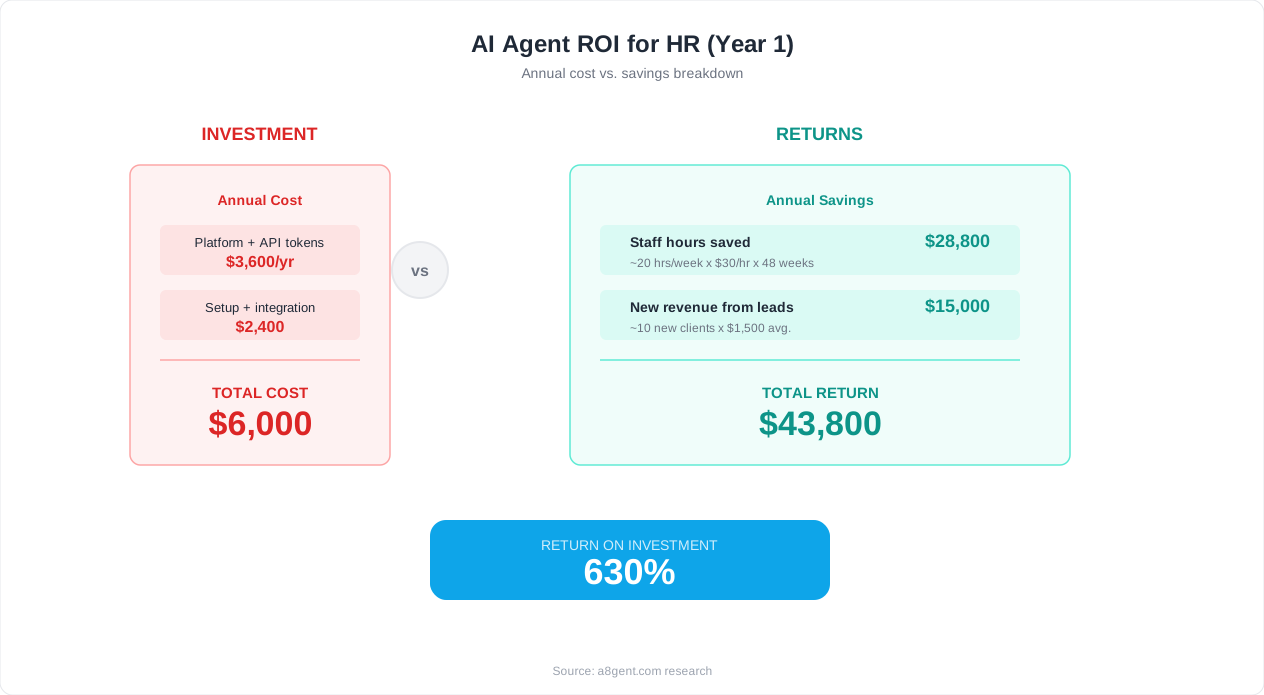
Most organizations see measurable time savings within 2-3 weeks of deploying onboarding automation. At average HR professional costs of $35-$50/hour, saving 8-12 hours per onboarding across 30 hires/year yields $8,400-$18,000 in annual labor savings. Add screening automation saving 15-20 hours per role and offboarding saving 4-6 hours per departure. Total first-year savings for a mid-size company typically range from $25,000-$75,000 against platform costs of $2,400-$6,000 annually.
Should we replace our HRIS with AI agents or use them alongside existing systems?
Use AI agents alongside your existing HRIS - not as a replacement. Your HRIS remains the system of record for employee data. AI agents sit on top as an automation and intelligence layer that orchestrates workflows, manages communications, and coordinates across systems. This approach protects your HRIS investment, maintains data integrity, and adds automation capability without the risk and cost of a full system migration. Platforms like Autonoly integrate with major HRIS platforms through pre-built connectors.