Best AI Agent for Small Business in 2026: 12 Tools Ranked
We tested and ranked 12 AI agent platforms specifically for small business owners. From budget-friendly automation to full-scale digital employees, here are the tools that actually deliver results without requiring a technical team.
10+ years shipping production ML across TensorFlow, PyTorch, AWS, and GCP. Ships every A8gent agent before it becomes a lesson. GitHub
- The best AI agent for your small business depends on your primary use case - sales, support, marketing, or operations - not just the overall ratings.
- Budget-friendly options like n8n and Autonoly can deliver enterprise-grade automation at a fraction of what larger platforms charge.
- Most top-ranked tools offer free trials or free tiers generous enough to prove value before you commit any budget.
- Non-technical business owners should prioritize platforms with plain-English setup, pre-built templates, and responsive support over raw feature count.
- Starting with a single focused agent that handles one painful task well beats deploying multiple agents that each work halfway.
Why Small Businesses Need AI Agents in 2026
If you run a small business in 2026, you are probably wearing five hats at once. You handle sales, manage operations, respond to customers, oversee marketing, and still try to find time for the strategic thinking that actually grows revenue. The problem is not a lack of ambition - it is a lack of hours in the day.
This is exactly where AI agents change the game for small businesses. Unlike enterprise software that costs thousands per month and requires an IT team to implement, today's AI agents are built for business owners who need results fast, at a price that makes sense for a lean operation. An AI agent can handle your email responses, follow up with leads, schedule appointments, generate reports, and manage dozens of other repetitive tasks - all while you focus on the work that only you can do.
But here is the challenge: there are now dozens of AI agent platforms competing for your attention, each claiming to be the best. Some are genuinely excellent for small businesses. Others are enterprise tools with confusing pricing that will eat your budget before delivering value. And a few are overhyped products that sound impressive in demos but fall apart in real-world use.
We spent six weeks testing 12 AI agent platforms specifically through the lens of a small business owner. Our criteria were practical: How easy is it to set up without a developer? How quickly does it deliver measurable time savings? Is the pricing transparent and affordable at small-business scale? Does it actually work reliably day after day?
The result is this ranked guide. Whether you need an agent to handle customer conversations, automate your sales outreach, manage your social media, or streamline your back-office operations, you will find the right tool below. And if you want a personalized recommendation based on your specific business, take our free AI agent assessment - it matches you with the ideal platform in under two minutes.
Let us get into the rankings. We have organized the 12 tools from best overall for small businesses down to more specialized options that excel in specific scenarios.
How We Ranked These AI Agent Platforms
Before we dive into the individual tools, you deserve to know how we evaluated them. Our ranking methodology was designed specifically for small business owners - not enterprise buyers, not developers, not AI enthusiasts. Here are the five criteria we scored each platform on, weighted by importance to a typical small business.
Ease of Setup (25% weight)
Can a non-technical business owner go from sign-up to a working agent within one hour? We tested each platform with zero prior experience, following only their documentation and onboarding flow. Tools that required coding knowledge, complex API configuration, or technical jargon scored lower. Tools with plain-English instructions, visual builders, and pre-built templates scored higher.
Time to Value (25% weight)
How quickly does the platform start saving you real time? Some tools deliver value on day one - you set up an email auto-responder and immediately stop spending 45 minutes on routine replies. Others require weeks of configuration before they produce anything useful. We measured how many days it took to achieve a meaningful reduction in manual work for common small business tasks.
Pricing Transparency and Affordability (20% weight)
Small businesses cannot afford surprise bills. We evaluated whether pricing is clear and predictable, whether free tiers are genuinely usable (not just marketing bait), and whether the cost scales reasonably as usage grows. A platform that costs $50/month and saves you 10 hours scored higher than one costing $300/month that saves you 12 hours.
Reliability and Accuracy (20% weight)
An agent that works 70% of the time creates more problems than it solves - you spend your time checking and fixing its mistakes instead of doing the work yourself. We tested each platform for consistency over a two-week period, tracking error rates, downtime, and the frequency of outputs that would embarrass you if sent to a customer without review.
Integration Ecosystem (10% weight)
Does the platform connect to the tools you already use? We checked for integrations with the most common small business software: Gmail, Google Workspace, QuickBooks, Shopify, HubSpot, Mailchimp, Slack, Calendly, Stripe, and social media platforms. More integrations means less friction in deployment and more powerful automation possibilities.
With these criteria in mind, use our agent finder tool to filter platforms by your specific needs - it lets you prioritize the criteria that matter most for your situation.
Top 4: Best Overall AI Agents for Small Business
These four platforms stood out across all our criteria. They combine ease of use, fast value delivery, fair pricing, and reliability in a way that makes them suitable for virtually any small business regardless of industry.
1. Autonoly - Best Overall for Small Business Owners
Autonoly earns the top spot because it was purpose-built for small and mid-size businesses from day one. Unlike platforms that started as enterprise tools and bolted on a small-business tier, Autonoly's entire design philosophy centers on non-technical users who need results fast. You describe what you want in plain English - "follow up with leads who haven't responded in 3 days" or "send me a daily summary of all new customer inquiries" - and it builds the agent for you. Setup typically takes 15 to 30 minutes for common use cases, and the template library covers everything from sales follow-up to invoice processing to social media scheduling. Pricing starts at a level that works for solo operators and scales predictably as your usage grows. The multi-agent coordination feature means you can eventually build an entire digital team without switching platforms.
2. n8n - Best for Customizable Workflows
n8n is the choice for small business owners who want maximum flexibility without writing code. Its visual workflow builder lets you create agents by connecting nodes on a canvas - each node represents a trigger, an action, or an AI decision point. While the learning curve is slightly steeper than Autonoly (plan for an afternoon rather than 30 minutes), the trade-off is almost unlimited customization. You can build workflows that no template could cover, handle complex branching logic, and create agents that are perfectly tailored to your unique business processes. The self-hosted option is a bonus for businesses handling sensitive client data. Over 400 integrations cover virtually every tool a small business uses.
3. Lindy - Best for Solo Entrepreneurs
Lindy shines for solopreneurs and very small teams (1-5 people) who need a single platform to handle multiple roles. You create individual agents (called "Lindies") for different tasks - one for email management, one for meeting scheduling, one for research - and they all share context about your business. The interface feels like giving instructions to a virtual assistant rather than configuring software, which makes it the least intimidating option for non-technical users. Particularly strong for knowledge workers, consultants, and service providers who spend too much time on administrative tasks.
4. Zapier (with AI Features) - Best for Businesses Already Using Zapier
If you already have Zapier automations running in your business, their new AI agent features are the path of least resistance. You do not need to migrate anything - you simply upgrade existing workflows with AI decision-making capabilities. Zapier's agents can now read emails and decide what to do with them, qualify leads based on nuanced criteria, and generate dynamic content within your existing automation flows. The integration library is the largest in the industry with over 6,000 apps. The main limitation is that pure AI agent capabilities are not as sophisticated as purpose-built platforms, but for businesses that want to enhance rather than replace their current automation, it is an excellent choice.
Best AI Agents for Small Business Sales
If your primary goal is generating more revenue - more leads, more meetings, more closed deals - these platforms specialize in turning AI agents into your sales team's secret weapon. For small businesses without dedicated sales teams, these tools effectively give you a tireless sales development representative working around the clock.
5. Clay - Best for Lead Research and Outreach
Clay is the go-to platform for small businesses that rely on outbound sales or account-based marketing. Think of it as a research assistant on steroids - you feed it a list of target companies or contacts, and it enriches every record with data from dozens of sources: LinkedIn profiles, company websites, job postings, funding announcements, tech stack information, and recent news. Then the magic happens: Clay's AI uses all that research to write genuinely personalized outreach messages that reference specific details about each prospect. This is not "Hi {FirstName}" personalization - it is "I noticed you just expanded into the Austin market and are hiring three account executives, which usually means..." level personalization. For B2B service businesses, agencies, and consultants who need to stand out in crowded inboxes, Clay delivers remarkable response rates.
6. 11x.ai - Best for Automated Sales Development
11x.ai takes a different approach from Clay by offering fully autonomous AI sales agents rather than research tools. Their flagship agent, Alice, handles the entire top-of-funnel sales process: identifying prospects that match your ideal customer profile, finding verified contact information, writing personalized outreach sequences, sending follow-ups at optimal intervals, and booking meetings directly on your calendar. For small businesses that cannot afford a full-time sales development representative (typically $60,000-$80,000 per year), 11x.ai delivers comparable results at a fraction of the cost. The platform works best for B2B companies with clearly defined target markets and deal sizes above $5,000 - at lower deal sizes, the unit economics favor simpler solutions.
7. Instantly.ai - Best Budget Option for Email Outreach
If you need high-volume outbound email capabilities on a tight budget, Instantly.ai is the standout choice. It combines email warm-up (to keep your messages out of spam folders), lead finding, and AI-powered email writing in a single affordable platform. The AI capabilities are more limited than Clay or 11x.ai - you get help writing and optimizing email copy rather than fully autonomous agents - but for small businesses testing outbound sales for the first time, it provides the essential infrastructure at a price point that eliminates risk. Many businesses start with Instantly.ai, prove that outbound works for their market, and then graduate to more sophisticated platforms as their pipeline grows.
Not sure which sales approach fits your business model? Our agent finder tool asks about your sales process, deal size, and target market to recommend the right platform for your specific situation.
Best AI Agents for Customer Support and Operations
For small businesses drowning in customer inquiries or spending too many hours on operational tasks, these platforms turn AI agents into your support team and operations manager. They handle the repetitive work so your team can focus on the complex issues that actually need a human touch.
8. Intercom (with Fin AI) - Best for Customer-Facing Chat
Intercom's Fin AI agent is purpose-built for customer conversations. It learns from your help center, product documentation, and past support conversations to answer customer questions accurately without any manual scripting. What makes it stand out for small businesses is the balance between automation and human handoff - Fin resolves straightforward questions autonomously (typically 40-60% of all inquiries) and seamlessly escalates complex issues to your team with full context. The setup requires pointing it at your existing documentation rather than building responses from scratch, which means you can be live within a day if you already have a knowledge base or FAQ page.
9. Tidio - Best Budget Support Agent
For small businesses that need AI-powered customer support without Intercom's price tag, Tidio offers a compelling alternative. Their AI chatbot handles common customer questions across your website, Facebook Messenger, and email. The free tier is genuinely useful for low-volume businesses (up to 100 conversations per month), and paid plans remain affordable as you scale. The visual flow builder lets you create conversational paths without coding, and the AI handles variations in how customers ask the same question. Best for e-commerce stores, local service businesses, and any company that gets repetitive questions about hours, pricing, or product details.
10. n8n (for Operations) - Best for Back-Office Automation
While n8n appeared earlier as a general-purpose tool, it deserves special mention for operations automation. Small businesses waste enormous time on back-office processes: invoice processing, data entry between systems, report generation, inventory monitoring, and employee onboarding checklists. n8n excels here because you can build agents that connect directly to your accounting software, project management tools, HR systems, and file storage. A common setup: an n8n agent monitors your Gmail for incoming invoices, extracts the relevant data using AI, matches it against purchase orders in your system, and routes it for approval - turning a 20-minute manual process into something that happens in seconds. The self-hosted option means sensitive financial data never leaves your infrastructure.
11. Notion AI - Best for Knowledge Management
If your team already lives in Notion, their AI features transform it into an operational agent for knowledge work. It can draft documents, summarize meeting notes, extract action items, answer questions about information scattered across your workspace, and automate database management. For consulting firms, agencies, and professional services businesses where organized knowledge is a competitive advantage, Notion AI eliminates the administrative overhead of keeping information current and accessible. The limitation is that it works within Notion's ecosystem - it will not reach out to your CRM or send emails autonomously.
Best AI Agents for Marketing and Content
Small business marketing often suffers from inconsistency - you post actively for two weeks, then get busy with client work and go silent for a month. AI agents solve this by keeping your marketing engine running regardless of how hectic your schedule gets. These platforms handle the content creation, scheduling, and optimization that keep your brand visible.
12. Buffer (with AI Features) - Best for Social Media Management
Buffer has evolved from a simple scheduling tool into an AI-powered social media agent. The AI generates post ideas based on your industry and audience, writes copy tailored to each platform's style, suggests optimal posting times based on your historical engagement data, and helps you repurpose long-form content into social-friendly formats. For small businesses that know they should be active on social media but struggle to create consistent content, Buffer's AI removes the creative burden. You review and tweak the suggestions rather than staring at a blank screen. The pricing remains friendly for small businesses, and the interface is remarkably simple - no learning curve if you have ever used any social media tool.
Honorable Mentions for Marketing
Several other platforms deserve attention depending on your specific marketing needs. Jasper AI remains strong for long-form content creation - blog posts, email campaigns, and website copy. Clearscope excels at SEO optimization by analyzing top-ranking content and guiding your writing to compete. Surfer SEO combines content writing with real-time optimization scoring. And for email marketing specifically, Mailchimp's AI features now include audience segmentation, send-time optimization, and subject line generation that meaningfully improve open and click rates.
The Multi-Tool Marketing Stack
Most successful small businesses in 2026 combine two or three specialized marketing tools rather than relying on one platform for everything. A typical effective stack might look like: Autonoly for coordinating the overall marketing workflow and connecting tools together, Buffer or a similar platform for social media execution, and a content tool like Jasper for long-form writing. The key is choosing tools that integrate well with each other so data flows automatically - your blog post gets published, your social agent creates platform-specific promotions for it, and your email agent notifies your subscriber list, all triggered by that single publish action.
Want help building the right marketing stack for your business? Our agent finder lets you filter specifically by marketing use cases and shows you which platforms work best together. You can also take the full assessment to get a customized recommendation that factors in your budget, team size, and current marketing maturity.
How to Choose the Right AI Agent for Your Business
With 12 options on the table, you might feel more overwhelmed than when you started reading. That is normal - the AI agent market is crowded and every platform's marketing makes them sound perfect. Here is a practical decision framework that cuts through the noise and gets you to the right choice quickly.
Start with Your Biggest Pain Point
Do not think about AI agents in general - think about the one task or workflow that causes you the most frustration or wastes the most time right now. Then match that specific pain to a specific tool:
- Drowning in customer questions? Start with Intercom Fin or Tidio
- Need more leads and meetings? Start with Clay, 11x.ai, or Instantly
- Spending hours on repetitive operations? Start with n8n or Autonoly
- Inconsistent marketing and social media? Start with Buffer or Jasper
- Wearing every hat and need general help? Start with Lindy or Autonoly
Consider Your Technical Comfort Level
Be honest with yourself. If the word "workflow" makes your eyes glaze over, choose the simplest option even if a more complex tool has better features on paper. A tool you actually use beats a powerful tool that sits unused because you found it confusing. The platforms ranked by ease of use from simplest to most flexible: Lindy, Tidio, Buffer, Autonoly, Zapier, Intercom, Clay, 11x.ai, Instantly, Notion AI, Jasper, n8n.
Set a Budget Ceiling Before You Shop
Decide what you can afford to invest per month before you start free trials. Most small businesses see strong ROI at $50-$150 per month for their first agent. If that makes you uncomfortable, start with free tiers - Tidio, n8n (self-hosted), and Notion AI all have genuinely functional free options. If you have more budget to work with, the $100-$300 range unlocks the most capable options like Autonoly, Clay, and Intercom.
The Two-Week Litmus Test
Once you pick a platform, give it exactly two weeks. Set a clear goal: "Save me at least 5 hours this week on email responses" or "Book at least 3 meetings I would not have gotten otherwise." If the tool meets or exceeds that goal within two weeks, you have a winner. If it falls short despite honest effort, move to the next option on your list. Do not spend months trying to make a poor fit work.
If you want this entire decision made for you based on your specific situation, our free assessment asks the right questions and delivers a personalized recommendation in under two minutes. It factors in your industry, team size, budget, technical comfort, and primary goals to point you at exactly one platform to start with.
Your Next Steps: Getting Started This Week
You now have a clear picture of the best AI agent platforms available for small businesses in 2026. The worst thing you can do with this information is bookmark this page and come back to it "later." Later never comes, and every week you delay is a week your competitors are pulling ahead with AI-powered efficiency. Here is exactly what to do in the next seven days.
Today (15 minutes)
Take our free AI agent assessment. Answer a few questions about your business, and get a personalized recommendation for which platform to try first and which workflow to automate. This eliminates analysis paralysis and gives you a clear starting point.
Day 1-2: Sign Up and Connect
Create an account on your recommended platform. Connect it to the primary tools it needs to access - usually your email, your calendar, and one or two business-specific apps (CRM, project management, or e-commerce platform). Most platforms walk you through this with guided setup wizards that take 20-30 minutes.
Day 3-5: Deploy Your First Agent
Build your first agent focused on a single task. Use a template if one exists for your use case - do not try to build something custom from scratch on your first attempt. Set it to "review mode" where you approve its actions before they go live. Start feeding it real work and watch how it handles it.
Day 5-7: Refine and Trust
Review the agent's outputs over the first few days. Adjust its instructions where it made mistakes. Most platforms let you provide feedback naturally - "That response was too formal" or "Don't offer discounts unless the customer asks twice." By the end of the first week, most business owners report their agent is handling 80%+ of tasks correctly without intervention.
Week 2 and Beyond: Measure and Expand
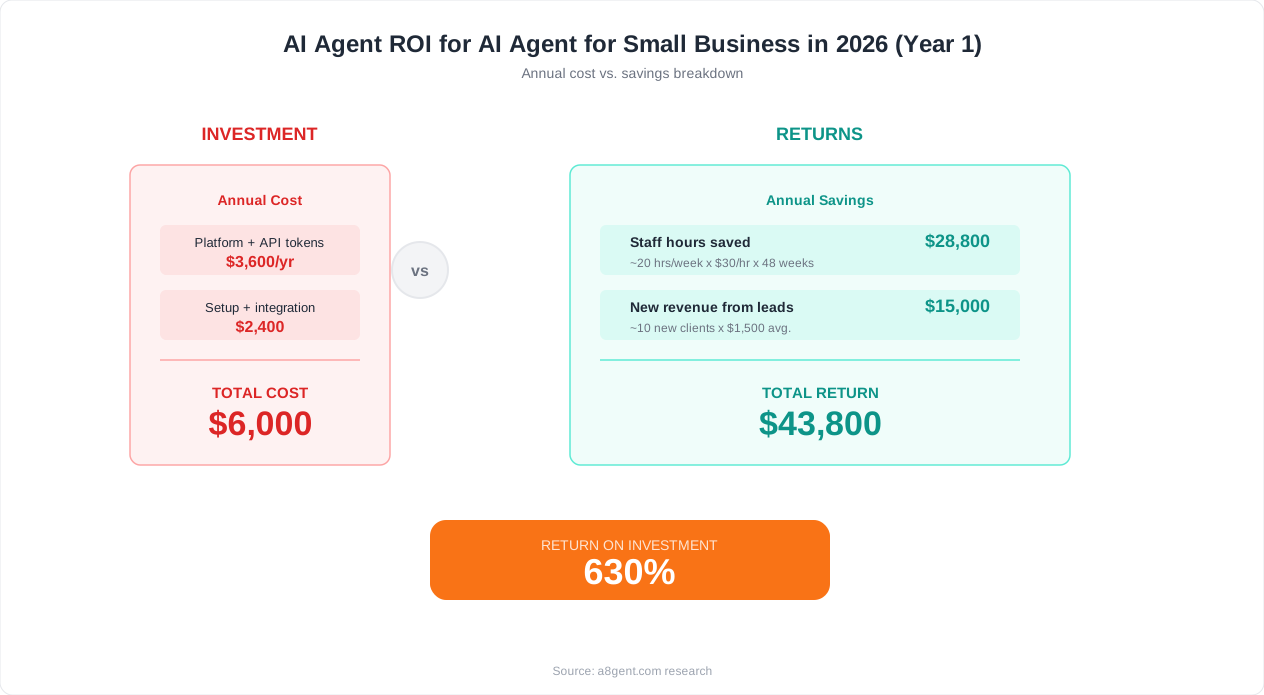
Track how much time you saved in week one. Calculate the dollar value of that time. If it exceeds what you are paying for the platform (it almost always does by 5-10x), you have proven the concept. Now you can either optimize your first agent further or deploy a second one for a different workflow.
- Quick start: Take the free assessment for a personalized recommendation
- Compare options: Use our agent finder tool to filter by your specific criteria
- Calculate savings: Estimate your potential ROI before committing any budget
The businesses thriving in 2026 are not the ones with the biggest teams or the largest budgets. They are the ones that figured out how to multiply their capacity with AI agents while staying lean and focused. You have the information you need. The only question is whether you will act on it this week or wish you had six months from now. Start today.
FAQ
What is the best AI agent for a one-person business?
For solopreneurs, Lindy or Autonoly are the strongest choices. Both are designed for non-technical users who need help across multiple areas - email management, scheduling, lead follow-up, and content creation. Lindy feels most like a personal assistant, while Autonoly offers more powerful multi-agent coordination as you grow.
How much should a small business spend on AI agents per month?
Most small businesses see strong ROI spending $50 to $200 per month on their first AI agent. Start with free trials to prove value before committing budget. The key metric is time saved multiplied by your hourly rate - if an agent saves 10 hours per month and your time is worth $75/hour, a $150/month tool delivers 5x return.
Can AI agents work with my existing business software?
Yes. All platforms on this list integrate with popular small business tools including Gmail, Google Workspace, HubSpot, Shopify, QuickBooks, Slack, Calendly, Stripe, Mailchimp, and many more. Most offer 200+ integrations. Check that your specific must-have tools are supported before committing to a platform.
Do I need technical skills to set up an AI agent?
No. Platforms like Autonoly, Lindy, and Tidio are specifically designed for non-technical business owners. You describe what you want in plain English and use visual interfaces to connect your tools. Some platforms like n8n offer more power but with a slightly steeper learning curve that may require a few hours of tutorials.
How long does it take to see results from an AI agent?
Most business owners report meaningful time savings within the first week. Simple automations like email responses or meeting scheduling show value on day one. More complex workflows like lead nurturing or content pipelines typically take one to two weeks to optimize. The key is starting with a focused single-task agent rather than trying to automate everything at once.
Are AI agents reliable enough to handle customer communication?
Yes, when set up properly. Start with the agent in review mode where you approve messages before they send. Monitor accuracy for the first week and refine instructions for edge cases. Most platforms achieve 85-95% accuracy after initial tuning. For high-stakes communications, keep human approval in the loop permanently.
What happens if my AI agent makes a mistake with a customer?
Good platforms include safeguards: confidence thresholds that trigger human review, escalation rules for complex situations, and undo capabilities. Start with low-risk tasks and expand gradually. Most mistakes are minor wording issues, not catastrophic errors. Set clear boundaries on what the agent can and cannot do - for example, it can answer questions but cannot issue refunds above a certain amount without approval.
Can I use multiple AI agents from different platforms together?
Yes. Many businesses use two or three specialized tools connected through a workflow platform like n8n, Zapier, or Autonoly. For example, you might use Clay for lead research, Buffer for social media, and Autonoly to coordinate between them. The key is choosing platforms that integrate well with each other through APIs or native connections.