AI Agents for Law Firms: Contract Review and Client Intake (2026)
Learn how AI agents help law firms automate contract review, streamline client intake, and reduce administrative overhead. A practical guide for firm owners and managing partners covering tools, compliance, and implementation.
10+ years shipping production ML across TensorFlow, PyTorch, AWS, and GCP. Ships every A8gent agent before it becomes a lesson. GitHub
- Attorneys spend 48% of their workday on administrative tasks rather than billable legal work - AI agents automate intake, document management, and routine communications to recover 10-20 billable hours per attorney per week.
- AI contract review tools analyze documents 60-90% faster than manual review while catching clause inconsistencies and missing terms that human reviewers miss 15-25% of the time during high-volume periods.
- Automated client intake converts 40-60% more potential clients by providing instant response to inquiries (vs. 24-48 hour callback delays), qualifying prospects, and scheduling consultations without staff involvement.
- Modern legal AI tools maintain attorney-client privilege protections, comply with ABA ethics rules on technology use, and provide audit trails that satisfy bar association requirements across all 50 states.
- Implementation starts at Free-$149/month for solo practitioners and requires no technical skills - most firms see measurable ROI within 30 days through improved intake conversion and recovered billable time.
Why Law Firms Are Falling Behind Without AI Automation
The legal profession faces a productivity crisis that most managing partners acknowledge privately but few have addressed systematically. A 2025 Thomson Reuters study found that attorneys at firms of 2-50 lawyers spend only 52% of their workday on substantive legal work. The remaining 48% goes to administrative tasks: managing client communications, chasing documents, updating case files, generating invoices, handling scheduling, and processing intake inquiries. For a firm billing at $300/hour, that means nearly half of each attorney's capacity is consumed by tasks that generate zero revenue.
The financial impact is staggering when quantified. An attorney working 2,000 hours annually with 48% administrative overhead has only 1,040 hours available for billable work. If that same attorney could reduce administrative time to 25% through AI automation, they'd recover 460 additional billable hours - worth $138,000 at $300/hour. For a 5-attorney firm, that's nearly $700,000 in recoverable revenue annually from addressing a single inefficiency.
Beyond revenue, administrative burden is driving attorney burnout and attrition at unprecedented rates. Associates cite paperwork and administrative tasks as a top-three reason for leaving firms, and lateral hiring costs ($50,000-150,000 per placement plus ramp-up time) make retention a critical business concern. Reducing the administrative grind through AI isn't just a revenue play - it's a talent retention strategy.
Client expectations have also shifted. Potential clients contacting your firm expect a response within hours, not days. They expect digital intake processes, not paper forms mailed to them. They expect regular case updates pushed to them, not requiring them to call your office and wait on hold. Firms that don't meet these expectations lose clients to competitors who do - regardless of legal expertise. A brilliant attorney who takes 3 days to return a potential client's call loses to a competent attorney who responds in 3 hours.
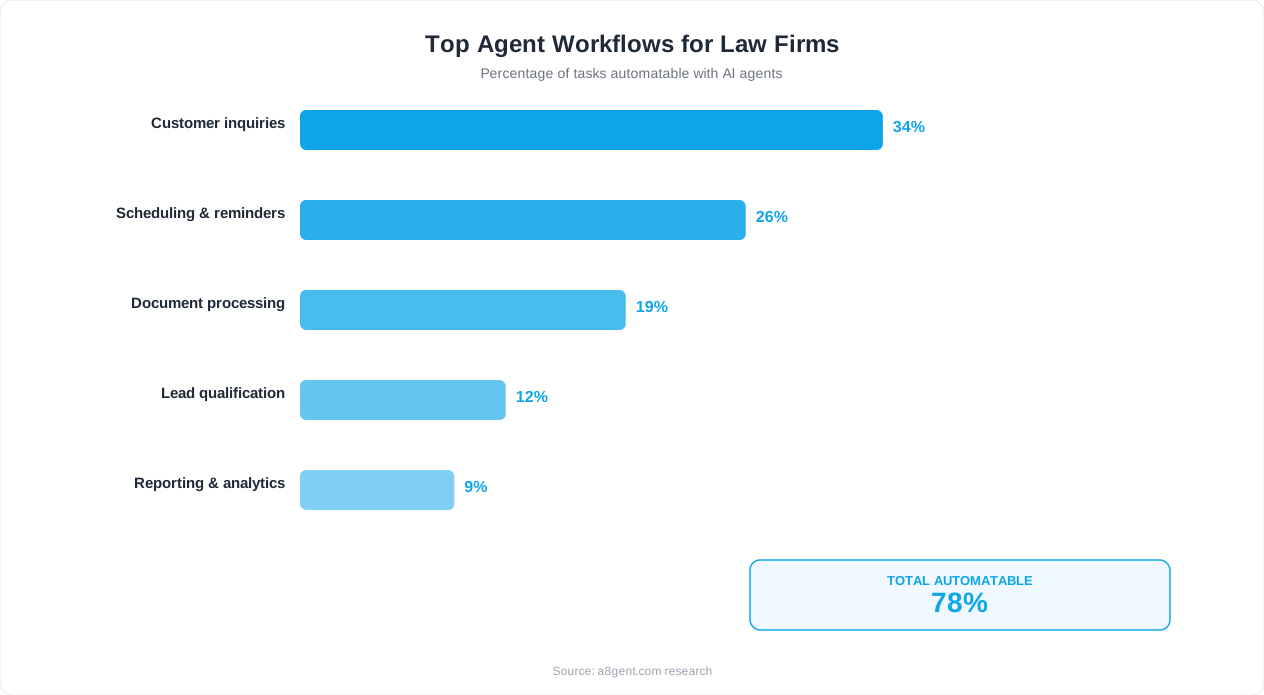
AI agents address all of these challenges simultaneously. They handle intake inquiries instantly at any hour, automate document processing and review, manage client communication workflows, and eliminate the administrative tasks that consume attorney time and drive burnout. The technology has matured to the point where it works within legal ethics frameworks, maintains privilege, and provides the audit trails that compliance requires.
Not sure where AI fits in your firm's operations? Take our free AI readiness assessment to identify which of your firm's administrative bottlenecks will deliver the fastest return when automated.
AI Contract Review: Faster Analysis, Fewer Missed Issues
Contract review is one of the most time-intensive activities in legal practice - and one where AI delivers the most dramatic efficiency gains. Whether your firm handles real estate transactions, business formations, employment agreements, or commercial contracts, the review process follows similar patterns: read the document, identify key terms, flag unusual clauses, compare against standards, note missing provisions, and summarize findings for the client or supervising attorney.
AI contract review tools perform this analysis in minutes rather than hours. Upload a contract and the AI identifies and extracts: key dates and deadlines (effective date, termination, renewal triggers), parties and their obligations, payment terms and conditions, indemnification and liability provisions, intellectual property assignments, non-compete and non-solicitation clauses, termination rights and cure periods, change of control provisions, governing law and dispute resolution mechanisms, and any unusual or non-standard language that deviates from typical market terms.
The speed advantage is significant - AI reviews a 30-page commercial contract in 2-3 minutes versus 45-90 minutes for manual attorney review. But speed is only part of the value. Consistency is equally important. Human reviewers suffer from fatigue, especially when reviewing multiple contracts in sequence. Studies show that issue detection rates drop 15-25% after the third consecutive contract in a review session. AI maintains consistent attention to every clause in every document regardless of how many contracts it has processed that day.
For firms handling high-volume contract work (real estate closings, M&A due diligence, vendor agreement management), AI review scales linearly without quality degradation. A 200-document due diligence review that would require two associates working full-time for a week can be processed by AI in a day, with the attorneys spending their time on the genuinely complex issues flagged by the AI rather than reading through hundreds of pages of standard boilerplate to find the handful of provisions that actually matter.
AI doesn't replace attorney judgment on substantive legal questions. It replaces the mechanical reading and extraction that consumes the majority of review time. The attorney's role shifts from reader to analyst: reviewing AI-flagged issues, applying legal judgment to ambiguous provisions, and advising clients on risk - the high-value work that clients actually need legal expertise for. Autonoly and Dust both offer document processing capabilities that integrate with legal practice management systems, feeding review results directly into your matter files.
For firms concerned about accuracy, AI contract review tools in 2026 provide confidence scores for each extraction, clearly distinguishing between definitive findings and items requiring human verification. This transparency lets attorneys calibrate their review effort appropriately - spending time only on uncertain items rather than re-reading everything the AI has already analyzed with high confidence.
Client Intake Automation: Convert More Prospects Into Paying Clients
Client intake is where law firms hemorrhage potential revenue without realizing it. The typical small firm intake process looks like this: a potential client calls or submits a web form. Someone at the firm (often a paralegal or receptionist) eventually returns the call - average response time is 24-48 hours at small firms. They conduct a brief screening conversation, determine if the matter is within the firm's practice areas, and either schedule a consultation or refer elsewhere. Simple in theory, but the execution gaps are enormous.
The data on legal intake is alarming. Studies show that 42% of potential clients who contact a law firm never receive a callback. Among those who do, 67% have already contacted another attorney by the time the firm responds. For firms spending $5,000-$20,000 monthly on marketing to generate those inquiries, the waste is unconscionable. You're paying to attract leads and then losing them through operational failure.
AI intake agents eliminate the response gap entirely. When a potential client submits a web form at 11 PM, calls during lunch hour, or sends an inquiry through your website chat at 6 AM, the AI responds immediately. It conducts a qualification conversation: gathering basic case information, confirming the matter type aligns with your practice areas, assessing urgency and timeline, checking for conflicts against basic criteria, and scheduling a consultation on your calendar for qualified prospects.
The qualification process is sophisticated enough to filter effectively without turning away good potential clients. The AI asks practice-area-specific questions that an experienced intake specialist would ask: for personal injury, details about the incident, timeline, treatment status, and insurance situation; for family law, the specific matter type, jurisdiction, and whether children are involved; for business law, entity type, transaction nature, and timeline constraints. Responses are scored and prospects are categorized as high-priority (immediate attorney review), standard (scheduled consultation), or not a fit (polite referral to appropriate resources).
For qualified prospects, the AI schedules consultations directly on attorney calendars based on availability, practice area match, and matter complexity. It sends confirmation communications with any required intake forms, directions, or preparation instructions. It follows up before the appointment to reduce no-shows. The attorney walks into the consultation already informed - the AI has prepared a matter summary based on the intake conversation.
Firms implementing AI intake consistently report 40-60% increases in consultation bookings from the same lead volume. The math is compelling: if your firm currently converts 30% of inquiries to consultations and AI moves that to 50%, that's a 67% increase in potential new clients without spending an additional dollar on marketing. At an average matter value of $3,000-$10,000, even 2-3 additional conversions per month easily justify the technology investment. Explore how AI handles the full client communication lifecycle in our operations automation guide.
Document Management and Generation: Eliminate the Paper Chase
Legal practice generates an extraordinary volume of documents - pleadings, motions, contracts, correspondence, discovery materials, court filings, and client communications. Managing this volume manually creates the administrative overhead that consumes attorney and paralegal time, produces filing errors that cause missed deadlines, and makes knowledge retrieval (finding that clause from a contract you drafted two years ago) frustratingly slow.
AI document management for law firms operates on two levels: organizing and retrieving existing documents, and generating new documents from templates and matter data. Both capabilities dramatically reduce the time spent on document-related tasks that currently consume 25-30% of a typical attorney's workday.
On the organization side, AI automatically classifies incoming documents by matter, document type, and relevance. An email with an attached contract gets filed to the correct matter folder, tagged with the document type, and its key terms extracted into the matter database - without anyone manually saving, naming, and filing the attachment. This eliminates the document chaos that plagues firms using shared drives or even basic practice management systems that require manual filing discipline.
Document generation through AI transforms how firms produce routine legal documents. Rather than starting from a template and manually filling in matter-specific details (a process that takes 30-90 minutes per document and introduces copy-paste errors), AI generates complete first drafts by pulling data from the matter file, client information, and applicable jurisdiction requirements. Engagement letters, demand letters, standard motions, corporate formation documents, basic contracts, and routine correspondence can be generated in minutes with matter-specific details already populated accurately.
For litigation firms, AI-powered document review during discovery is transformative. Processing thousands of documents to identify relevant materials, privileged communications, and responsive items previously required teams of contract attorneys billing at $75-150/hour for weeks. AI review tools process the same volume in a fraction of the time, with initial relevance scoring that lets human reviewers focus on borderline documents rather than wading through clearly non-responsive materials. Firms report 60-80% cost reductions on document review projects.
Knowledge management - the ability to find and reuse work product across matters - is another high-value AI capability. Need a non-compete clause suitable for a tech company in California? AI searches your firm's entire document history, finds relevant precedents, and presents options ranked by recency and relevance. This institutional knowledge, which traditionally lived only in senior attorneys' memories, becomes accessible to every attorney in the firm. Dust's knowledge management capabilities are particularly strong for firms wanting to build searchable institutional knowledge bases from their document archives.
Client Communication and Case Updates: Stay Connected Without the Effort
The number one complaint clients have about their attorneys isn't about legal outcomes - it's about communication. Bar association surveys consistently show that "my lawyer doesn't return my calls" and "I don't know what's happening with my case" are the top grievances. This isn't because attorneys don't care. It's because updating 50-100 active clients regularly, responding to every status inquiry, and maintaining proactive communication cadences is physically impossible alongside substantive legal work.
AI communication agents solve this by maintaining consistent, informative touchpoints with every client on every active matter. The system operates on two levels: proactive updates pushed to clients at appropriate intervals, and reactive responses to client inquiries handled automatically when the answer is available in the case file.
Proactive communication follows matter-type-specific cadences. A personal injury case in litigation gets monthly status updates covering recent developments, next scheduled events, and expected timeline. A transactional matter approaching closing gets more frequent updates as milestones are completed. An estate planning matter in drafting gets notifications when documents are ready for review. The AI generates these updates by reading the matter file, recent activity, and calendar entries - producing clear, jargon-free summaries that clients can actually understand.
Reactive communication handles the routine inquiries that interrupt attorney workflow dozens of times daily: "When is my next court date?" "Did you receive the documents I sent?" "What's the status of my closing?" "When will my contract be ready?" These questions, which account for 60-70% of client communications, have answers already present in the matter management system. The AI looks up the information and provides an immediate, accurate response - often faster and more complete than what a busy attorney could provide between meetings.
For inquiries requiring attorney input or judgment, the AI captures the question, gathers relevant context from the matter file, and routes to the appropriate attorney with a prepared brief. The attorney can respond in 2 minutes with full context rather than spending 10 minutes pulling up the file, remembering where things stand, and composing a response from scratch. The AI then delivers the attorney's response to the client in appropriate format and language.
Client satisfaction improvements from automated communication are dramatic: firms report 40-60% reductions in "where's my case?" calls, 25-35% improvements in client satisfaction scores, and measurable increases in referral rates from clients who feel informed and valued throughout their matter lifecycle. Learn how Autonoly manages multi-channel client communications while maintaining attorney-client privilege protections and ethics compliance.
Billing, Time Tracking, and Revenue Recovery
Law firms leave shocking amounts of money on the table through inadequate time capture. Studies consistently show that attorneys fail to record 10-30% of their billable time - not from dishonesty, but from the difficulty of reconstructing a day's activities after the fact. An attorney who worked 9 hours but only captures 6.5 because they forgot the 20-minute client call, the 15-minute email exchange, and the 30-minute research tangent loses $750/day at $300/hour. Over a year, that's $195,000 in unrecovered revenue per attorney.
AI time tracking operates passively in the background, monitoring attorney activity across email, documents, phone calls, calendar events, and practice management systems. It automatically generates time entries that the attorney reviews and approves rather than requiring manual reconstruction at the end of each day. The entries include accurate durations, matter associations (determined by analyzing context - which client was in the email, which matter does the document relate to), and preliminary task descriptions that the attorney can refine.
The revenue recovery from AI-assisted time capture is immediate and substantial. Firms implementing passive time tracking report 15-25% increases in captured billable hours - directly translating to revenue without requiring attorneys to work longer or bill differently. For a 5-attorney firm averaging 1,500 billed hours per attorney annually, a 20% capture improvement at $300/hour represents $450,000 in additional annual revenue from time that was already being worked but not recorded.
Invoice generation through AI reduces the billing cycle friction that plagues small firms. Rather than a partner spending Sunday afternoon reviewing and editing time entries, the AI pre-processes entries: consolidating related activities, formatting descriptions for client clarity, flagging entries that need attention (unusually short or long, missing descriptions, potential duplicate entries), and generating draft invoices that require only final review before sending. The billing cycle that used to take 4-6 hours monthly per billing attorney shrinks to 45-60 minutes.
Accounts receivable management is another AI-powered revenue recovery tool. The system tracks outstanding invoices, sends professionally worded payment reminders at appropriate intervals, escalates past-due accounts through progressively firmer communication sequences, and provides the billing partner with aging reports that highlight collection risks before they become write-offs. Firms using AI collections automation report 15-20% reductions in days outstanding and 5-10% reductions in write-offs.
For firms transitioning from hourly billing to flat-fee or value-based models, AI provides the data foundation. By accurately tracking time across matter types, the firm builds the historical data needed to price flat-fee offerings profitably - knowing exactly how many hours each matter type actually consumes rather than relying on estimates that frequently undercount. Autonoly integrates with major legal billing platforms (Clio, MyCase, PracticePanther, Rocket Matter) to provide seamless time capture and billing automation within your existing financial workflow.
Ethics, Compliance, and Privilege Considerations
Legal ethics obligations create legitimate concerns about AI adoption that other industries don't face. Attorneys have duties of competence, confidentiality, supervision, and candor that directly implicate how they use technology. The good news: AI tools designed for legal practice in 2026 are built with these ethical obligations as foundational requirements, not afterthoughts. Here's how the major ethical considerations are addressed.
Attorney-client privilege and confidentiality: Legal AI tools process matter data in isolated environments where information from one client cannot influence or be exposed to another. Data is encrypted in transit and at rest, access is controlled through role-based permissions, and processing occurs within SOC 2 Type II certified infrastructure. Critically, reputable legal AI vendors do not use your client data to train their models - your matters remain confidential and isolated. Data processing agreements (DPAs) are standard and explicitly address privilege concerns.
Duty of competence (ABA Model Rule 1.1): Attorneys must understand the tools they use well enough to identify errors. Legal AI tools address this through transparency - showing confidence scores, flagging uncertain analyses, and never presenting outputs as final legal conclusions. The attorney's role remains as the competent professional reviewing and validating AI analysis, not delegating final judgment to an algorithm. Most state bar associations have issued guidance confirming that using AI tools appropriately falls within competent practice.
Duty of supervision (ABA Model Rule 5.3): Partners must supervise non-lawyer assistants, which extends to AI tools. This is satisfied by maintaining human review of all AI outputs that affect client matters, establishing firm policies about AI use and review procedures, and documenting the review process. Legal AI platforms provide audit trails showing who generated, reviewed, and approved each AI output - satisfying supervisory documentation requirements.
Duty of candor and disclosure: Some jurisdictions now require disclosure when AI is used in certain contexts (court filings, for example). Legal AI platforms can be configured to include appropriate disclosures automatically based on jurisdiction-specific requirements. They also maintain generation records that support attorneys in making accurate representations about document preparation to courts when required.
For firms navigating these ethical considerations, the practical approach is straightforward: use legal-specific AI tools (not general-purpose consumer AI), maintain human oversight of all client-affecting outputs, document your AI use policies, stay current with your state bar's technology ethics opinions, and choose vendors who understand and specifically address legal ethics requirements. Autonoly and Dust both provide legal ethics compliance documentation and can assist firms in developing appropriate AI use policies that satisfy bar requirements in all 50 states.
Getting Started: Implementation Roadmap for Law Firms
Implementing AI in a law firm requires a methodical approach that addresses both operational needs and professional responsibility obligations. Here's the practical roadmap that works for firms of all sizes, from solo practitioners to 50-attorney firms, based on successful deployments across hundreds of legal practices.
Phase 1 (Week 1-2): Client intake automation. This is the ideal starting point for every firm because it generates immediate revenue impact, carries minimal risk (intake is pre-engagement, reducing privilege concerns), and demonstrates value quickly. Connect your website forms to an AI intake agent, configure practice-area-specific qualification questions, and link to your calendar for consultation scheduling. Within days, you'll see previously missed inquiries converting to consultations without any staff effort.
Phase 2 (Week 3-4): Client communication automation. Set up proactive update sequences for your active matters and configure automated responses to common status inquiries. This reduces the inbound call volume that disrupts attorney workflow and immediately improves client satisfaction. Start with one practice area and expand as you refine the communication templates and cadence.
Phase 3 (Month 2): Document generation and time tracking. Implement AI-powered document generation for your most common document types - engagement letters, standard correspondence, routine motions, or basic contracts depending on your practice. Simultaneously deploy passive time tracking to begin recovering unbilled time. These two implementations together produce the largest productivity gain for most firms.
Phase 4 (Month 3): Contract review and advanced document analysis. Once your team is comfortable with AI-assisted work, introduce contract review tools for applicable practice areas. Start with lower-stakes review tasks to build confidence and calibrate the tool's performance against your standards. Gradually expand to more complex review as trust in accuracy develops.
Phase 5 (Month 4-6): Full integration and optimization. At this stage, AI handles intake, communication, document generation, time capture, and review across all practice areas. Your focus shifts to optimization: refining qualification criteria for better intake conversion, improving document templates based on attorney feedback, tuning communication cadences for different matter types, and measuring the revenue impact across the firm.
Common implementation mistakes to avoid: trying to deploy everything simultaneously (creates resistance and makes troubleshooting impossible), skipping the ethics review step (establish your AI use policy before deployment, not after), not training staff on review procedures (AI is a tool requiring human oversight, not a replacement for professional judgment), and choosing general-purpose AI tools instead of legal-specific platforms (generic tools lack privilege protections and ethics compliance features).
Ready to identify your firm's highest-impact starting point? The AI readiness assessment evaluates your firm's current operations, practice areas, and pain points to recommend a specific implementation sequence. Or explore Autonoly's legal practice templates to see pre-built workflows designed for firms like yours - from solo practitioners to multi-practice firms handling diverse matter types.
FAQ
Is it ethical for law firms to use AI agents?
Yes, when used appropriately with human oversight. The ABA and most state bars have issued guidance confirming that AI tools are acceptable within legal practice provided attorneys maintain competence in understanding the technology, supervise AI outputs, preserve client confidentiality through secure platforms, and disclose AI use when required by jurisdiction. Legal-specific AI platforms are designed to satisfy these ethical requirements with built-in privilege protections, audit trails, and compliance documentation.
How much does AI automation cost for a small law firm?
Solo practitioners can start with AI intake and communication tools at $149-249/month. Small firms (2-10 attorneys) typically invest $299-799/month for comprehensive automation covering intake, documents, communication, and time tracking. Compare this to the revenue impact: recovering just 3-5 billable hours per attorney per week at $250-400/hour more than justifies the investment. Most firms see positive ROI within 30 days through improved intake conversion and captured billable time alone.
Will AI replace paralegals or legal assistants?
No. AI handles the mechanical, repetitive portions of paralegal work - data entry, document filing, routine correspondence, basic research retrieval - while paralegals focus on higher-complexity tasks that require legal knowledge and judgment: substantive case preparation, client interaction, complex document drafting, and practice-area-specific work that benefits from human expertise. Firms using AI typically don't reduce paralegal headcount; they redirect paralegal time to higher-value activities and often grow capacity without proportional staff increases.
Is client data safe with legal AI tools?
Reputable legal AI platforms maintain SOC 2 Type II certification, encrypt all data in transit and at rest, provide per-matter data isolation (one client's information never influences or is exposed to another), and sign data processing agreements that explicitly address attorney-client privilege. Client data is not used for model training. Choose platforms that provide written security documentation, can demonstrate compliance with your state's data protection requirements, and offer data residency options if needed.
Can AI actually review contracts accurately?
Yes, with appropriate human oversight. AI contract review tools in 2026 achieve 90-95% accuracy on standard clause identification, extraction, and comparison tasks - comparable to experienced associates. They provide confidence scores for each finding, clearly flagging items requiring human verification. The value isn't replacing attorney judgment on complex provisions; it's eliminating the mechanical reading time and ensuring no standard clauses are overlooked during high-volume reviews. Attorneys review AI findings rather than reading every page from scratch.
How does AI handle different practice areas?
Modern legal AI tools are configurable by practice area. Personal injury firms configure intake for accident screening and medical documentation. Family law firms configure for jurisdictional requirements and custody considerations. Corporate firms configure for entity types and transaction workflows. The same underlying platform adapts to your specific practice through configuration - not custom development. Most platforms support multi-practice firms with different workflows for each practice area under a single account.
Do I need IT staff to implement and maintain legal AI tools?
No. Modern legal AI platforms are designed for non-technical users with visual configuration, guided setup wizards, and pre-built legal templates. Setup involves connecting your existing practice management system (Clio, MyCase, PracticePanther, etc.) through click-based authorization and configuring workflows through forms and toggles. Most solo practitioners complete basic setup in 2-3 hours. Ongoing maintenance is minimal - typically updating templates or adjusting settings when practice needs change, all through the same visual interface.
What's the difference between legal AI and generic AI tools like ChatGPT?
Legal-specific AI tools differ from generic AI in critical ways: they maintain attorney-client privilege protections (your data stays isolated and isn't used for training), they're designed around legal workflows (intake, matter management, billing cycles), they include compliance features specific to bar requirements, they integrate with practice management systems, and they understand legal document structures and terminology natively. Generic AI tools lack these protections and capabilities, making them inappropriate for client matter work despite their general language abilities.