AI Agents for SaaS Companies: Reduce Churn and Scale Support (2026)
SaaS companies lose millions to preventable churn every year. AI agents can intervene at the right moment, resolve support tickets instantly, and guide users through onboarding - all without growing your headcount. This guide covers exactly how SaaS teams are using AI agents to retain customers and scale support in 2026.
10+ years shipping production ML across TensorFlow, PyTorch, AWS, and GCP. Ships every A8gent agent before it becomes a lesson. GitHub
- AI agents can reduce SaaS churn by 20-40% by detecting at-risk users early and intervening with personalized outreach before they cancel.
- Support agents like Intercom Fin resolve 60-80% of customer tickets instantly, freeing your human team for complex relationship-building conversations.
- Onboarding agents guide new users through setup steps, answer questions in real time, and ensure activation milestones are hit within the first 7 days.
- Multi-agent systems can coordinate across support, success, and product teams to create a seamless customer experience without adding headcount.
- The best starting point for any SaaS company is to take a free assessment, identify the highest-churn user segment, and deploy one agent targeting that group within a week.
Why SaaS Companies Are Turning to AI Agents in 2026
If you run a SaaS company in 2026, you already know the math that keeps founders up at night. Acquiring a new customer costs five to seven times more than retaining an existing one. Every point of churn you eliminate flows directly to your bottom line. And yet, most SaaS companies are still fighting churn with the same playbook they used in 2020 - reactive support teams, generic email sequences, and quarterly check-in calls that happen too late to save anyone.
AI agents are changing that equation entirely. They do not replace your customer success team - they give your team superpowers. An AI agent can monitor every single user in your product simultaneously, detect early warning signs of disengagement, intervene with the right message at the right moment, and resolve routine issues before they become cancellation reasons. Your human team simply cannot do this at scale. An agent can.
Consider what happens today when a user signs up for your product and gets stuck during setup. If they are lucky, they find your help docs. If they are persistent, they open a support ticket and wait hours or days for a response. If they are like most people, they quietly leave and never come back. With an AI agent watching the onboarding flow, that stuck user gets immediate, contextual help - right there in the moment, without waiting, without searching, without frustration building.
This is not theoretical. SaaS companies that have deployed AI agents for support and retention are reporting 20-40 percent reductions in churn, 60-80 percent resolution rates on support tickets without human involvement, and dramatically faster time-to-value for new users. The tools exist today, they are affordable for companies of every size, and they do not require an engineering team to deploy.
In this guide, we will walk through exactly how SaaS companies are using AI agents across the entire customer lifecycle - from first sign-up to renewal and expansion. You will learn which tools to use, how to set them up, where to start, and how to measure results. Whether you are a bootstrapped startup with 100 users or a growth-stage company with 10,000, there is an AI agent strategy that fits your situation. Take our free assessment to get a personalized recommendation for your specific SaaS business.
How AI Agents Detect and Prevent Churn Before It Happens
Traditional churn prevention is reactive. A customer sends a cancellation request, and then your team scrambles to save them with a discount or a call. By that point, the decision is already made - you are negotiating with someone who has mentally moved on. AI agents flip this model on its head by detecting churn signals weeks before the customer ever clicks "cancel."
Here is how it works in practice. An AI agent connects to your product analytics, your support system, and your billing data. It builds a behavioral profile for each user - login frequency, feature usage depth, support ticket history, billing issues, and engagement with your emails. It then compares each user's current behavior against patterns that historically preceded cancellations in your specific product. When it spots a match, it acts.
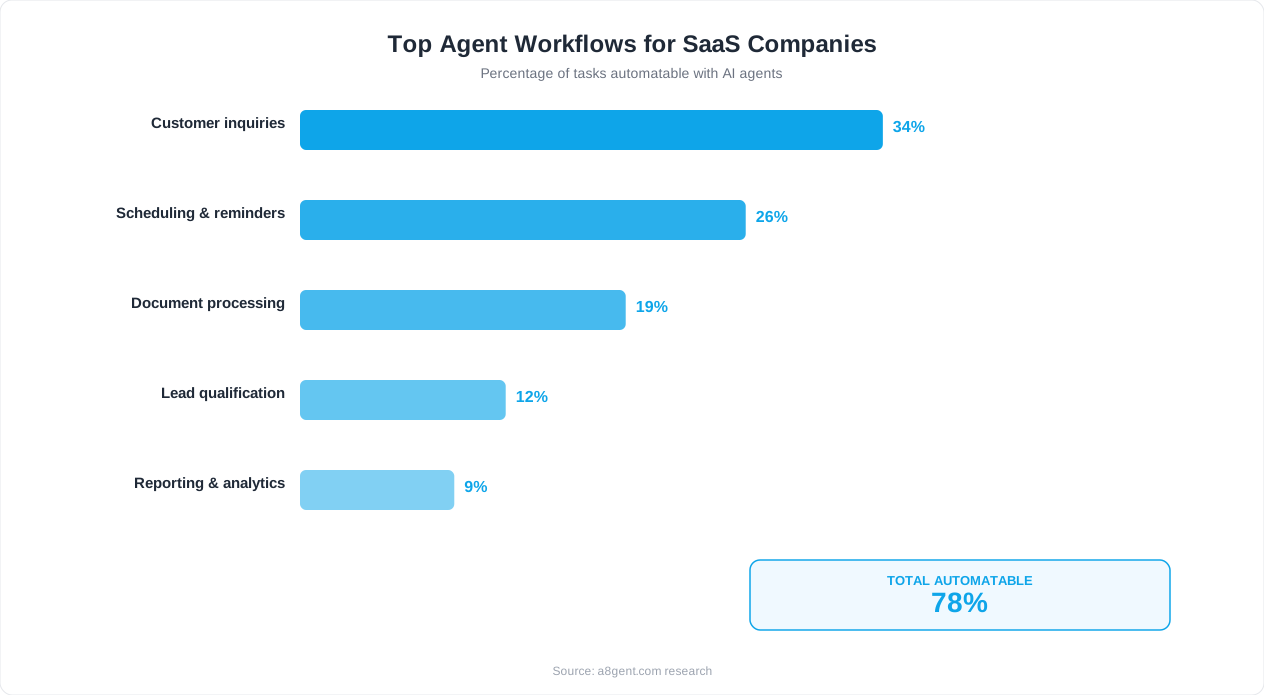
The actions vary based on the signal. A user who has not logged in for 10 days might receive a personalized email highlighting a new feature relevant to their use case. A user whose usage dropped by 50 percent might get an in-app message asking if they need help with a specific workflow. A user who just filed their third support ticket in a week might get a proactive call from your success team - but only after the agent has already resolved the underlying technical issues and prepared a summary for the human rep.
What makes AI agents fundamentally different from traditional churn scoring tools is their ability to act, not just alert. Legacy platforms give you a dashboard with red flags. You still need a human to look at the dashboard, decide what to do, write the message, and send it. AI agents close that loop automatically. They identify the risk, choose the intervention, execute it, and report the outcome - all in real time.
The results speak for themselves. SaaS companies using AI-driven churn prevention report that early intervention - reaching users in the first 48 hours of disengagement - saves 3-5 times more accounts than waiting until traditional "at-risk" thresholds trigger. That is because the agent catches users during the window when they are confused or frustrated but have not yet decided to leave. A timely, helpful message in that window changes the trajectory entirely.
The most sophisticated setups use multi-agent systems where one agent monitors behavior, another handles the outreach, and a third follows up to measure whether the intervention worked. Platforms like Autonoly make this kind of coordination accessible without requiring your engineering team to build custom infrastructure. The agents communicate with each other, share context, and adapt their strategies based on what works for your specific user base.
If churn is your biggest growth bottleneck - and for most SaaS companies between one million and twenty million in ARR, it is - deploying a churn prevention agent should be your first move. The ROI is immediate and measurable: fewer cancellations this month means more revenue next month, compounding over time.
Scaling Customer Support Without Growing Your Team
Every SaaS founder knows this pain: as your customer base grows, support volume grows with it. You hire more support reps, costs climb, and you still cannot provide instant responses at 2 AM when your international customers need help. The traditional answer - more people, more shifts, more overhead - does not scale linearly with revenue. AI agents solve this by handling the volume that humans cannot.
Intercom Fin is one of the most proven solutions in this space. It reads your entire knowledge base, understands your product deeply, and resolves customer questions in seconds rather than hours. When a customer asks "How do I connect my Stripe account?" or "Why is my data not syncing?", Fin does not just point them to a help article. It provides a direct, conversational answer with step-by-step guidance tailored to their specific situation. If the issue requires human judgment, Fin seamlessly escalates with full context so your team never starts from scratch.
The numbers are compelling. SaaS companies deploying AI support agents typically see 60-80 percent of incoming tickets resolved without human involvement. That does not mean lower quality - customer satisfaction scores often increase because users get instant answers instead of waiting in a queue. The remaining 20-40 percent of tickets reach your human team, but they arrive with complete context, the agent's attempted resolution, and a suggested next step. Your team handles fewer tickets, and the ones they handle get resolved faster.
Beyond reactive support, AI agents excel at proactive support - reaching out to users before they encounter problems. An agent monitoring your product can detect when a user is about to hit a known limitation, when their usage is approaching a plan threshold, or when a feature they rely on has a known workaround for a common issue. Instead of waiting for a frustrated ticket, the agent sends a helpful heads-up. This transforms support from a cost center into a retention and expansion driver.
For SaaS companies with technical products, support agents can also handle common troubleshooting workflows autonomously. They can check API status, verify configuration settings, run diagnostic checks, and walk users through resolution steps - all without a human touching the ticket. This is particularly valuable for developer tools, infrastructure products, and platforms where support queries often involve technical debugging.
The financial impact is straightforward to calculate. If your average support rep costs $60,000 per year fully loaded and handles 50 tickets per day, and an AI agent handles 200 tickets per day at a cost of $500 per month, the math overwhelmingly favors the agent for routine queries. You do not eliminate your support team - you redirect them to high-value interactions like enterprise onboarding, strategic account reviews, and complex escalations that genuinely require human empathy and creativity.
Ready to see what support automation could look like for your product? Explore our support automation guide for platform comparisons and implementation blueprints tailored to SaaS companies at different stages.
AI-Powered Onboarding: Get Users to Value Faster
The first seven days after signup are make-or-break for any SaaS product. Industry data consistently shows that users who do not reach their first "aha moment" within the first week have a dramatically higher likelihood of churning within 30 days. Traditional onboarding - a welcome email sequence, maybe a product tour, perhaps a knowledge base link - leaves too many users to figure things out on their own. AI agents change this by providing every single user with what previously only your highest-paying enterprise customers got: a dedicated onboarding guide.
An AI onboarding agent sits inside your product and watches each user's progress through your activation milestones. Did they connect their data source? Did they invite a team member? Did they create their first workflow? Did they experience the core value proposition? When the agent detects a user has stalled at any step, it intervenes immediately with contextual guidance. Not a generic tooltip - a conversational, helpful response that understands what they have already done and what they need to do next.
Here is a concrete example. Imagine you run a project management SaaS. Your activation milestones are: create a project, add three tasks, invite a team member, and complete a task. A new user signs up, creates a project, adds one task, and then stops. They have not logged in for two days. Your AI onboarding agent sends a brief, friendly message: "Hey - I noticed you started setting up your first project. Most teams find it clicks once they have a few tasks in there and invite at least one collaborator. Want me to walk you through importing tasks from your existing system? It takes about 90 seconds."
That message is personalized to exactly where the user is in their journey, it addresses the likely friction point (adding tasks feels tedious), and it offers a specific, low-effort next step. No human could send this message to every user at exactly the right moment. An agent can - for thousands of users simultaneously.
Advanced onboarding agents go further. They learn which activation paths lead to long-term retention for different user segments. A user from a marketing team might need different guidance than a user from an engineering team, even in the same product. The agent adapts its messaging, feature highlights, and suggested workflows based on what it knows about the user - their role, company size, use case, and behavior patterns.
The impact on activation rates is substantial. SaaS companies report 25-50 percent improvements in seven-day activation when they deploy AI onboarding agents. This compounds powerfully - higher activation means lower early churn, which means higher lifetime value, which means you can afford to spend more on acquisition, which accelerates growth. It is a flywheel, and the onboarding agent is the push that gets it spinning.
Platforms like Autonoly allow you to build onboarding agents that coordinate across in-app messages, email, and even SMS without writing code. You define your activation milestones, set the intervention triggers, write the messages in plain English, and the agent handles the timing, personalization, and follow-up logic automatically. Take our assessment to discover which onboarding approach fits your product type and user base.
Using AI Agents to Drive Expansion Revenue and Upsells
Reducing churn is only half the retention equation. The other half - and often the more profitable half - is expansion revenue. Getting existing customers to upgrade plans, add seats, or purchase additional features is far cheaper than acquiring new customers, and it compounds the lifetime value of every account you have already won. AI agents are uniquely suited to identify and capture expansion opportunities because they see usage patterns that humans miss.
Think about how upselling works in most SaaS companies today. Your sales team periodically reviews accounts, looks at usage data in a dashboard, identifies accounts that might be ready for an upgrade, and reaches out. The problem is this process is manual, sporadic, and often too late - the customer already hit their limit, got frustrated, and started evaluating competitors. Or the opportunity was there but nobody noticed because the account was not "big enough" for a dedicated success manager to monitor.
An AI agent monitors every account continuously. It knows when a customer is consistently hitting 80 percent of their plan limits. It knows when they start using a feature that is only available in a limited capacity on their current plan. It knows when their team has grown and they have more active users than their plan allows. And it acts on each of these signals with a perfectly timed, contextually relevant message.
The message is not a hard sell. It is helpful. "I noticed your team has been using the reporting feature heavily this month - you've generated 47 reports, which is approaching your plan limit of 50. Your current plan caps custom dashboards at 5, but based on your usage patterns, the Growth plan would give you unlimited reports and dashboards. Want me to show you what the upgrade looks like for your team?" That is the kind of personalized, data-driven outreach that a human success manager could never do at scale across hundreds or thousands of accounts.
Beyond individual upgrades, AI agents can identify accounts ready for enterprise conversations. When a startup customer's usage patterns start resembling your enterprise customers - multiple teams, API usage, SSO requests, compliance questions - the agent flags them for your sales team with a full briefing: current usage, growth trajectory, features they are bumping against, and suggested expansion path. Your salesperson walks into that conversation fully prepared and at exactly the right moment.
The revenue impact is meaningful. SaaS companies using AI-driven expansion motions report 15-30 percent increases in net revenue retention. For a company with ten million in ARR, that is an additional 1.5 to 3 million dollars annually - from customers you already have, with zero acquisition cost. The agent pays for itself many times over in the first quarter.
The key to making this work is connecting your AI agent to the right data sources: your product analytics, billing system, CRM, and support history. When the agent has full context on an account, its expansion recommendations are relevant and well-timed rather than spammy and premature. Platforms that integrate deeply with your existing SaaS stack - like Intercom Fin for customer communication and Autonoly for workflow coordination - make this connectivity straightforward to achieve without custom engineering work.
How to Implement AI Agents in Your SaaS Company (Step by Step)
You are sold on the concept. Now let us talk about implementation. The SaaS companies that succeed with AI agents follow a specific sequence that minimizes risk and maximizes learning. Here is the proven playbook, whether you are a 5-person startup or a 200-person growth-stage company.
Phase 1: Audit Your Current State (Week 1)
Before deploying any agent, you need clarity on three things. First, where are your customers churning and why? Pull your cancellation data, exit survey responses, and support ticket themes. Identify the top three to five reasons people leave. Second, what does your support volume look like? How many tickets per day, what are the most common categories, and what percentage are truly complex versus routine? Third, what does your onboarding funnel look like? Where do users drop off, and what are your current activation rates by cohort?
Phase 2: Deploy Your First Agent (Weeks 2-3)
Start with the area where you have the clearest data and the highest volume. For most SaaS companies, that is customer support. Deploy Intercom Fin or a similar support agent, connect it to your knowledge base, and put it in supervised mode for the first week. Review its responses, correct its mistakes, and refine your knowledge base to fill gaps. By the end of week three, you should have the agent handling 40-60 percent of routine tickets autonomously.
Phase 3: Add Proactive Capabilities (Weeks 4-6)
Once your reactive support agent is humming, add proactive elements. Connect a churn detection agent that monitors user behavior and triggers interventions. Start simple - focus on one churn signal, like users who have not logged in for seven days. Set up a personalized re-engagement message and measure response rates. Iterate on the message, the timing, and the targeting based on what you learn.
Phase 4: Build Your Onboarding Flow (Weeks 6-8)
With support and retention agents running, turn your attention to the top of the funnel. Deploy an onboarding agent that guides new signups through your activation milestones. Define three to five key actions that correlate with long-term retention, set up intervention triggers for users who stall, and craft contextual help messages for each step. Measure activation rates weekly and optimize based on where users are still dropping off.
Phase 5: Coordinate and Expand (Months 3-6)
Now you have multiple agents running. The next step is coordination - making sure your support agent, churn prevention agent, and onboarding agent are sharing context and not sending conflicting messages to the same user. Platforms like Autonoly specialize in multi-agent orchestration, ensuring a unified customer experience across all touchpoints. This is also when you add expansion revenue agents and deeper product analytics integrations.
Throughout this process, measure everything. Track your key metrics - churn rate, time to first value, support resolution rate, customer satisfaction, and expansion revenue - and attribute changes to specific agent interventions. This data tells you where to invest more and what to adjust. Start with our assessment to get a customized implementation roadmap based on your company's stage, team size, and biggest challenges.
Measuring Success: Key Metrics and ROI of AI Agents for SaaS
Deploying AI agents without measuring their impact is like running ads without tracking conversions - you are spending money but you have no idea if it is working. Here are the specific metrics every SaaS company should track when deploying AI agents, along with benchmarks for what good looks like in 2026.
Churn and Retention Metrics
The ultimate measure of your churn prevention agents is your monthly and annual churn rate. But do not just look at the headline number - segment it. Compare churn rates for users who received AI interventions versus those who did not. Track save rates: when the agent identifies an at-risk user and intervenes, what percentage remain active 30 days later? Good agents achieve 15-25 percent save rates on identified at-risk users. Also track time-to-churn: are users who eventually leave staying longer because of agent interventions? Even extending average lifetime by one month multiplied across your user base can be worth hundreds of thousands of dollars.
Support Metrics
For support agents, track resolution rate (percentage of tickets resolved without human involvement), first response time, customer satisfaction score (CSAT) on agent-handled versus human-handled tickets, and escalation rate. Top-performing SaaS support agents in 2026 achieve 65-75 percent resolution rates with CSAT scores equal to or better than human agents for routine queries. Also measure time savings for your human team - how many hours per week are freed up, and what higher-value activities are they spending that time on?
Onboarding Metrics
For onboarding agents, the critical metrics are activation rate (percentage of signups who complete your key milestones within 7 days), time to first value (how quickly users experience the core benefit), and early churn (percentage who cancel within 30 days). Compare cohorts before and after agent deployment. Best-in-class SaaS onboarding agents improve 7-day activation by 25-50 percent. Also track which agent interventions are most effective - which messages get responses, which nudges drive action, and which ones are ignored.
Revenue Impact Metrics
For expansion agents, track net revenue retention (should be above 110 percent for healthy SaaS), upgrade conversion rates on agent-identified opportunities versus control groups, and average revenue per account over time. Calculate the dollar value of prevented churn: if your average customer lifetime value is $5,000 and your agent prevents 50 cancellations per month, that is $250,000 in preserved revenue monthly.
Calculating Total ROI
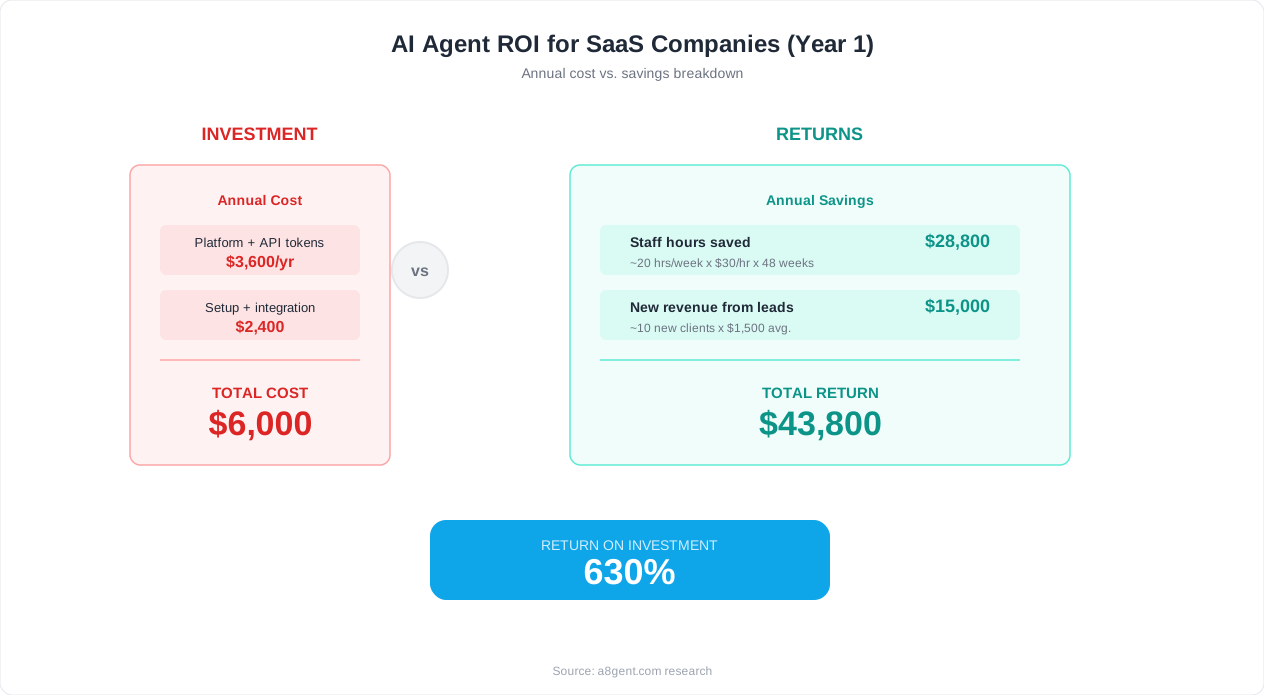
To calculate your AI agent ROI, add up four components: prevented churn revenue, support cost savings (fewer tickets requiring human time), expansion revenue attributed to agent outreach, and productivity gains (your team doing higher-value work). Subtract the total cost of your agent tools, setup time, and ongoing management. Most SaaS companies see 5-15x ROI within the first six months. A company spending $2,000 per month on agent platforms that prevents $15,000 in monthly churn and saves $8,000 in support costs is generating $21,000 in value against $2,000 in cost - a 10.5x return.
The companies that see the highest ROI are those that start measuring from day one and iterate weekly based on data. Do not set and forget. Review your metrics every Friday, identify underperforming agents, adjust their instructions and triggers, and redeploy. Continuous improvement is what separates 3x ROI from 15x ROI. Explore our support automation guide for detailed metric tracking templates and benchmarking data specific to SaaS companies.
Common Mistakes SaaS Companies Make With AI Agents (And How to Avoid Them)
After watching hundreds of SaaS companies deploy AI agents over the past year, clear patterns have emerged around what works and what does not. Here are the most common mistakes - and how to avoid them so you get results faster.
Mistake 1: Starting with the most complex use case. Many founders want to immediately deploy a multi-agent system handling support, onboarding, churn prevention, and upselling all at once. This overwhelms your team, creates too many variables to debug, and delays time to first results. Instead, start with one high-volume, well-defined use case (usually support), prove it works, and expand systematically. You will learn lessons from agent one that make agents two through five dramatically better.
Mistake 2: Not connecting enough data sources. An AI agent is only as good as the context it has. If your support agent cannot see user behavior data, billing history, or previous conversations, it gives generic responses that frustrate customers. Invest the time upfront to connect your agent to your product analytics, CRM, billing system, and knowledge base. The difference between a mediocre agent and a great one is almost always about data access, not AI intelligence.
Mistake 3: Setting it and forgetting it. AI agents are not magic boxes you plug in and ignore. They need ongoing refinement. Review their performance weekly. Read conversations they handled. Identify patterns in escalations - these reveal gaps in your knowledge base or instructions that need updating. The best-performing agents have owners who spend 30-60 minutes per week reviewing and tuning. This investment compounds - each adjustment makes the agent permanently better.
Mistake 4: Not telling customers they are talking to AI. Transparency builds trust. Users in 2026 are sophisticated - they can usually tell, and feeling deceived damages your brand more than the AI interaction itself. Be upfront. "Hi, I'm [your product]'s AI support agent. I can help with most questions instantly, and I'll connect you with a human if I can't resolve your issue." Most users prefer this to waiting in a queue.
Mistake 5: Measuring the wrong things. Some teams celebrate high resolution rates without checking satisfaction. Others focus on deflection rates without verifying that "deflected" users actually got their problems solved. Always pair efficiency metrics with quality metrics. A 90 percent resolution rate means nothing if customers are unsatisfied with the resolutions. Track CSAT on agent interactions, monitor social media for complaints about your AI support, and regularly spot-check conversations for quality.
Mistake 6: Ignoring the handoff experience. The moment an agent escalates to a human is critical. If the human has to ask the customer to repeat everything, you have destroyed the efficiency gains. Ensure your escalation flow passes full conversation history, user context, the agent's attempted resolution, and a suggested next step to the human rep. The customer should feel the handoff is seamless, not a restart.
Avoiding these mistakes does not require perfection - it requires intentionality. Start small, measure relentlessly, iterate quickly, and expand deliberately. If you want a structured approach, take our assessment for a customized deployment plan that accounts for your specific situation and helps you avoid these common pitfalls from day one.
FAQ
How quickly can a SaaS company deploy an AI support agent?
Most SaaS companies can have a basic AI support agent running within one to two weeks. The first few days involve connecting your knowledge base and configuring the agent. Then you run it in supervised mode for five to seven days, reviewing responses and refining instructions. By the end of week two, most teams are comfortable letting the agent handle routine queries autonomously.
Will AI agents work with my existing support tools like Intercom or Zendesk?
Yes. Major AI agent platforms integrate directly with popular SaaS support tools including Intercom, Zendesk, Freshdesk, Help Scout, and others. Intercom Fin works natively within Intercom. For other platforms, integration typically takes less than an hour through pre-built connectors and does not require engineering resources.
Can AI agents handle technical support queries about complex SaaS products?
AI agents handle routine and moderately complex technical queries well - things like configuration guidance, troubleshooting common errors, and explaining feature usage. For highly complex or novel technical issues, agents escalate to your engineering team with full context. Most SaaS companies find that 60-70 percent of their technical support volume falls into the routine category that agents handle well.
How do AI agents prevent churn differently from traditional health scoring tools?
Traditional health scoring tools alert your team that an account is at risk, but humans still need to decide what to do and execute the intervention. AI agents close that loop automatically - they detect the risk signal, determine the appropriate intervention, execute it in real time, and measure the result. This means intervention happens in minutes rather than days, catching users before they mentally check out.
What is the typical ROI timeline for AI agents in a SaaS company?
Most SaaS companies see positive ROI within 30-60 days of deployment. Support cost savings are immediate - fewer tickets requiring human time from week one. Churn impact takes 30-60 days to measure as you compare cohort retention rates. Expansion revenue typically shows results within 60-90 days. Full 5-15x ROI is commonly achieved within six months.
Do AI agents work for B2B SaaS with enterprise customers who expect high-touch service?
Absolutely. AI agents do not replace high-touch service - they enhance it. Enterprise accounts still get their dedicated success manager, but the agent handles routine queries instantly (even at 2 AM), surfaces usage insights for the human rep, and ensures nothing falls through the cracks between quarterly reviews. Enterprise customers often prefer instant AI responses for simple questions over waiting for their rep.
How do I ensure my AI agent does not give incorrect information about my product?
Start with a comprehensive, up-to-date knowledge base as your agent's source of truth. Configure the agent to only answer based on verified documentation - never guess. Set up escalation rules for any query where confidence is low. Review conversations regularly during the first few weeks to catch and correct any inaccuracies. Most platforms also allow you to set strict boundaries on what the agent can and cannot claim.
Can AI agents help with SaaS user onboarding for complex products?
Yes, and they are particularly effective for complex products where users often get stuck. Onboarding agents can provide step-by-step guided setup, answer contextual questions in real time, detect when users are stalling and proactively offer help, and adapt their guidance based on the user's role and goals. SaaS companies with complex products often see the highest activation rate improvements from onboarding agents.