AI Agents vs Virtual Assistants: Cost and Capability Comparison (2026)
AI agents cost $79-$299/month and work 24/7 on repetitive tasks. Virtual assistants cost $1,500-$4,000/month but handle complex judgment calls. This guide compares both options side by side so you can decide which is right for your business.
10+ years shipping production ML across TensorFlow, PyTorch, AWS, and GCP. Ships every A8gent agent before it becomes a lesson. GitHub
- AI agents cost 80-95% less than virtual assistants for repetitive tasks ($79-$299/month vs $1,500-$4,000/month) and work 24/7 without breaks, sick days, or time-off requests.
- Virtual assistants still excel at tasks requiring human judgment, emotional intelligence, relationship building, and handling truly novel situations that have never occurred before.
- The optimal setup for most small businesses is a hybrid: AI agents handle high-volume repetitive work while a part-time VA manages complex tasks that require human creativity and judgment.
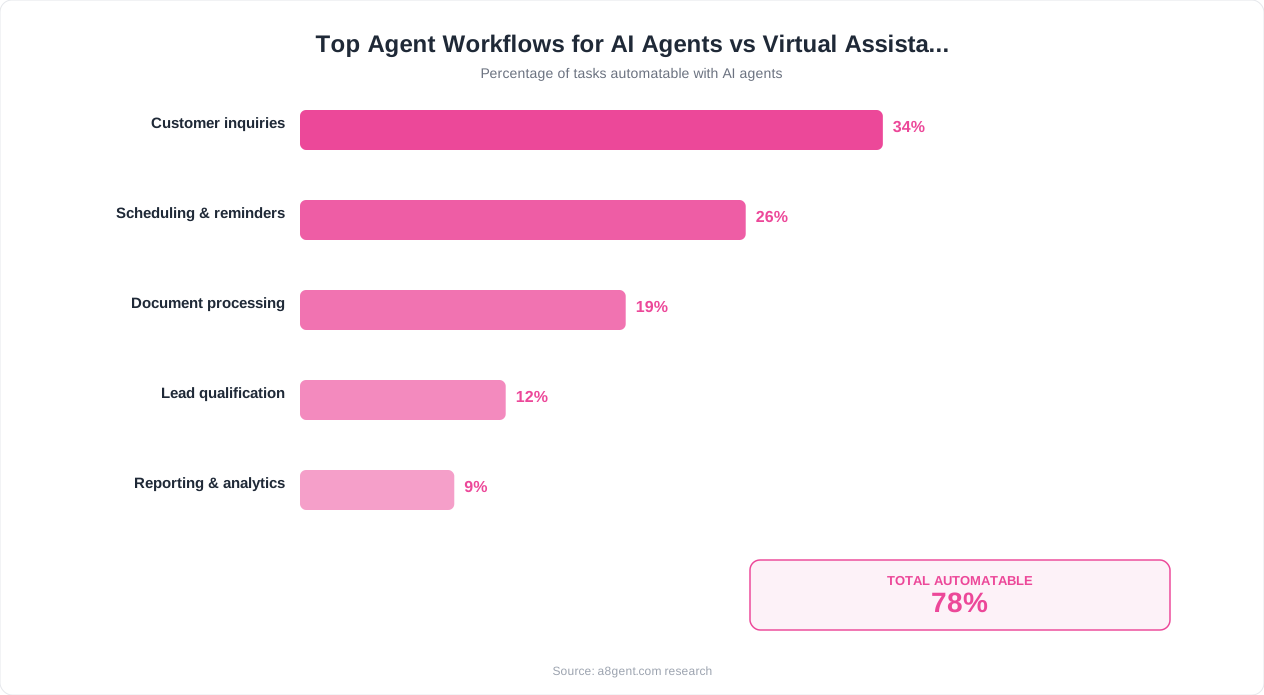
- AI agents from platforms like Autonoly and Lindy can now handle 70-85% of tasks that businesses traditionally outsource to virtual assistants, including email management, scheduling, data entry, and customer support.
- Switching from a full-time VA to an AI agent plus part-time VA saves the average small business $2,000-$3,500/month while maintaining or improving quality and response times.
The New Reality: AI Agents Are Competing Directly with Virtual Assistants
For the past decade, hiring a virtual assistant was the go-to solution for overwhelmed business owners. Need help with email? Hire a VA. Drowning in scheduling? Hire a VA. Cannot keep up with data entry? Hire a VA. Virtual assistants became a multi-billion dollar industry because they solved a real problem: business owners had too much repetitive work and not enough hours.
But in 2026, a new option has emerged that is fundamentally changing this calculation. AI agents can now handle the majority of tasks that businesses historically outsourced to virtual assistants - at a fraction of the cost, with faster turnaround, and with 24/7 availability.
This does not mean virtual assistants are obsolete. There are still tasks where a human VA is clearly superior. But the line is moving fast, and many business owners are overpaying for human labor on tasks that an AI could handle better and cheaper. The question is not "AI or human?" - it is "which tasks belong to which?"
In this guide, we will compare AI agents and virtual assistants across every dimension that matters: cost, capability, reliability, speed, scalability, and quality. We will show you exactly where each option wins, provide real cost comparisons, and give you a framework for deciding the optimal mix for your business.
If you are currently paying for a virtual assistant and wondering whether AI could handle some of that workload, you are asking the right question at the right time. If you are considering hiring a VA for the first time and wondering whether AI is good enough, the answer may surprise you.
Let us start with the numbers, because for most business owners, cost is the deciding factor. Use our cost comparison tool to get a personalized estimate based on your specific tasks and volume, or read on for the full breakdown.
Head-to-Head Cost Comparison (Real Numbers)
Let us put real numbers side by side. These are 2026 market rates based on thousands of data points from hiring platforms, agency rate cards, and AI platform pricing pages.
Virtual Assistant Costs
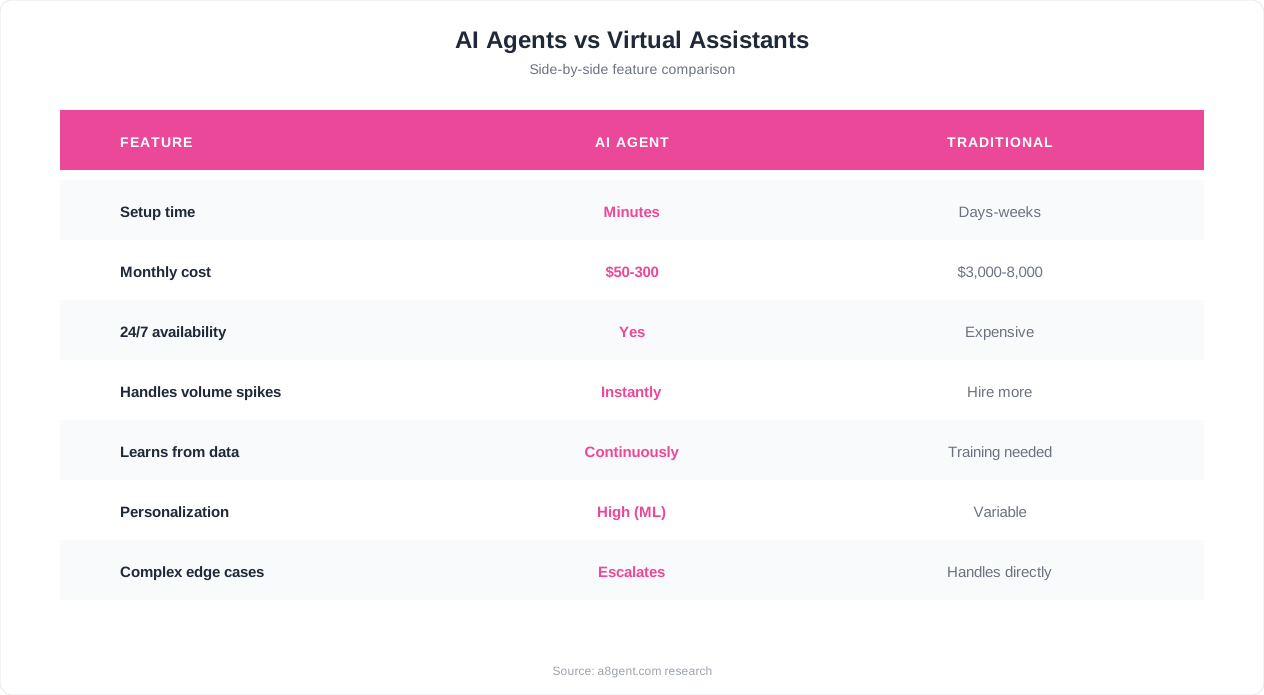
Overseas VA (Philippines, India): $5-$12/hour, typically 20-40 hours/week = $400-$1,920/month. US-based VA: $25-$50/hour, typically 10-20 hours/week = $1,000-$4,000/month. Specialized VA (bookkeeping, executive): $35-$75/hour = $1,400-$6,000/month. These rates do not include agency fees (add 20-40%), management time (1-2 hours/week of your time), training time (10-20 hours initially), or replacement costs when a VA leaves (typically every 6-12 months).
AI Agent Costs
Autonoly: $79-$249/month for 3-10 agents handling unlimited hours. Lindy: $49-$299/month per agent. n8n: $0-$120/month (self-hosted to cloud). The AI agent works 24/7 - that is 720 hours/month vs a VA's 80-160 hours/month. There are no training costs, no management time (beyond 30 minutes/week monitoring), no turnover risks, and no ramp-up period when you need to add capacity.
Equivalent Task Cost Comparison
Let us compare the cost of handling 500 customer emails per month. With a VA at $10/hour, averaging 3 minutes per email: 25 hours = $250/month. With an AI agent on Autonoly at Free-$149/month: all 500 emails handled automatically = Free-$149/month. The AI is 40% cheaper AND responds instantly 24/7 instead of during the VA's working hours.
Now let us look at lead follow-up for 200 leads per month. With a VA researching each lead and writing personalized emails at 15 minutes per lead: 50 hours = $500-$750/month (overseas VA). With an AI agent: Free-$149/month and each lead gets a response within 5 minutes of submission, not the next business day. The AI is 70-80% cheaper AND significantly faster.
The Time-Value Multiplier
Here is what most cost comparisons miss: AI agents respond instantly. A lead that gets a follow-up in 5 minutes is 21x more likely to convert than one that waits 30 minutes. A customer support inquiry resolved in 2 minutes creates a dramatically better experience than one resolved in 4-8 hours. The speed advantage of AI agents is not just a nice-to-have - it directly impacts revenue and satisfaction metrics.
Use our cost comparison tool to calculate the exact savings for your specific task mix and volume. Most businesses discover they can save $1,500-$3,500/month by shifting repetitive tasks from their VA to an AI agent.
Capability Comparison: What Each Can Actually Do
Cost matters, but capability matters more. An AI agent that cannot actually do the job is worthless at any price. Here is an honest assessment of what AI agents can and cannot do compared to virtual assistants in 2026.
Tasks Where AI Agents Are Now Equal or Better Than VAs
Email management and response: AI agents read, categorize, draft responses, and send - with better consistency and 24/7 availability. Calendar management and scheduling: AI agents check availability, propose times, handle back-and-forth, and confirm - faster than any human. Data entry and CRM updates: AI agents extract data from emails, forms, and documents and update your systems with zero transcription errors. Basic customer support: answering common questions, checking order status, processing simple requests. Social media scheduling: posting pre-approved content at optimal times across platforms. Invoice processing: reading invoices, extracting data, matching to purchase orders, routing for approval. Follow-up sequences: sending the right message at the right time based on recipient behavior.
Tasks Where VAs Still Win (For Now)
Complex relationship management: building rapport with high-value clients, remembering personal details, managing delicate situations. Creative problem-solving for novel situations: when something truly unprecedented happens and no playbook exists. Emotional intelligence tasks: detecting that a customer is genuinely upset (not just using frustrated language) and knowing exactly how to de-escalate. Research requiring judgment: evaluating sources, weighing contradictory information, making subjective quality assessments. Phone calls requiring natural conversation: while AI voice is improving fast, complex negotiations or sales calls still benefit from human nuance. Tasks requiring physical world interaction: picking up packages, running errands, or anything in the physical world.
Tasks in the Gray Zone (AI Agents Are Catching Up Fast)
Writing complex, nuanced content (AI handles 80% of business writing well now). Managing vendor relationships for routine matters. Conducting initial screening interviews. Creating presentations from raw data. Handling multi-party coordination with conflicting constraints.
The trend is clear: the gray zone is shrinking every quarter as AI capabilities improve. Tasks that required a VA a year ago now work perfectly with an AI agent from platforms like Autonoly or Lindy. Take our free assessment to see exactly which of your current VA tasks could transition to AI agents today.
Reliability and Consistency: The Factor Nobody Talks About
Ask any business owner who has worked with virtual assistants for years, and they will tell you about the reliability challenges. This is not a criticism of VAs as people - it is a structural reality of depending on any individual human for business operations. AI agents change this equation fundamentally.
The VA Reliability Problem
Virtual assistants get sick. They take vacations. They have family emergencies. They quit with two weeks notice (or less). They have off days where quality drops. They get distracted. They sometimes miss deadlines. They need training when processes change. And they operate in specific time zones - meaning your business gets no coverage outside their working hours.
The average VA turnover rate is 35-50% annually. That means roughly every 18-24 months, you lose your VA and need to recruit, hire, and train a replacement. Each turnover costs 2-4 weeks of reduced productivity during the transition. Over five years, you might go through 3-4 VAs - each requiring the same ramp-up investment.
AI Agent Reliability
AI agents do not call in sick. They work holidays, weekends, and 3 AM. They never have a bad day where quality drops. They do not quit. They handle their 1st task of the day with the same quality as their 500th. They follow your process exactly the same way every time. They respond within seconds regardless of volume spikes. Platform uptime for major AI agent providers is typically 99.5-99.9%, meaning less than 9 hours of downtime per year.
Consistency Is Underrated
When you task a VA with handling customer emails, you get variation. Monday's responses are slightly different from Friday's. The tone shifts based on mood. Edge cases get handled differently depending on how busy the VA is. This variation, while natural and human, creates inconsistency in your customer experience.
AI agents deliver identical quality every single time. Your 500th customer gets the same thoughtful, well-structured response as your 1st. Your lead follow-up emails maintain the same tone, timing, and professionalism whether you send 10 per month or 10,000. For businesses that depend on consistent customer experience, this reliability premium is worth its weight in gold.
The Honesty Caveat
AI agents are not perfect. They can misinterpret ambiguous situations. They occasionally produce responses that miss context a human would catch. They struggle with truly novel scenarios that do not match any pattern in their training. The key difference is that their failure mode is predictable - they fail the same way consistently, which makes it easy to add guardrails. Human failures are unpredictable. You can configure an AI agent on Autonoly to escalate anything it is uncertain about, creating a safety net that costs nothing extra.
The Hybrid Model: AI Agents Plus Part-Time VA
The smartest business owners in 2026 are not choosing between AI agents and virtual assistants - they are using both strategically. The hybrid model captures the cost savings of AI while preserving human capability where it genuinely matters. Here is how to set it up.
The 80/20 Split
For most small businesses, approximately 80% of VA tasks are repetitive and predictable enough for AI agents to handle. The remaining 20% requires human judgment, creativity, or emotional intelligence. By shifting that 80% to AI and keeping a part-time VA for the 20%, you get massive cost savings without sacrificing quality on complex tasks.
Math Example
Current setup: Full-time overseas VA at $1,800/month handling everything. Hybrid setup: AI agent platform at Free-$149/month handling 80% of volume + part-time VA at 8 hours/week ($320/month) handling complex tasks = $469/month total. Savings: $1,331/month or $15,972/year. And the hybrid actually performs better because the AI handles the 80% faster and more consistently, while the VA can focus their limited hours on tasks where human touch genuinely adds value.
How to Divide Tasks
Give to the AI agent: Email triage and standard responses, meeting scheduling and confirmations, data entry and CRM updates, follow-up sequences, social media posting (pre-approved content), invoice processing, order status inquiries, FAQ responses, report generation from templates, and appointment reminders.
Give to the part-time VA: High-stakes client communication, creative content that requires brand voice nuance, complex research requiring judgment calls, vendor negotiations, handling escalated customer complaints, event planning and coordination, tasks requiring phone calls with natural conversation, and anything involving subjective quality assessment.
The Escalation Bridge
The key to making the hybrid model work is a clean escalation path. Your AI agent handles inbound tasks and routes anything it cannot confidently resolve to your part-time VA. The VA gets the pre-processed context (the AI has already gathered the information and summarized the situation), so they can resolve it quickly. This means your VA is always working on high-value tasks - never wasting time on things a machine could handle.
Platforms like Autonoly and Lindy make this escalation path easy to configure. You set rules like "if customer sentiment is negative, escalate to human" or "if the deal value exceeds $5,000, route to VA for personal follow-up." The result is a system that is both automated AND personal where it counts.
Use our assessment tool to identify which of your current tasks are AI-ready and which should stay with a human. It gives you a specific split recommendation based on your business type and task complexity.
How to Transition from a VA to AI Agents (Without Disruption)
If you currently have a virtual assistant and want to shift repetitive tasks to AI agents, the transition needs to be handled carefully. Here is a proven 6-week transition plan that minimizes disruption and maintains quality throughout.
Week 1-2: Document and Observe
Before changing anything, document exactly what your VA does. Create a task list with frequency, time spent, and complexity rating (1-5 scale). Watch how they handle each task - note the decision points, the exceptions, and the quality standards. This documentation becomes the instruction set for your AI agents. Many business owners discover during this phase that their VA is spending significant time on tasks that are simpler than they thought - perfect candidates for AI.
Week 3: Deploy AI Agents in Shadow Mode
Set up your AI agents on a platform like Autonoly and have them process the same inputs as your VA - but without sending outputs to customers. Compare the AI's responses to your VA's responses side by side. Track accuracy: how often does the AI produce an acceptable output? For well-defined tasks (email responses, data entry, scheduling), most businesses see 85-95% accuracy from day one.
Week 4: Parallel Running
Start letting the AI handle the simplest, highest-volume tasks directly (with your quick daily review). Keep your VA handling everything else normally. This is a gradual handoff - not a sudden switch. Your VA's workload decreases slightly, and you confirm the AI handles its assigned tasks well. Adjust and refine the AI's instructions based on any quality gaps you observe.
Week 5: Expand AI Scope
Move additional tasks from your VA to the AI agent. By now, you have confidence from weeks of parallel observation. Your VA focuses increasingly on complex tasks that genuinely require human judgment. This is also when you have an honest conversation with your VA about the changing role - if you are keeping them part-time, clarify the new scope.
Week 6: Stabilize New Setup
Your new operating model is in place: AI agents handle 70-85% of what your VA used to do, and either a part-time VA or no VA handles the rest (depending on your task complexity). Monitor closely for the first few weeks of the new normal. Make adjustments as edge cases appear. Document anything that needs to escalate to a human.
Important Considerations
If you are reducing your VA's hours or ending the relationship, handle it professionally and with adequate notice. Good VAs are hard to find - if you might need human capacity in the future, consider maintaining a reduced engagement rather than cutting ties entirely. Some business owners keep their VA at 5-10 hours/week for complex tasks while AI handles the volume, which maintains the relationship at much lower cost.
Also consider your VA's knowledge. They have accumulated institutional knowledge about your business, preferences, and quirks. Before reducing their role, capture this knowledge in your AI agent's instructions. Have them review and refine the AI's outputs during the transition - their expertise improves the AI's performance permanently.
Decision Framework: When to Choose AI vs Human vs Both
Here is a simple decision framework you can apply to any task in your business. Ask these five questions and the answer becomes clear.
Question 1: How often does this task occur?
If it happens multiple times daily: strongly favor AI agent. If it happens a few times per week: AI agent is still preferable for consistency. If it happens once a week or less: a VA or doing it yourself may be more practical than setting up automation.
Question 2: How predictable is the process?
If the task follows clear rules with defined inputs and outputs: AI agent wins. If it involves some judgment but within known parameters: AI agent with human review for exceptions. If every instance is significantly different and requires creative problem-solving: human VA is better.
Question 3: What is the cost of a mistake?
If mistakes are easily correctable and low-impact: AI agent is fine (and you can review periodically). If mistakes are noticeable but recoverable: AI agent with review mode for the first few weeks. If a single mistake could damage a key relationship or cost significant money: human oversight required, either VA or your own review.
Question 4: Does it require emotional intelligence?
If the task is purely transactional (data processing, scheduling, status updates): AI agent, no question. If it involves reading emotional cues and adapting approach: human VA is safer. If emotional intelligence matters only in edge cases: AI agent with escalation rules for negative sentiment.
Question 5: Is speed a competitive advantage?
If responding faster directly impacts outcomes (lead conversion, customer satisfaction): AI agent wins - instant 24/7 response beats any human's availability. If timing is flexible: either option works, choose on cost. If deliberate pacing is important (not appearing too eager in a negotiation): human VA with better social calibration.
Quick Reference Table
Choose AI agent: Email triage, scheduling, data entry, follow-ups, FAQs, invoice processing, status updates, reminders, social posting, report generation. Choose human VA: Client gifting, complex negotiations, creative strategy, vendor relationship management, event coordination, handling emotional customers, brand voice content. Choose both (hybrid): Customer support (AI for tier-1, human for escalations), sales outreach (AI for volume, human for closing), content (AI for scheduling/repurposing, human for original pieces).
Still unsure about your specific situation? Our assessment evaluates your exact task list and recommends the optimal AI-vs-human split based on your business type, team size, and complexity profile.
The Future: What This Means for Your Business in 2026 and Beyond
The capability gap between AI agents and human assistants is closing faster than most people realize. Understanding where this is heading helps you make smarter investment decisions today.
The Tipping Point Is Happening Now
In 2024, AI agents could handle maybe 40-50% of typical VA tasks reliably. In 2025, that jumped to 60-70%. In 2026, we are at 75-85% for well-configured agents on mainstream platforms. The rate of improvement is accelerating, not slowing down. By 2027, AI agents will likely handle 90%+ of tasks that businesses currently outsource to virtual assistants - and do them faster, cheaper, and more consistently.
What This Means for Pricing
As AI agents eat into the VA market, expect two effects. First, AI agent pricing will continue to drop as competition increases and technology becomes more efficient. Second, human VA pricing will bifurcate: basic VAs handling simple repetitive tasks will face downward price pressure (their work is being automated away), while specialist VAs handling complex, high-judgment tasks will command premium rates (their unique capabilities become more valuable as everything else gets automated).
The Skills That Will Still Require Humans
Some tasks will require human involvement for the foreseeable future: building genuine personal relationships with key clients, navigating truly unprecedented situations with no prior pattern, making ethical judgment calls in gray areas, providing emotional support and empathy in sensitive situations, and representing your brand in high-stakes face-to-face interactions. These are the tasks to invest human time in - everything else is fair game for AI.
Your Competitive Advantage
Here is the strategic reality: businesses that master AI agent deployment in 2026 will have a structural cost advantage over competitors who still rely entirely on human labor for repetitive tasks. If your competitor spends $4,000/month on VAs doing work that your $249/month AI agent handles, you can either pocket the $3,750 difference as profit or reinvest it into growth, product quality, or pricing advantage. This gap compounds over time.
Your Action Plan
Do not wait for AI to be perfect - it is already good enough for the majority of repetitive business tasks. Start now with the tasks that are clearly ready for AI (email, scheduling, data entry, follow-ups, basic support). Keep humans on tasks that genuinely require human capability. Reassess every 6 months as AI capabilities improve. Build your AI infrastructure now so you are not scrambling to catch up when your competitors are already running lean.
The best time to start was a year ago. The second best time is this week. Take our assessment to identify your starting point, or use our cost comparison tool to see exactly how much you could save by optimizing your human-AI task allocation today.
FAQ
Can an AI agent completely replace my virtual assistant?
For 70-85% of tasks, yes. AI agents now handle email management, scheduling, data entry, customer support, follow-ups, and most administrative work better than VAs - at a fraction of the cost. However, tasks requiring complex judgment, emotional intelligence, or creative problem-solving still benefit from a human. The optimal setup for most businesses is AI for volume work plus a part-time VA for complex tasks.
How much money will I save switching from a VA to an AI agent?
Most businesses save $1,500-$3,500/month by transitioning repetitive VA tasks to AI agents. A full-time overseas VA costs $1,200-$1,800/month. The same tasks handled by an AI agent cost $79-$249/month. Even the hybrid model (AI agent + part-time VA) typically saves $1,000-$2,000/month compared to a full-time VA alone.
Will my customers notice if I switch from a human to an AI agent?
For most routine interactions, no. AI agents write natural, personalized responses and handle standard requests indistinguishably from a competent human. For complex or sensitive situations, set up escalation rules to route to a human. Many businesses find customer satisfaction actually improves because AI agents respond instantly 24/7 instead of during limited working hours.
How long does it take to transition from a VA to AI agents?
Plan for a 4-6 week transition period. Week 1-2 for documentation and AI setup, week 3-4 for parallel running and comparison, week 5-6 for gradual handoff and stabilization. Rushing the transition risks quality drops. A phased approach ensures nothing falls through the cracks during the switch.
What tasks should I never give to an AI agent?
Keep humans on: high-stakes client negotiations, handling genuinely angry or upset customers who need empathy, creative strategy development, vendor relationship management requiring personal rapport, and any situation where a mistake could cause significant financial or reputational damage. Use AI for everything predictable and repetitive.
Do AI agents work in my time zone?
AI agents work in every time zone simultaneously - 24/7/365. This is actually a major advantage over VAs, who work specific hours. Your customers get instant responses at 2 AM. Your leads get follow-ups within minutes regardless of when they submit a form. For businesses with international customers or leads, this alone justifies the switch.
What if my VA does things an AI agent cannot handle?
Keep your VA for those specific tasks. The hybrid model works perfectly: AI handles the volume (email, scheduling, data entry, follow-ups) while your VA focuses their hours on high-value tasks where human judgment is irreplaceable. You might reduce your VA from 30 hours/week to 8-10 hours/week, keeping their expertise for what matters.
Which AI agent platform is best for replacing VA tasks?
For general VA task replacement, Autonoly offers the best combination of ease-of-use and capability - it handles email, scheduling, CRM updates, customer support, and follow-ups in one platform starting at $79/month. Lindy is excellent for solopreneurs wanting a simple all-in-one AI employee. Use our assessment tool for a personalized recommendation based on your specific task list.