ChatGPT vs Custom AI Agents: Which Is Better for Business? (2026)
ChatGPT is great for one-off tasks, but custom AI agents run entire workflows autonomously. This guide breaks down when to use each, what they cost, and which delivers better ROI for your specific business needs.
10+ years shipping production ML across TensorFlow, PyTorch, AWS, and GCP. Ships every A8gent agent before it becomes a lesson. GitHub
- ChatGPT is a general-purpose assistant that responds to prompts one at a time, while custom AI agents run autonomously, execute multi-step workflows, and connect directly to your business tools.
- For repetitive tasks like lead follow-up, invoice processing, or customer support, custom AI agents deliver 5-10x better ROI than ChatGPT because they work without human prompting.
- ChatGPT is best for ad-hoc tasks like drafting emails, brainstorming, or research - things you do once and move on from.
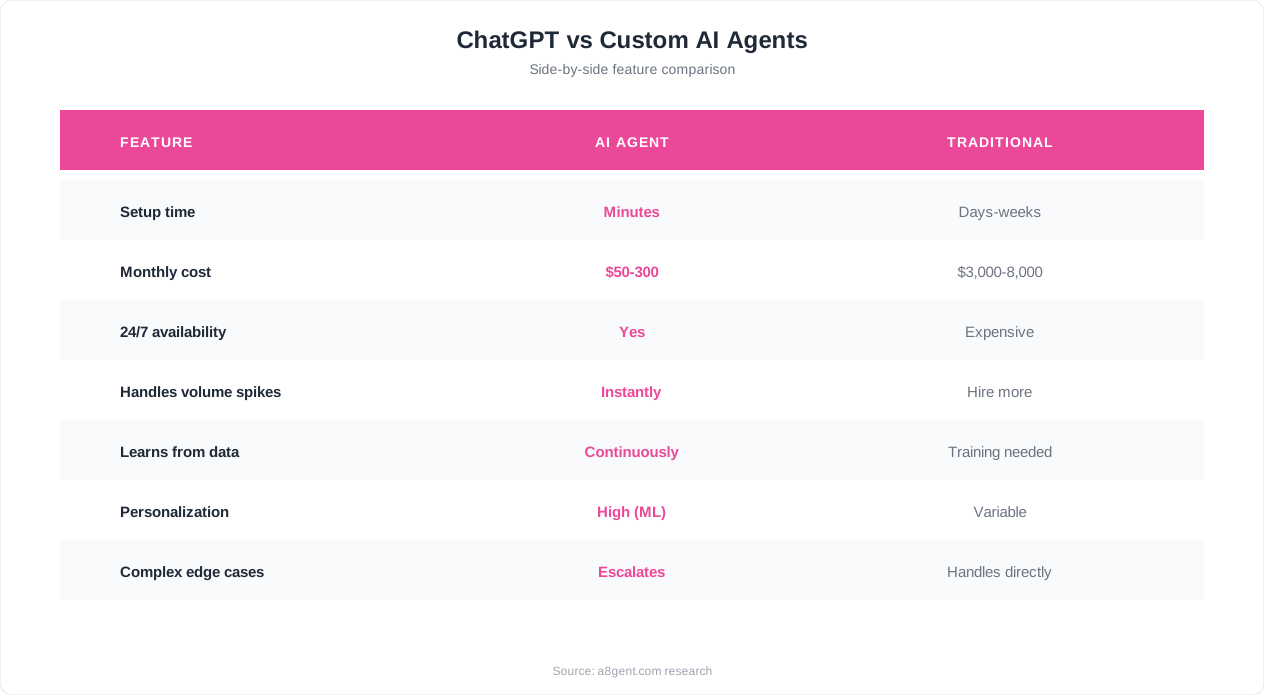
- Custom AI agents from platforms like Autonoly cost $50-$300/month but replace $2,000-$5,000/month of manual labor, while ChatGPT costs $20-$25/month but still requires your time for every interaction.
- The smartest approach is to use both: ChatGPT for one-off thinking tasks, and custom AI agents for anything that repeats more than three times per week.
ChatGPT and AI Agents Are Not the Same Thing
If you are a business owner in 2026, you have almost certainly used ChatGPT. Maybe you draft emails with it, brainstorm marketing ideas, or ask it to summarize long documents. It is a genuinely useful tool that has changed how millions of people work. But here is what many business owners are realizing: ChatGPT is not the same thing as an AI agent, and confusing the two is costing them serious time and money.
ChatGPT is a conversation tool. You ask, it answers. You prompt, it responds. Every single interaction requires you to open the app, type something, wait for a response, and then do something with that response yourself. It is brilliant at generating text, answering questions, and helping you think - but it cannot act on your behalf without you being there.
A custom AI agent is an autonomous worker. You set it up once, define what success looks like, connect it to your business tools, and it runs. It does not wait for you to type a prompt. It monitors triggers, makes decisions, takes actions, and completes workflows - all while you are sleeping, in meetings, or focusing on strategy.
Here is a concrete example that illustrates the difference perfectly. Say you want to follow up with every lead who downloads your pricing guide. With ChatGPT, you would open the tool every day, paste in the lead list, ask it to write follow-up emails, copy those emails, and send them manually through your email system. That is 20-30 minutes of your time every single day.
With a custom AI agent from a platform like Autonoly, you set it up once: "When someone downloads the pricing guide, wait 24 hours, then send a personalized follow-up email based on their company and role. If they reply, respond within 5 minutes. If they don't reply in 3 days, send a second follow-up with a case study." The agent runs that workflow for every single lead, 24/7, without you touching anything.
That is the fundamental difference, and understanding it will save you from the trap of thinking "I already have AI" when what you actually have is a smart notepad. If you are not sure which approach is right for your business, take our free assessment - it will tell you exactly where ChatGPT is enough and where you need a custom agent.
What ChatGPT Does Well for Business Owners
Let us give credit where it is due. ChatGPT is an extraordinary tool, and there are legitimate business use cases where it is the right choice - even if you also have custom AI agents. Understanding where ChatGPT shines helps you make better decisions about where to invest your automation budget.
Ad-hoc writing and editing. When you need to draft a single email, rewrite a paragraph on your website, or polish a proposal, ChatGPT is fast and effective. You paste in your rough draft, tell it the tone you want, and get polished output in seconds. For one-off writing tasks, it is genuinely hard to beat. You would not deploy a custom agent for something you do once.
Brainstorming and strategy. ChatGPT is remarkably good at helping you think through problems. Want ten angles for a marketing campaign? Need to think through the pros and cons of entering a new market? Looking for creative solutions to a customer retention problem? ChatGPT is like having a smart thinking partner available 24/7. This is high-value work that benefits from conversational, back-and-forth interaction.
Research and synthesis. When you need to quickly understand a new topic, summarize industry reports, or gather information for a decision, ChatGPT can save hours of reading. It pulls together information, explains complex topics in plain language, and helps you get up to speed fast. For the price of $20-$25/month, this alone can be worth the investment.
One-time analysis. Paste in a spreadsheet of customer feedback and ask for patterns. Upload a competitor's pricing page and ask for a comparison. Feed it your last quarter's metrics and ask what stands out. These analytical tasks are perfect for ChatGPT because they are one-time events that require human judgment to act on.
Learning and training. Many business owners use ChatGPT as a tutor - asking it to explain concepts, walk through processes, or help them learn new skills. This interactive, question-and-answer format is ideal for learning and does not require automation.
The pattern should be clear: ChatGPT excels at tasks that are one-time, require your active participation, and benefit from back-and-forth conversation. If you find yourself doing the exact same ChatGPT interaction more than three times per week, that is your signal that you need to graduate to a custom agent. Use our comparison tool to see exactly where the crossover point is for your specific workflows.
What Custom AI Agents Do That ChatGPT Cannot
Now let us talk about what custom AI agents bring to the table that ChatGPT simply cannot match, no matter how clever your prompts are. These are not minor differences - they are fundamental capabilities that change what is possible for your business.
Autonomous execution without prompting. The single biggest difference is that custom agents work without you. You do not open an app. You do not type a prompt. You do not copy and paste anything. The agent monitors triggers (a new email arrives, a form is submitted, a deadline passes, a metric crosses a threshold) and takes action automatically. This means work gets done at 2 AM on a Saturday. It means nothing falls through the cracks because you were busy. It means your capacity is no longer limited by your available hours.
Direct integration with your business tools. ChatGPT lives in its own world. Yes, it has plugins, but they are limited and clunky. Custom AI agents connect directly to your CRM, email platform, calendar, accounting software, project management tools, e-commerce platform, and dozens more. They do not just generate text about what you should do - they actually do it. They send the email. They update the record. They create the task. They move the deal to the next stage.
Multi-step workflows with decision logic. Real business processes involve sequences of steps with branching decisions. "If the lead is from a company with more than 50 employees, route to enterprise sales. If they opened the last email but didn't click, send the case study version. If they have been in the pipeline for more than 30 days without a meeting, trigger the breakup sequence." Custom agents handle this complex logic effortlessly. ChatGPT cannot execute sequences - it can only tell you what to do.
Persistent memory across interactions. Custom agents remember everything. They know that this customer complained last month. They know that this lead prefers morning meetings. They know that your busiest day is Tuesday. This accumulated context makes them more effective over time. ChatGPT's memory is limited and resets with each conversation thread.
Scale without proportional cost increase. When your business grows from 50 to 500 leads per month, ChatGPT requires 10x more of your time. A custom agent handles 500 leads with the same setup as 50. This is the true power of automation - the marginal cost of the next unit of work approaches zero. Your agent on Autonoly handles 10 leads or 10,000 leads with the same monthly subscription.
Reliability and consistency. Custom agents follow your workflows the same way every single time. They do not have off days. They do not forget steps. They do not get distracted. When you need a process executed identically 500 times per month, agents deliver consistency that no human (and no ChatGPT session) can match.
Real Cost Comparison: ChatGPT vs Custom AI Agents
Let us talk numbers. Business owners need to understand the true cost of each approach, including the hidden costs that are not on the price tag. This section breaks down exactly what you will spend - and what you will save - with each option.
ChatGPT Pricing
ChatGPT Plus costs $20/month (or $25 for the Team plan with more features). ChatGPT Enterprise runs $60/user/month for larger organizations. At face value, this seems incredibly cheap. But here is what the price tag does not include: your time. Every interaction with ChatGPT requires you to be there, typing prompts, reviewing outputs, and manually executing the results.
If you spend 45 minutes per day using ChatGPT for tasks that a custom agent could handle autonomously, and your time is worth $100/hour (a conservative estimate for a business owner), that "free" tool is costing you $2,250/month in opportunity cost. The subscription is cheap. Your time is not.
Custom AI Agent Pricing
Custom agent platforms typically cost $50-$300/month depending on the platform, usage volume, and complexity. Autonoly starts at $79/month for small businesses. Enterprise solutions can run $500-$2,000/month for complex multi-agent setups. But these agents work autonomously - your time investment after setup is minimal, typically 15-30 minutes per week for monitoring and adjustments.
The True ROI Calculation
Here is a real scenario. A consulting firm was spending 2 hours per day on lead qualification, follow-up emails, and meeting scheduling. That is 10 hours/week of partner time at $200/hour = $8,000/month in labor cost. They deployed a custom AI agent for Free-$149/month. The agent now handles 85% of that workflow autonomously. Net savings: approximately $6,600/month after the agent subscription. Payback period: less than one day.
Compare that to using ChatGPT: the partner would still spend 45 minutes per day prompting ChatGPT, copying responses, and executing manually. Savings drop to maybe $4,000/month - and that $4,000 still requires daily human involvement. The difference is the difference between partial assistance and true automation.
When ChatGPT Is More Cost-Effective
If a task happens less than 3 times per week, the setup time for a custom agent is not justified. ChatGPT is more economical for occasional tasks, creative work, and one-time projects. The crossover point where custom agents become more cost-effective is roughly when a task occurs daily or involves more than 3 steps.
Use our cost comparison tool to calculate the exact ROI for your specific workflows. It factors in your hourly rate, task frequency, complexity, and the platforms that fit your needs.
Use Case Breakdown: Which Solution Wins for Each Task
Let us get specific about common business tasks and which solution delivers better results for each one. This is not theoretical - these recommendations are based on real outcomes from businesses using both tools.
Customer Support - Winner: Custom AI Agents
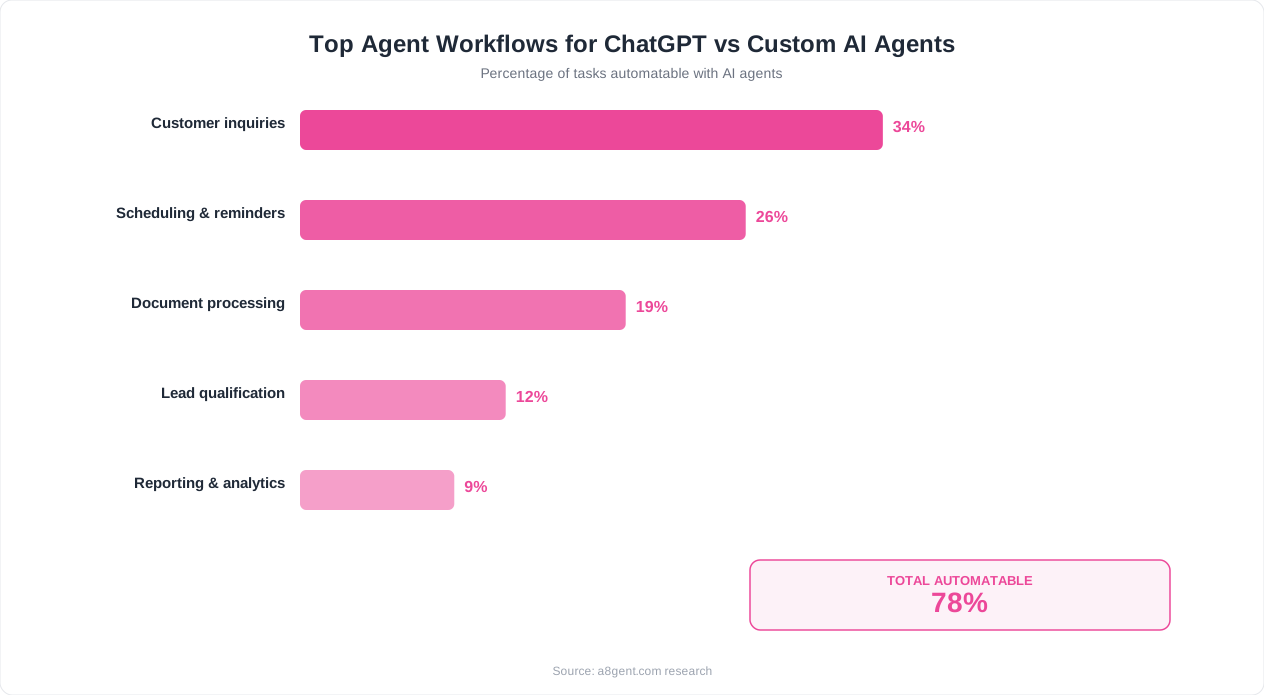
Support requires instant responses 24/7, access to order data, and the ability to take actions like processing refunds or updating accounts. ChatGPT cannot monitor your inbox, look up customer records, or take action in your systems. A custom agent handles the entire cycle: receives the inquiry, looks up the customer, resolves the issue, and follows up - all without human involvement. For any business with more than 10 support inquiries per day, agents win decisively.
Content Creation - Winner: ChatGPT (with caveats)
For writing blog posts, social media captions, or marketing copy, ChatGPT's interactive nature is genuinely superior. You can iterate, refine, adjust tone, and explore different angles in real-time. However, if you need content published on a schedule across multiple platforms with consistent formatting, a custom agent handles the distribution and scheduling while you use ChatGPT for the creative generation.
Lead Follow-Up - Winner: Custom AI Agents
Lead follow-up is the textbook case for custom agents. It is time-sensitive (slow follow-up loses deals), repetitive (same basic workflow for every lead), and multi-step (initial email, wait, follow-up, qualify, book meeting). Trying to do this with ChatGPT means logging in every day, checking who needs follow-up, generating emails, and sending them manually. An agent on Autonoly does it all in real-time as leads come in.
Data Analysis - Winner: ChatGPT
When you need to understand trends, find patterns, or make sense of a dataset, ChatGPT's conversational interface lets you ask follow-up questions, drill into specifics, and explore hypotheses. This exploratory, creative work benefits from human-in-the-loop interaction. Custom agents are better for recurring reports with fixed formats.
Invoice Processing - Winner: Custom AI Agents
Extracting data from invoices, matching them to purchase orders, categorizing expenses, and routing for approval is a perfect agent workflow. It is high-volume, rule-based, and requires system integration. ChatGPT cannot read your emails, download attachments, or update your accounting system.
Meeting Scheduling - Winner: Custom AI Agents
The back-and-forth of scheduling requires real-time availability checking and calendar access. A custom agent responds to scheduling requests immediately, checks your calendar, proposes times, and confirms - all within minutes. Using ChatGPT for this would still require you to manually send every message.
Strategic Planning - Winner: ChatGPT
High-level thinking about business direction, market analysis, and strategic decisions benefits from interactive exploration. You want to bounce ideas, challenge assumptions, and think through scenarios. This is where ChatGPT's conversational nature genuinely shines.
Not sure where to start? Our assessment analyzes your specific business and tells you exactly which tasks belong to ChatGPT and which need a custom agent.
The Limitations of ChatGPT That Business Owners Discover Too Late
Many business owners start with ChatGPT, get excited about its capabilities, and then hit a wall when they try to scale their usage. Here are the limitations that catch people by surprise - and why they eventually look at custom AI agents.
No persistent execution. ChatGPT does not run in the background. The moment you close the tab, it stops working. There is no way to say "check my email every hour and respond to customer inquiries" - because ChatGPT only exists while you are actively using it. For any business process that needs to run continuously, this is a fundamental blocker.
Limited integrations. While ChatGPT has plugins and can browse the web, it cannot directly interact with your specific business tools in meaningful ways. It cannot update your HubSpot deals, send emails from your business address, create invoices in QuickBooks, or post to your social media accounts. Custom agents from platforms like Autonoly connect directly to hundreds of business tools and take real actions within them.
Context window limits. ChatGPT can only process a certain amount of text in each conversation. When you are dealing with large datasets, long email threads, or complex multi-step processes, you hit the context limit and the AI starts "forgetting" earlier parts of the conversation. Custom agents have persistent memory systems designed for long-running workflows.
No workflow logic. Real business processes involve conditions, branches, loops, and sequences. "If the deal is over $10,000, require manager approval. If the customer has complained before, escalate immediately. If it's Friday after 5pm, hold the response until Monday." ChatGPT cannot execute this kind of logic - it can only describe it. Custom agents implement it.
Manual output handling. Every time ChatGPT generates something, you have to manually do something with it. Copy the email and paste it into Gmail. Take the analysis and put it in a slide. Copy the social post and schedule it in your platform. These small manual steps add up to hours per week. Custom agents deliver outputs directly to their destination - no human copying and pasting required.
Inconsistency at scale. Ask ChatGPT to write 100 follow-up emails and you will get 100 slightly different approaches, tones, and formats. Some will be great, some will be mediocre. Custom agents follow your exact templates and rules consistently, ensuring every customer gets the same quality experience regardless of whether it is the first interaction or the thousandth.
No trigger-based activation. You cannot tell ChatGPT "when a new lead comes in, do X." You have to notice the lead yourself and then go to ChatGPT. Custom agents monitor triggers in real-time and respond instantly - often faster than any human could. For time-sensitive workflows like lead response (where responding within 5 minutes dramatically increases conversion), this speed advantage alone justifies the investment.
These limitations do not make ChatGPT bad - they make it the wrong tool for automation. Use our agent comparison tool to see which platforms solve these specific limitations for your use case.
The Smart Hybrid Approach: Using Both Together
The most successful business owners in 2026 are not choosing between ChatGPT and custom agents - they are using both strategically. Here is the framework for deciding which tool handles which part of your workflow, and how to combine them for maximum efficiency.
The Decision Framework
Ask three questions about any task: (1) Does it happen more than 3 times per week? (2) Does it involve more than 2 steps? (3) Does it require access to your business systems? If you answered "yes" to at least two of these, it belongs to a custom agent. If you answered "no" to all three, ChatGPT is sufficient.
Example Hybrid Setup: Marketing Department
Use ChatGPT for: brainstorming campaign concepts, writing first drafts of important thought-leadership pieces, analyzing competitor positioning, creating presentation decks, and exploring new market angles. Use a custom AI agent for: scheduling and publishing approved content across platforms, monitoring brand mentions and sending daily digests, repurposing long-form content into social posts automatically, A/B testing subject lines and reporting winners, and nurturing leads through email sequences.
Example Hybrid Setup: Sales Team
Use ChatGPT for: preparing for important client meetings (research and talking points), crafting proposals for high-value deals, role-playing objection handling scenarios, and analyzing win/loss patterns. Use a custom AI agent for: researching every inbound lead automatically, sending personalized first-touch emails within minutes of form submission, following up with consistent sequences, updating CRM records after interactions, and booking meetings when leads show interest.
Example Hybrid Setup: Operations
Use ChatGPT for: drafting new SOPs and process documentation, analyzing quarterly performance data, troubleshooting one-off operational issues, and planning resource allocation. Use a custom AI agent for: processing daily invoices and routing for approval, sending payment reminders on schedule, onboarding new team members through automated checklists, monitoring inventory levels and triggering reorders, and generating weekly performance reports.
The Handoff Pattern
One powerful pattern is using ChatGPT to design workflows that your custom agent then executes. Use ChatGPT to think through the logic: "What should happen when a customer requests a refund? What conditions require human review? What's the ideal sequence?" Then implement that logic in your agent platform. ChatGPT is the strategist; the custom agent is the executor.
This hybrid approach gives you the best of both worlds: creative, flexible thinking from ChatGPT and reliable, autonomous execution from custom agents. If you want help mapping your specific business processes to this framework, take our assessment - it will identify exactly which of your tasks belong in each category and recommend the right platforms for your agent workflows.
How to Transition from ChatGPT to Custom Agents (Step by Step)
If you have been relying on ChatGPT and are ready to upgrade your repetitive workflows to custom agents, here is your step-by-step transition plan. This approach lets you maintain productivity while gradually shifting your most time-consuming tasks to autonomous agents.
Week 1: Audit Your ChatGPT Usage
For one week, keep a simple log every time you use ChatGPT. Note what you asked it to do, how long the entire process took (including executing the output), and whether this is something you do regularly. At the end of the week, sort by frequency. The tasks you did more than 3 times are your candidates for custom agents. Most business owners discover that 60-70% of their ChatGPT usage is repetitive tasks that could be fully automated.
Week 2: Choose Your First Agent Workflow
From your audit, pick the task that combines high frequency with high time investment. This is your first agent project. Common winners: lead follow-up emails, customer support responses, social media scheduling, invoice processing, and meeting scheduling. Crucially, pick something where a mistake is recoverable - you want low-risk for your first deployment.
Week 3: Set Up and Test
Sign up for an agent platform. If you want the easiest experience for non-technical users, Autonoly is purpose-built for business owners making this transition. Connect your relevant tools (email, CRM, calendar, etc.). Build your first workflow using the templates and instructions the platform provides. Run it in "review mode" - the agent does the work but you approve before anything goes out.
Week 4: Monitor and Adjust
Review your agent's outputs daily. Where is it 95%+ accurate? Where does it need adjustment? Refine your instructions based on edge cases. Most agents reach reliable autonomy within 5-7 days of active refinement. By the end of week 4, you should be comfortable letting it run with minimal oversight.
Month 2 and Beyond: Expand
Once your first agent is running smoothly, add a second workflow. Then a third. The businesses seeing the biggest impact typically have 3-5 agents running within 90 days. Each new agent takes less time to set up because you understand the patterns. Keep using ChatGPT for creative and strategic tasks, but let agents handle everything repetitive.
Common Pitfalls to Avoid
Do not try to automate everything at once - that leads to overwhelm and abandoned projects. Do not skip the review period - trust needs to be earned through observed performance. Do not choose the most complex workflow first - start simple and build confidence. And do not forget to measure results - track time saved and quality maintained so you can justify expanding your agent investment.
Ready to start your transition? Our assessment identifies your highest-ROI automation opportunity and recommends the exact platform and setup steps. Or use our comparison tool to evaluate platforms side by side based on your specific needs.
FAQ
Can ChatGPT do everything a custom AI agent does?
No. ChatGPT is a conversational AI that responds to prompts - it cannot run autonomously, connect to your business tools, execute multi-step workflows, or take actions in your systems. Custom AI agents work independently 24/7, integrating directly with your CRM, email, calendar, and other tools to complete tasks without human prompting.
Is ChatGPT cheaper than a custom AI agent?
ChatGPT's subscription is cheaper ($20-$25/month vs $50-$300/month for agent platforms), but the total cost is higher because you spend your own time on every interaction. If a task takes you 30 minutes daily with ChatGPT and your time is worth $75/hour, that is $1,125/month in labor. A custom agent doing the same task at Free-$149/month is significantly cheaper in total cost.
Do I need technical skills to set up a custom AI agent?
No. Modern platforms like Autonoly are designed for non-technical business owners. You describe what you want in plain English, connect your apps through simple authorization flows, and the platform handles the technical implementation. Most business owners have their first agent running within 1-2 hours without writing any code.
Can I use ChatGPT and custom AI agents together?
Absolutely - this is the recommended approach. Use ChatGPT for creative tasks, strategic thinking, ad-hoc writing, and one-time analysis. Use custom agents for repetitive workflows, customer-facing interactions, lead follow-up, and anything that needs to run autonomously. The two complement each other perfectly.
What tasks should I automate with a custom agent first?
Start with tasks that are high-frequency (daily), follow predictable patterns, require access to your existing tools, and where mistakes are recoverable. The most common first agents handle lead follow-up emails, customer support responses, invoice processing, social media scheduling, or meeting coordination.
How long does it take to see ROI from a custom AI agent?
Most business owners see positive ROI within the first week. If your agent saves you 1 hour per day of manual work at $75/hour, that is $375/week - more than covering the monthly subscription cost of most platforms within days. The ROI compounds as you add more agents and expand their responsibilities.
Will ChatGPT eventually become as capable as custom AI agents?
ChatGPT is adding more features over time, but it is fundamentally designed as a conversational assistant. Custom agent platforms are designed from the ground up for autonomous execution, tool integration, and workflow management. These are different products solving different problems, and both will continue to improve in their respective areas.
What happens if my custom AI agent makes a mistake?
All reputable platforms include guardrails. You can run agents in review mode (they prepare outputs for your approval before sending), set boundaries on actions they can take, configure escalation rules for edge cases, and monitor performance dashboards. Start supervised and gradually increase autonomy as the agent proves reliable - most reach 95%+ accuracy within the first week.