AI Agents for HR and Recruiting: Complete Guide
AI agents are transforming every stage of the HR lifecycle, from resume screening to employee onboarding to retention analytics. This complete guide covers the tools, workflows, and real results HR teams are seeing in 2026.
10+ years shipping production ML across TensorFlow, PyTorch, AWS, and GCP. Ships every A8gent agent before it becomes a lesson. GitHub
- AI agents can automate 60-80% of repetitive HR tasks including resume screening, interview scheduling, onboarding paperwork, benefits enrollment, and routine employee inquiries.
- Companies using AI recruiting agents report 94% time savings on resume screening, reducing the average time-to-shortlist from 5 days to 4 hours for a typical 500-applicant pipeline.
- The biggest HR AI wins come from eliminating bottlenecks in the candidate experience: AI agents that respond to applicants within minutes instead of days increase offer acceptance rates by 35%.
- Bias mitigation in AI recruiting requires deliberate design, including blind screening modes, diverse training data, and regular audit cycles. AI agents can reduce bias compared to human screeners when properly configured.
- HR teams should start with interview scheduling automation (highest ROI, lowest risk), then expand to resume screening, onboarding, and employee engagement agents.
How AI Agents Are Transforming HR From Administrative to Strategic
Human resources has always been caught in a painful contradiction. HR professionals enter the field because they care about people, culture, and organizational development. But the reality of the job in most companies is that 60-70% of an HR team's time goes to administrative tasks: processing paperwork, scheduling interviews, answering the same benefits questions for the hundredth time, chasing managers for performance review completions, and manually screening hundreds of resumes for a single open position. The strategic, people-focused work gets squeezed into whatever time is left over.
AI agents are finally breaking this pattern. Not by replacing HR professionals, but by handling the administrative volume that prevents them from doing their best work. According to SHRM's 2026 HR Technology Report, companies that have deployed AI agents in their HR departments report that HR professionals spend 40% more time on strategic initiatives like culture development, leadership coaching, and organizational design. Employee satisfaction with HR services simultaneously increased by 28% because routine requests are now handled instantly instead of sitting in a queue.
The transformation is happening across every stage of the employee lifecycle. In recruiting, AI agents screen resumes, schedule interviews, and communicate with candidates around the clock. In onboarding, they guide new hires through paperwork, system access, and training modules without HR needing to manually coordinate every step. In ongoing operations, they answer benefits questions, process leave requests, and flag compliance issues before they become problems. In retention, they analyze engagement patterns and alert managers to at-risk employees before resignation conversations happen.
What makes 2026 different from previous waves of HR technology is that these agents are genuinely autonomous. Previous "AI" tools in HR were mostly keyword matching systems or rigid chatbots that frustrated users with their inability to handle anything outside a narrow script. Modern AI agents powered by large language models understand context, handle nuanced questions, make judgment calls, and learn from feedback. They can read a resume and understand that "managed a team of 12 engineers across 3 time zones" implies both leadership experience and remote management skills, even if those exact keywords are not listed. They can answer an employee's benefits question by understanding the intent behind a vaguely worded query, not just matching keywords to a FAQ database.
If your HR team is still spending the majority of their time on administrative work, you are paying expert salaries for data entry. This guide covers exactly how to deploy AI agents across the HR function, with specific workflows, tool recommendations, and the implementation sequence that produces the fastest ROI. For the broader perspective on where AI agents fit in your business, start with our complete guide to AI agents for business.
AI Agents for Recruiting: From Job Posting to Signed Offer
Recruiting is where AI agents deliver the most dramatic and immediately measurable results in the HR function. The recruiting process is inherently high-volume, time-sensitive, and full of repetitive tasks that agents handle better than humans. Here is how AI agents transform each stage of the recruiting pipeline.
Job distribution and sourcing. An AI recruiting agent starts working the moment a hiring manager approves a new position. It takes the job description, optimizes it for different platforms (adjusting length and format for LinkedIn, Indeed, Glassdoor, and niche job boards), posts it across all channels simultaneously, and begins sourcing passive candidates from your talent database and professional networks. What previously took a recruiter 2-3 hours of manual posting and formatting now happens in minutes. More importantly, the agent tracks which channels produce the best candidates for each role type, and it adjusts distribution strategy accordingly over time. This data-driven sourcing consistently outperforms human intuition about where to post.
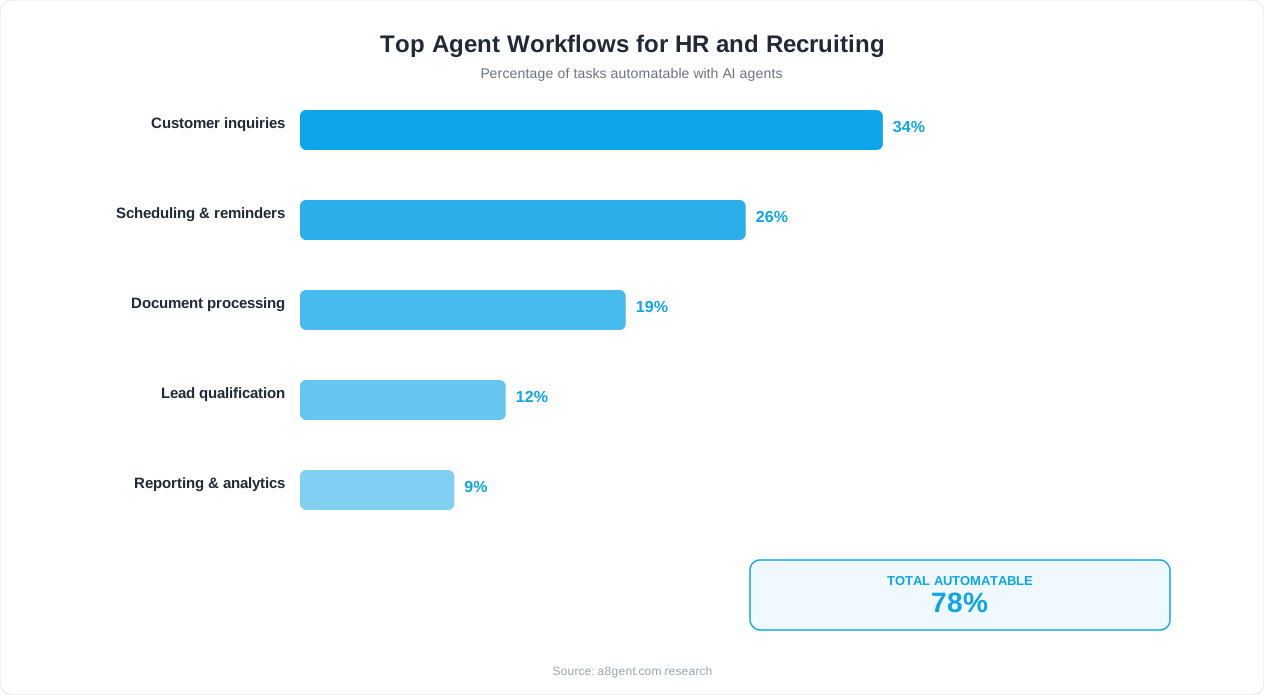
Resume screening at scale. This is the single highest-ROI application of AI in recruiting. A typical mid-market company receives 200-500 applications per open position. Screening those manually takes an experienced recruiter 15-30 seconds per resume, which translates to 2-4 hours of focused screening time per position. An AI agent screens the entire applicant pool in minutes, evaluating each candidate against the job requirements, identifying transferable skills, detecting experience patterns, and producing a ranked shortlist with explanations for each ranking. Companies using AI screening agents report 94% time savings on this step alone, and the quality of shortlists is consistently as good as or better than human screening because the agent never gets fatigued, never develops unconscious bias toward resumes that look familiar, and evaluates every candidate against the same criteria.
Candidate communication and scheduling. The candidate experience is often the weakest link in recruiting, and it is almost entirely due to response time. Research from Glassdoor shows that 58% of candidates lose interest if they do not hear back within one week. AI agents eliminate this problem by responding to every application within minutes with a personalized acknowledgment, providing status updates proactively, and scheduling interviews by coordinating between candidate availability and interviewer calendars. The scheduling automation alone is worth the investment: the typical back-and-forth of scheduling a single interview involves 4-6 emails and takes 2-3 days. An AI agent resolves it in a single interaction. For a company making 50 hires per year with 3 interview rounds each, that is 150 scheduling interactions automated. Check our related guide on AI agents for recruiting for specific platform recommendations.
Interview preparation and debrief. Before each interview, the AI agent prepares the interviewer with a candidate summary, suggested questions based on the specific role and the candidate's background, and any notes from previous interview rounds. After the interview, it collects structured feedback from the interviewer, compiles it into the candidate's profile, and triggers the next step in the process. If all interviewers give positive feedback, the agent automatically initiates the offer process. If feedback is mixed, it flags the candidate for a hiring committee discussion. This structured approach produces more consistent hiring decisions and dramatically reduces the time between final interview and offer, which directly impacts offer acceptance rates.
Offer management and closing. The final stage is where speed matters most. Top candidates often have multiple offers, and the company that moves fastest frequently wins. AI agents generate offer letters from approved templates, route them for digital signature, track acceptance timelines, and send personalized follow-ups if the candidate has not responded. They can also handle basic negotiation parameters: if the hiring manager has pre-approved a salary range, the agent can adjust the offer within that range based on the candidate's request, cutting days out of the negotiation process.
AI-Powered Employee Onboarding That Scales Without Friction
If recruiting gets the candidate in the door, onboarding determines whether they stay and thrive. Yet onboarding remains one of the most inconsistently executed HR processes in most organizations. According to Gallup's 2026 Workplace Report, only 12% of employees strongly agree that their company did a great job of onboarding them. AI agents are changing this by making excellent onboarding the default rather than the exception, regardless of how many people you are onboarding simultaneously.
Pre-first-day automation. The onboarding experience should begin the moment a candidate accepts the offer, not on their first day. An AI onboarding agent triggers a welcome sequence immediately upon offer acceptance: sends a personalized welcome email from their new manager, provides access to pre-reading materials about the company and team, collects all necessary paperwork (tax forms, direct deposit, emergency contacts) through a conversational interface instead of boring PDF forms, provisions IT equipment orders based on role requirements, and adds the new hire to relevant Slack channels and calendar invites before they even walk in the door. Companies that implement pre-first-day automation report 45% higher day-one productivity because new hires arrive prepared and feeling valued.
First-week guided experience. The first week at a new job is overwhelming. There are dozens of systems to learn, people to meet, and processes to understand. An AI onboarding agent acts as a personal guide throughout this week. It sends morning messages outlining the day's activities, introduces the new hire to colleagues they should meet (with context about each person's role and how they will work together), walks them through each software tool they need to use with step-by-step tutorials, and checks in at the end of each day to see if they have questions. The agent answers questions that new hires are often embarrassed to ask a human: "Where is the kitchen?" "How do I submit an expense report?" "What is the dress code for client meetings?" Having a non-judgmental AI resource available 24/7 removes the friction that makes new employees feel lost and anxious.
30-60-90 day structured onboarding. Beyond the first week, the AI agent manages the entire onboarding arc. It schedules check-ins with the new hire's manager at 30, 60, and 90 days. It delivers training modules on a schedule that matches the new hire's role and learning pace. It tracks completion of required compliance training and certifications. It sends pulse surveys to gauge how the new hire is feeling about their experience, their team, and their workload. If any survey response falls below a threshold, it alerts the HR business partner and the manager so they can intervene early. This structured approach ensures that no new hire slips through the cracks, even when your company is hiring rapidly. Read our detailed guide on AI agents for HR onboarding for specific workflow templates.
Onboarding analytics and optimization. Perhaps the most undervalued capability of AI onboarding agents is the data they generate. Over time, the agent builds a comprehensive picture of what predicts onboarding success: which training modules correlate with faster ramp-up, which team introductions matter most, what questions new hires ask most frequently (indicating gaps in your documentation or process). This data allows you to continuously improve your onboarding program in ways that were previously impossible. One a8gent customer discovered that new hires who completed a specific cross-functional introduction sequence in their first week were 60% more likely to be rated "exceeds expectations" at their first annual review. That insight would have been invisible without the data from their onboarding agent.
AI Agents for Day-to-Day HR Operations and Employee Engagement
Beyond recruiting and onboarding, AI agents handle the constant flow of HR operations that consume the majority of an HR team's time. These are the tasks that are individually small but collectively massive: answering benefits questions, processing leave requests, managing performance review cycles, and monitoring employee engagement.
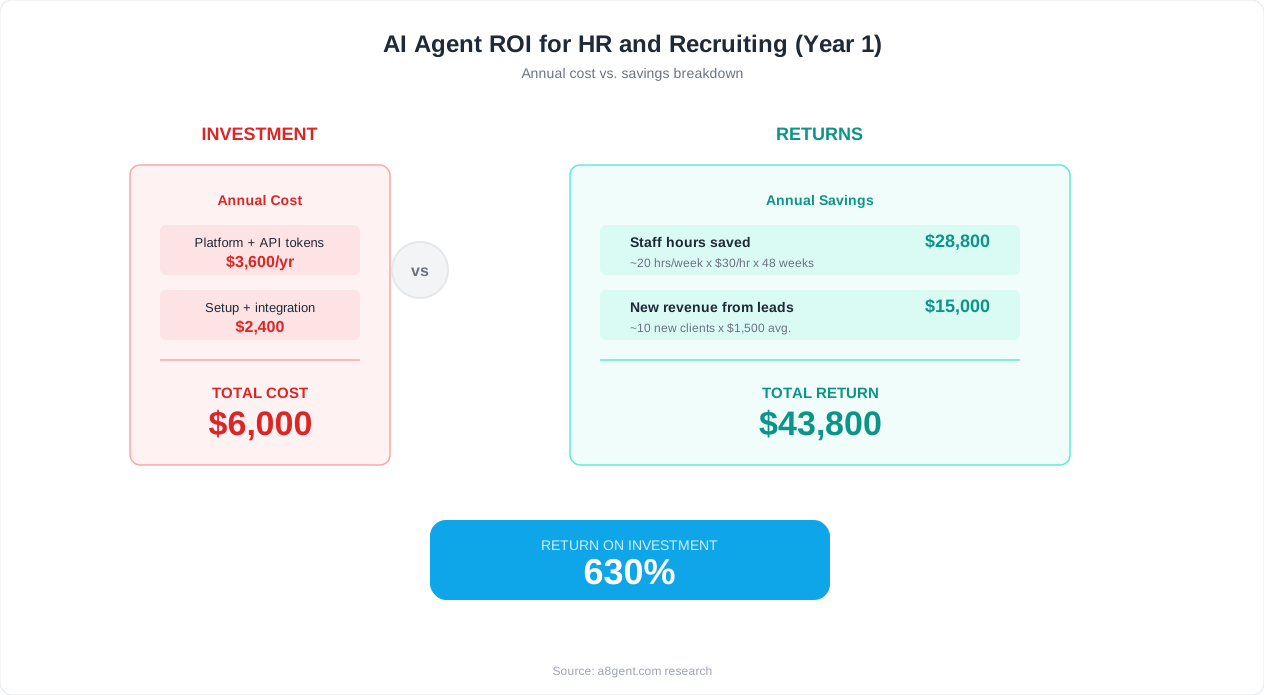
Employee self-service agent. Every HR team knows the pain of answering the same questions hundreds of times: "How many vacation days do I have left?" "What is our dental insurance deductible?" "How do I change my tax withholding?" "What is the process for requesting a transfer?" An AI employee service agent answers these questions instantly, 24/7, by drawing on your employee handbook, benefits documentation, and company policies. It handles 75-85% of routine HR inquiries without any human involvement. For the remaining 15-25% that require human judgment (sensitive situations, policy exceptions, complaints), the agent collects the relevant information, creates a structured ticket, and routes it to the appropriate HR team member with full context. This means HR professionals spend their time on cases that actually need their expertise, not on looking up vacation balances.
Leave and time-off management. Processing leave requests is straightforward but time-consuming when done manually. An AI agent handles the entire flow: employee submits a request (via Slack, email, or an internal portal), the agent checks their available balance, evaluates team coverage for the requested dates, routes the approval to the appropriate manager, sends confirmation to the employee, and updates the HRIS and team calendar. For predictable leave types (vacation, personal days), this can be fully automated with manager notification rather than requiring explicit approval for every request. For complex leave types (FMLA, disability, parental), the agent guides the employee through the required documentation and routes to an HR specialist for final processing.
Performance review orchestration. Performance reviews are the bane of every manager's existence, primarily because of the administrative overhead. AI agents transform this by automating the scheduling, reminders, template distribution, and completion tracking. The agent sends review forms to employees and managers at the configured intervals, sends escalating reminders for incomplete reviews (with polite persistence that never feels annoying because an AI is sending it, not a nagging colleague), compiles completed reviews for HR analysis, and generates aggregate reports showing department-level trends in ratings, competency gaps, and development needs. Some organizations have the agent generate first-draft reviews based on documented achievements, peer feedback, and goal completion, which the manager then edits and finalizes. This cuts review writing time by 50-60% while improving consistency.
Engagement monitoring and retention risk detection. This is the most strategically valuable application of AI in ongoing HR operations. The agent continuously monitors engagement signals across multiple data sources: survey responses, Slack activity patterns, calendar utilization, learning platform engagement, and time-off patterns. When the model detects a pattern that historically correlates with turnover risk (a previously engaged employee stops participating in optional meetings, starts using all their PTO in short bursts, or gives declining engagement scores), it alerts the manager and HR business partner with specific, actionable recommendations. Early intervention based on these signals has been shown to reduce voluntary turnover by 20-30% at companies that act on the insights. This alone can save organizations hundreds of thousands of dollars annually in replacement costs. For the full retention playbook, see our guide on AI-powered retention strategies.
Addressing Bias, Privacy, and Compliance in HR AI Agents
No guide on AI agents for HR would be complete without addressing the elephant in the room: bias, privacy, and legal compliance. HR is one of the highest-stakes domains for AI deployment because decisions directly affect people's livelihoods. Getting this wrong can expose your company to lawsuits, regulatory penalties, and reputational damage. Getting it right means AI agents that are not only efficient but demonstrably fairer than human-only processes.
Bias in AI recruiting: the real picture. The headline fear is that AI will perpetuate or amplify existing biases in hiring. This fear is legitimate - there are well-documented cases of AI screening tools that discriminated against women, minority candidates, or people with disabilities. However, the nuance that often gets lost is that human recruiters are also biased, consistently and unconsciously. Research from the National Bureau of Economic Research shows that identical resumes with different names receive dramatically different callback rates. The question is not "Is AI biased?" (it can be) but "Can we make AI less biased than the status quo?" (we can, with deliberate effort). Modern AI recruiting agents offer several advantages: they evaluate every candidate against the same criteria, they do not get tired and start cutting corners, they can be configured for blind screening (removing names, photos, addresses, and graduation years), and their decisions can be audited comprehensively. No human screening process has ever been audited with this level of transparency.
Designing for fairness. If you are deploying AI agents for recruiting or any HR decision-making, follow these design principles. First, define your evaluation criteria explicitly before the agent sees any candidates. Vague instructions like "find the best candidates" give the AI room to develop its own biases. Specific instructions like "evaluate candidates on these five competencies with these definitions" produce more equitable results. Second, run regular disparate impact analyses on your agent's outputs. Compare acceptance rates across protected classes and investigate any statistically significant differences. Third, maintain a human-in-the-loop for all final hiring decisions. AI agents should screen, rank, and recommend - humans should make the final call, informed by the agent's analysis but not bound by it. Fourth, use multiple evaluation signals rather than relying on a single score. An agent that evaluates resume match, skills assessment results, and structured interview performance produces fairer outcomes than one that relies solely on resume screening.
Privacy and data protection. HR data is among the most sensitive information in any organization. Your AI agents will process Social Security numbers, medical information (for benefits and leave management), salary data, performance reviews, and personal contact information. Ensure your chosen platform complies with GDPR (if you have any EU employees or candidates), CCPA/CPRA (for California residents), and your industry-specific regulations. Key requirements include: data minimization (the agent should only access data it needs for the specific task), retention limits (do not store candidate data indefinitely), consent mechanisms (candidates should know AI is involved in screening), and data portability (employees and candidates can request their data). Our guide on AI agent security and privacy covers the complete compliance checklist.
Regulatory landscape in 2026. Several jurisdictions have enacted AI-specific employment regulations. New York City's Local Law 144 requires bias audits for automated employment decision tools. The EU AI Act classifies HR AI systems as "high risk" with mandatory conformity assessments. Illinois' AI Video Interview Act requires consent for AI analysis of video interviews. Colorado's AI Act requires impact assessments for consequential AI decisions. Your AI agent platform should help you comply with these regulations, not create compliance headaches. Ask your vendor specifically about their compliance features, audit trail capabilities, and how they handle regulatory updates. The regulatory landscape is evolving rapidly, so choose a platform that treats compliance as a core feature rather than an afterthought.
Building trust with employees and candidates. Transparency is your most powerful tool for building trust. Communicate clearly about how AI is used in your HR processes, what data it accesses, how decisions are made, and how people can request human review. Companies that are transparent about AI use in HR report higher candidate satisfaction and employee trust than companies that try to hide AI involvement. People generally accept AI assistance when they understand it and believe it makes the process better - they resist it when they feel it is being done to them without their knowledge or consent.
Your HR AI Agent Implementation Roadmap
After covering the full landscape of HR AI agents, here is the practical implementation sequence we recommend based on ROI, risk, and complexity. Follow this roadmap to transform your HR function systematically over six months.
Month 1: Interview scheduling and candidate communication. Start here because it is the lowest-risk, highest-immediate-impact deployment. There is almost no downside to automating the logistics of scheduling, and the impact on candidate experience is immediate and measurable. Connect your AI agent to your ATS, calendar system, and email. Configure it to handle scheduling requests, send automated status updates, and answer common candidate questions about the process, role, and company. Measure: time-to-schedule, candidate satisfaction scores, recruiter hours saved. Expected result: 80-90% of scheduling handled autonomously, 15+ hours per week saved for a recruiting team of 3.
Month 2: Employee self-service for benefits and policy questions. Deploy an AI agent trained on your employee handbook, benefits documentation, and company policies. This agent handles inbound questions from employees via Slack, email, or your internal portal. Start with the top 50 most frequently asked questions (your HR team can list these immediately from memory) and expand the knowledge base weekly. Measure: ticket volume reduction, average response time, employee satisfaction with HR service. Expected result: 70-80% of routine inquiries handled without human involvement, employees get answers in seconds instead of hours.
Month 3: Resume screening and candidate sourcing. With two successful agents running, your team has built confidence in the technology. Now deploy the higher-stakes recruiting agent. Start in shadow mode where the agent screens resumes and produces recommendations, but a human reviewer validates every shortlist for the first 2-3 hiring cycles. Run a disparate impact analysis on the agent's recommendations before switching to autonomous mode. Measure: screening time per position, quality of shortlists (measured by interview-to-offer conversion rate), diversity metrics. Expected result: 90%+ time savings on resume screening with equal or better shortlist quality.
Month 4: New employee onboarding automation. Build the onboarding agent that manages the pre-first-day through 90-day experience. Start with the administrative components (paperwork, system access, training scheduling) and gradually add the experiential components (check-ins, pulse surveys, social introductions). Measure: time-to-productivity for new hires, onboarding completion rates, new hire satisfaction at 30/60/90 days. Expected result: 50% reduction in HR time spent on onboarding coordination, 30% improvement in new hire satisfaction scores.
Month 5: Leave management and performance review orchestration. These are operationally important but less urgent than the first four deployments. Automate the leave request workflow end-to-end and build the performance review orchestration agent that handles scheduling, reminders, and compilation. Measure: leave processing time, review completion rates, manager satisfaction with review process. Expected result: leave requests processed in minutes instead of days, review completion rates above 95%.
Month 6: Engagement monitoring and retention analytics. This is the capstone deployment that requires the most data and the most thoughtful design. By month six, you have several agents generating rich data about employee interactions, satisfaction, and behavior patterns. The engagement monitoring agent synthesizes these signals into actionable intelligence. Measure: early identification accuracy (did flagged employees actually show turnover risk), intervention success rates, voluntary turnover reduction. Expected result: 20-30% reduction in avoidable voluntary turnover within six months of deployment.
Throughout this roadmap, maintain regular communication with your employees about what the agents do and do not do. Gather feedback from both employees and the HR team to continuously refine agent behavior. And remember that the goal is not to reduce your HR headcount - it is to free your HR professionals to do the strategic, human-centric work they were hired to do. The companies that get the best results from HR AI agents are the ones that reinvest the efficiency gains into better culture, better development programs, and better employee experiences. Get started with a8gent to deploy your first HR agent this week, or explore our HR onboarding automation guide for detailed workflow templates.
FAQ
Will AI agents replace HR professionals?
No. AI agents replace repetitive administrative tasks, not HR professionals. The most successful implementations redeploy HR time from paperwork and routine inquiries to strategic work like culture development, leadership coaching, organizational design, and employee experience initiatives. Companies using AI agents in HR typically maintain or grow their HR teams while dramatically increasing the scope and quality of what those teams accomplish.
Is AI resume screening legal?
AI resume screening is legal in most jurisdictions but is subject to growing regulation. New York City requires bias audits for automated employment decision tools. The EU AI Act classifies HR AI as high-risk. Several US states have disclosure requirements. To stay compliant, use bias-audited tools, maintain human oversight for final decisions, disclose AI use to candidates, and run regular disparate impact analyses on your screening outcomes.
How accurate are AI agents at screening resumes?
Modern AI screening agents match or exceed human recruiter accuracy when properly configured with clear evaluation criteria. Studies show they identify qualified candidates that human screeners miss (especially when dealing with non-traditional career paths or transferable skills) while maintaining consistent evaluation standards. The key is providing specific, measurable screening criteria rather than vague requirements.
What HR software does AI agents integrate with?
Major AI agent platforms integrate with popular HRIS systems (Workday, BambooHR, Gusto, ADP), applicant tracking systems (Greenhouse, Lever, Ashby), communication tools (Slack, Teams, email), calendar systems (Google Calendar, Outlook), and learning management systems. Most platforms offer 100+ pre-built integrations and custom API connections for specialized tools.
How do I measure the ROI of AI agents in HR?
Measure across four dimensions: time savings (hours per week reclaimed from administrative tasks), cost reduction (labor savings on automated processes), quality improvement (candidate experience scores, onboarding satisfaction, review completion rates), and strategic impact (time-to-fill reduction, quality of hire improvements, voluntary turnover reduction). Most companies see positive ROI within 30-60 days of deploying their first HR agent.