AI Agents for Lead Nurturing: From Cold to Closed on Autopilot (2026)
AI agents now nurture leads from first touch to closed deal without manual follow-up. Learn how automated sequences, intelligent scoring, and personalized outreach convert 3-5x more leads while your sales team focuses on high-value conversations.
10+ years shipping production ML across TensorFlow, PyTorch, AWS, and GCP. Ships every A8gent agent before it becomes a lesson. GitHub
- AI nurturing agents increase lead-to-customer conversion rates by 3-5x compared to manual follow-up - primarily because they respond instantly, follow up consistently, and never let a lead go cold due to human forgetfulness or capacity limits.
- The average sales rep follows up with a lead 1.5 times before giving up. AI agents maintain personalized contact across 12-15 touchpoints over weeks or months - and 80% of sales require 5+ follow-ups to close, which is why AI dramatically outperforms manual nurturing.
- Modern AI nurturing goes beyond generic drip emails - agents analyze each lead's behavior (pages visited, content consumed, emails opened) and dynamically adjust messaging, timing, and channel to match that specific lead's buying signals.
- Platforms like 11x AI and Conversica handle the entire nurturing workflow autonomously - from initial outreach to qualification conversations to meeting booking - only involving human reps when a lead is genuinely ready for a sales conversation.
- Small businesses deploying AI lead nurturing see average pipeline growth of 40-60% within 90 days, with platform costs of $99-$500/month replacing $4,000-$8,000/month in SDR salary costs for equivalent follow-up volume.
Why Most Leads Die: The Follow-Up Problem AI Solves
Here is a painful statistic: 79% of marketing leads never convert to sales. Not because the leads are bad - but because nobody followed up properly. The lead came in, got one or two emails, maybe a call that went to voicemail, and then... nothing. The lead went cold. The opportunity evaporated. The marketing dollars were wasted.
This is not a people problem. It is a math problem. A typical sales rep handles 50-100 leads simultaneously. Each lead needs 5-12 touchpoints over 2-8 weeks to convert. That is 250-1,200 follow-up actions competing for attention with the leads who are already further down the funnel. The urgent always beats the important, and early-stage nurturing is the first thing that falls off the plate.
AI agents solve this math problem completely. An AI nurturing agent handles unlimited leads simultaneously, maintains consistent follow-up across weeks or months, personalizes every touchpoint based on the lead's behavior, and never gets too busy or forgets. The result: 3-5x more leads convert to customers because every lead gets the persistent, personalized attention that historically only your top prospects received.
In 2026, AI lead nurturing has moved far beyond basic drip emails. Modern AI agents carry on actual conversations with leads - responding to replies, answering questions, handling objections, booking meetings when buying signals appear, and escalating to human reps only when the lead is qualified and ready to talk. They work across email, SMS, LinkedIn, and chat simultaneously, choosing the right channel for each lead based on engagement patterns.
This guide covers how AI lead nurturing works in practice, which platforms to use, how to set up nurturing workflows without technical skills, and how to measure the revenue impact. Whether you are a solo founder whose follow-up is inconsistent, a sales team drowning in lead volume, or a marketing team frustrated that good leads are being wasted, AI nurturing agents solve the fundamental problem: ensuring every lead gets the right message at the right time until they are ready to buy or explicitly opt out.
If you want to know how much revenue you are currently leaving on the table from poor follow-up, start with our sales workflow assessment. It evaluates your lead volume, current follow-up process, and conversion rates to estimate the revenue opportunity AI nurturing can unlock.
How AI Lead Nurturing Works: Beyond Basic Drip Campaigns
Traditional drip campaigns send the same sequence of emails to every lead on a fixed schedule regardless of behavior. They are better than nothing - but they are static, impersonal, and increasingly ignored. AI nurturing is fundamentally different because it adapts in real time to each lead's specific signals.
Behavior-Driven Sequencing
An AI nurturing agent watches what each lead does - not just whether they open emails. It tracks: which pages they visit on your website (pricing page visits signal buying intent), what content they consume (case studies and comparison pages indicate evaluation stage), how quickly they respond to messages (fast responses indicate engagement), what questions they ask (objections reveal their decision criteria), and whether they involve other stakeholders (forwarding emails or adding colleagues indicates organizational buy-in). Based on these signals, the AI adjusts the nurturing path dynamically. A lead who just visited your pricing page gets a different next message than one who read a top-of-funnel blog post.
Conversational Nurturing
The biggest advancement in 2026 AI nurturing is conversational capability. When a lead replies to an email - asking a question, raising an objection, or requesting information - the AI responds naturally and helpfully. It answers product questions from your knowledge base, handles common objections with your approved messaging, provides relevant case studies and social proof, and moves the conversation toward next steps without being pushy. This turns one-directional email sequences into two-way conversations that build rapport and trust at scale.
Multi-Channel Orchestration
AI agents nurture across multiple channels based on where each lead is most responsive: email for detailed information and content sharing, SMS for time-sensitive messages and meeting confirmations, LinkedIn for professional context and social proof, and chat/messaging for real-time conversations when leads are actively browsing. The AI learns each lead's channel preference and prioritizes accordingly. A lead who never opens emails but responds to LinkedIn messages gets LinkedIn-first nurturing. A lead who engages via email but ignores SMS gets email-heavy sequences.
Intelligent Timing
When you send a message matters as much as what you say. AI agents optimize send timing based on: individual engagement patterns (this lead opens emails at 7:30 AM, that one at 2 PM), day-of-week effectiveness (B2B leads engage more Tuesday-Thursday, consumers more on weekends), urgency signals (a lead browsing competitors should be contacted today, not next week), and response patterns (if a lead takes 3 days to respond, do not follow up after 24 hours - give them space). This timing optimization alone improves response rates by 20-35% compared to fixed-schedule sequences.
The Human Handoff Moment
AI nurturing agents do not try to close deals - they prepare leads for productive human conversations. The handoff trigger is configurable: when a lead asks to speak with someone, when buying signals reach a threshold (pricing page + case study + response to ROI question), when a lead matches your ideal customer profile and shows engagement above a certain level, or when the AI detects an objection it cannot resolve. The handoff includes full context: every interaction history, identified needs, potential objections surfaced, and recommended talking points for the sales rep.
Platforms like 11x AI and Conversica specialize in this conversational nurturing approach, handling the full journey from first touch through qualification to meeting booking autonomously.
AI Lead Scoring: Know Exactly When to Engage
Not all leads are equal. Some are ready to buy this week. Others are researching for a project six months away. AI lead scoring separates these groups in real time so your nurturing intensity matches each lead's actual readiness - and your sales team talks only to leads who are genuinely ready to convert.
How AI Scoring Differs from Traditional Scoring
Traditional lead scoring assigns static points: downloaded a whitepaper (+10), visited pricing (+20), has VP title (+15). The problem is that these weights are arbitrary and decay quickly. AI scoring learns continuously from your actual conversion data - which signals actually predicted closed deals in your business, weighted by how strongly they correlate. If attending your webinar historically leads to a 3x higher close rate, the AI weights that heavily. If job title turns out to not predict conversion in your market, the AI de-weights it. The model updates continuously as new deals close or are lost.
Behavioral Signals That AI Tracks
Beyond basic page views and email opens, AI scoring agents analyze: content consumption patterns (reading 5+ pages in one session indicates active evaluation), return visit frequency (coming back 3 times in one week signals urgent need), engagement depth (reading an entire case study vs bouncing after 10 seconds), comparison behavior (visiting your competitor comparison pages), and social signals (engaging with your team's LinkedIn posts, mentioning related pain points in public forums). Each signal contributes to a continuously updated score that reflects the lead's current buying readiness.
Predictive Scoring: Who Will Buy?
Beyond measuring current engagement, AI agents predict future conversion probability. By analyzing which patterns preceded successful deals historically, the AI identifies leads that match those patterns early - before the lead has explicitly shown intent. A lead whose firmographic profile, initial behavior, and engagement pattern match your best customers gets flagged as high-probability even if their activity level is moderate. This lets you nurture high-potential leads more aggressively before competitors capture their attention.
Dynamic Score-Based Routing
Lead scores drive routing decisions in real time. Score 0-30 (cold): AI maintains light-touch nurturing with educational content. Score 31-60 (warming): AI increases engagement frequency and introduces solution-specific content. Score 61-80 (hot): AI shifts to bottom-of-funnel content, case studies, and ROI-focused messaging. Score 81-100 (sales-ready): AI triggers meeting booking attempt or immediate sales team notification for personal outreach. These thresholds adjust based on your pipeline data - if leads at score 65 are closing at high rates, the AI lowers the handoff threshold.
Score Decay and Re-Engagement
Scores are not permanent. A lead who was highly engaged three months ago but has gone silent should not retain a high score indefinitely. AI agents apply score decay - gradually reducing scores when engagement stops. But they also distinguish between "lost interest" and "timing not right." A lead who actively unsubscribes is different from one who simply paused activity. The AI maintains leads in appropriate nurturing tiers based on their decayed score, ready to re-engage when fresh signals appear.
Measuring Scoring Effectiveness
Track these metrics to validate your AI scoring model: conversion rate by score bracket (higher scores should convert at higher rates - if not, the model needs recalibration), time-to-close by score at handoff (leads handed to sales at higher scores should close faster), false positive rate (leads scored as hot that never convert - should be under 20%), and coverage rate (of leads that do convert, what percentage were scored as hot before conversion - should exceed 75%). Platforms like Autonoly provide built-in scoring analytics dashboards that track these metrics automatically.
Building High-Converting Nurturing Sequences with AI
The nurturing sequence - the series of touchpoints that moves a lead from awareness to decision - is where AI creates the most direct revenue impact. Here is how to build sequences that convert, leveraging AI's ability to personalize and adapt at every step.
The Anatomy of an AI Nurturing Sequence
Unlike linear drip campaigns, AI sequences are branching decision trees that adapt based on lead behavior. A typical high-converting sequence includes: Touch 1 (Day 0): Value-first outreach - share something immediately useful related to the lead's industry or role. No hard sell. Touch 2 (Day 2-3): Follow-up referencing their specific engagement (if they opened Touch 1, visited your site, etc.). Touch 3 (Day 5-7): Educational content that addresses their likely pain point based on their profile and behavior. Touch 4 (Day 10-14): Social proof - case study or result from a similar company/role. Touch 5 (Day 15-20): Direct value proposition - how you solve their specific problem. Touch 6+ (varies): Escalating specificity and urgency based on response patterns.
Personalization That Converts
Generic messages ("Hi {first_name}, hope you are well") convert at 2-5%. AI-personalized messages convert at 15-25%. The difference: AI personalizes based on the lead's company (referencing their specific industry, size, and likely challenges), role (matching content to their decision-making level), behavior (referencing what they looked at, downloaded, or asked about), timing (acknowledging where they are in their buying journey), and pain points (addressing the specific problem their behavior signals). Each message feels individually crafted because it essentially is - the AI composes it from your templates using the lead's specific context.
Handling Replies and Objections
The most powerful nurturing sequences are conversational - they handle replies intelligently. When a lead responds with "not interested right now," the AI does not just drop them - it acknowledges the timing, asks permission to check back later, and schedules a re-engagement touch in 30-60 days. When a lead asks "how much does this cost?" the AI provides pricing context appropriate to their profile while steering toward a conversation with sales for detailed quotes. When a lead raises an objection ("we already use Competitor X"), the AI responds with relevant competitive differentiation from your approved messaging. This conversational handling converts 20-40% of leads who initially object - leads that would be permanently lost under a static drip campaign.
Multi-Stakeholder Sequences
For B2B sales involving multiple decision-makers, AI agents can run parallel sequences targeting different stakeholders within the same account. The champion gets technical content and ROI data. The economic buyer gets cost justification and executive summaries. The end user gets product demonstrations and use case examples. The AI coordinates these sequences to avoid over-contacting the account while ensuring all stakeholders receive relevant information aligned with their role in the decision.
Sequence Optimization Through AI Learning
AI nurturing agents continuously test and optimize: which subject lines generate opens, which content drives replies, which offers trigger meeting bookings, which channels work for which segments, and which timing patterns maximize response rates. Unlike traditional A/B testing (which requires manual setup and takes weeks for statistical significance), AI optimization runs continuously across all sequences, adjusting in real time. After 60-90 days of operation, your sequences are dramatically more effective than their starting versions - optimized by thousands of micro-experiments the AI ran automatically.
For proven sequence templates you can deploy immediately, see our sales automation use cases - including templates for cold outreach, inbound follow-up, post-demo nurturing, and renewal/expansion sequences.
Best AI Lead Nurturing Platforms (2026 Comparison)
The market for AI nurturing platforms ranges from specialized SDR replacement tools to general-purpose automation platforms with nurturing capabilities. Here are the best options for different business sizes and sales models.
11x AI - Best for Outbound SDR Replacement ($1,000-$3,000/month)
11x AI provides an AI-powered SDR (named Alice) that handles outbound prospecting and nurturing end-to-end. Alice researches prospects, crafts personalized outreach, handles responses conversationally, qualifies leads through natural dialogue, and books meetings directly on your sales team's calendars. She operates across email and LinkedIn with human-quality personalization. Best for: B2B companies that want to replace or supplement their SDR function entirely with AI. Typical results: 3-5x more meetings booked per month compared to one human SDR at 70% lower cost.
Conversica - Best for Inbound Lead Follow-Up ($1,500-$4,000/month)
Conversica specializes in inbound lead response and nurturing. When leads come in from marketing (form fills, content downloads, webinar attendees, trial signups), Conversica's AI engages them immediately with personalized conversations. It qualifies interest level, identifies needs, handles initial objections, and routes qualified leads to the appropriate sales rep with full context. Best for: companies with high inbound lead volume where speed-to-response and consistent follow-up directly impact conversion. Typical results: 35-50% of inbound leads engaged in conversation (vs 10-15% with manual follow-up).
Autonoly - Best All-in-One for Small Teams ($99-$299/month)
Autonoly offers lead nurturing as part of a broader automation platform. It handles multi-step email sequences, behavior-triggered follow-ups, lead scoring, and CRM updates without the enterprise price tag. While less specialized than 11x or Conversica, it provides 80% of the functionality at 80% lower cost - making it the right choice for small businesses and startups that need nurturing automation without five-figure monthly commitments. Best for: small businesses and solo founders who need affordable, effective nurturing that integrates with their broader workflow automation.
HubSpot Sequences + AI - Best for HubSpot Users ($800-$1,200/month for Sales Hub Pro)
If you are already on HubSpot, their built-in sequence automation with AI-powered send time optimization and smart content provides solid nurturing capabilities within your existing CRM. It is not as sophisticated as dedicated AI nurturing tools (conversations are less natural, personalization is more template-based), but the tight CRM integration and zero-additional-platform simplicity makes it compelling for teams already invested in the HubSpot ecosystem. Best for: teams on HubSpot who want incremental nurturing improvement without adding another platform.
Choosing the Right Platform
Solo founder or small team, mixed inbound/outbound, budget under $300/month: Autonoly. B2B company wanting to scale outbound without hiring SDRs: 11x AI. High inbound lead volume needing instant engagement: Conversica. Already on HubSpot, wanting to optimize existing sequences: HubSpot AI features. Not sure which approach fits your sales model? Our assessment tool evaluates your lead sources, sales cycle, and team structure to recommend the best platform match.
Integration Considerations
Whichever platform you choose, ensure it integrates with your CRM (HubSpot, Salesforce, Pipedrive), your calendar (for meeting booking), your email infrastructure (for deliverability), and your analytics (for attribution). Disconnected nurturing that does not sync to your CRM creates data silos and missed handoffs. All platforms listed above offer native CRM integrations for the major providers.
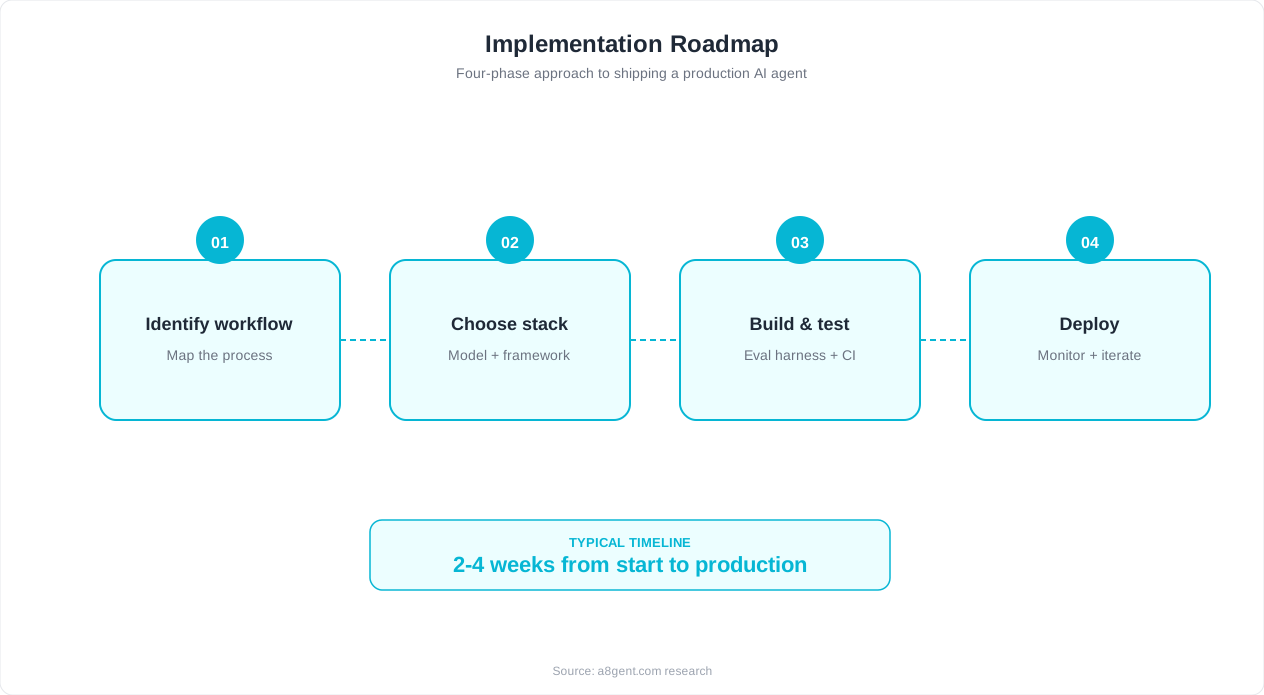
Implementation: Launch AI Nurturing in 7 Days
You do not need months of planning to launch AI lead nurturing. Here is a practical 7-day plan that gets your first nurturing workflows generating pipeline.
Day 1: Platform Selection and Setup
Choose your platform based on the comparison above. Sign up and connect your core integrations: CRM (where your leads live), email (for outreach delivery), calendar (for meeting booking), and website tracking (for behavior signals). Most platforms complete initial setup in 2-3 hours. While the platform syncs your data, move to content preparation.
Day 2: Content and Messaging Preparation
Prepare the raw materials your AI agent needs: your value proposition (1-2 sentences describing what you do and for whom), 3-5 customer pain points (the problems your leads are trying to solve), 3-5 case studies or result statements (proof that you solve those problems), common objections and your responses (price, timing, competitor comparisons), and your ideal customer profile (who should be prioritized). You do not need polished marketing copy - the AI will compose actual messages from these building blocks. Just provide the facts and positions clearly.
Day 3: Sequence Design
Build your first nurturing sequence. Start with your highest-volume lead source (inbound form fills, cold outbound list, or webinar attendees). Define: the trigger (what puts a lead into this sequence), the cadence (how many days between touchpoints), the content at each step (value-first, educational, social proof, direct ask), the exit conditions (what moves them out - replied, booked meeting, unsubscribed), and the escalation trigger (when to involve a human rep). Most platforms offer templates - start with one and customize rather than building from scratch.
Day 4: AI Training and Testing
Configure the AI's conversation capabilities: upload your FAQ responses, objection handling, product information, and qualification criteria. Run test sequences against yourself or team members to validate: messages sound natural and on-brand, replies are handled appropriately, meeting booking works correctly, and CRM records update properly. Fix any issues before going live. This testing phase prevents embarrassing errors in real lead conversations.
Day 5: Soft Launch with Small Cohort
Activate the sequence for a small subset of leads - 20-50 from your current pipeline or new leads from a single source. Monitor closely: are messages being delivered (check deliverability), are leads engaging (opens, clicks, replies), are conversations flowing naturally, and are handoffs to sales happening correctly? This small-batch test validates your setup without risking your entire lead database on an untested workflow.
Day 6: Refinement and Expansion
Based on Day 5 results, adjust messaging, timing, or targeting. Common refinements: subject lines that got low opens need rewriting, reply handling that felt robotic needs tone adjustment, timing that generated out-of-office responses needs shifting, and qualification questions that confused leads need simplification. Once refinements are made, expand to your full lead flow.
Day 7: Full Launch and Measurement Setup
Activate nurturing for all incoming leads and import your existing pipeline for nurturing. Set up measurement dashboards tracking: sequence enrollment rate, engagement rate (opens, replies), qualification rate (leads progressing to sales-ready), meeting booking rate, and ultimate conversion rate. Establish a weekly review cadence to optimize sequences based on performance data. Your AI nurturing engine is now running.
For detailed implementation guidance specific to your sales model, see our sales automation use cases with step-by-step workflows for different scenarios.
Measuring Results: Pipeline Impact and Revenue Attribution
AI lead nurturing generates clear, measurable pipeline and revenue impact. Here is how to track results, attribute revenue correctly, and demonstrate ROI to justify continued investment.
Core Metrics to Track
Response Rate: What percentage of nurtured leads engage (reply, click, or take action)? Benchmark: 15-25% for AI-personalized outreach vs 2-5% for generic drips. Qualification Rate: Of engaged leads, what percentage qualify for sales conversation? Benchmark: 20-40% of responders become qualified opportunities. Meeting Booking Rate: What percentage of qualified leads schedule a sales conversation? Benchmark: 30-50% of qualified leads book meetings when the AI offers scheduling. Pipeline Generated: Total dollar value of opportunities created through AI nurturing. This is your primary leading indicator. Revenue Closed: Deals closed that originated from or were influenced by AI nurturing. This is your ultimate success metric.
Attribution Models
Lead nurturing contributes to revenue through multiple paths, and attribution must account for all of them. First-touch attribution: the AI sequence was the lead's first interaction with your company. Last-touch attribution: the AI sequence was the final interaction before they became an opportunity. Multi-touch attribution: the AI sequence was one of several touchpoints in the lead's journey. Influence attribution: the lead was already in pipeline but AI nurturing re-engaged them or advanced them to the next stage. Track all four models to understand AI nurturing's full contribution. Most businesses find that multi-touch attribution reveals the highest value because nurturing typically sits between awareness and decision rather than being the sole driver.
Before/After Comparison
The cleanest ROI measurement compares identical time periods before and after AI nurturing deployment. Compare: lead-to-opportunity conversion rate (should increase 2-4x), average time from lead to opportunity (should decrease by 30-50%), sales rep time spent on follow-up (should decrease by 60-80%), pipeline generated per month (should increase 40-60%), and revenue closed per month from nurtured leads (should increase within 60-90 days depending on your sales cycle). Ensure you compare equivalent lead volumes and quality to isolate the impact of AI nurturing from other variables.
ROI Calculation
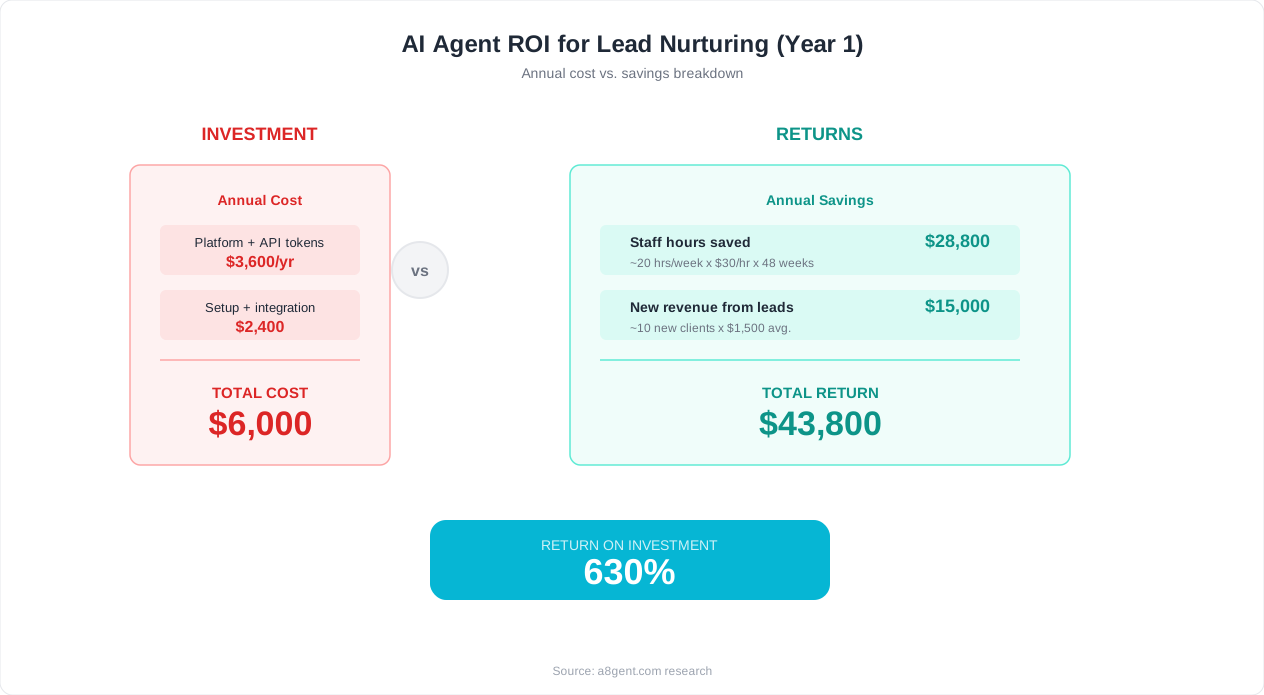
Simple ROI formula: (Additional Revenue from AI Nurturing - Platform Cost) / Platform Cost x 100. Example: A company spending $299/month on Autonoly for nurturing. Before AI: 10 qualified opportunities/month from 200 leads (5% conversion), 3 closed deals at $5,000 average = $15,000/month. After AI: 30 qualified opportunities/month from the same 200 leads (15% conversion), 9 closed deals at $5,000 average = $45,000/month. Additional revenue: $30,000/month. ROI: ($30,000 - $299) / $299 = 9,933% return. Even conservative estimates (doubling rather than tripling conversion) show 20-50x returns on platform investment.
Optimization Cadence
Review performance weekly and optimize monthly. Weekly checks: delivery rates (ensuring emails land in inbox), response rates (identifying messaging that resonates or falls flat), and any conversation issues (AI responses that confused leads). Monthly optimizations: update messaging based on what is converting best, adjust scoring thresholds based on actual conversion data, add new sequences for lead sources or segments you have identified, and retire sequences that underperform despite optimization attempts. This continuous improvement compounds - sequences get 10-20% more effective each month as the AI accumulates learning.
Advanced Strategies: Account-Based Nurturing and Pipeline Acceleration
Once your basic nurturing is running and converting, these advanced strategies unlock additional revenue from your existing lead flow.
Account-Based Nurturing (ABM with AI)
For B2B companies selling to organizations (not individuals), AI agents can coordinate nurturing across multiple stakeholders within a target account. The AI identifies additional contacts within accounts where you have initial engagement, crafts role-appropriate messaging for each stakeholder (technical for engineers, ROI-focused for executives, workflow-focused for end users), coordinates timing so the account receives consistent but not overwhelming outreach, and tracks account-level engagement to determine when the organization (not just one person) is ready for sales engagement. This multi-threaded approach increases enterprise deal velocity by 30-45% because you are building consensus across the buying committee simultaneously rather than relying on a single champion.
Pipeline Acceleration for Stalled Deals
Not all nurturing is top-of-funnel. AI agents also re-engage stalled pipeline - deals that entered your pipeline but have not progressed. Common stall reasons: the champion got busy, a competing priority emerged, or the evaluation committee has not reconvened. AI acceleration touches for stalled deals include: sharing relevant new content (new case study from their industry, new feature that addresses their stated need), triggering urgency (limited-time offer, upcoming price change, competitor activity), involving new angles (connecting them with a customer reference, offering an executive-level conversation), and status check-ins that give the champion ammunition to re-prioritize internally.
Renewal and Expansion Nurturing
AI nurturing is not just for new business. Existing customer expansion follows the same principles: monitor usage signals that indicate readiness for upgrades, nurture toward expansion with content showing how similar customers benefit from premium features, time outreach to contract renewal windows, and engage additional departments or teams within existing customer accounts. Companies using AI for expansion nurturing see 20-35% higher net revenue retention because they catch expansion opportunities that would otherwise require expensive human CSM attention to identify.
Event-Triggered Nurturing
Configure AI agents to initiate nurturing based on external events: a target company raises funding (they now have budget), a prospect changes jobs to a new company (warm relationship, new opportunity), a competitor announces a price increase (your value proposition just improved), industry regulation changes (creates urgency for solutions like yours), or a prospect's company appears in the news (relevant conversation starter). These event triggers create timely, relevant outreach that feels helpful rather than intrusive because it is tied to something the prospect actually cares about right now.
AI-Human Hybrid: The Best of Both
The highest-converting approach combines AI consistency with human authenticity at key moments. The AI handles: initial outreach and follow-up (volume and consistency), qualification conversations (standardized and scalable), meeting booking (no back-and-forth scheduling friction), and re-engagement after silence (persistent without being annoying). Humans handle: discovery calls (understanding complex needs), proposal presentations (building confidence and trust), negotiation (judgment and flexibility), and relationship moments (congratulations on wins, empathy during challenges). This hybrid model maximizes conversion while keeping your sales team focused exclusively on revenue-generating conversations rather than administrative follow-up.
For a complete guide to combining AI and human touchpoints in your sales process, see our sales automation use cases - including decision frameworks for when AI should handle versus escalate to humans.
FAQ
Will leads know they are talking to an AI?
Modern AI nurturing agents write with human-quality language, personalization, and conversational flow. Most leads cannot distinguish AI outreach from human-written messages. However, best practice (and legal requirements in some jurisdictions) recommend transparency when asked directly. Platforms like 11x AI and Conversica are designed to be indistinguishable from human SDRs in normal conversation while maintaining ethical standards. The key is that value and relevance matter more to leads than who wrote the message.
How many leads can an AI nurturing agent handle simultaneously?
Unlimited, practically speaking. AI agents can nurture thousands of leads simultaneously with fully personalized, behavior-adaptive sequences - each lead getting individualized attention as if they had a dedicated human rep. This is the fundamental advantage over human nurturing, which degrades in quality as volume increases. A single AI agent replaces the nurturing capacity of 5-15 human SDRs while maintaining higher quality and consistency.
How long before AI nurturing generates measurable pipeline?
Expect first engaged responses within 48-72 hours of launching sequences. First qualified opportunities typically appear within 1-2 weeks. Measurable pipeline impact (statistically significant improvement over baseline) takes 30-60 days. Full optimization (AI has learned what works and sequences are refined) takes 60-90 days. Businesses with shorter sales cycles see revenue impact faster; longer enterprise sales cycles may take 90-120 days for closed revenue attribution.
Does AI nurturing work for high-ticket B2B sales?
Yes, and often delivers even higher ROI than for low-ticket sales because the value of each converted lead is larger. For enterprise sales, AI handles the high-volume early stages (initial outreach, qualification, meeting booking) while humans handle the relationship-intensive later stages. A $50,000 deal that converts because AI nurturing maintained consistent follow-up during a 6-month evaluation represents massive ROI on a $299/month platform investment.
What about email deliverability? Will AI nurturing trigger spam filters?
Legitimate AI nurturing platforms manage deliverability carefully: gradual sending volume ramp-up, domain warming protocols, personalization that avoids spam triggers, automatic throttling when bounce rates increase, and compliance with CAN-SPAM and GDPR requirements. Deliverability rates of 95%+ are standard for well-configured platforms. The key is choosing a platform with built-in deliverability management rather than sending through your own email without these safeguards.
Can AI nurturing integrate with my existing CRM and sales tools?
All major AI nurturing platforms integrate with standard CRM systems (HubSpot, Salesforce, Pipedrive, Close), calendar tools (Google Calendar, Calendly, Microsoft Outlook), email infrastructure (Gmail, Outlook, custom SMTP), and analytics platforms (Google Analytics, Mixpanel). Data flows bidirectionally - lead activity from the AI syncs to your CRM, and CRM updates (deal stage changes, rep assignments) inform the AI's nurturing behavior. No manual data transfer required.
How is AI nurturing different from marketing automation like Mailchimp?
Marketing automation sends predetermined emails on fixed schedules. AI nurturing adapts dynamically - changing messaging, timing, channel, and content based on each lead's real-time behavior and engagement signals. The AI also handles two-way conversations (responding to replies intelligently), which marketing automation cannot do. Think of marketing automation as a broadcast system and AI nurturing as a conversational system that scales to thousands of individualized relationships simultaneously.
What if a lead gets nurturing from AI and also hears from my sales rep?
Good AI nurturing platforms prevent this through CRM integration: when a sales rep claims a lead or moves them to an active deal stage, the AI automatically pauses or adjusts its sequences. You can configure rules like: pause all AI outreach when a rep logs activity, reduce AI to support-only messaging during active deals, or have AI handle only specific channels while reps own others. Coordination is essential - double-contacting leads erodes trust and professionalism.