Automate Data Entry: AI Agents vs Offshore VAs (2026 Comparison)
Tired of manual data entry eating your team's time? This 2026 comparison breaks down two popular solutions - AI agents and offshore virtual assistants - across cost, speed, accuracy, scalability, and reliability. Discover which option fits your business and how to make the switch without disruption.
10+ years shipping production ML across TensorFlow, PyTorch, AWS, and GCP. Ships every A8gent agent before it becomes a lesson. GitHub
- AI agents process data 10-50x faster than human VAs and operate 24/7 without breaks, sick days, or timezone constraints - making them ideal for high-volume, time-sensitive data entry.
- Offshore VAs cost $5-15 per hour but introduce hidden costs including management time, quality checks, training, and turnover - AI agents cost $50-300 per month with zero management overhead.
- AI agents achieve 95-99% accuracy on structured data entry tasks and improve over time, while human VAs typically sustain 92-97% accuracy with fatigue-related decline during long sessions.
- VAs retain an advantage for tasks requiring subjective judgment, cultural context, or handling highly unstructured data that AI cannot yet parse reliably.
- The optimal strategy for most businesses is AI agents for high-volume structured tasks with human oversight for exceptions and edge cases that require judgment.
The Data Entry Problem Every Growing Business Faces
Data entry is the tax every business pays for existing in the digital age. Information arrives in one format and needs to exist in another. Invoices land in your email as PDFs and need to appear in your accounting system as line items. Customer inquiries come through your website form and need to populate your CRM with clean, structured records. Receipts pile up in a folder and need to become categorized expenses in your bookkeeping software. Orders come in through one channel and need to be reflected in your inventory, shipping, and financial systems simultaneously.
For growing businesses, this problem scales faster than revenue. More customers mean more data. More data means more entry. More entry means more time, more cost, and more errors. At some point, every business owner asks the same question: how do I stop my team from spending hours every day moving data between systems?
In 2026, two solutions dominate the conversation: AI agents and offshore virtual assistants. Both promise to eliminate data entry from your team's workload. Both have passionate advocates. And both have real trade-offs that are often glossed over in marketing materials. This guide gives you the honest, detailed comparison you need to make the right choice for your specific situation.
We will compare these solutions across every dimension that matters: total cost (including hidden costs most people miss), processing speed, accuracy rates, scalability, reliability, security, and ease of management. We will also show you the scenarios where each option shines and where each falls short. By the end, you will have a clear recommendation based on your business size, data volume, and operational priorities.
If you want a quick answer based on your specific situation, take our free assessment - it asks about your data entry volume, complexity, and budget, then recommends the right approach. Or use our cost comparison tool to see exactly how AI agents and VAs compare for your particular workload. But if you want the full picture with all the nuance, read on.
One important note before we begin: this is not an anti-VA argument. Virtual assistants are excellent for many business tasks. But the data entry landscape has shifted dramatically in the past 18 months as AI agents have become genuinely reliable for structured data processing. Understanding where each solution excels helps you make a decision based on current reality, not outdated assumptions.
True Cost Comparison: AI Agents vs Offshore VAs (2026 Numbers)
Let us start with what most people care about most: money. The headline numbers seem straightforward - offshore VAs cost $5-15 per hour, AI agents cost $50-300 per month. But the true cost of each option involves factors that are easy to overlook until they hit your budget.
Offshore VA: Visible and Hidden Costs
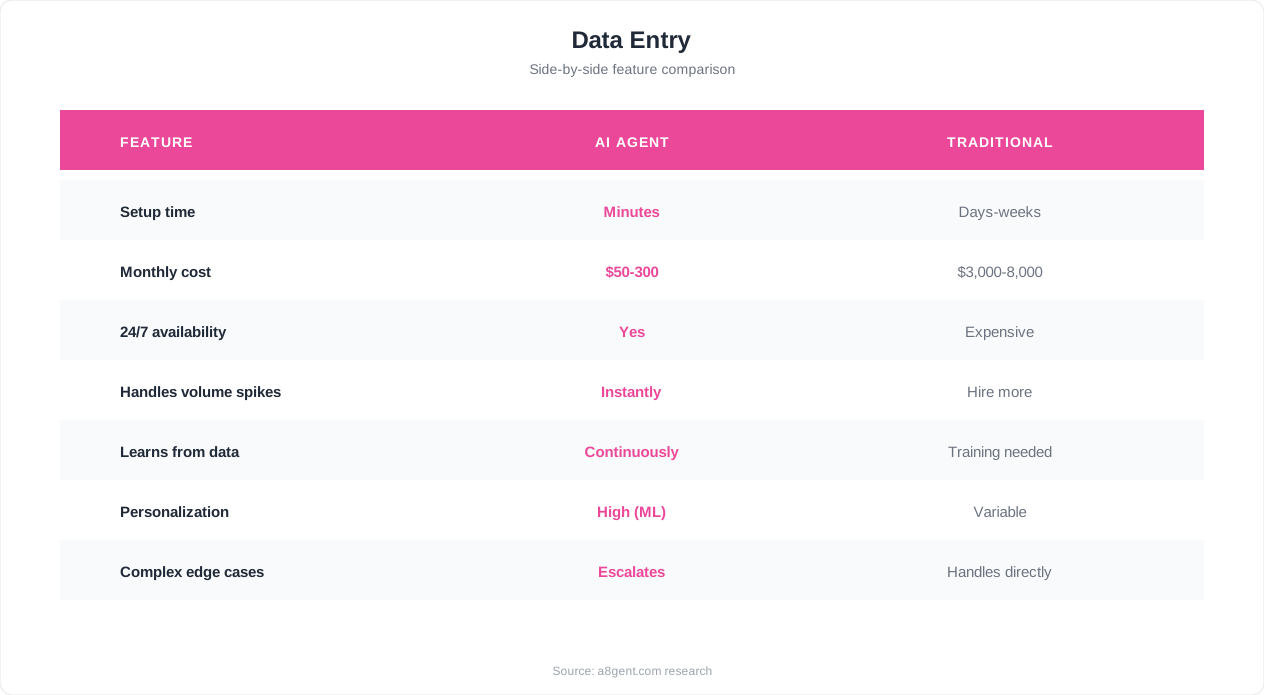
The hourly rate is just the beginning. Here is what a realistic VA engagement for data entry actually costs monthly when you account for everything:
- Base rate: $8/hour × 8 hours/day × 22 days = $1,408/month for one full-time VA
- Agency fee or platform fee: $100-300/month (if using a managed service)
- Your management time: 3-5 hours/week reviewing work, providing feedback, answering questions = $400-800/month in your time
- Quality assurance: 2-3 hours/week checking for errors and corrections = $200-400/month
- Training time for new VAs (average VA tenure is 6-9 months, so you retrain 1-2 times per year): $500-1,000 amortized monthly
- Error correction costs: when mistakes slip through (wrong data entered, duplicates created, items miscategorized), someone has to fix them = $100-300/month
Total realistic monthly cost for one offshore VA doing data entry: $2,700-$4,200. That is significantly more than the $1,400 headline number most people calculate.
AI Agent: Visible and Hidden Costs
AI agent costs are more predictable and have fewer hidden components:
- Platform subscription: $50-300/month depending on volume tier
- Connected tool costs (if any additional integrations needed): $0-50/month
- Your setup time (one-time): 2-4 hours, amortized over 12 months = $30-60/month
- Weekly review and maintenance: 30-60 minutes/week = $100-200/month
- Edge case handling (items the agent cannot process that you handle manually): varies, typically 5-15% of volume
Total realistic monthly cost for AI agent data entry: $200-600. That is 75-85 percent less than the VA option for equivalent volume.
The Volume Multiplier
The cost gap widens dramatically as volume increases. If your data entry needs double, your VA cost roughly doubles (you need a second VA or overtime). Your AI agent cost might increase slightly if you hit a higher usage tier, but typically stays within 10-20 percent of the original cost. At scale, AI agents are not just cheaper - they are categorically more affordable. Use our cost comparison tool to model the exact numbers for your specific data volume and see where the crossover point is.
Speed and Accuracy: How AI Agents and VAs Actually Perform
Cost matters, but so does performance. If a cheaper option takes three times longer or makes twice as many errors, the savings evaporate. Let us look at how AI agents and VAs actually perform on real data entry tasks in 2026.
Processing Speed
A skilled human VA can process approximately 30-60 data entries per hour for moderately complex tasks (like entering invoice line items, populating CRM records from business cards, or transferring order data between systems). This assumes focused work without interruptions. In reality, with breaks, questions, and multitasking, effective throughput is often 20-40 entries per hour.
An AI agent processes the same tasks at a rate of 200-2,000 entries per hour depending on complexity and system response times. For simple structured data (like transferring form submissions to a CRM), rates above 1,000 per hour are common. For complex entries requiring document parsing (like invoices with varying formats), 200-500 per hour is typical. That is a 10-50x speed advantage.
Speed also means availability. A VA works set hours - typically 8 hours per day in their timezone. If a batch of invoices arrives at 6 PM your time (2 AM theirs), it waits until morning. An AI agent processes data the moment it arrives, 24 hours a day, 7 days a week, including holidays. For time-sensitive data entry (like processing orders during a flash sale or entering leads before they go cold), this availability difference can directly impact revenue.
Accuracy Rates
Human VAs typically achieve 92-97 percent accuracy on data entry tasks. This varies significantly based on fatigue (accuracy drops 10-15 percent over an 8-hour shift), task complexity, motivation, and individual skill. Errors tend to cluster in predictable patterns: transposed digits, misspelled names, wrong field selections, and missed entries in long repetitive sets.
AI agents achieve 95-99 percent accuracy on structured data entry tasks in 2026. Their accuracy does not degrade with volume - the thousandth entry is processed with the same precision as the first. They also do not make "fatigue errors" like transposed digits. Their errors tend to be systematic rather than random: if the agent misinterprets a format, it will consistently misinterpret that format until corrected (making errors easier to catch and fix in bulk).
Where VAs Still Win on Quality
Accuracy numbers tell only part of the story. VAs have a genuine advantage in handling ambiguity and making judgment calls. When an invoice has a handwritten note that is partially illegible, a VA can often figure it out from context. When a customer's name could be spelled two different ways, a VA can check LinkedIn or the website. When data is contradictory (the email says one amount, the attachment says another), a VA can flag the discrepancy and use common sense to resolve it.
AI agents are improving rapidly in these areas, but as of 2026, highly ambiguous or unstructured inputs still benefit from human judgment. The practical solution is to use AI agents for the 80-90 percent of entries that are clean and structured, with automatic escalation to a human reviewer for the 10-20 percent that need judgment. Platforms like Autonoly and Airtable AI make this hybrid approach straightforward to configure.
Scalability and Reliability: Which Solution Grows With Your Business?
Your business is not static. Revenue fluctuates, seasons create volume spikes, and growth means more data over time. How well does each solution handle the reality of a dynamic business?
Scaling AI Agents
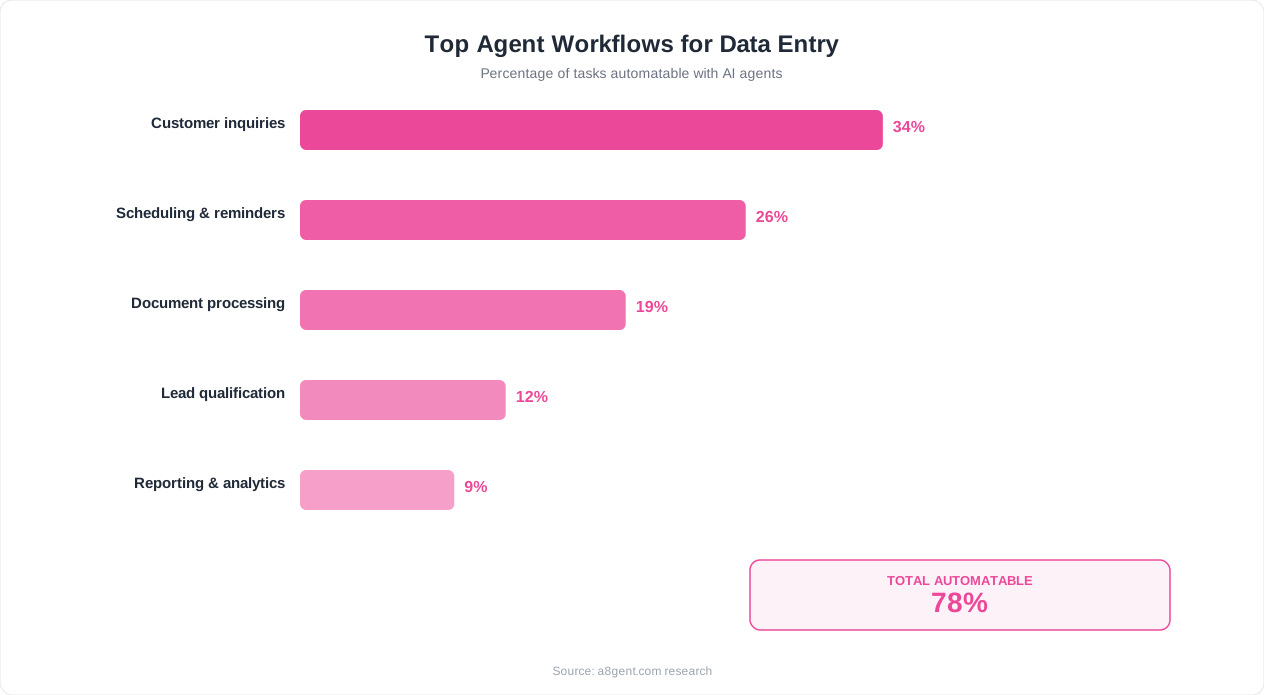
AI agents scale instantly. If your data entry volume doubles tomorrow because of a successful marketing campaign, your agent handles it without any intervention. There is no hiring process, no training period, no capacity planning. During your busiest day of the year, the agent processes entries at the same speed and accuracy as your slowest day. During quiet periods, you are not paying idle labor - most platforms charge based on actual usage or offer generous monthly allowances.
This elasticity is particularly valuable for seasonal businesses, companies running promotions or launches, and anyone whose data volume is unpredictable. You never need to worry about having "enough capacity" - the agent scales to whatever the workload demands.
Scaling VAs
Scaling human VAs requires lead time and management effort. Need to double capacity? You need to find, interview, hire, and train a second VA - a process that takes two to four weeks minimum. Need to scale down after a busy period? You either maintain the cost of an underutilized VA or deal with the awkwardness of reducing hours or letting someone go. Need to handle a sudden spike on a Tuesday? Your VA is already at capacity and cannot absorb the extra volume without overtime (and overtime work is often lower quality due to fatigue).
Some VA agencies offer "flex" arrangements with multiple VAs available on demand, but these come at premium rates and still involve coordination overhead. The fundamental constraint is biological: each human can only process so many entries per hour, and adding more humans adds management complexity.
Reliability Comparison
AI agents have predictable uptime - typically 99.5-99.9 percent availability from reputable platforms. They do not call in sick, take vacations, have personal emergencies, or quit without notice. They process data at a consistent speed and quality every single hour of every single day. When there is a platform issue, it affects all users and gets resolved quickly because the platform's business depends on it.
VAs are human, which means inherent variability. Even the best VA has off days, gets sick, has family emergencies, and eventually leaves for a better opportunity. Average VA tenure in the offshore market is 6-9 months, meaning you will face the disruption of finding and training a replacement one to two times per year. Each transition involves a learning curve, a quality dip, and your management time. Some VA agencies mitigate this with team structures, but turnover remains a persistent challenge.
The Combined Approach
Many businesses find the ideal solution is not either/or but both. AI agents handle the high-volume, structured, predictable data entry that benefits from speed and consistency. Human reviewers (who might be VAs or internal team members) handle exceptions, ambiguous cases, and quality audits. This gives you the scalability and reliability of automation with the judgment of humans for edge cases. Take our assessment to determine what ratio makes sense for your specific data entry workload and business context.
Data Security and Compliance: What You Need to Know
When sensitive business data is involved - customer information, financial records, employee details, health data - security and compliance are not optional considerations. They are requirements. Here is how AI agents and VAs compare on the dimensions that matter for data protection.
AI Agent Security
Reputable AI agent platforms operate under enterprise-grade security standards. This typically includes SOC 2 Type II compliance (audited security practices), data encryption in transit and at rest, strict access controls, regular security audits, and clear data retention policies. Your data is processed programmatically - no human at the platform company ever sees your actual data entries. Most platforms offer data processing agreements (DPAs) for GDPR compliance and can sign Business Associate Agreements (BAAs) for HIPAA-regulated data.
The security risk with AI agents is primarily about the platform you choose. Use established, well-funded platforms with published security certifications. Avoid startups with no security track record or platforms that cannot clearly explain where your data goes. Platforms like Autonoly and Airtable AI have published security documentation and compliance certifications you can verify.
VA Security Challenges
VAs introduce a different category of security risk: human access to sensitive data. When an offshore VA processes your invoices, customer records, or financial data, a human being in another country is viewing that information on their personal or office computer. Consider these factors:
- You have limited visibility into the VA's work environment - are they in a shared office? Can others see their screen?
- Data can be copied, screenshotted, or photographed with no way for you to detect it
- If the VA uses their personal device, your data exists on hardware you do not control
- Turnover means your data has passed through multiple people's hands over time
- Legal recourse in case of a data breach is complex across international jurisdictions
This does not mean VAs are inherently insecure - millions of businesses use them safely. But it does mean you need additional safeguards: NDAs, restricted access (only the minimum data needed), secure communication channels, regular audits, and clear data handling policies. These safeguards add management overhead and still rely on trust rather than technical enforcement.
Compliance Implications
If your business handles regulated data (healthcare, financial, education), the compliance picture differs significantly. AI agents can be configured to process data within specific geographic boundaries, generate audit logs automatically, enforce data retention schedules, and redact sensitive fields. These controls are systematic and verifiable. With VAs, compliance depends on individual behavior - harder to enforce and harder to audit. For regulated industries, AI agents typically offer a clearer path to compliance with less ongoing effort.
Practical Recommendation
For sensitive data (financial records, customer PII, health information): use AI agents with established security certifications and keep human oversight minimal and role-restricted. For less sensitive data (public business information, non-personal content, general operational data): either solution works, but still choose platforms and VA agencies with clear security practices. Use our cost comparison tool which also factors in compliance costs when recommending the right approach for your industry.
Best AI Agent Tools for Data Entry Automation in 2026
If you have decided that AI agents are the right choice for some or all of your data entry needs, here are the specific platforms worth evaluating in 2026. Each has different strengths depending on your data types, volume, and existing tool stack.
Autonoly excels at end-to-end data entry workflows where information needs to move between multiple systems. You describe the flow in plain English - "When an invoice PDF arrives in my email, extract the vendor name, amount, line items, and due date, then create a bill in QuickBooks and notify me in Slack if the amount exceeds $5,000" - and Autonoly builds and runs the workflow. It handles document parsing, data extraction, system entry, and exception routing all in one platform. Best for businesses with multi-step data workflows that span several tools.
If your data entry involves populating or maintaining databases, Airtable AI is a natural fit. It can automatically categorize entries, fill in related fields based on patterns it learns, detect duplicates, and clean messy inputs. The visual database interface makes it easy to see what your agent is doing and spot any issues. Particularly strong for CRM data maintenance, inventory tracking, content calendars, and any use case where data lives in a structured table format.
n8n with AI Nodes
For businesses that want maximum control over their data entry automation, n8n offers a visual workflow builder with powerful AI capabilities at each step. You can build sophisticated extraction pipelines - connecting email inputs to document parsing to AI classification to database entry - with full visibility into each step. The learning curve is slightly steeper than pure no-code platforms, but the flexibility is unmatched. n8n also offers self-hosting for businesses that need data to stay on their own infrastructure.
Specialized Document Processing Tools
For businesses with heavy document processing needs (hundreds of invoices, receipts, or forms per week), specialized tools like Nanonets, Rossum, or DocuClipper offer AI-powered document parsing that feeds into your existing systems. These excel at handling variable document formats - different invoice layouts, handwritten forms, or scanned papers - and extracting structured data with high accuracy. They often integrate with the broader agent platforms mentioned above.
How to Choose
Your choice depends on three factors. First, data complexity: if your data entry involves simple transfers between systems, Autonoly handles it elegantly. If it involves complex document parsing with variable formats, specialized tools may be needed. Second, volume: high-volume needs benefit from platforms with strong scaling and batch processing capabilities. Third, existing tools: choose a platform that integrates natively with your current stack to minimize setup friction.
Not sure which platform fits? Take our free assessment which asks about your specific data entry workflows, volume, and tools, then recommends the right platform with implementation guidance. Most businesses can have their first automated data entry workflow running within a day of choosing their platform.
How to Migrate From Manual Data Entry or VAs to AI Agents
Switching from manual data entry or an existing VA relationship to AI agents does not have to be disruptive. The key is a phased transition that proves value before you fully commit. Here is the migration playbook that minimizes risk and maximizes confidence.
Phase 1: Parallel Processing (Weeks 1-2)
Do not immediately eliminate your current solution. Instead, run AI agents in parallel with your existing process for two weeks. Have the agent process the same data your VA (or team member) handles, but route the agent's output to a review queue rather than directly into your systems. Compare results: is the agent's output as accurate as the human's? Faster? More consistent? This gives you concrete data to validate the switch without any disruption to your operations.
Phase 2: Gradual Handover (Weeks 3-4)
Once you have confidence in the agent's accuracy (typically after seeing it match or beat human accuracy for 10-14 days), begin routing real work to it. Start with the simplest, most structured data entry tasks - the ones where the agent performed best during testing. Keep your VA or team member handling the complex, ambiguous entries that the agent flagged during phase one. This hybrid approach lets you capture most of the speed and cost benefits while maintaining quality on edge cases.
Phase 3: Full Automation with Human Oversight (Weeks 5-8)
Expand the agent's scope to handle 80-90 percent of your data entry volume. Configure it to process autonomously for entries within its confidence threshold and escalate uncertain cases for human review. Your human reviewer (who might be a retained VA at reduced hours, or an internal team member spending 30 minutes per day) catches the 10-20 percent of entries that need judgment. This is the steady-state model most businesses land on - it captures nearly all the efficiency gains while maintaining a quality backstop.
Phase 4: Optimization (Ongoing)
Every week, review the entries your agent escalated. For each escalation, ask: could better instructions have prevented this? Often the answer is yes - you can teach the agent to handle patterns it initially flagged as uncertain. Over time, the escalation rate drops from 15-20 percent to 5-10 percent as the agent covers more edge cases. This continuous improvement is what makes AI agents increasingly superior to static solutions over time.
Managing the VA Transition
If you currently use VAs for data entry, handle the transition professionally. Give adequate notice, provide references, and consider whether your VA has skills beyond data entry that add value in other areas. Many businesses redirect their VA hours from data entry to tasks where human judgment is genuinely necessary - research, customer communication, creative work, or quality assurance on the AI agent's output. This way you keep a valued relationship while dramatically improving your data entry efficiency.
What Success Looks Like
After 60 days of migration, most businesses achieve: 75-90 percent reduction in data entry costs, 10-50x faster processing times, equal or better accuracy with systematic (not random) errors, and zero management overhead for the automated portion. Use our cost comparison tool to model what these improvements look like financially for your specific situation, and explore our operations guide for detailed migration templates and checklists.
The Decision Framework: When to Choose AI Agents, VAs, or Both
After comparing costs, speed, accuracy, scalability, security, and tools, here is a practical decision framework to help you choose the right approach for your specific situation. The answer is not always one or the other - many businesses benefit from a strategic combination.
Choose AI Agents When:
- Your data entry volume is high (more than 50 entries per day) and growing
- The data is structured and follows predictable formats (invoices, forms, orders, CRM records)
- Speed matters - you need entries processed in minutes, not hours
- You need 24/7 processing without timezone constraints
- Data sensitivity requires strict access controls and audit trails
- You want costs that scale sub-linearly with volume (not 1:1 like labor)
- Consistency is critical - every entry processed the same way every time
- You are tired of managing people for repetitive tasks and dealing with turnover
Choose VAs When:
- Your data entry involves highly unstructured inputs that require interpretation (handwritten notes, ambiguous documents, images requiring description)
- Volume is low (fewer than 20 entries per day) and does not justify tool setup
- The task requires significant cultural or linguistic context that AI handles poorly
- You need the VA for multiple task types and data entry is just one small part of their role
- Your processes change frequently and you prefer verbal instructions over system configuration
- The data entry is a temporary need (one-time project) that does not justify setting up automation infrastructure
Choose a Hybrid Approach When:
- You have a mix of structured and unstructured data entry needs
- You want the speed and cost benefits of AI for the majority of entries with human judgment for exceptions
- You are in a regulated industry where human review is required but speed still matters
- You are transitioning from VAs and want to reduce hours gradually rather than cut immediately
The 80/20 Rule
For most growing businesses in 2026, the optimal strategy is clear: use AI agents for the 80 percent of data entry that is structured, repetitive, and high-volume. Use human review (whether internal team or a VA) for the 20 percent that requires judgment, interpretation, or exception handling. This gives you the best of both worlds - the speed, cost, and scalability of automation combined with the judgment and adaptability of humans where it genuinely matters.
The businesses that get this right save 60-80 percent on data entry costs while maintaining or improving quality. They free up human time for work that is actually interesting and valuable. And they build a data infrastructure that scales effortlessly as they grow, rather than one that requires proportional headcount increases.
Ready to find the right solution for your business? Take our free assessment for a personalized recommendation based on your data entry volume, types, complexity, and budget. Or use the cost comparison tool to see exact numbers for your situation. Either way, the answer is clearer than you might think - and the implementation is faster than you expect.
FAQ
How accurate are AI agents at data entry compared to humans?
AI agents achieve 95-99% accuracy on structured data entry tasks in 2026, compared to 92-97% for human VAs. The key difference is consistency - AI agents maintain the same accuracy level for the thousandth entry as the first, while human accuracy declines with fatigue over long sessions. AI errors also tend to be systematic (easier to catch in bulk) rather than random.
Can AI agents handle invoices from different vendors with different formats?
Yes. Modern AI document processing can handle variable invoice formats - different layouts, fonts, positions of key fields, and even handwritten elements. The AI learns to recognize common patterns across formats and extracts relevant data regardless of layout. For truly unusual formats it encounters for the first time, it typically flags them for human review until it learns the new pattern.
What happens to my data when an AI agent processes it?
Reputable platforms process your data under strict security protocols - encrypted in transit and at rest, not used to train models, not accessible to platform employees, and deleted according to your retention preferences. Always verify a platform's security certifications (SOC 2, GDPR compliance) before connecting sensitive data. Most platforms publish detailed security documentation.
How long does it take to set up AI data entry automation?
Simple data entry workflows (like form submissions to CRM) can be running within 30-60 minutes. More complex document processing pipelines (like multi-format invoice extraction) take 2-4 hours for initial setup and a week of refinement to handle edge cases. Compare this to hiring and training a VA, which takes 2-4 weeks minimum.
Is it worth automating data entry if I only have 10-20 entries per day?
It depends on complexity and growth trajectory. At 10-20 simple entries per day, the time savings might be modest (30-60 minutes daily). However, if each entry is complex (requiring research or multiple system updates), if you expect volume to grow, or if the entries are time-sensitive, automation is still worthwhile. The setup investment pays off quickly once volume increases.
Can AI agents handle data entry in languages other than English?
Yes. Major AI agent platforms support data processing in dozens of languages. They can extract data from documents in one language and enter it into systems in another, or maintain data in its original language. This is one area where AI agents match or exceed VAs, since finding bilingual VAs for less common languages can be challenging and expensive.
What if my data entry requires checking information against external sources?
AI agents excel at this. They can verify data against external databases, cross-reference information across systems, check for duplicates, and validate entries against known correct formats - all automatically as part of the entry process. This type of verification is tedious and error-prone for humans but trivial for AI agents that can query multiple sources in milliseconds.
How do I handle the transition period if I currently use VAs for data entry?
Use a phased approach: run AI agents in parallel with your VA for two weeks to validate accuracy, then gradually shift volume to the agent while reducing VA hours. Keep the VA for exception handling and quality audits initially. Most businesses complete the transition within 6-8 weeks with zero disruption to their operations or data quality.