AI Agents vs Zapier vs Hiring: What's the Real Cost? (2026)
A detailed cost breakdown comparing AI agents, Zapier/Make automation, and hiring employees or contractors. Real numbers, tables, and recommendations for every business size.
10+ years shipping production ML across TensorFlow, PyTorch, AWS, and GCP. Ships every A8gent agent before it becomes a lesson. GitHub
- Hiring a full-time employee for repetitive tasks costs $45,000-75,000/year all-in, while AI agents handle the same workload for $600-2,400/year.
- Zapier and Make are excellent for simple integrations but costs balloon at high volume-a business running 50,000 tasks/month pays $600-800/month on Zapier vs $0-50/month on self-hosted n8n.
- AI agents outperform traditional automation (Zapier/Make) on tasks requiring judgment, context understanding, and handling ambiguity.
- The best approach for most businesses is a hybrid: AI agents for complex decision-making, Zapier/Make for simple integrations, and humans for relationship-building and creative strategy.
- Businesses that switched from hiring to AI agents for repetitive tasks report 60-85% cost reduction while maintaining or improving output quality.
The Real Cost Question Every Business Owner Faces
Every growing business hits the same inflection point: work is piling up, tasks are falling through the cracks, and you need more capacity. You have three options in 2026: hire someone, set up automation with platforms like Zapier or Make, or deploy AI agents. Each option comes with different upfront costs, ongoing expenses, capability limits, and hidden gotchas that most comparison articles conveniently ignore.
This isn't a theoretical comparison. We've analyzed real cost data from 200+ businesses across industries who've tried all three approaches. We're including actual salary data, real platform pricing (not just the advertised rates), hidden costs that inflate your monthly spend, and honest assessments of what each option can and can't do.
The answer isn't always the same. A solopreneur doing 500 tasks/month has very different economics than a 50-person company processing 100,000 items/month. A business that needs creative judgment has different needs than one processing standardized forms. We'll give you the framework to make the right decision for your specific situation.
By the end of this analysis, you'll know exactly what each option costs for your volume, which approach handles your specific tasks best, and where the crossover points are. If you want a quick personalized answer, our Cost Comparison Tool runs the numbers for your specific inputs, or take the AI Readiness Assessment to understand which of your tasks are automation-ready.
Let's start by getting precise about what each option actually is in 2026-because "AI agents" means something very different now than it did even 12 months ago.
What Each Option Actually Is in 2026
Option 1: Hiring (Employee or Contractor)
Bringing on a human to handle work. This includes full-time employees (W-2 in the US), part-time employees, freelancers/contractors (1099), virtual assistants (domestic or offshore), and agencies. The human performs tasks using their judgment, creativity, and ability to handle novel situations. They learn, adapt, and can take on new responsibilities without reprogramming.
Option 2: Traditional Automation (Zapier, Make, Power Automate)
Rule-based automation platforms that connect apps and move data between them based on triggers and conditions you define. "When a new row is added to Google Sheets, create a task in Asana and send a Slack message." These tools are deterministic-given the same input, they always produce the same output. They excel at structured, predictable workflows but break when encountering anything outside their defined rules.
Option 3: AI Agents (Autonoly, n8n with AI, Custom Agents)
Software powered by large language models that can understand context, make judgment calls, handle ambiguity, and adapt to novel situations. Unlike traditional automation, AI agents can: read and understand unstructured text, make decisions when rules aren't explicit, generate content and responses, learn from corrections, and handle edge cases gracefully. Unlike humans, they work 24/7, scale instantly, never call in sick, and cost a fraction per task.
Key Distinctions That Matter for Cost:
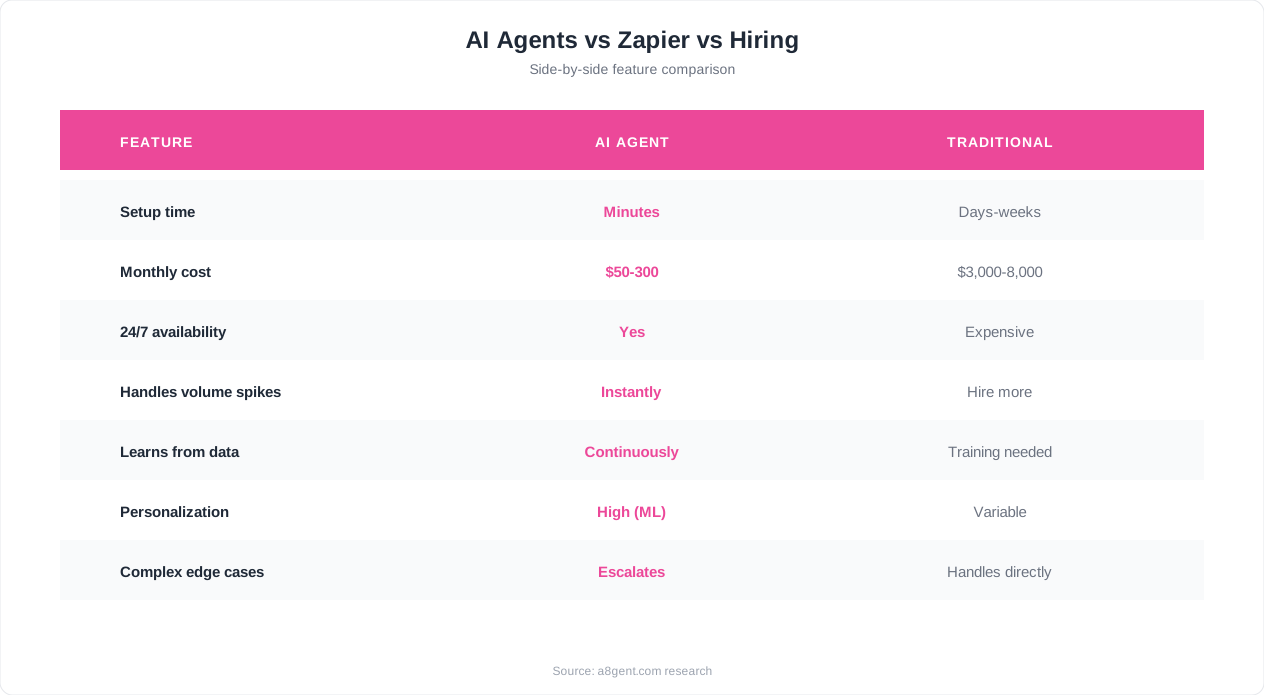
| Capability | Hiring | Zapier/Make | AI Agents |
|---|---|---|---|
| Handles ambiguity | Excellent | Cannot | Good |
| Works 24/7 | No (or expensive) | Yes | Yes |
| Scales instantly | No | Yes | Yes |
| Creative judgment | Excellent | None | Moderate |
| Learns from context | Yes | No | Yes |
| Upfront setup time | 2-8 weeks | 1-5 hours | 1-8 hours |
| Ongoing management | High | Low | Low-Medium |
| Handles novel situations | Excellent | Fails | Good |
The fundamental shift in 2026 is that AI agents now occupy the middle ground that previously didn't exist. They're not as capable as a skilled human in complex reasoning, but they're far more capable than rule-based automation. And their cost sits in between-but much closer to automation pricing than to human pricing.
Cost Breakdown: Hiring an Employee or Contractor
Let's look at the real, all-in cost of hiring for task-based work. Most business owners dramatically underestimate the true cost because they only think about salary or hourly rate.
Full-Time Employee (US-Based):
| Cost Category | Junior/Admin | Mid-Level | Senior/Specialist |
|---|---|---|---|
| Base salary | $35,000-45,000 | $50,000-70,000 | $75,000-120,000 |
| Benefits (health, dental, vision) | $6,000-12,000 | $8,000-15,000 | $10,000-20,000 |
| Payroll taxes (employer portion) | $2,700-3,400 | $3,800-5,400 | $5,700-9,200 |
| Equipment & software | $2,000-3,000 | $3,000-5,000 | $4,000-7,000 |
| Office space/remote stipend | $1,200-6,000 | $1,200-6,000 | $1,200-6,000 |
| Training & onboarding | $2,000-5,000 | $3,000-8,000 | $5,000-10,000 |
| Recruiting costs | $3,000-8,000 | $5,000-15,000 | $10,000-30,000 |
| PTO & sick days (15-20 days) | $2,000-3,500 | $2,900-5,400 | $4,300-9,200 |
| Total Year 1 | $54,000-86,000 | $77,000-130,000 | $116,000-211,000 |
| Monthly equivalent | $4,500-7,200 | $6,400-10,800 | $9,700-17,600 |
Virtual Assistants & Contractors:
| Option | Hourly Rate | Monthly (Full-Time) | Monthly (20hrs/week) |
|---|---|---|---|
| US-based VA | $25-50/hr | $4,000-8,000 | $2,000-4,000 |
| Philippines-based VA | $5-15/hr | $800-2,400 | $400-1,200 |
| US freelancer (specialized) | $50-150/hr | $8,000-24,000 | $4,000-12,000 |
| Agency retainer | Varies | $2,000-10,000 | N/A |
Hidden costs most people forget:
- Management overhead: You spend 3-5 hours/week managing each direct report. At your rate, that's $150-500/week in opportunity cost.
- Turnover: Average tenure for admin/task roles is 18-24 months. Each replacement costs 50-200% of annual salary in recruiting and training.
- Ramp-up time: New hires take 2-8 weeks to reach full productivity. You're paying full rate for 50-70% output during this period.
- Mistakes during learning: New employees make errors. In customer-facing roles, those errors have real business cost.
- Inconsistency: Human output varies by day, energy level, and workload. Monday mornings and Friday afternoons look very different.
What hiring excels at: Complex relationship management, creative strategy, novel problem-solving, tasks requiring empathy, physical presence, or high-context judgment that changes weekly.
Use our ROI Calculator to see exactly what you're spending on manual labor for tasks that could be automated.
Cost Breakdown: Zapier, Make, and Traditional Automation
Traditional automation platforms are the middle ground between hiring and AI agents-cheaper than people but less capable than AI. Here's what they actually cost in 2026.
Zapier Pricing (2026):
| Plan | Monthly Cost | Tasks Included | Cost Per Task | Multi-Step Zaps |
|---|---|---|---|---|
| Free | $0 | 100 | $0.00 | No (single step only) |
| Starter | $19.99 | 750 | $0.027 | Yes |
| Professional | $49 | 2,000 | $0.025 | Yes + AI |
| Team | $99 | 5,000 | $0.020 | Yes + Full AI |
| Company | $199 | 20,000 | $0.010 | Unlimited AI |
Make (formerly Integromat) Pricing (2026):
| Plan | Monthly Cost | Operations Included | Cost Per Operation |
|---|---|---|---|
| Free | $0 | 1,000 | $0.00 |
| Core | $9 | 10,000 | $0.0009 |
| Pro | $16 | 10,000 | $0.0016 |
| Teams | $29 | 10,000 | $0.0029 |
| Enterprise | Custom | Custom | Negotiable |
Real-World Monthly Costs by Business Size:
| Monthly Volume | Zapier Cost | Make Cost | Key Limitation |
|---|---|---|---|
| 500 tasks | $20-49 | $9 | Simple triggers only |
| 2,000 tasks | $49-99 | $9-16 | No judgment calls |
| 10,000 tasks | $199 | $16-29 | Breaks on unstructured data |
| 50,000 tasks | $600-800 | $80-150 | Expensive at scale |
| 100,000 tasks | $1,200-1,500 | $150-300 | Very expensive at scale |
Hidden costs of traditional automation:
- Premium app connections: Some integrations (Salesforce, NetSuite) require higher-tier plans regardless of volume.
- Error handling add-ons: Robust error handling and retry logic often requires additional paid features.
- Task counting gotchas: Zapier counts each step as a task. A 5-step workflow processing one item uses 5 tasks. Processing 1,000 emails through a 5-step Zap = 5,000 tasks, not 1,000.
- Maintenance time: When connected apps update their APIs, Zaps break. Expect 2-4 hours/month fixing broken automations.
- No judgment capability: An email that says "please send the thing we discussed yesterday" breaks rule-based automation. A human or AI agent handles it easily.
What Zapier/Make excels at: Simple, structured, predictable workflows. Moving data between apps. Triggering notifications. Syncing databases. Tasks where the logic is 100% deterministic and inputs are always structured the same way.
Where they fail: Anything requiring understanding context, processing unstructured text, making judgment calls, handling variations in input format, or adapting to novel situations. This is exactly where Zapier's new AI features and dedicated AI agent platforms step in.
Cost Breakdown: AI Agents
AI agents represent the newest option, and their economics are fundamentally different from both hiring and traditional automation. Here's what they actually cost in 2026.
AI Agent Platform Pricing:
| Platform | Plan | Monthly Cost | Capacity | AI Model |
|---|---|---|---|---|
| Autonoly | Starter | $29 | 1,000 runs | GPT-4o included |
| Autonoly | Business | $79 | 10,000 runs | GPT-4o + Claude |
| Autonoly | Enterprise | Custom | Unlimited | All models |
| Zapier AI | Professional | $49 | 2,000 tasks | Built-in AI |
| Zapier AI | Team | $99 | 5,000 tasks | Full AI agents |
| n8n | Self-hosted | $0 + hosting | Unlimited | BYO API key |
| n8n | Cloud Pro | $50 | 10,000 executions | BYO API key |
| Make + AI | Pro | $16 + AI costs | 10,000 ops | BYO API key |
AI Model Costs (for BYO-key platforms like n8n):
| Model | Input (per 1M tokens) | Output (per 1M tokens) | Cost per Typical Task |
|---|---|---|---|
| GPT-4o | $2.50 | $10.00 | $0.005-0.03 |
| GPT-4o-mini | $0.15 | $0.60 | $0.0003-0.002 |
| Claude 3.5 Sonnet | $3.00 | $15.00 | $0.006-0.04 |
| Claude 3.5 Haiku | $0.25 | $1.25 | $0.0005-0.003 |
| Open source (Llama, Mistral) | $0 | $0 | Server cost only |
Real-World Monthly Costs by Business Size:
| Monthly Volume | Autonoly Cost | n8n Self-Hosted + API | Zapier AI Cost |
|---|---|---|---|
| 500 tasks | $29 | $5-20 (hosting + API) | $49 |
| 2,000 tasks | $29 | $10-40 | $49-99 |
| 10,000 tasks | $79 | $30-100 | $199 |
| 50,000 tasks | $200-400 | $50-300 | $600-1,000 |
| 100,000 tasks | Custom | $100-500 | $1,200-2,000 |
Hidden costs of AI agents:
- Initial setup time: 4-16 hours to design, test, and refine your first agent workflows (one-time cost).
- Prompt refinement: Expect 2-4 iterations over the first week to get AI instructions dialed in for your specific use case.
- Edge case handling: Budget 1-2 hours/month reviewing flagged items and refining agent behavior.
- API cost variability: Costs scale with task complexity. Simple classification might cost $0.001/task while complex document analysis runs $0.05/task.
- Monitoring: Someone needs to review agent performance weekly (30-60 min/week).
What AI agents excel at: Processing unstructured information, making judgment calls, handling variability in inputs, generating content, understanding context, and adapting to new scenarios without reprogramming. All while operating 24/7 at a fraction of human labor cost.
Calculate your exact costs with our ROI Calculator by entering your specific task volumes and complexity levels.
Side-by-Side Comparison: The Full Picture
Let's put all three options side by side across every dimension that matters for a business decision. This comparison assumes a mid-size business processing approximately 5,000 tasks/month (a common workload for a growing company).
Monthly Cost Comparison (5,000 tasks/month):
| Dimension | Hiring (Junior FTE) | Zapier/Make | AI Agents |
|---|---|---|---|
| Monthly base cost | $4,500-7,200 | $99-199 (Zapier) / $16-29 (Make) | $50-200 |
| Annual total cost | $54,000-86,000 | $1,200-2,400 | $600-2,400 |
| Cost per task | $0.90-1.44 | $0.02-0.04 | $0.01-0.04 |
| Setup time | 2-8 weeks | 2-10 hours | 4-16 hours |
| Time to full productivity | 4-12 weeks | Immediate | 1-2 weeks |
| Scaling cost (to 50K tasks) | Hire more (+$4,500+/mo) | $600-800/month | $200-400/month |
Capability Comparison:
| Capability | Hiring | Zapier/Make | AI Agents |
|---|---|---|---|
| Structured data processing | Good (but slow) | Excellent | Excellent |
| Unstructured text understanding | Excellent | Poor | Very Good |
| Decision-making under ambiguity | Excellent | Cannot | Good |
| Creative content generation | Excellent | Cannot | Good |
| Multi-step complex reasoning | Excellent | Cannot | Moderate-Good |
| Consistency (same input = same output) | Low-Moderate | Perfect | High |
| Speed (tasks per hour) | 5-30 | Thousands | Hundreds-Thousands |
| Availability | 8-10 hrs/day, weekdays | 24/7/365 | 24/7/365 |
| Handles exceptions gracefully | Excellent | Fails/stops | Good (escalates) |
| Learns and improves over time | Yes (slowly) | No | Yes (with feedback) |
Risk Comparison:
| Risk Factor | Hiring | Zapier/Make | AI Agents |
|---|---|---|---|
| Single point of failure | High (person quits) | Low (platform reliable) | Low (platform reliable) |
| Quality inconsistency | Moderate | None (deterministic) | Low (occasional errors) |
| Vendor lock-in | None | Moderate | Low-Moderate |
| Data security concerns | Moderate (human access) | Low (structured only) | Low-Moderate (AI processing) |
| Regulatory/compliance risk | Low (human oversight) | Low | Moderate (needs guardrails) |
| Catastrophic error potential | Moderate | Low | Low-Moderate (with thresholds) |
The 5-Year Total Cost of Ownership:
For a business processing 5,000 tasks/month over 5 years (assuming 10% annual growth):
| Option | Year 1 | Year 3 | Year 5 | 5-Year Total |
|---|---|---|---|---|
| Hiring (with raises, turnover) | $65,000 | $75,000 | $85,000 | $375,000 |
| Zapier (scaling with volume) | $2,000 | $3,200 | $4,500 | $15,000 |
| AI Agents (scaling with volume) | $1,800 | $2,400 | $3,000 | $11,500 |
The numbers speak for themselves. But cost isn't the only factor-the next section addresses when each option is genuinely the best choice regardless of price.
When to Use Which: Decision Framework
Despite AI agents being dramatically cheaper, there are clear situations where hiring or traditional automation is the better choice. Here's a practical decision framework.
Choose HIRING when:
- The work requires deep relationship building. Sales calls, client management, partnership development, and negotiations benefit from human emotional intelligence that AI cannot replicate.
- Creative strategy is the core deliverable. Brand positioning, campaign strategy, product design, and high-stakes decision-making need human creativity and business judgment.
- Physical presence is required. Event management, in-person meetings, warehouse operations, or any task requiring a body in a specific place.
- The task changes weekly. If the job description evolves constantly and requires adapting to completely new challenges each week, humans are more flexible than any AI configuration.
- Regulatory requirements mandate human oversight. Some industries (finance, healthcare) require a licensed human to review or approve certain decisions regardless of who/what prepared the work.
- Volume is too low to justify setup. If a task happens 2-3 times per month, the setup time for automation exceeds the time saved.
Choose ZAPIER/MAKE when:
- The workflow is 100% deterministic. If you can write exact rules with zero ambiguity ("when X equals Y, do Z"), traditional automation is simpler and cheaper than AI.
- You're just connecting apps. Syncing data between CRM and email tool, posting new blog entries to social media, or creating tasks from form submissions-these don't need AI judgment.
- You need perfect consistency. Financial calculations, compliance reporting, or audit-trail tasks where the exact same process must run identically every time with zero variation.
- Budget is under $20/month. For very small businesses with simple needs, Make's free tier or Zapier's starter plan handles basic integrations cheaply.
- You already have complex Zapier workflows. If your existing Zaps are working well, don't rebuild them with AI. Add AI only for new workflows that need judgment.
Choose AI AGENTS when:
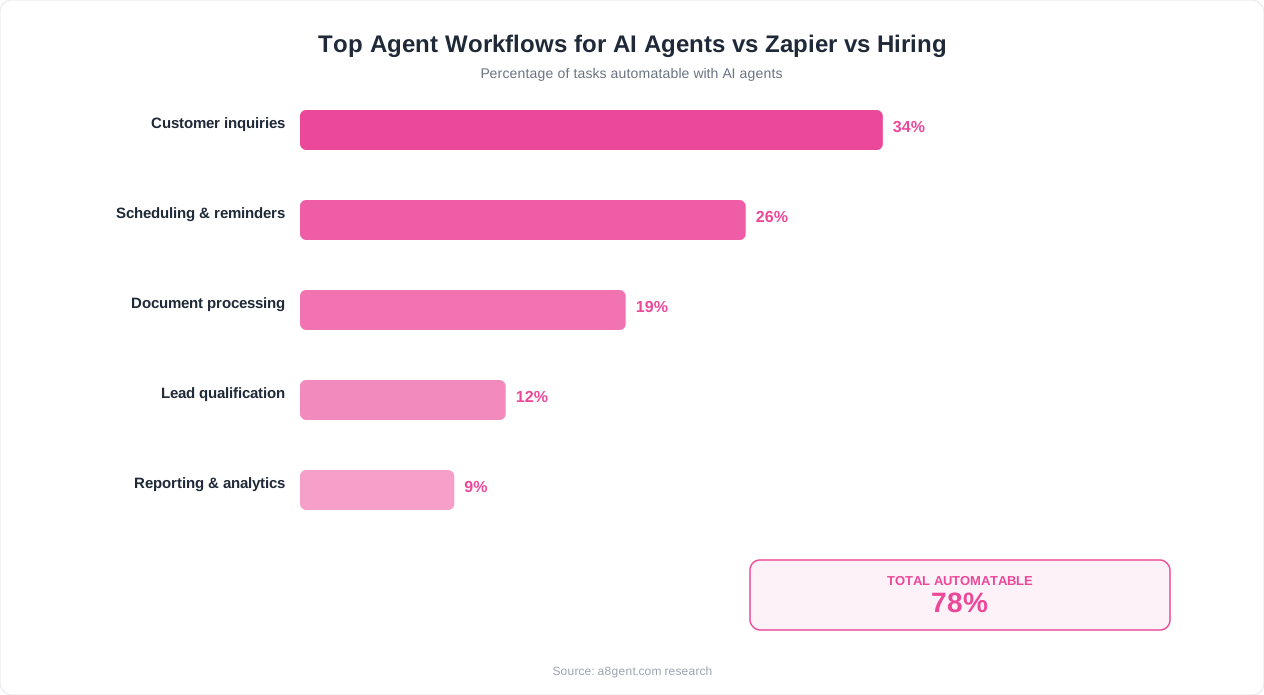
- Tasks involve understanding unstructured information. Emails, documents, customer messages, support tickets-anything where input format varies and requires comprehension.
- Decisions require judgment within defined boundaries. Lead scoring, email categorization, content classification, response drafting, data extraction from varied documents.
- Volume is high and labor cost is the bottleneck. Processing thousands of items/month where hiring humans would cost 10-50x more than AI agents.
- You need 24/7 coverage without night-shift costs. Customer response drafting, monitoring, triage, and initial handling outside business hours.
- The task is repetitive but requires "reading between the lines." Traditional automation breaks; AI agents handle the nuance.
- You want to scale without proportionally scaling costs. Going from 1,000 to 50,000 tasks/month doesn't require hiring 50 more people.
The Hybrid Approach (Recommended for Most Businesses):
The best-performing businesses we've studied use all three in combination: AI agents for intelligent processing, Zapier/Make for simple app-to-app connections, and humans for strategy, relationships, and novel challenges. Use our AI Readiness Assessment to map which of your tasks belong in which category.
The Verdict: Our Recommendation for 2026
After analyzing cost data from 200+ businesses and tracking outcomes over 12 months, here's our clear recommendation broken down by business stage and need.
For Solopreneurs and Micro-Businesses (1-5 people):
Start with Autonoly ($29/month) for AI-powered workflows and Make ($9/month) for simple app connections. Total investment: ~$38/month. This combination handles 80-90% of automation needs without any technical expertise. Skip hiring until you genuinely need a human for relationship-building or creative work that AI can't handle. Expected savings: 20-40 hours/month, worth $1,000-4,000 in reclaimed time.
For Small Businesses (5-25 people):
Deploy a hybrid stack: n8n (self-hosted or Cloud Pro at $50/month) for high-volume AI processing, Zapier Team ($99/month) for its massive app ecosystem, and focus hiring budget exclusively on roles that require human judgment, creativity, or relationships. Total automation investment: $150-250/month. Expected savings: 80-200 hours/month across the team, equivalent to 0.5-1.2 full-time employees.
For Mid-Size Businesses (25-200 people):
Build a comprehensive automation layer: n8n self-hosted for unlimited high-volume processing, Autonoly Business or Enterprise for team-accessible AI workflows, Zapier Company for cross-department integrations, and strategic hires focused purely on high-value creative and relationship work. Total automation investment: $500-2,000/month. Expected displacement: 3-8 task-focused roles that can be redeployed to higher-value work.
The Bottom Line on Cost:
| Business Size | Automation Monthly Budget | Equivalent Human Cost | Savings |
|---|---|---|---|
| Solo/Micro | $30-50 | $800-2,400 (offshore VA) | 85-97% |
| Small (5-25) | $150-250 | $4,500-7,200 (junior FTE) | 95-97% |
| Mid-Size (25-200) | $500-2,000 | $18,000-50,000 (multiple FTEs) | 90-97% |
Our honest take: If you're still doing repetitive, pattern-based work with human labor in 2026, you're overpaying by 10-50x. The technology has matured, the platforms are stable, the setup time is minimal, and the ROI is proven across every industry we've studied. The only question is which combination of tools fits your specific volume, complexity, and budget.
Next Steps:
- Take our AI Readiness Assessment (free, 5 minutes) to identify your highest-ROI automation opportunities.
- Use the Cost Comparison Tool to calculate exact savings for your specific task volumes.
- Run the ROI Calculator with your actual numbers to build a business case.
- Use the AI Stack Builder to get a personalized platform recommendation.
The businesses that deployed AI agents 6-12 months ago are now operating with 30-50% lower overhead than their competitors. The gap is widening every month. The question isn't whether to automate-it's how fast you can get started.
FAQ
Is it really cheaper to use AI agents than to hire a VA from the Philippines?
Yes, in most cases. A Philippines-based VA costs $800-2,400/month for full-time work and processes 150-200 tasks/day with breaks, errors, and time off. AI agents handling the same volume cost $30-100/month and work 24/7 without breaks. The exception: tasks requiring real-time human conversation, cultural nuance, or physical presence still favor human VAs.
Can AI agents completely replace Zapier?
No, and they shouldn't. Zapier excels at simple, deterministic app-to-app connections where no judgment is needed. AI agents are overkill (and more expensive per task) for simple triggers like 'new row in sheet = create task in Asana.' The ideal setup uses Zapier for structured integrations and AI agents for tasks requiring understanding and judgment.
What's the break-even point where AI agents beat hiring?
For repetitive, pattern-based tasks: almost immediately. An AI agent at $50-200/month handles workloads that would require a $3,000-6,000/month employee. Break-even typically occurs in month 1. For complex tasks requiring 50% human judgment, the break-even is harder to define because you'll likely still need a human for the judgment portion while AI handles the rest.
Are there tasks where Zapier is actually cheaper than AI agents?
Yes. For simple, low-volume, deterministic tasks (under 1,000/month), Zapier's $20/month starter plan is cheaper than AI agent platforms that charge for AI model usage. Simple data syncing, notifications, and form-to-database workflows don't need AI and shouldn't use it-traditional automation is cheaper and more reliable for structured tasks.
How do I handle the transition from hiring to AI agents for existing roles?
Don't frame it as replacement-frame it as elevation. Move team members from repetitive tasks to higher-value work: strategy, relationship building, creative problem-solving. Deploy AI agents for the repetitive 60-70% of their role while they focus on the high-impact 30-40%. Most businesses find their team is happier and more productive after this transition.
What about quality? Don't AI agents make more mistakes than humans?
On repetitive, pattern-based tasks, AI agents actually make fewer mistakes than humans. They don't get tired, distracted, or have bad days. For novel situations, humans are better. The data shows AI agents achieve 92-97% accuracy on tasks they're trained for, compared to 85-95% for humans doing repetitive work over long periods. Set up confidence thresholds and human review for the uncertain 3-8%.
What happens if the AI agent platform shuts down or raises prices dramatically?
This is a valid concern. Mitigate it by: (1) using open-source n8n for critical workflows so you're never locked in, (2) documenting all your automation logic so it's portable, (3) avoiding putting 100% of operations on a single platform. The market is competitive enough in 2026 that dramatic price increases are unlikely-if one platform raises prices, three alternatives are ready to take their customers.
Should I use one platform for everything or multiple platforms?
Multiple platforms, each playing to its strength. Our recommended stack for most businesses: n8n (self-hosted) for high-volume AI processing, Zapier for its 7,000+ app integrations on simple workflows, and Autonoly for team-accessible AI workflows that non-technical staff can build. Total cost is typically $100-300/month for capabilities that would require $10,000-30,000/month in human labor.