How to Sell AI Agent Services to Business Clients
Selling AI automation services requires a different approach than selling traditional software or marketing services. This guide covers finding clients, running discovery calls, demonstrating value, building proposals, closing deals, and managing expectations through the entire sales cycle.
10+ years shipping production ML across TensorFlow, PyTorch, AWS, and GCP. Ships every A8gent agent before it becomes a lesson. GitHub
- The most effective way to find AI automation clients is targeting businesses already spending on manual labor for automatable tasks - look for companies hiring for roles like data entry clerk, appointment scheduler, or customer support representative.
- Discovery calls should focus 80% on the client's current pain and only 20% on your solution - the goal is to quantify the cost of their problem so your price feels small by comparison.
- Live demonstrations beat slide decks every time. Build a simple prototype of the client's specific use case before the proposal meeting - even a rough demo closes deals 3x more effectively than a polished presentation.
- The biggest objection in AI sales is not price but trust - clients worry about quality, reliability, and losing the human touch. Address these proactively with guarantees, shadow mode testing, and escalation workflows.
- Post-sale expectation management is where client relationships are won or lost. Set specific, measurable milestones for the first 30, 60, and 90 days rather than vague promises about transformation.
Finding Clients Who Are Ready to Buy AI Automation
The biggest mistake new AI automation agencies make is trying to sell to everyone. Broad outreach with generic "AI can transform your business" messaging generates almost zero response because it is indistinguishable from the hundreds of similar messages business owners receive every week. The agencies that build pipelines quickly are the ones that target specific, identifiable signals that a business is ready for AI automation.
Signal 1: Hiring for Automatable Roles
This is the single most reliable buying signal. When a business posts a job listing for a customer support representative, data entry clerk, appointment scheduler, or similar repetitive role, they have already identified the need and allocated budget to solve it. Your pitch becomes: "I saw you are hiring a support rep at $45K/year. What if I could handle 60-70% of that workload for $500/month instead?" Check job boards like Indeed, LinkedIn, and local Craigslist postings for businesses in your target industries. A 30-minute daily scan of job boards can generate 5 to 10 qualified leads per week.
Signal 2: Growing Pains on Social Media
Business owners frequently vent about operational frustrations on LinkedIn, Facebook groups, and industry forums. Search for phrases like "drowning in emails," "need to hire but cannot afford to," "spending all my time on admin," or "how do you handle scheduling." These are people actively experiencing the pain your services solve. Engage with their posts genuinely - share a useful tip or resource - before pitching your services. Cold pitches in comments get blocked. Warm engagement followed by a DM converts.
Signal 3: Businesses Using Outdated Automation
Companies already using basic automation tools like Zapier, IFTTT, or simple chatbots are ideal prospects. They understand the value of automation, they have budget allocated for it, and they have likely hit the limitations of their current tools. Look for businesses with basic chatbots on their websites that clearly cannot handle complex questions, or companies that mention using Zapier or Make in their tech stack on sites like BuiltWith or Stackshare. Your pitch: "I noticed you are already using Zapier for [process]. AI agents can handle the 70% of tasks that rule-based automation cannot - the ones that require understanding context and making judgment calls."
Signal 4: Rapid Growth Companies
Check sources like the Inc. 5000 list, local business journal growth awards, and companies announcing funding rounds or expansion. Rapid growth creates operational bottlenecks faster than companies can hire. A company that grew 50% last year and is projecting similar growth this year will hit capacity limits in support, sales follow-up, and operations. Position AI agents as a way to scale without proportionally scaling headcount.
Outreach Channels That Actually Work
- LinkedIn direct messaging (warm): Connect, engage with their content for 1 to 2 weeks, then send a personalized message referencing a specific pain point you have observed. Response rate: 15 to 25%.
- Loom video outreach: Record a 2-minute personalized video showing a specific automation opportunity for their business. This takes 10 minutes per prospect but converts at 3 to 5x the rate of text-only outreach. Response rate: 20 to 35%.
- Local business networking: Chamber of commerce events, industry meetups, and BNI groups provide face-to-face introductions that build trust faster than any digital channel. Bring a tablet with a live demo of an AI agent handling a common business task.
- Referral partnerships: Partner with complementary service providers - web designers, CRM consultants, business coaches, and accountants. They interact with businesses that need your services and can make warm introductions in exchange for reciprocal referrals or a finder's fee.
For a systematic approach to client acquisition, our AI Agents for Agencies Course includes a complete outreach system with templates, tracking spreadsheets, and weekly activity targets.
The Discovery Call Framework: Uncovering Pain and Quantifying Value
The discovery call is where deals are won or lost. Most agency owners make the mistake of spending the call demonstrating how smart they are and how impressive their tools are. The best sales conversations do the opposite: you talk 20 percent of the time and the client talks 80 percent. Your job is to ask questions that help the client articulate the full cost of their current pain, so that by the end of the call, your solution feels like an obvious investment.
Phase 1: Situation Questions (5-7 Minutes)
Start by understanding their current reality. These questions are factual and non-threatening:
- "Walk me through how your team currently handles [specific process - e.g., incoming customer inquiries]."
- "How many [inquiries/leads/appointments/transactions] does your team process per day/week?"
- "What tools are you currently using for this? CRM, email platform, scheduling software?"
- "How many people on your team are involved in this process?"
- "What does a typical day look like for the person handling this?"
Take detailed notes. The specific numbers you capture here become the foundation of your ROI calculation later.
Phase 2: Pain Questions (8-10 Minutes)
Now dig into the problems created by their current approach. These questions should feel empathetic, not interrogative:
- "What happens when your team gets overwhelmed - during busy periods or when someone is out sick?"
- "How quickly are you currently responding to new leads? What about after hours or weekends?"
- "Have you lost any deals or received negative feedback because of delays in response?"
- "What are the most common mistakes or inconsistencies that come up with this process?"
- "If you could wave a magic wand and fix one thing about this workflow, what would it be?"
Listen for emotional language - frustration, stress, anxiety about growth. These emotions drive buying decisions more than rational analysis. When a client says "I am terrified of what happens when we hit 200 customers because we can barely handle 120," that is a much stronger buying signal than "it would be nice to be more efficient."
Phase 3: Impact Questions (5-7 Minutes)
Help the client quantify the cost of their pain. Most business owners have never calculated these numbers, and the realization is often the tipping point:
- "You mentioned your team spends about 20 hours per week on this. At your average loaded labor cost, that is roughly [$X] per month - does that sound about right?"
- "You said you lose about 30% of leads because of slow follow-up. What is your average deal value? So that is roughly [$Y] per month in lost revenue?"
- "You mentioned the errors cost you about 2 hours per week to fix, plus the occasional customer complaint. What does a lost customer cost you in lifetime value?"
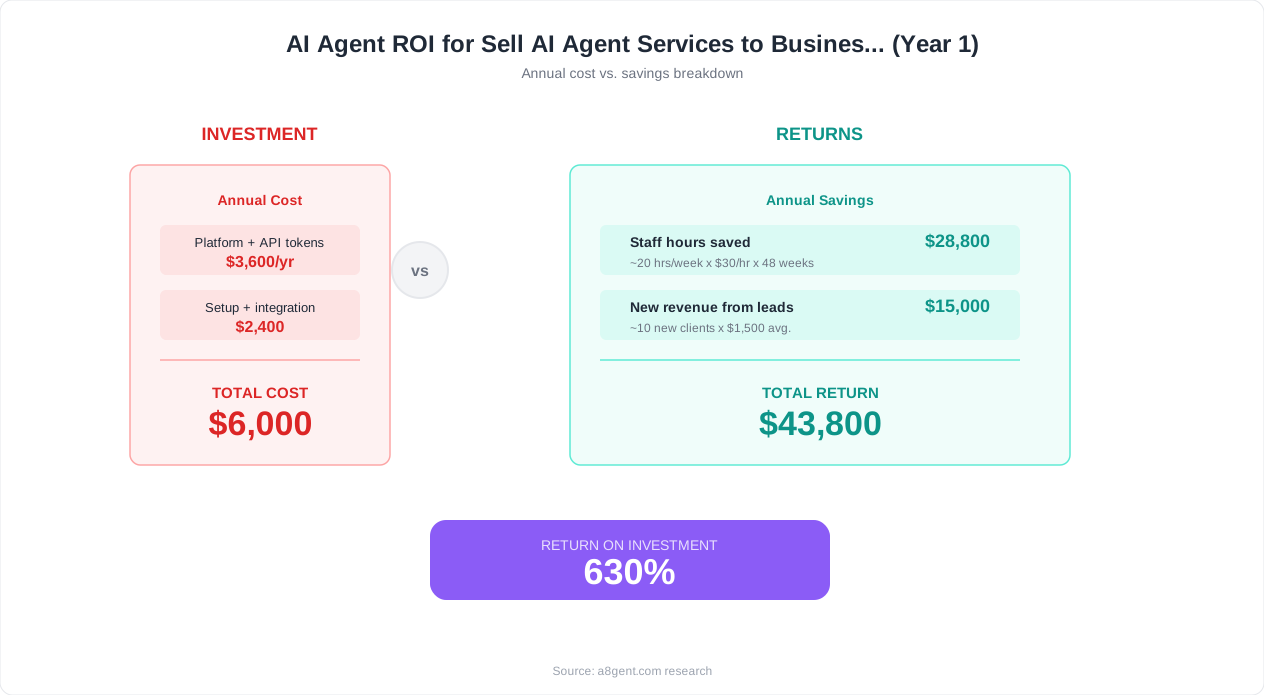
By this point, the client should have a clear picture of the total cost of their current approach. If their pain adds up to $5,000 per month and your solution costs $5,000 one-time plus $500/month, the math does the selling for you.
Phase 4: Vision Questions (3-5 Minutes)
End by painting the picture of what their business looks like with the problem solved:
- "If this process was running smoothly with minimal manual work, what would your team focus on instead?"
- "What would it mean for your business to be able to respond to every lead within 2 minutes, 24/7?"
- "If you could add 50 more customers without adding headcount, how would that change your growth plans?"
Close the discovery call with a clear next step: "Based on what you have shared, I am confident we can build a solution that handles [specific outcome]. I would like to put together a detailed proposal with specific numbers. Can we schedule 30 minutes next [day] for me to walk you through it?"
For a complete discovery call script with word-for-word questions and follow-up sequences, download our Client Discovery Call Script template.
Demonstrating Value: Live Demos That Close Deals
In AI automation sales, showing beats telling by a factor of 10. A polished slide deck explaining what AI agents can do generates polite interest. A live demonstration of an AI agent handling the client's actual use case generates buying urgency. Here is how to build and deliver demos that close deals.
The Prototype Approach
Before your proposal meeting, invest 2 to 4 hours building a rough prototype that mirrors the client's specific situation. For a dental practice prospect, build a simple AI agent that handles appointment booking conversations using their actual services and hours. For an e-commerce prospect, build an agent that answers product questions using data from their website. The prototype does not need to be production-ready - it needs to be real enough that the client can see their business reflected in it.
This investment of time pays for itself many times over. Agencies that present proposals with live demos report close rates of 50 to 65 percent, compared to 15 to 25 percent for proposal-only presentations. When a client watches an AI agent handle a conversation that they recognize from their daily operations, the abstract concept of "AI automation" becomes concrete and immediate.
Building Quick Prototypes
You do not need complex infrastructure for a demo prototype. Here is a practical approach that takes 2 to 3 hours:
- For chat/email agents: Use a platform like Relevance AI or Voiceflow to create a basic conversational agent. Load it with information scraped from the prospect's website - services, hours, pricing, FAQ content. Configure it to handle the top 5 to 10 question types for their industry. Set it up in a shareable demo environment.
- For workflow automation: Build a simple Make or n8n workflow that demonstrates the core logic. Use test data that mirrors the client's actual data structure. Screen-record the workflow executing and show the recording during your presentation if a live demo is too risky.
- For lead qualification: Create a simple form or chat interface that simulates a lead conversation. Show how the agent asks qualifying questions, scores the lead, and produces a summary that would be sent to the sales team. Use realistic scenarios based on the client's typical customer profile.
The Demo Meeting Structure
Structure your proposal meeting in four parts to maximize impact:
- Recap pain (3 minutes): "In our last conversation, you shared that [specific pain points with specific numbers]. I want to make sure I captured this accurately before I show you what we have built."
- Live demo (10 minutes): Walk through the prototype handling 3 to 4 realistic scenarios. Let the client interact with it if possible - having them type a question and watching the AI respond creates an emotional connection to the solution. Point out specific capabilities: "Notice how it recognized this is a billing question and routed it differently from a general inquiry."
- ROI presentation (5 minutes): Present the financial case using numbers from your discovery call. Show a simple before/after comparison: current monthly cost versus projected monthly cost with the AI agent. Use conservative estimates - under-promising and over-delivering builds trust.
- Proposal and close (10 minutes): Walk through the implementation plan, timeline, pricing, and next steps. The proposal should feel like a natural conclusion to everything you have discussed, not a separate sales pitch.
Handling the "Can You Show Me More?" Request
Prospects often want to see more scenarios, more features, or more polish before committing. This is natural but can become a stalling tactic. The correct response is: "The prototype I showed today was built in a few hours to demonstrate the concept. The production version will handle [broader scope] and include [additional features]. What I need to know is whether this approach - AI handling [X%] of your [process] autonomously - is the direction you want to go. If so, let us lock in the timeline, and I will build the full system to your specifications."
Use our ROI Calculator during your demo meetings to model the client's specific savings in real time - it is far more compelling than static numbers in a slide deck.
Closing Techniques for AI Automation Sales
Closing an AI automation deal is different from closing traditional service sales because the buyer's primary concern is rarely price - it is trust. They are trusting you to implement technology that will interact with their customers, handle their data, and affect their reputation. Every aspect of your closing process should address this trust gap.
The Risk Reversal Close
The most effective closing technique in AI sales is removing risk from the buyer's decision. Here are three risk reversal frameworks that consistently close deals:
- Performance guarantee: "If the agent does not achieve [specific metric - e.g., 70% autonomous handling rate] within 30 days of going live, I will continue working at no additional cost until it does." This works because you are confident in your delivery, and the client's worst case is getting more work for free.
- Shadow mode promise: "We will run the agent in shadow mode for the first two weeks - it processes everything but a human reviews every response before it is sent. You will see exactly what the agent would do before it ever touches a real customer interaction." This addresses the "what if it says something wrong" fear directly.
- Phased payment: "You pay 50% to start the build and 50% only after the agent is live and meeting our agreed performance targets." This puts your financial commitment where your confidence is.
The Timeline Close
Create gentle urgency by connecting the implementation timeline to the client's business reality:
- "You mentioned your busy season starts in September. If we begin this week, we will have the agent trained, tested, and fully operational with 6 weeks to spare. If we start next month, we are cutting it close and may need to expedite testing."
- "You are currently spending $4,200/month on this process. Every month we delay, that is another $4,200 spent on a problem we could solve. The agent pays for itself within 6 weeks of going live."
The Choice Close
Instead of asking "Do you want to proceed?" present two options that both result in a yes: "Based on our discussion, I see two approaches. Option A is the full implementation we discussed at $7,500, which handles scheduling, support inquiries, and follow-up automation. Option B is a focused implementation at $4,500 that handles scheduling and support, with follow-up automation added in phase two. Which approach fits your priorities better right now?"
Handling the "We Need to Think About It" Response
This is the most common non-objection in AI sales. It usually means one of three things: they need to consult someone else (ask who and offer to present to that person), they have an unvoiced concern (ask directly: "What specifically are you weighing?"), or they are genuinely not ready (set a specific follow-up date and ask what information would help their decision).
Never respond to "we need to think about it" with desperation or discounting. Instead: "Absolutely - this is an important decision. What specific questions or concerns should I address to help you reach a decision? And when would be a good time for us to reconnect - I want to make sure I am available when you are ready to move forward."
The Contract and Kickoff
Once the client agrees, move quickly. Send the contract or statement of work within 24 hours. Keep it simple - 2 to 3 pages covering scope, timeline, payment terms, and key responsibilities for both parties. Complex legal documents slow deals down and introduce new opportunities for doubt. Include a kickoff date in the contract. The faster you move from verbal agreement to active project, the lower the chance of the deal falling through. Aim for a kickoff call within 3 to 5 business days of signing.
For detailed contract templates and statement of work examples, visit our AI Agents for Agencies Course, which includes legally reviewed templates you can customize for your specific services.
Post-Sale Expectation Management: The Key to Long-Term Clients
The sale is not the finish line - it is the starting line. How you manage expectations during the first 90 days determines whether a client becomes a long-term retainer or a one-time project with a lukewarm testimonial. AI projects are especially prone to expectation gaps because clients often have unrealistic visions of what AI can do based on marketing hype.
The Kickoff Call: Setting the Right Expectations
Your first meeting after signing should explicitly address what success looks like, what the timeline is, and what the client's responsibilities are. Cover these topics in detail:
- Performance ramp-up: "Your AI agent will not be perfect on day one. In week one, we target 50-60% autonomous handling. By week four, we target 75-80%. By month three, we target 85-90%. This ramp-up is normal and expected - the agent learns and improves with every interaction."
- Human involvement: "During the first two weeks, your team will review every agent response before it is sent. This takes about 30 minutes per day. After shadow mode, they will only review escalated cases, which takes about 15 minutes per day. The time investment decreases as the agent improves."
- What you need from them: Be specific about client responsibilities - access to systems, response time for questions, availability for weekly check-ins, and commitment to updating you when products, policies, or processes change.
The 30-60-90 Day Framework
Define specific, measurable milestones for each phase and share them with the client in writing:
- Day 30 - Foundation: Agent is live and handling [X]% of target tasks autonomously. Response accuracy is at [Y]% or higher. Zero critical errors (wrong information given to customers, unauthorized commitments, data leaks). Client team has completed training on monitoring and escalation procedures.
- Day 60 - Optimization: Autonomous handling rate has increased to [X+15]%. Knowledge base has been expanded based on real-world edge cases. At least one A/B test has been run to improve a specific metric. Weekly performance review process is established and running smoothly.
- Day 90 - Maturity: Agent is operating at target performance levels. Client team is comfortable managing day-to-day operations with minimal agency support. Expansion opportunities have been identified and discussed. Retainer engagement terms have been finalized for ongoing optimization.
Proactive Communication Cadence
Do not wait for clients to ask how things are going. Establish a communication rhythm from day one:
- Week 1-2 (shadow mode): Daily email updates with performance stats and notable interactions. Flag any issues before the client discovers them.
- Week 3-4 (early live): Three times per week email updates plus one 30-minute check-in call per week.
- Month 2-3 (optimization): Weekly email reports plus bi-weekly 30-minute check-in calls.
- Month 4+ (steady state): Weekly automated reports plus monthly strategy calls.
The key principle is: over-communicate during the first 30 days and gradually reduce as confidence builds. Clients who feel informed and in control during the critical early period become your strongest advocates. Clients who feel left in the dark become your biggest headaches, even if the technical implementation is flawless.
Handling Problems Transparently
Every AI agent deployment hits bumps - an unexpected edge case, an integration hiccup, a customer interaction that goes sideways. How you handle these moments defines the client relationship. The formula is simple: notify, explain, fix, prevent. Notify the client immediately when an issue occurs - before they discover it themselves. Explain what happened in non-technical terms. Fix the specific issue within 24 hours. Implement a prevention measure so it does not recur. Clients expect problems. They do not expect being blindsided by them. Proactive transparency turns potential relationship-damaging incidents into trust-building moments.
Building a Referral Engine: Turning Clients into Your Sales Team
The most profitable client acquisition channel for AI automation agencies is referrals. A referred lead closes at 3 to 5 times the rate of a cold lead and typically has a 25 percent higher lifetime value. But referrals do not just happen - you need to build a systematic referral engine.
The Referral Timeline
There are three optimal moments to ask for referrals, and most agencies miss all three:
- The 30-Day Win: When the agent hits its first major milestone - for example, the first week where it handles over 100 inquiries autonomously - share the results with the client and ask: "These results are exactly what we discussed during our first call. Do you know any other business owners who are dealing with similar challenges? I would love to help them achieve the same results." This works because the client is experiencing the peak of excitement about their new system.
- The 90-Day Review: At the three-month mark, compile a comprehensive ROI report showing total time saved, cost savings, and performance improvements. Present this in a meeting and then ask: "We have now saved your team over [X hours] and [$Y]. I would be grateful if you could introduce me to one or two colleagues who might benefit from similar results. I am happy to do a free 15-minute assessment for anyone you refer." This works because you have concrete data to back up the request.
- The Retainer Renewal: When a client renews their retainer (or at the 6-month mark for ongoing clients), they have demonstrated with their wallet that they value your service. This is the highest-intent moment to ask for referrals.
Making Referrals Easy
Do not just ask "Do you know anyone?" - that puts the cognitive burden on the client and usually results in "Let me think about it." Instead, make referrals effortless:
- Provide a one-paragraph email template that the client can forward to their contacts. Something like: "Hi [Name], I have been working with [Your Agency] on an AI agent that handles [specific task]. It is saving us [X hours per week / $Y per month]. I thought you might be interested since you mentioned [relevant pain point]. Would you be open to a quick call with them? Here is their calendar link: [link]."
- Create a case study (with the client's permission) that they can share. A one-page PDF with the problem, solution, and results is easy to forward and makes the client look smart for having found you.
- Offer a referral incentive. This does not need to be monetary - a free month of retainer service, priority access to new features, or a complementary audit of a different workflow all work well. The incentive is less about the value and more about signaling that you take referrals seriously.
Strategic Partnerships
Beyond client referrals, build partnerships with professionals who serve the same client base but offer non-competing services:
- Web development agencies: They build websites but do not handle AI automation. When their clients ask about chatbots or AI features, you are the referral.
- Business consultants and coaches: They advise on strategy and operations. When their clients need implementation, they refer to you.
- CRM consultants: They implement HubSpot, Salesforce, or other CRM platforms. AI agents that integrate with these CRMs are a natural extension of their work.
- Accountants and bookkeepers: They see the financial pain of manual processes firsthand and can recommend automation when they spot inefficiency in client operations.
Formalize these partnerships with a simple agreement: you refer clients to them, they refer clients to you, and you optionally pay a finder's fee (10 to 15 percent of the first project) for referred clients that convert. Track referrals with a simple shared spreadsheet so both parties can see the value flowing in each direction.
The Long Game
Building an AI automation agency's sales pipeline is a 6 to 12 month process. The first three months are the hardest - you are building your portfolio, refining your pitch, and establishing your reputation. By month six, if you have delivered excellent results for 5 to 10 clients, word-of-mouth and referrals should be generating 30 to 50 percent of your leads. By month twelve, referrals and inbound should account for 50 to 70 percent, with outbound prospecting focused on strategic accounts rather than volume. Read our guide on AI agents for agencies for a complete overview of building and scaling an AI automation agency beyond just the sales function.
For a full sales system including outreach templates, discovery call scripts, proposal frameworks, and referral program templates, explore our AI Agents for Agencies Course - it covers the entire client lifecycle from first contact to long-term retainer.
FAQ
How do I find my first AI automation clients?
The fastest method is monitoring job boards for businesses hiring for automatable roles (data entry, scheduling, customer support). When a company posts a $40K/year support rep position, you can offer an AI agent that handles 60-70% of that workload for $500/month. LinkedIn outreach to business owners who post about operational frustrations is the second most effective channel. Aim for 5-10 qualified leads per week through targeted prospecting.
What should I say on a discovery call for AI automation services?
Focus 80% of the call on questions about their current process, not your solution. Ask: How do you currently handle [process]? How many hours does your team spend on it weekly? What happens during busy periods? What is the cost when things go wrong? The goal is to help the client quantify their pain in dollar terms. If they realize their current approach costs $5,000/month and your solution costs $500/month plus a one-time setup fee, the deal largely closes itself.
How do I demonstrate AI agent value to non-technical business owners?
Build a simple prototype that mirrors their specific use case - this takes 2-4 hours but closes deals 3x more effectively than slide decks. Load an AI agent with information from their website, configure it to handle their top 5-10 customer questions, and let them interact with it live during your proposal meeting. When a dental practice owner watches an AI agent correctly book an appointment using their actual services and hours, the concept becomes real and immediate.
What is the biggest objection when selling AI automation?
Trust, not price. Business owners worry about AI saying the wrong thing to customers, handling sensitive data incorrectly, or losing the personal touch that differentiates their business. Address this proactively with three guarantees: shadow mode testing (human reviews every response for the first 2 weeks), escalation rules (AI routes complex issues to humans automatically), and a performance guarantee (you continue working at no extra cost if targets are not met within 30 days).
How long does it take to close an AI automation deal?
The average sales cycle from first contact to signed agreement is 2-4 weeks for small business clients and 4-8 weeks for mid-market clients. The key variable is how quickly you can schedule and deliver a discovery call. Prospects who see a live demo during the proposal meeting close 50-65% of the time, often within the same week. The biggest delays come from 'we need to think about it' responses, which you can minimize by addressing trust concerns proactively and creating gentle timeline urgency.