AI Agents for Inventory Management: Auto-Reorder, Sync and Forecast (2026)
AI agents now handle automatic reordering, multi-channel inventory sync, demand forecasting, and stockout prevention for businesses of all sizes. This guide covers practical deployment strategies, platform recommendations, and the specific workflows that deliver the fastest ROI.
10+ years shipping production ML across TensorFlow, PyTorch, AWS, and GCP. Ships every A8gent agent before it becomes a lesson. GitHub
- AI agents reduce stockouts by 40-65% and overstock situations by 30-50% through demand forecasting that accounts for seasonality, trends, promotions, and external factors - delivering accuracy that manual reorder points cannot match.
- Multi-channel inventory sync automation eliminates overselling by updating stock levels across all sales channels (Shopify, Amazon, wholesale, POS) within seconds of any change - versus the 15-60 minute delays of manual or scheduled sync.
- Automated reorder point calculation saves 8-15 hours per week for businesses with 200+ SKUs by dynamically adjusting reorder triggers based on lead time variations, demand velocity, and supplier reliability rather than static thresholds.
- Platforms like Autonoly connect to existing inventory systems (Shopify, NetSuite, TradeGecko) and add an AI decision layer without requiring you to replace your current stack or migrate historical data.
- Small businesses with 100-500 SKUs typically see full ROI within 3 weeks of deploying inventory AI agents through reduced stockout losses, lower carrying costs, and freed staff time from manual counting and ordering.
Inventory Management in 2026: The AI Automation Opportunity
Inventory management has always been a balancing act. Too much stock ties up capital and increases carrying costs. Too little stock means lost sales and disappointed customers. Getting it exactly right - across hundreds or thousands of SKUs, multiple sales channels, fluctuating demand, and unreliable supplier lead times - has traditionally required either expensive inventory planners or accepting that you will always have some level of overstock and stockout waste.
In 2026, AI agents have changed this equation. Businesses deploying inventory AI agents report 40-65% fewer stockouts and 30-50% less overstock compared to manual or rule-based inventory management. These are not marginal improvements. For a business carrying $500,000 in inventory, a 30% reduction in overstock frees $150,000 in working capital while simultaneously improving product availability.
What makes AI agents different from the inventory software you might already use is the decision-making layer. Traditional inventory software tracks what you have. AI agents decide what to do about it. They calculate dynamic reorder points that adjust daily based on current demand velocity. They forecast demand weeks ahead using patterns invisible to human analysis. They sync stock levels across channels in real-time so you never oversell. They identify slow-moving inventory before it becomes dead stock. And they do all of this continuously, without anyone manually reviewing spreadsheets or running reports.
The biggest shift in 2026 is accessibility. Three years ago, AI inventory management required enterprise budgets and dedicated data science teams. Today, platforms with pre-built inventory intelligence are accessible to businesses with as few as 100 SKUs at price points starting under $150/month. The technology has democratized from enterprise-only to everyone.
This guide covers the specific capabilities of inventory AI agents, which workflows deliver the fastest ROI, how to choose and deploy the right platform for your business type, and the practical steps to go from reading this to having automated inventory intelligence running within a week. For broader e-commerce automation strategies beyond inventory, see our e-commerce automation use cases.
If you want to know exactly which inventory workflows in your business are ready for AI automation, take our free assessment. It evaluates your SKU count, sales channels, current tools, and pain points to recommend specific automation opportunities with projected savings.
Automated Reordering: Dynamic Triggers That Prevent Stockouts
Traditional reorder points are static: when SKU X drops below 50 units, order 200 more. This approach fails because demand is not static. A product selling 10 units/day in January might sell 40 units/day in December. A static reorder point either overstocks in January or runs out in December. AI agents solve this with dynamic reorder calculation.
How Dynamic Reorder Points Work
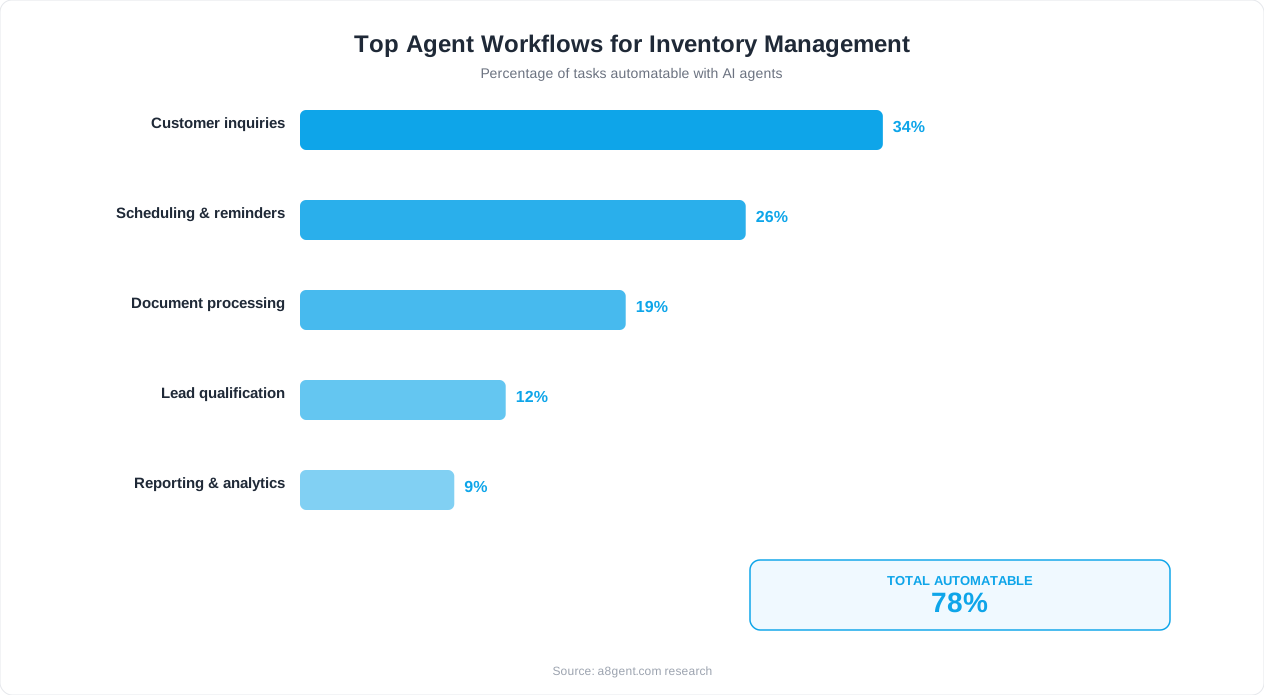
Instead of fixed thresholds, AI agents calculate reorder points daily (or even hourly for fast-moving items) based on: current sales velocity over the past 7/14/30 days, known upcoming demand factors (promotions, seasonal trends, marketing campaigns), actual supplier lead time (not the quoted lead time, but the measured average including delays), safety stock buffer adjusted for demand variability, and minimum order quantities and supplier pricing tiers. The result is a reorder point that shifts with your business reality rather than sitting at an arbitrary number you set six months ago and forgot about.
Intelligent Purchase Order Generation
When a reorder point is triggered, the AI does not just flag it - it generates a complete purchase order. It selects the optimal supplier (based on current pricing, lead time, and reliability scores), calculates the optimal order quantity (factoring MOQs, price breaks, and projected demand through the replenishment cycle), consolidates multi-SKU orders to the same supplier (saving on shipping), and routes the PO for approval or auto-submits based on your configured thresholds. What used to require a purchasing manager reviewing reports and manually creating POs happens automatically - and more accurately.
Supplier Lead Time Learning
Most businesses use quoted lead times for reorder calculations. But quoted lead times are often wrong. Supplier A quotes 14 days but consistently delivers in 10. Supplier B quotes 7 days but averages 12 (and occasionally takes 21). AI agents track actual delivery performance against every order and use measured lead times - including variability - for reorder calculations. This means orders to unreliable suppliers trigger earlier (accounting for their inconsistency) while orders to consistent suppliers can trigger later (freeing up working capital that would otherwise be tied up in unnecessary safety stock).
Multi-Location Reorder Optimization
For businesses with multiple warehouses, stores, or fulfillment locations, AI agents optimize inventory distribution across locations. They consider: demand patterns at each location, transfer costs between locations, supplier proximity to each location, and storage capacity constraints. Instead of each location managing its own reorder independently (leading to some locations overstocked while others stock out), the AI optimizes the system holistically - sometimes transferring existing stock between locations instead of ordering new inventory.
Seasonal and Promotional Demand Adjustment
AI agents automatically detect and account for seasonal patterns in your historical data. They increase reorder quantities ahead of high seasons and reduce them before slow periods - without you manually adjusting parameters. For planned promotions, you can input expected demand multipliers ("Black Friday - expect 5x normal volume") and the AI pre-calculates the inventory needed, generates advance orders to suppliers, and adjusts reorder points back to normal after the event ends.
Results in Practice
Businesses deploying automated reordering through platforms like Autonoly report: stockout incidents reduced by 45-65%, average days of inventory reduced by 20-30% (freeing working capital), time spent on manual ordering reduced by 80-90%, emergency/rush orders reduced by 70% (eliminating premium shipping costs), and supplier relationships improved through consistent, predictable ordering patterns.
To calculate your projected savings from automated reordering based on your specific SKU count, order volume, and current stockout rate, use our ROI calculator.
Multi-Channel Inventory Sync: Eliminate Overselling Forever
If you sell through multiple channels - your own website, Amazon, eBay, wholesale, retail POS, or any combination - inventory sync is a constant risk. Sell the last unit on Amazon and your Shopify store still shows it in stock for another 15-60 minutes? That is an oversell that damages customer trust, triggers platform penalties, and creates operational headaches. AI agents make this problem disappear.
Real-Time Cross-Channel Updates
AI inventory agents monitor stock changes across all channels simultaneously and propagate updates within seconds - not minutes or hours. When a unit sells on any channel, all other channels reflect the reduced quantity within 5-15 seconds. When new stock arrives at your warehouse, all channels see increased availability immediately. When you allocate inventory to a wholesale order, retail availability decreases across all storefronts instantly. This near-instant sync eliminates the window where overselling can occur.
Channel-Specific Allocation Rules
Not all channels deserve equal inventory access. Your highest-margin channel might warrant priority allocation. Your fastest-growing channel might need reserved stock. AI agents let you set allocation rules: reserve 20% of SKU X for Amazon (because penalties for stockouts are severe there), prioritize your own website (where margins are highest), set minimum available quantities per channel, and automatically shift allocation when one channel's velocity increases unexpectedly. These rules run continuously without manual intervention.
Bundle and Kit Sync
Inventory sync becomes exponentially complex with bundles and kits. If you sell Product A individually AND as part of Bundle AB, selling one Bundle AB needs to decrease available quantity of both Product A and Product B across all channels. AI agents manage this component-level sync automatically: understanding bundle compositions, calculating available-to-promise for both individual items and bundles, and updating all channels when any related item sells. This component tracking is nearly impossible to manage manually once you exceed 10-20 bundles.
Pre-Order and Backorder Intelligence
When stock reaches zero, AI agents can automatically: switch listings to pre-order status (with calculated availability dates based on incoming PO lead times), enable backorder with transparent communication about fulfillment timeline, suppress listings entirely if the item is being discontinued, or automatically list substitute products as recommendations. This intelligent zero-stock handling means you never just show "out of stock" - every scenario has a configured response that maximizes recovery of potential lost sales.
Returns and Adjustment Handling
When returns arrive, the AI determines whether returned items are resellable and automatically adjusts available inventory across channels. Damaged returns get routed to a damaged/liquidation pool without inflating sellable inventory counts. Restocked returns increase availability across all channels immediately. This real-time returns processing means returned inventory is available for resale faster - improving cash flow and reducing the pile of "returned but not yet restocked" items that accumulate in warehouses.
Warehouse Management Integration
For businesses with WMS (Warehouse Management Systems) or 3PL (Third-Party Logistics) providers, AI agents bridge the gap between your sales channels and physical inventory. They reconcile WMS stock counts with channel-listed quantities, flag discrepancies for investigation, sync receiving data as new shipments arrive, and ensure physical inventory changes flow to digital channels without delay. This WMS bridge eliminates the common problem of channel quantities drifting from actual physical stock over time.
For ecommerce businesses specifically, see our detailed guide on AI agents for ecommerce automation which covers channel sync alongside other ecommerce-specific automation workflows.
AI Demand Forecasting: Predict What You Will Sell Before You Sell It
Demand forecasting is where AI inventory management delivers its most significant advantage over traditional methods. Human planners working with spreadsheets can identify obvious seasonal trends but miss subtle patterns that AI detects across thousands of data points simultaneously.
What AI Forecasting Analyzes
Modern demand forecasting AI considers: historical sales data (daily, weekly, monthly patterns over 1-3 years), seasonal trends (both macro seasons and micro-patterns like day-of-week effects), promotional impact (how past promotions affected demand and for how long), price elasticity (how price changes correlate with volume changes), external factors (weather patterns, economic indicators, competitor actions), marketing spend correlation (how advertising investment maps to demand), and channel-specific trends (growth or decline by sales channel). This multi-factor analysis produces forecasts that are typically 30-50% more accurate than manual forecasting or simple moving-average calculations.
Forecast Granularity
AI agents generate forecasts at the granularity you need: by SKU (what will each individual product sell?), by location (which warehouse or store needs what?), by channel (how much demand comes from each sales platform?), by time period (daily, weekly, monthly projections), and by customer segment (if different customer types buy different quantities). This granularity lets you make precise inventory decisions - not just "order more of everything" but "order 200 units of SKU-A for warehouse East and 50 for warehouse West because demand patterns differ."
Promotional Demand Planning
When you plan a promotion - a sale, a marketing campaign, a product launch - the AI agent uses historical promotion data to predict the demand impact. It answers: How many additional units will a 20% discount generate? How long does the demand spike last after the promotion ends? Is there a post-promotion demand dip (customers who bought early during the sale and will not buy again for months)? This promotional intelligence lets you stock appropriately for events without the traditional choice between "risk a stockout during the sale" and "be stuck with excess inventory after."
New Product Forecasting
Forecasting is hardest for new products with no sales history. AI agents handle this through analog matching: finding existing products with similar characteristics (category, price point, target audience) and using their launch trajectories as predictive models. This "similar product" approach is imperfect but dramatically better than pure guesswork - which is what most businesses do when launching new SKUs. After 2-4 weeks of actual sales data, the AI shifts from analog-based to data-based forecasting with increasing accuracy.
Forecast Accuracy Monitoring
Good AI platforms continuously measure their own forecast accuracy. They track: Mean Absolute Percentage Error (MAPE) by SKU and category, forecast bias (consistently over or under-predicting?), accuracy degradation signals (when forecasts start becoming less reliable - indicating market changes), and specific SKUs where forecasting performs poorly (flagging for human attention). This self-monitoring means you know which forecasts to trust and which to apply human judgment to. Typical MAPE for well-tuned AI forecasting on products with 6+ months of history: 15-25% at the SKU/weekly level - significantly better than the 35-50% typical of manual planning.
Actionable Forecast Outputs
Forecasts are only valuable if they drive action. AI inventory agents convert forecasts into: recommended purchase order quantities and timing, warehouse capacity planning projections, cash flow projections (how much capital will inventory require in coming months?), staffing recommendations for fulfillment (expect 3x volume in December), and markdown timing suggestions for products forecasted to slow. The forecast is not a report you read - it is a decision engine that automatically adjusts your inventory operations.
For restaurants and food businesses where demand forecasting intersects with perishability constraints, see our specialized guide on AI agents for restaurants.
Best AI Platforms for Inventory Management (2026)
The right inventory AI platform depends on your business type, SKU count, sales channels, and existing technology stack. Here are the leading options in 2026.
Autonoly - Best for Multi-Channel SMBs ($129-$349/month)
Autonoly offers pre-built inventory automation templates covering reorder point management, multi-channel sync, low-stock alerts, and supplier order automation. It connects natively to Shopify, WooCommerce, Amazon, eBay, and most popular ecommerce platforms. The visual workflow builder lets non-technical users create sophisticated inventory logic without coding. Includes demand velocity tracking and dynamic reorder calculation out of the box. Best for: ecommerce businesses with 100-2,000 SKUs selling across 2-5 channels who want comprehensive automation without technical complexity.
Inventory Planner by Sage - Best for Pure Forecasting ($249-$799/month)
Inventory Planner focuses specifically on demand forecasting and purchase order optimization. Its AI analyzes your sales history across connected platforms and generates replenishment recommendations with forecasted demand, optimal order quantities, and timing. Strong Shopify and multi-channel integrations. Less automation capability (it recommends but does not auto-execute) but excellent forecasting accuracy. Best for: businesses that want AI-powered forecasting recommendations but prefer human approval before orders are placed.
n8n + Inventory APIs - Best for Technical Teams ($20-$50/month self-hosted)
For technically capable teams, n8n provides the workflow automation engine while you connect to your inventory system's APIs directly. This approach offers unlimited customization: build exactly the logic your business needs without platform constraints. The trade-off is higher implementation time and technical skill requirements. Best for: businesses with developer resources who want maximum flexibility and minimum recurring cost, or those with unusual inventory management requirements that pre-built platforms cannot accommodate.
Cin7 Core - Best for Wholesale and Manufacturing ($349-$999/month)
Cin7 Core (formerly DEAR Inventory) is a full inventory management platform with built-in AI forecasting, auto-reorder, and multi-location management. It handles complex scenarios: manufacturing BOMs, wholesale pricing tiers, landed cost calculations, and serial/batch tracking. Stronger as a complete IMS replacement than as an AI layer on top of existing tools. Best for: product businesses with complex inventory needs (manufacturing, wholesale, multi-location) who want an all-in-one platform with AI capabilities built in.
How to Choose
Ecommerce with straightforward inventory and wanting fast deployment: Autonoly. Need best-in-class forecasting with human-in-the-loop approval: Inventory Planner. Technical team wanting maximum customization at lowest cost: n8n self-hosted. Complex inventory (manufacturing, wholesale, multi-location): Cin7 Core. Under 50 SKUs with simple needs: your existing platform's built-in inventory features may be sufficient - start with those and add AI when complexity increases.
Not sure which category you fit? Use our Agent Finder tool to get a personalized recommendation based on your specific inventory complexity, channel count, and technical resources. Or explore the cost implications in our cheapest AI automation tools guide.
Dead Stock Prevention and Slow-Mover Optimization
Dead stock - inventory that sits unsold for months, tying up capital and incurring carrying costs - is one of the largest hidden costs in product businesses. AI agents attack this problem from two angles: preventing dead stock from accumulating and optimizing the disposition of slow-moving inventory that already exists.
Early Warning Detection
AI agents continuously monitor sales velocity for every SKU and flag items whose velocity is declining before they become dead stock. Traditional inventory systems only identify dead stock after it has been sitting for 90-180 days. AI agents detect the deceleration trend within 2-4 weeks of decline onset, giving you months of lead time to take action. Flags include: velocity dropping below threshold compared to 30-day average, velocity declining for 3+ consecutive weeks, seasonal item not selling at expected pre-season rate, and new product with launch velocity below analog predictions.
Automated Markdown Optimization
When slow-moving inventory is identified, AI agents calculate the optimal markdown strategy: timing (when to start discounting), depth (how much discount is needed to clear the inventory within your target timeframe), channel (which channels respond best to markdowns for this product type), and velocity (gradual price reduction versus aggressive clearance). They can automatically adjust pricing across channels, create promotional campaigns for slow movers, or bundle slow items with popular products. The goal is recovering maximum revenue rather than the binary choice between full price and fire sale.
Purchase Quantity Optimization
The best way to avoid dead stock is to not over-purchase in the first place. AI agents prevent over-ordering by: limiting initial orders for new/unproven products (order conservative first batch, reorder quickly if demand materializes), applying confidence intervals to forecasts (ordering to the 70th percentile of demand rather than the 95th), flagging when suggested order quantities exceed historical peak demand, and preventing orders that would push inventory above a configurable months-of-supply threshold. This conservative-then-expand approach means you might occasionally miss a sale (which can often be recovered with expedited reorder) but you avoid the much more expensive problem of stuck inventory.
Supplier Return and Liquidation Routing
For inventory that does become dead stock despite prevention efforts, AI agents automate the disposition process: identify items eligible for supplier return (within return windows, meeting condition requirements), route items to liquidation channels (B-stock platforms, wholesale clearance buyers, donation for tax benefit), calculate the financial impact of each disposition option (return value vs. liquidation recovery vs. holding cost of continued storage), and execute the optimal disposition automatically. This replaces the common pattern of dead stock sitting indefinitely because nobody has time to figure out what to do with it.
Carrying Cost Visibility
Most businesses dramatically underestimate their inventory carrying costs. AI agents calculate and surface the true cost of holding each SKU: warehouse space cost per unit, insurance allocation, obsolescence risk (technology products lose value rapidly), capital opportunity cost (what that tied-up money could earn elsewhere), and handling/counting costs. When you see that a pallet of slow-moving product costs $400/month just to store, the urgency of action becomes clear. This carrying cost visibility, automatically calculated and surfaced, changes how managers think about inventory decisions.
Category Lifecycle Management
Some products have natural lifecycles: trending items, seasonal products, technology goods, fashion items. AI agents learn the typical lifecycle curve for each product category in your business and apply that knowledge to current inventory decisions. If phone cases for a specific model historically sell 80% of lifetime volume in the first 6 months, the AI ensures you do not over-order at month 4 based on then-current velocity. This lifecycle awareness prevents the most common source of dead stock: ordering based on peak-period demand for products already past their peak.
For businesses that also struggle with broader operational automation, inventory optimization is often the highest-ROI starting point because it directly frees working capital that can fund other automation investments.
Getting Started: Deploy Inventory AI This Week
Ready to bring AI intelligence to your inventory operations? Here is the fastest path from reading this to having automated inventory management running for your business.
Day 1: Audit Your Current State (30 minutes)
Document: How many active SKUs do you manage? Which sales channels are you on? What inventory software do you currently use? What is your biggest inventory pain point (stockouts, overstock, manual ordering time, sync errors)? What is your monthly order volume to suppliers? How many hours per week does someone spend on inventory-related tasks? These answers determine which automation to deploy first and which platform suits your needs.
Day 1: Choose Your Starting Automation (15 minutes)
Pick your highest-pain, fastest-win starting point. For most businesses: if stockouts are your biggest problem, start with dynamic reorder point automation. If overselling across channels is your pain, start with multi-channel sync. If you are overwhelmed by manual PO creation, start with automated reorder generation. If cash is tied up in dead stock, start with slow-mover detection and markdown automation. One automation at a time - deployed well - beats attempting everything simultaneously.
Day 2: Platform Setup (1-2 hours)
Sign up for your chosen platform (most offer 14-day free trials). Connect your primary inventory data source: Shopify store, Amazon Seller Central, your WMS, or whatever system of record holds your inventory data. Connect your sales channels for real-time sync. Verify the connection by checking that current stock levels match between your source and the platform. Import your supplier information (names, lead times, MOQs, contact details) for automated ordering.
Day 2-3: Configure Your First Workflow (2-3 hours)
If starting with dynamic reorder points: set safety stock levels for your top 50 SKUs (the AI will optimize these over time), configure supplier details and lead times, set approval rules (auto-order below $500, require approval above), and enable the reorder agent. If starting with multi-channel sync: map your SKU identifiers across channels, configure allocation rules if applicable, set update frequency (real-time recommended), and enable sync monitoring. If starting with slow-mover detection: set your threshold for "slow" (e.g., less than 1 unit/week for 4 consecutive weeks), configure notification preferences, and set markdown rules if you want automated pricing adjustments.
Day 3-7: Monitor and Calibrate (15 min/day)
During the first week, review the AI's recommendations and actions daily. For reorder automation: verify suggested quantities make sense for your business context. For sync: confirm quantities are updating correctly across channels. For slow-mover detection: check whether flagged items genuinely need attention. Make adjustments to thresholds, safety stocks, and rules based on what you observe. Most businesses need 3-5 calibration tweaks before the system matches their judgment consistently.
Week 2-4: Trust and Expand
After confirming the first workflow operates accurately, reduce oversight to every-other-day, then weekly spot-checks. Begin planning your second automation. The typical expansion path: sync first (prevent immediate revenue loss from overselling), then reorder automation (save time and prevent stockouts), then forecasting (optimize forward-looking decisions), then dead stock management (recover tied-up capital). Within 30 days, you can realistically have 2-3 inventory workflows automated.
Measuring Success
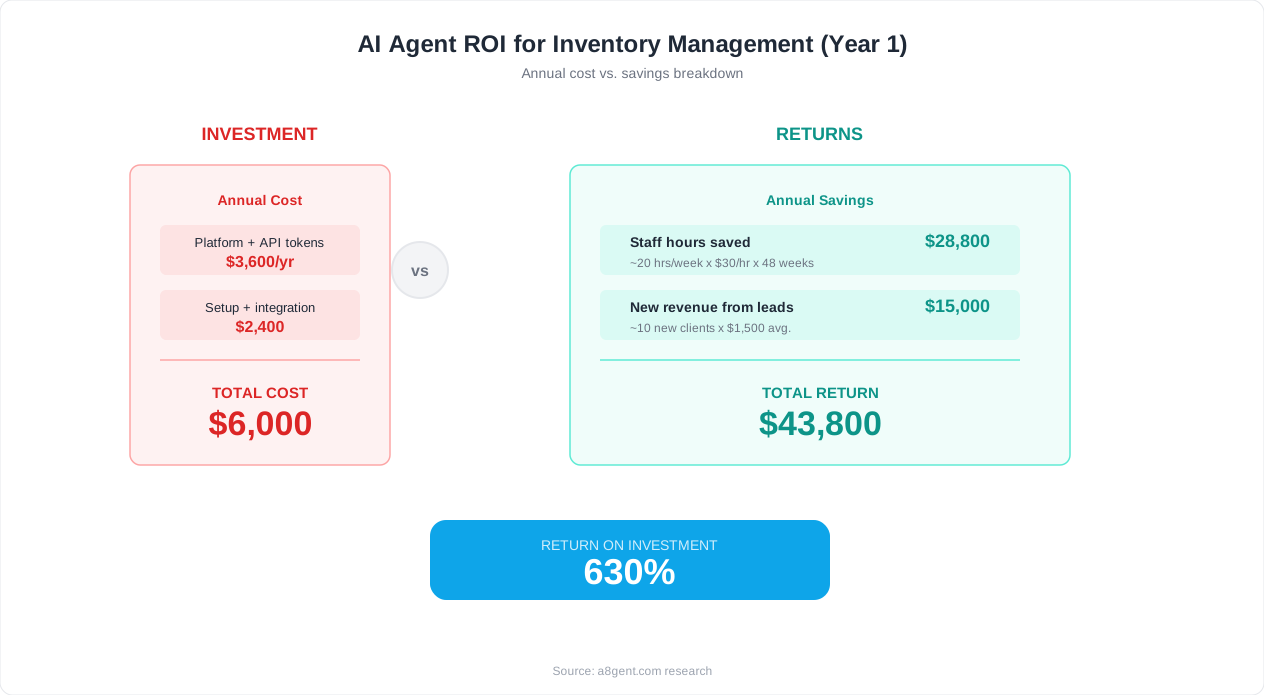
Track these metrics weekly: stockout incidents (should decrease 40-65%), days of inventory on hand (should decrease 15-30%), time spent on manual inventory tasks (should decrease 60-80%), oversell incidents (should drop to near zero with sync), and purchasing accuracy (actual demand vs. ordered quantity). Use our ROI calculator to project your savings and track actual results against projections. Most businesses find actual savings exceed projections because the calculator cannot account for all the indirect benefits (fewer customer complaints, less emergency shipping, better supplier terms from consistent ordering).
Advanced Inventory AI: Just-in-Time, ABC Analysis, and Beyond
Once basic inventory automation is running smoothly, advanced strategies unlock additional value. These approaches require a foundation of clean data and proven basic automation before they deliver reliable results.
AI-Optimized ABC Classification
Traditional ABC analysis categorizes products by revenue contribution: A items (top 20% of SKUs generating 80% of revenue), B items (middle), C items (bottom). AI agents enhance this with dynamic classification that updates automatically as sales patterns shift. A product can move from B to A based on trending velocity, or from A to C as it ages out. The AI then applies different management strategies per category: A items get tighter safety stocks and more frequent review, B items get moderate automation, and C items get minimal-touch management with aggressive dead-stock monitoring. This dynamic allocation ensures management attention always focuses where it generates the most value.
Just-in-Time Optimization
For businesses with reliable suppliers and high carrying costs, AI agents can optimize toward just-in-time (JIT) inventory. Instead of maintaining large safety stocks, the AI orders smaller quantities more frequently, timing deliveries to arrive just as current stock depletes. This minimizes capital tied up in inventory but requires accurate demand forecasting and reliable supplier performance. AI agents make JIT viable for more businesses by continuously monitoring both demand accuracy and supplier reliability - automatically widening safety buffers when either becomes uncertain and tightening them when confidence is high.
Supplier Diversification Intelligence
Over-dependence on a single supplier for critical SKUs creates business risk. AI agents identify single-source vulnerabilities, recommend alternative suppliers based on product category, and can automatically split orders across multiple suppliers to reduce concentration risk. They also monitor supplier health indicators: increasing lead times, declining quality metrics, or delivery reliability drops that might signal problems before they become supply chain disruptions. This proactive supplier management replaces reactive crisis management when a supplier suddenly cannot deliver.
Cross-SKU Cannibalization Detection
When you introduce a new product, does it grow total sales or just steal from existing products? AI agents detect cannibalization by correlating new product velocity with declining velocity of similar existing items. This intelligence informs inventory decisions: if Product New is cannibalizing Product Old, you should reduce reorder quantities for Product Old proportionally rather than maintaining historical ordering levels and accumulating overstock. This cross-product awareness is nearly impossible to maintain manually across hundreds of SKUs but straightforward for AI monitoring velocity changes across your entire catalog.
Weather and External Factor Integration
For products with weather-sensitive demand (seasonal clothing, outdoor equipment, food and beverage), AI agents integrate weather forecast data into demand predictions. A predicted heat wave increases forecasted demand for fans and cold beverages. An early winter forecast accelerates seasonal product ordering. Beyond weather: local events, economic indicators, competitor promotions, and social media trends can all feed into demand adjustment. Each external signal the AI incorporates improves forecast accuracy incrementally, and the cumulative improvement can be substantial for weather-dependent categories.
Warehouse Layout and Pick Optimization
Advanced inventory AI extends beyond what to stock to where to place it. High-velocity items should be positioned for fastest pick access. Items frequently ordered together should be co-located. Seasonal items should be accessible during their peak and moved to deep storage in off-season. AI agents analyze order patterns and recommend warehouse layout changes that reduce pick time. For businesses using Autonoly or similar platforms with WMS integration, these recommendations can be automated: the system generates move-lists when layout optimization would improve pick efficiency by a configurable threshold.
For more on how inventory automation connects to broader ecommerce operations, explore our guide on AI agents for ecommerce which covers the full operational stack from order to delivery. For businesses exploring automation for the first time, our automation courses include inventory-specific modules with hands-on deployment exercises.
FAQ
How many SKUs do I need for inventory AI to be worthwhile?
Inventory AI becomes worthwhile at around 50-100 active SKUs. Below 50 SKUs, manual management is typically feasible without significant time investment. At 100+ SKUs, the complexity of tracking reorder points, demand patterns, and multi-channel sync across all items exceeds what most people can manage effectively in their head or with spreadsheets. The more SKUs you have, the greater the ROI - businesses with 500+ SKUs see the most dramatic time and accuracy improvements.
Will AI inventory management work with my existing Shopify/Amazon setup?
Yes. AI inventory platforms are designed to layer on top of existing ecommerce infrastructure. They connect to Shopify, Amazon Seller Central, WooCommerce, BigCommerce, and most major platforms through standard API integrations. Your existing product listings, inventory counts, and order history remain in your current platforms. The AI reads this data, makes decisions, and writes back (updating stock levels, creating POs) without requiring you to migrate away from tools you already use.
How accurate is AI demand forecasting compared to manual planning?
AI demand forecasting typically achieves 15-25% Mean Absolute Percentage Error (MAPE) on established products with 6+ months of history, compared to 35-50% MAPE for manual spreadsheet-based planning. This translates to roughly 30-50% more accurate predictions. The AI excels at detecting patterns across hundreds of SKUs simultaneously and accounting for multiple factors (seasonality, trends, promotions) that manual planners often handle inconsistently. Accuracy improves over time as the AI accumulates more data about your specific business patterns.
What happens if the AI makes a bad reorder decision?
Good platforms include safeguards: approval thresholds for large orders (auto-order small POs but require human approval above a dollar amount), anomaly detection (flagging orders that are unusually large compared to history), and undo capability (canceling orders before supplier confirmation). During the first 2-4 weeks, most businesses run in 'recommend' mode rather than 'auto-execute' mode, reviewing AI suggestions before acting on them. Once confidence is established, auto-execution is enabled with safety thresholds for exceptional cases.
Can AI handle perishable inventory with expiration dates?
Yes, with proper configuration. AI inventory agents can track expiration dates, implement FEFO (First Expired, First Out) rotation logic, generate markdown recommendations as expiration approaches, calculate optimal order quantities to minimize waste while maintaining availability, and forecast demand with waste factors included. This is particularly valuable for food, beverage, supplements, and cosmetics businesses where expiration management is both critical and complex.
How does inventory AI handle unexpected demand spikes?
AI agents detect demand spikes faster than manual monitoring because they continuously compare actual sales to forecasted sales. When actual demand exceeds forecast by a configurable threshold (typically 2x or more), the agent triggers emergency reorder logic: contacting suppliers for expedited delivery, calculating revised stock coverage based on elevated demand, alerting you to the anomaly, and adjusting forecasts forward if the spike appears sustained rather than temporary. Response time from spike detection to reorder action is typically minutes versus days for manual processes.
What is the typical implementation timeline for inventory AI?
Basic implementation (single-channel sync or simple reorder automation): 1-3 days. Standard implementation (multi-channel sync plus reorder across primary SKUs): 1-2 weeks. Full implementation (forecasting, optimization, and multi-location): 3-4 weeks. The AI's accuracy improves over the first 4-8 weeks as it accumulates data about your specific demand patterns, supplier behavior, and seasonal rhythms. Most businesses see measurable ROI within the first 2-3 weeks from time savings alone, even before forecasting accuracy fully matures.
Does inventory AI work for dropshipping or print-on-demand businesses?
Partially. For dropshipping, AI agents add value through demand forecasting (predicting which products to market more heavily), supplier monitoring (tracking fulfillment speed and quality), and multi-channel listing management. For print-on-demand, the value is primarily in demand prediction and raw material management. Neither model benefits from traditional reorder automation since you do not hold finished inventory. The sync and forecasting capabilities remain valuable, but auto-reorder features are less applicable.