AI Agents for Property Management: Tenants, Maintenance and Rent (2026)
AI agents now automate tenant communications, maintenance coordination, rent collection, and lease management for property managers. This guide covers which tasks to automate first, the best platforms, and how to deploy without disrupting your existing operations.
10+ years shipping production ML across TensorFlow, PyTorch, AWS, and GCP. Ships every A8gent agent before it becomes a lesson. GitHub
- AI agents can automate 60-80% of routine property management tasks including tenant inquiries, maintenance coordination, rent reminders, and lease renewal processing - reducing administrative workload by 25-35 hours per week for a 50-unit portfolio.
- Automated maintenance request triage saves the most immediate time: AI agents categorize urgency, route to the correct vendor, schedule appointments, and follow up - eliminating the phone tag that consumes 30-40% of a property manager's day.
- Rent collection automation with AI reduces late payments by 35-50% through intelligent reminder sequences, payment plan offers for at-risk tenants, and instant escalation when accounts hit threshold delinquency levels.
- Platforms like Autonoly integrate with existing property management software (AppFolio, Buildium, Rent Manager) so you do not need to replace your current stack - the AI layer works on top of what you already use.
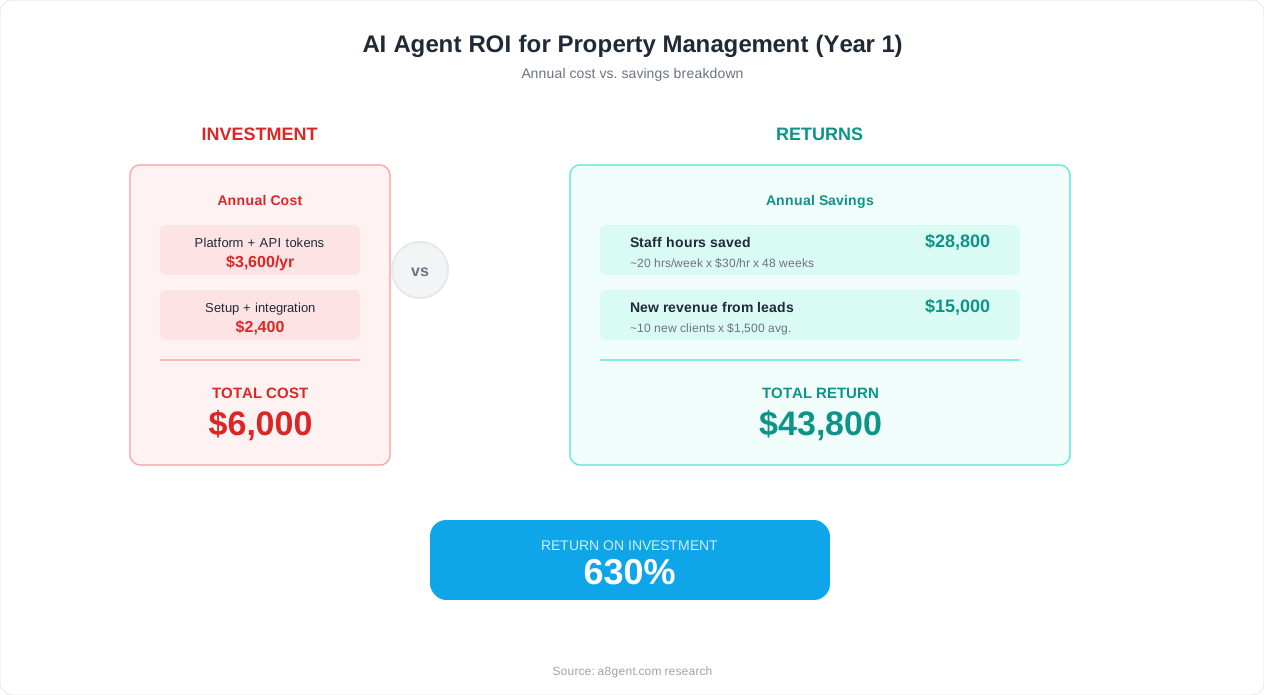
- Property managers handling 20+ units see full ROI within the first month of deployment, with typical cost savings of $1,200-$3,500/month depending on portfolio size and current staffing costs.
Property Management in 2026: Why AI Agents Are Now Essential
Property management is a business defined by constant interruptions. A burst pipe at 2 AM. A tenant asking about their lease renewal for the third time this week. A vendor who missed an appointment and needs rescheduling. Rent that is two days late from the same tenant who is always two days late. Every day brings dozens of small tasks that individually take five minutes but collectively consume your entire workday.
This is exactly the environment where AI agents thrive. In 2026, AI agents can handle 60-80% of routine property management communications and administrative tasks autonomously - responding to tenants, coordinating maintenance, sending rent reminders, processing applications, and managing lease renewals without requiring your constant attention.
The property management industry has been slow to adopt technology compared to other sectors. Many managers still coordinate maintenance by phone, track rent payments on spreadsheets, and handle tenant communications through fragmented text messages and emails. The good news is that this means the automation opportunity is enormous - the gap between current operations and what is possible with AI is wider in property management than almost any other industry.
What has changed in 2026 is that AI agents are finally smart enough to handle the nuanced, context-dependent communications that property management requires. They understand that a "water leak" from a third-floor unit needs immediate escalation while a "dripping faucet" can wait until Monday. They know to offer a payment plan to a tenant who has been reliable for two years but just lost their job, versus escalating to legal for a tenant with a pattern of non-payment. This contextual judgment was impossible with the chatbots and automation tools of even two years ago.
In this guide, we will cover exactly what AI agents can automate in property management today, how to deploy them without disrupting your existing operations, which platforms work best for different portfolio sizes, and the specific workflows that deliver the fastest ROI. Whether you manage 10 units or 500, there are immediate wins available.
If you want to know which specific property management tasks in your operation are ready for automation, take our free assessment. It evaluates your current workflow, portfolio size, and tools to recommend specific automation opportunities with projected time savings.
Automating Tenant Communications: Inquiries, Updates and Notifications
Tenant communication is the single largest time consumer in property management - and the area where AI agents deliver the most dramatic improvement. Let us break down exactly what can be automated and how it works in practice.
Inbound Inquiry Handling
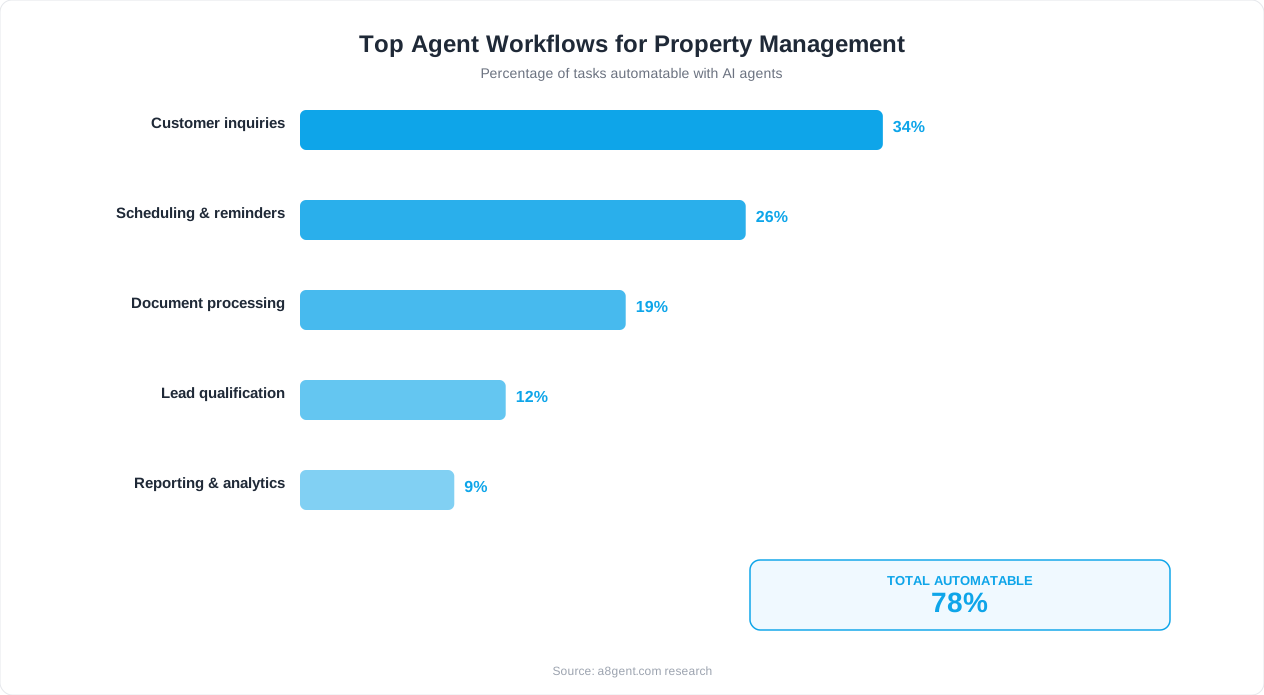
Tenants ask the same questions repeatedly: When is rent due? What is the guest parking policy? How do I submit a maintenance request? Can I have a pet? What are the move-out procedures? An AI agent connected to your property knowledge base answers these instantly - 24/7, without you lifting a finger. After analyzing communication patterns across property management firms, we find that 70-80% of inbound tenant inquiries are answerable from existing policies and documents. The AI handles these automatically. The remaining 20-30% (complex situations, complaints, disputes) get escalated to you with full context so you can respond efficiently.
Lease Renewal Communications
The lease renewal process involves a predictable sequence: 90-day notice, renewal offer, negotiation (sometimes), document generation, and signing coordination. AI agents manage this entire sequence automatically. They send the initial notice at the right time based on lease expiration date, generate renewal offers with your specified terms and rent adjustments, follow up if tenants have not responded within your defined timeline, and route signed documents to your property management system. You only get involved when a tenant wants to negotiate terms or has a question the AI cannot answer.
Move-In and Move-Out Coordination
New tenant onboarding requires: welcome package, key pickup coordination, utility transfer reminders, move-in inspection scheduling, and initial maintenance walkthrough. AI agents send the right information at the right time, schedule inspections with your preferred vendors, and ensure nothing falls through the cracks. The same applies to move-out: reminder sequences about cleaning expectations, forwarding address collection, security deposit timeline communication, and inspection scheduling all happen automatically.
Broadcast and Emergency Communications
When you need to communicate with all tenants - water shut-off for maintenance, parking lot resurfacing schedules, holiday office hours, or emergency weather advisories - AI agents handle multi-channel distribution. They send via email, text, and app notification simultaneously, track who has acknowledged receipt, and follow up with non-responders. During emergencies, they can triage incoming responses and prioritize those needing immediate human attention.
Communication Tone and Personalization
Unlike generic automated systems, modern AI agents adapt their communication style to the context. Professional and formal for lease documents. Friendly and warm for welcome messages. Empathetic and solution-oriented for maintenance acknowledgments. Firm but respectful for late payment notices. This tonal awareness means tenants often cannot tell they are communicating with an AI - the experience feels personal and responsive rather than robotic and generic.
The overall impact: property managers report reducing time spent on tenant communications by 60-75% within the first month of deployment. For a detailed savings estimate based on your specific unit count and communication volume, use our ROI calculator.
AI-Powered Maintenance Management: Triage, Dispatch and Follow-Up
Maintenance coordination is where property management becomes a juggling act. Requests come in at all hours, urgency varies wildly, vendors need scheduling, tenants need updates, and nothing ever resolves as quickly as anyone wants. AI agents bring order to this chaos.
Intelligent Request Triage
When a maintenance request arrives - whether by text, email, portal, or phone transcript - the AI agent immediately: classifies the issue category (plumbing, electrical, HVAC, structural, appliance, pest, cosmetic), assesses urgency based on keywords and context (a "flooding bathroom" gets emergency priority while a "squeaky door" goes to the routine queue), identifies whether it is a tenant responsibility or landlord responsibility based on your lease terms, and determines which vendor or staff member should handle it. This triage process that takes you 5-10 minutes per request happens in seconds, and it happens at 3 AM just as effectively as at 3 PM.
Automated Vendor Dispatch
Once triaged, the AI agent contacts your preferred vendor for that category. It sends the work order with all relevant details (unit number, issue description, tenant contact info, access instructions, urgency level), requests available time slots, and coordinates with the tenant to find a mutually workable appointment time. This vendor-tenant scheduling coordination - the "phone tag" that property managers dread - happens automatically with the AI managing both sides of the conversation.
Tenant Updates and Status Tracking
After dispatch, tenants want updates. "When is the plumber coming?" "Did they order the part?" "How long until it is fixed?" The AI agent provides proactive updates at each stage: request received, vendor assigned, appointment scheduled, work in progress, completion confirmed. It also responds to tenant check-in messages with current status without needing your involvement. This proactive communication reduces follow-up inquiries by 80% and dramatically improves tenant satisfaction scores.
Preventive Maintenance Scheduling
Beyond reactive maintenance, AI agents manage your preventive maintenance calendar: HVAC filter changes, smoke detector battery replacements, gutter cleaning, landscaping schedules, annual inspections, and appliance servicing. They schedule vendors, coordinate access with tenants, and track completion - all on autopilot. This prevents costly emergency repairs (a $200 annual HVAC service prevents a $3,000 compressor failure) while reducing your cognitive load of remembering dozens of recurring tasks across all units.
Cost Tracking and Vendor Performance
The AI tracks every maintenance interaction: response times, completion times, costs, and tenant satisfaction ratings. Over time, this gives you clear data on which vendors perform best, where costs are trending up (indicating potential capital expenditure needs), and which units or systems require the most attention. This data-driven maintenance approach replaces gut-feel decisions with actual performance metrics.
Emergency Protocol Automation
For genuine emergencies - burst pipes, electrical hazards, fire damage, security breaches - the AI activates a pre-configured escalation protocol. It simultaneously contacts emergency services if needed, notifies you directly (bypassing normal queue), dispatches emergency vendors, communicates safety instructions to affected tenants, and documents everything for insurance purposes. This instant, multi-channel response is faster than any individual could coordinate manually during a high-stress emergency situation.
Property managers using AI maintenance coordination through platforms like Autonoly report: average maintenance resolution time reduced by 40%, tenant satisfaction with maintenance increased by 55%, and personal time spent on maintenance coordination reduced by 70%. For operations optimization beyond maintenance, see our operations automation guide.
Automated Rent Collection: Reminders, Escalation and Payment Plans
Rent collection should be the simplest part of property management - money arrives monthly at a predictable time. In reality, it involves chasing, reminding, tracking, and sometimes negotiating. AI agents turn rent collection from a monthly headache into a smooth, mostly-automated process.
The Intelligent Reminder Sequence
Rather than a single "rent is due" email that tenants ignore, AI agents deploy a multi-touch reminder sequence calibrated to each tenant's payment history. For consistently on-time payers: a single courtesy reminder 3 days before the due date. For occasionally late payers: reminders at 5 days before, 1 day before, and on the due date. For chronically late payers: earlier reminders starting 7 days out, with escalating urgency in tone. This personalization means reliable tenants are not pestered while at-risk tenants get the extra nudges they need. The result: late payments typically drop 35-50% within the first two months of deployment.
Multi-Channel Collection
Different tenants respond to different channels. Some check email religiously. Others only respond to text messages. Some need a phone call to take action. AI agents deliver reminders across multiple channels based on what has historically worked for each tenant. If email gets no response within 24 hours, the system escalates to text. If text gets no response, it can trigger a phone notification or even send a physical letter for serious delinquency. This multi-channel approach dramatically increases response rates compared to single-channel collection efforts.
Automated Payment Plan Offers
When a good tenant hits financial difficulty, offering a payment plan retains the tenant (avoiding expensive turnover) and recovers the rent (avoiding write-offs). AI agents can identify candidates for payment plans based on criteria you set: long tenure, previously reliable, first-time delinquency, or communication indicating temporary hardship. The agent automatically offers pre-approved payment plan options, collects agreement, schedules the payments, and monitors compliance. If the tenant fails the plan, it escalates to you for a decision on next steps.
Late Fee Calculation and Application
Late fees vary by jurisdiction, lease terms, and sometimes by grace period day. AI agents calculate and apply late fees automatically based on your configured rules: grace period length, fee amount or percentage, maximum caps, and any jurisdiction-specific regulations. They also communicate the fee to the tenant with a clear breakdown showing how to avoid additional fees. This removes the awkwardness of personally imposing fees and ensures consistent, defensible application across all units.
Delinquency Escalation Protocol
For tenants who do not respond to reminders or break payment plan agreements, the AI follows your escalation protocol: Day 1-5 past due (reminders), Day 6-10 (formal notice with late fee), Day 11-15 (payment plan offer if eligible, otherwise final notice), Day 16+ (escalation to you or your attorney for legal action). Each step is documented with timestamps and delivery confirmations, building a paper trail that protects you legally if eviction becomes necessary. The AI never makes the eviction decision - but it ensures every pre-eviction step is properly executed and documented.
Financial Reporting and Forecasting
The AI tracks all payment data and generates reports: collection rate by property, average days to payment, delinquency trends, seasonal patterns, and projected cash flow for upcoming months. It flags concerning trends early - if a typically reliable building starts showing increasing late payments, it might indicate a local economic issue you should investigate. This forward-looking intelligence helps you make proactive decisions rather than reacting to problems after they have compounded.
Combined with automated reminders, most property managers report their collection rate improves from 92-95% to 97-99% within 90 days of deployment - a significant impact on cash flow predictability and bottom-line revenue.
Best AI Platforms for Property Management (2026)
The right platform depends on your portfolio size, technical comfort, and which aspects of property management you want to automate first. Here are the leading options for AI-powered property management in 2026.
Autonoly - Best All-in-One for Independent Managers ($99-$349/month)
Autonoly offers pre-built property management automation templates covering tenant communication, maintenance coordination, rent collection, and lease management. It connects to AppFolio, Buildium, Rent Manager, and other property management platforms through standard integrations. The non-technical interface means you can deploy your first automation in under 2 hours without any coding. Ideal for: independent property managers and small management companies with 20-200 units who want comprehensive automation without technical complexity.
n8n - Best for Technical Managers Who Want Full Control ($20-$50/month self-hosted)
n8n is an open-source workflow automation platform that gives you complete control over your automation logic. You build workflows visually, connecting your property management software, communication tools, and vendor databases. The learning curve is steeper, but the flexibility is unmatched. You can create highly customized workflows that exactly match your operational procedures. Ideal for: technically comfortable managers or teams with a technical member who want maximum customization at minimal cost.
EliseAI - Best for Large Portfolios ($2-$5/unit/month)
EliseAI is purpose-built for property management, handling leasing inquiries, maintenance requests, and resident communications through AI. Their system is trained specifically on property management conversations and handles prospect-to-lease conversion, resident retention, and maintenance triage. Strong integrations with enterprise property management platforms (Yardi, RealPage, Entrata). Ideal for: large property management companies with 500+ units and institutional portfolios that need a dedicated AI leasing and communications solution.
AppFolio AI - Best for Existing AppFolio Users (included in higher tiers)
If you already use AppFolio for property management, their built-in AI features handle basic communication automation, maintenance triage, and smart workflows within the platform you already know. The advantage is zero integration work - it is built into your existing tool. The limitation is that it only works within AppFolio's ecosystem and offers less flexibility than standalone AI platforms. Ideal for: current AppFolio users who want basic automation without adding another platform to their stack.
How to Choose
Managing under 20 units and technically comfortable: n8n self-hosted for maximum savings. Managing 20-200 units and wanting turnkey automation: Autonoly for its balance of power and simplicity. Managing 200-500 units with a dedicated team: evaluate both Autonoly's growth tier and EliseAI based on which features matter most. Managing 500+ units: EliseAI or a combination platform approach. Already on AppFolio: start with their built-in AI, then add Autonoly for workflows AppFolio does not cover.
Not sure which platform fits your situation? Use our Agent Finder tool to get a personalized recommendation based on your portfolio size, current software, and automation priorities.
AI-Enhanced Tenant Screening and Leasing
Finding and vetting quality tenants is one of property management's highest-leverage activities. A bad tenant costs thousands in damages, legal fees, and lost rent. AI agents accelerate the screening process while reducing the risk of poor decisions or fair housing violations.
Application Processing Automation
When a prospective tenant submits an application, the AI agent immediately: verifies completeness (flagging missing fields before processing), initiates background and credit checks through your preferred screening service, cross-references employment information against stated income, checks rental history references automatically, and compiles all results into a standardized scoring format. What used to take 24-48 hours of back-and-forth happens in 2-4 hours, letting you respond to qualified applicants before they sign somewhere else.
Fair Housing Compliance
AI screening agents apply identical criteria to every applicant, eliminating unconscious bias that can lead to fair housing complaints. The system evaluates every application against the same set of objective criteria (income-to-rent ratio, credit score threshold, rental history, criminal background per your policy) without considering protected characteristics. Every decision is documented with the specific criteria that led to approval or denial, providing a defensible paper trail. This consistency actually reduces legal risk compared to human-only screening where subjective judgments can creep in.
Listing Optimization and Lead Nurturing
Before screening even begins, AI agents help fill vacancies faster. They optimize listing descriptions based on what generates the most qualified inquiries in your market. They respond to initial inquiries within minutes (versus the industry average of 24 hours), answer common questions about the property, schedule showings, and send follow-up messages to interested prospects who have not applied yet. This reduces vacancy time - often the single largest expense in property management - by getting qualified applicants into the pipeline faster.
Showing Coordination
Coordinating property showings is a calendar nightmare - balancing your availability, prospect preferences, current tenant access windows, and travel time between properties. AI agents manage this automatically: they offer available time slots to prospects, confirm appointments with reminders, coordinate access with current tenants (for occupied units), and handle rescheduling when conflicts arise. Self-showing lockbox integrations can even enable fully autonomous showings for qualified prospects, eliminating your physical presence requirement entirely.
Lease Generation and Signing
Once an applicant is approved, the AI generates the lease document using your templates, populated with the correct terms, dates, rent amount, and any negotiated provisions. It sends the document for e-signature, follows up on unsigned leases, collects security deposits and first month's rent, and triggers the move-in onboarding sequence once everything is complete. The entire approved-to-signed process can happen in under 24 hours without you touching a single document.
Market Rent Analysis
AI agents continuously monitor comparable rental listings in your area, tracking asking rents, concessions, and vacancy rates. When a lease renewal approaches, the agent provides data-backed rent adjustment recommendations: how much you can increase while remaining competitive, whether concessions are necessary in the current market, and what comparable units are offering. This data-driven pricing replaces guesswork and ensures you maximize revenue without pricing yourself into extended vacancies.
The combined effect of AI-enhanced leasing typically reduces average vacancy time by 30-45% and improves tenant quality (measured by on-time payment rates) by 15-25%. For a complete view of how leasing automation connects to your broader business operations, explore our automation courses.
Getting Started: Deploy Your First Property Management Agent
Ready to automate your property management operations? Here is the fastest path from reading this to having your first AI agent handling real tasks for your portfolio.
Step 1: Identify Your Biggest Pain Point (10 minutes)
Which daily task consumes disproportionate time or causes the most frustration? For most property managers, it is one of: responding to routine tenant inquiries (same questions, different tenants, all day long), coordinating maintenance requests (the phone tag, the scheduling, the follow-ups), chasing rent payments (reminders, tracking, escalation), or processing applications and leasing (paperwork and coordination). Pick the one that would free up the most time if it disappeared tomorrow. That is your first automation target.
Step 2: Audit Your Current Tools (15 minutes)
List what you currently use: property management software (AppFolio, Buildium, Rent Manager, spreadsheets), communication channels (email, phone, text, portal), maintenance tracking (software, spreadsheets, paper), and payment processing (ACH, checks, online portal). Your AI agent needs to connect to these tools, so knowing your current stack determines which platform will integrate most smoothly.
Step 3: Choose Your Platform (15 minutes)
Based on your portfolio size and pain point: for tenant communication automation, Autonoly with its property management templates is the fastest path. For maintenance coordination, either Autonoly or n8n depending on your technical comfort. For rent collection automation, Autonoly integrates with most payment platforms out of the box. Not sure? Take our assessment for a personalized recommendation.
Step 4: Deploy Your First Workflow (1-3 hours)
For tenant communication: upload your property policies, lease FAQ document, and common responses. Configure the AI to answer routine questions and escalate complex ones to you. Connect to your communication channels (email, portal, text). Test with a few sample questions, then enable for one property as a pilot. For maintenance: configure your vendor list with categories and contact info, set urgency classification rules, connect to your maintenance request intake channel, and test with sample requests. For rent collection: connect your payment platform, configure reminder schedules and escalation rules, set up payment plan criteria, and enable for your next billing cycle.
Step 5: Monitor, Adjust, Expand (Week 1-2)
During the first two weeks, review the AI's actions daily. Check that tenant responses are accurate and appropriately toned. Verify maintenance triage matches your judgment. Confirm rent reminders are going to the right tenants at the right times. Make adjustments - add knowledge base entries for questions the AI could not answer, refine urgency classifications, adjust reminder timing. By week two, the system should be running smoothly with minimal intervention.
Step 6: Scale to Additional Workflows (Month 2)
Once your first workflow proves itself, add the next. Most property managers deploy in this order: tenant communication first (quickest win), then maintenance coordination (biggest time savings), then rent collection (most revenue impact), then leasing automation (longest-term value). Within 60 days, you can realistically have all four core workflows automated, reducing your administrative time by 60-80%.
For a custom deployment roadmap based on your specific portfolio and priorities, use our ROI calculator to project savings and our assessment tool to identify the optimal starting point.
Scaling Your Portfolio with AI: From 20 Units to 200 Without Adding Staff
The real power of AI in property management is not just efficiency - it is leverage. With the right automation, you can grow your portfolio significantly without proportionally growing your team. Here is how property managers are using AI agents to scale.
The Traditional Scaling Problem
Conventional wisdom says one property manager can handle 30-50 units effectively. Beyond that, you need additional staff: another manager, an assistant, a leasing coordinator, or a maintenance dispatcher. Each hire adds $35,000-$55,000 in annual cost plus management overhead. This creates a staircase growth pattern where profits plateau every time you need to add headcount to handle additional units.
The AI-Enabled Scaling Model
With AI agents handling routine communications, maintenance coordination, and rent collection, the unit-per-manager ratio shifts dramatically. Property managers using comprehensive automation report handling 80-150 units solo - a 2-3x increase over the traditional ratio. This means you can grow from 50 to 150 units without hiring a single additional person. The AI acts as your virtual assistant, leasing coordinator, and maintenance dispatcher combined - at a fraction of the cost of any one of those roles.
When You Do Need to Hire
Even with AI, there are inflection points where human additions are necessary. Physical property inspections and walkthroughs still require a person. Complex negotiations (commercial leases, difficult tenant situations) benefit from human judgment and empathy. Legal proceedings require human decision-making and representation. Major capital improvement oversight needs on-site management. The key insight: AI lets you hire for high-judgment roles instead of data-entry and communication roles. Your next hire is a property inspector or capital project manager - not another person answering phones.
Technology Stack for Scale
At scale, your technology stack becomes critical. The combination that property managers report working best at 100+ units: a core property management platform (AppFolio or Buildium for small-mid, Yardi for enterprise), an AI automation layer (Autonoly or similar), integrated maintenance management with vendor networks, digital lease signing and document management, and centralized communication hub that connects all tenant touchpoints. This integrated stack means information flows between systems automatically. A maintenance request creates a work order, dispatches a vendor, updates the tenant, logs the cost, and closes the loop - all without manual data transfer between systems.
Financial Impact of AI-Enabled Scaling
Let us illustrate with real numbers. A property manager at 50 units generating $150/unit in management fees earns $7,500/month gross. Growing to 150 units triples revenue to $22,500/month. Without AI, that growth requires 2 additional staff (~$8,000/month total cost), netting $14,500. With AI automation ($300/month), the same growth costs $300/month, netting $22,200. The difference: $7,700/month in additional profit, or $92,400/year. This is the scaling leverage that AI provides - growth without proportional cost increases.
Maintaining Quality at Scale
The risk with rapid portfolio growth is service quality degradation. AI agents actually help maintain quality at scale because their response time does not degrade with volume (unit 150 gets the same instant response as unit 1), they never forget follow-ups or drop tasks, they apply policies consistently across all units, and they surface exceptions early so you can address problems before they compound. Many property managers find that service quality actually improves after deploying AI because the consistency and speed exceed what they could deliver manually even at smaller scale.
Ready to model the growth potential for your specific situation? Our ROI calculator projects not just cost savings but revenue capacity - showing how many additional units you could manage with AI support and what that means for your bottom line. For a broader understanding of no-code automation capabilities, explore our guide on automating your business without code.
FAQ
Can AI agents handle emergency maintenance requests at night?
Yes. AI agents operate 24/7 and can triage emergency maintenance requests immediately regardless of time. They assess urgency based on keywords and context, contact emergency vendors from your pre-approved list, communicate safety instructions to tenants, and notify you only when your direct involvement is needed. Routine requests received at night are queued for normal business hours while genuine emergencies trigger immediate action.
Will tenants know they are communicating with an AI?
Modern AI agents communicate naturally enough that most tenants cannot distinguish them from a human property manager for routine interactions. However, transparency best practices suggest disclosing AI use in your communication policies. Many managers use a hybrid approach: AI handles initial responses and routine matters under the company name, while complex or sensitive conversations are flagged for personal human follow-up.
How does AI rent collection comply with debt collection laws?
AI rent reminder systems are configured to comply with applicable regulations including timing restrictions, communication frequency limits, and required disclosures. The AI follows your configured rules about when and how often to contact tenants, what language to use, and when to stop automated contact and escalate to legal channels. Always configure your system with guidance from a local attorney familiar with your jurisdiction's landlord-tenant and debt collection laws.
What happens when the AI makes a mistake with a tenant?
AI systems occasionally misclassify requests or provide incorrect information. Good platforms include confidence scoring - the AI only responds autonomously when highly confident, and escalates uncertain situations to you. When errors occur, they are logged for review and the AI learns from corrections. Most managers set up a daily 5-minute review of AI actions during the first month, reducing to weekly spot-checks once accuracy stabilizes above 95%.
Can AI agents work with my existing property management software?
Yes. Leading AI platforms integrate with all major property management software including AppFolio, Buildium, Rent Manager, TenantCloud, and Yardi through API connections. Your existing data, tenant records, and lease information stay in your current system. The AI layer connects on top, reading data it needs and writing back actions it takes. No data migration or system replacement is required.
How much does AI property management automation cost?
Costs range from $20-50/month for self-hosted open-source solutions (requiring technical setup) to $99-349/month for turnkey platforms like Autonoly, to $2-5/unit/month for enterprise solutions like EliseAI. Most independent managers with 20-100 units spend $99-199/month and see ROI within the first month through time savings alone. The break-even point is typically saving 5-8 hours of work per month, which nearly all managers achieve in week one.
Is AI property management suitable for commercial properties?
AI agents work for commercial property management with some configuration differences. Maintenance coordination, vendor management, and communication automation apply directly. Lease management is more complex for commercial (NNN reconciliation, CAM charges, percentage rent) and typically requires more human oversight. Tenant communication is less frequent but often higher-stakes. Most platforms offer commercial-specific templates or can be configured for commercial workflows.
How long does it take to see results from AI automation?
Most property managers see immediate time savings from day one for simple automations like tenant FAQ responses and rent reminders. Maintenance coordination typically shows clear improvement within 1-2 weeks as the AI learns your vendor preferences and triage patterns. Full optimization - where the system handles 60-80% of tasks autonomously with minimal oversight - usually takes 30-45 days of operation and periodic refinement.