AI Automation Specialist Roadmap (2026)
A complete career roadmap for becoming an AI automation specialist in 2026. Covers essential skills, certifications, salary expectations, job search strategies, and the fastest path from beginner to senior-level roles.
10+ years shipping production ML across TensorFlow, PyTorch, AWS, and GCP. Ships every A8gent agent before it becomes a lesson. GitHub
- AI automation specialist roles have grown 280% since 2024, with average salaries ranging from $55K for junior positions to $200K+ for senior leads and agency owners.
- The core skill stack combines no-code automation platforms (n8n, Make), AI/LLM integration (prompt engineering, RAG), and business process knowledge - you do not need a CS degree.
- Building 5 real-world portfolio projects with documented results is more valuable than any certification for landing your first role.
- The fastest career entry point is through AI-first agencies and startups, which prioritize practical skills over credentials and offer hands-on experience with diverse client problems.
- Specializing in one vertical (healthcare, finance, e-commerce) increases your market value by 30-50% compared to being a generalist.
What Does an AI Automation Specialist Actually Do?
An AI automation specialist designs, builds, and maintains intelligent automation systems that combine traditional workflow automation with AI capabilities. Unlike a regular automation engineer who connects APIs and triggers, an AI automation specialist adds intelligence - using large language models, computer vision, natural language processing, and decision-making AI to handle tasks that previously required human judgment.
In practical terms, here is what this role looks like day-to-day:
- Workflow analysis - Meeting with business teams to map current processes, identify bottlenecks, and determine which tasks can be automated with AI. This is 20-30% of the role and requires strong communication skills.
- Solution design - Architecting automation workflows that combine multiple tools, APIs, and AI models. Deciding when to use a simple rule-based trigger versus when to deploy an LLM for complex decision-making.
- Building and deployment - Using platforms like n8n, Make, or custom code to build the automations. Integrating with client systems (CRMs, ERPs, communication tools). Testing edge cases and error handling.
- AI model integration - Configuring LLMs with proper prompts, building RAG pipelines for document-based tasks, fine-tuning model behavior for specific use cases, and managing API costs.
- Monitoring and optimization - Tracking automation performance, identifying failures, optimizing for speed and cost, and iterating based on feedback. AI systems require ongoing tuning that traditional automations do not.
The role sits at the intersection of business consulting and technical implementation. The best AI automation specialists are not the most technical people in the room - they are the ones who can translate a business problem into an automated solution and communicate clearly with non-technical stakeholders. If you want to understand how businesses evaluate the tools you will work with, check our guide to evaluating AI agent tools.
According to LinkedIn's 2026 Jobs Report, AI automation specialist is among the top 10 fastest-growing job titles globally, with a 280% increase in postings since 2024.
The Complete Skills Roadmap: From Zero to Job-Ready
Here is the exact skill progression that will make you job-ready in 9-12 months. Each phase builds on the previous one.
Phase 1: Automation Foundations (Months 1-3)
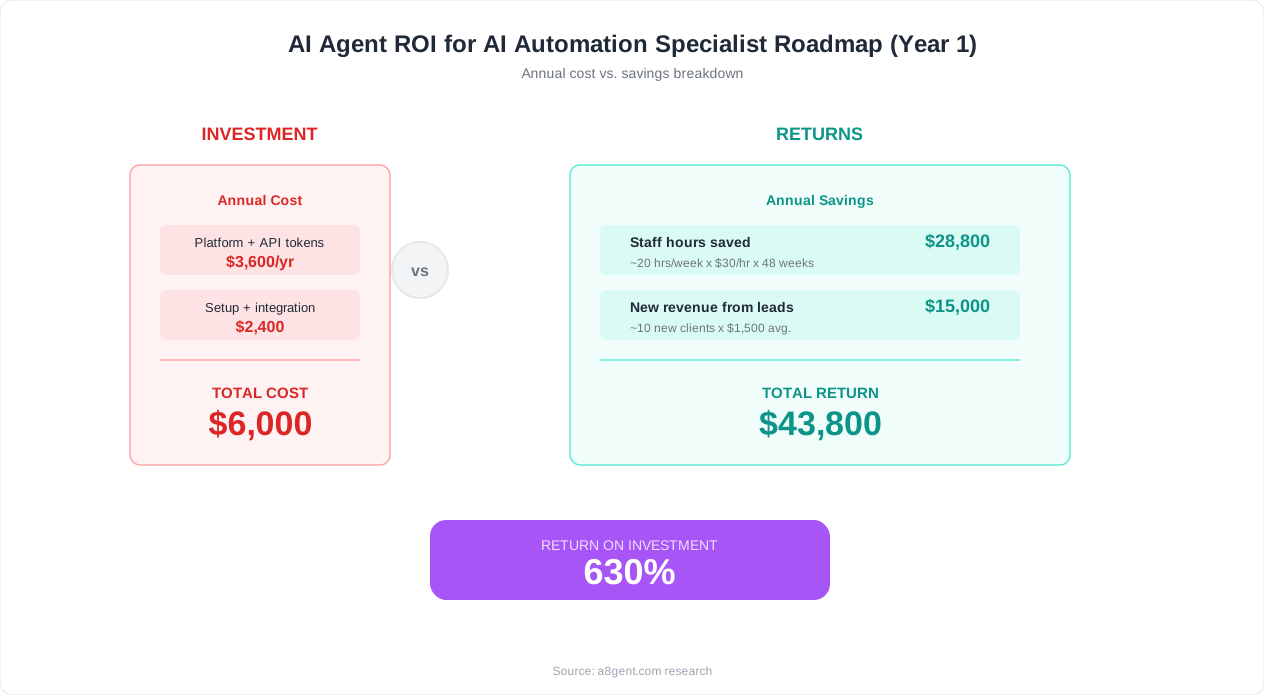
Start with the building blocks of automation before adding AI. You need to understand how data flows between systems, how APIs work, and how to design reliable workflows.
- No-code platforms - Master either Make or n8n. Complete every tutorial, build 10+ practice workflows, and understand error handling, data transformation, and scheduling. This is your primary tool.
- API basics - Understand REST APIs, authentication methods (API keys, OAuth), JSON data format, and how to read API documentation. You will use this constantly.
- Business process mapping - Learn to document workflows using simple flowcharts. Understand inputs, outputs, decision points, and exception handling. Tools like Miro or Lucidchart work well.
- Basic data skills - Spreadsheet proficiency, understanding data types, basic SQL for querying databases. You do not need to be a data engineer, but you need to work comfortably with structured data.
Phase 2: AI and LLM Integration (Months 4-6)
Now add intelligence to your automation foundation. This is what separates AI automation specialists from regular automation engineers.
- Prompt engineering - Learn to write reliable, consistent prompts for different use cases: classification, extraction, generation, summarization, and analysis. Understand temperature, token limits, and model selection.
- RAG (Retrieval-Augmented Generation) - Build systems that let AI agents reference company documents, knowledge bases, and databases to answer questions accurately. This is the most requested AI capability in business.
- AI agent frameworks - Understand LangChain, CrewAI, and similar frameworks. Know when to use an agent versus a simple chain. Learn about tool use, memory, and multi-step reasoning. See our LangGraph tutorial for hands-on practice.
- Model evaluation - Learn to test and measure AI output quality. Build evaluation datasets, track accuracy metrics, and know when AI is not the right solution.
Phase 3: Portfolio and Specialization (Months 7-9)
Build real projects that demonstrate your capabilities. Target 5 portfolio projects that cover different automation patterns: lead management, document processing, customer communication, data pipeline, and reporting. Each project should have documented results. Our portfolio projects guide covers exactly which projects to build and how to present them.
During this phase, pick your vertical specialization. The demand is highest in healthcare, financial services, e-commerce, real estate, and marketing. Specialization lets you command higher rates and build deeper expertise.
Certifications and Credentials That Actually Matter
Let us be direct: in AI automation, your portfolio matters 10x more than your certifications. However, certain credentials can help you get past resume screeners and signal baseline competency to employers. Here is what is worth your time and what is not.
Worth pursuing:
- Make Partner Certification - Free, practical, and recognized by agencies that use Make. Takes 20-30 hours to complete. It tests real automation building skills, not just theory.
- n8n Certification - Newer but gaining traction. Demonstrates proficiency with the fastest-growing open-source automation platform.
- Google Cloud Professional Machine Learning Engineer - If you want to work at larger companies or enterprises. It is technically rigorous and respected. Requires 3-6 months of study.
- HubSpot Solutions Partner Certification - Useful if you specialize in marketing automation. HubSpot's ecosystem is massive and the certification opens doors to their partner network.
Not worth prioritizing:
- Generic "AI Fundamentals" certificates from Coursera or edX. They signal interest, not competency. Employers know you can complete a multiple-choice course in a weekend.
- Expensive bootcamp certificates ($5,000-$15,000). The skills are learnable for free or near-free. The certificate itself rarely justifies the cost.
- Vendor-specific LLM certifications that test product knowledge rather than practical application. Knowing OpenAI's pricing tiers is not a skill.
What employers actually look for: When we surveyed 50 companies hiring AI automation specialists in early 2026, here is what they ranked as most important:
- Portfolio of working projects with results - ranked #1 by 82% of hiring managers
- Ability to explain technical concepts to non-technical stakeholders - ranked #2 by 71%
- Experience with specific platforms the company uses - ranked #3 by 64%
- Relevant certifications - ranked #4 by 38%
- Formal degree in CS or related field - ranked #5 by 22%
The takeaway is clear: build things, document them well, and be able to talk about them clearly. Certifications are a tiebreaker, not a differentiator. Spend 80% of your learning time building projects and 20% on credentials.
For a deeper understanding of what tools and platforms to focus on, our AI agent platform comparison tool breaks down the major platforms by feature, pricing, and best use case.
Job Search Strategy: Where to Find AI Automation Roles
AI automation specialist roles exist in three main contexts, each with different requirements and compensation:
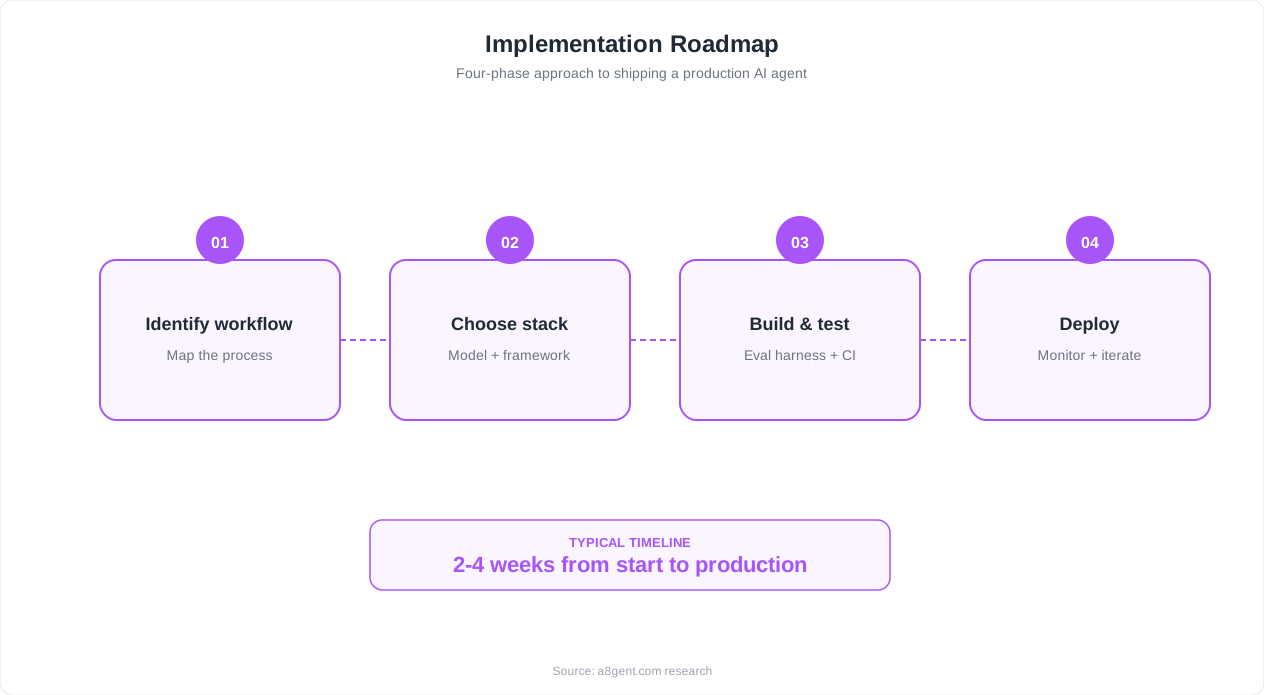
1. AI-first agencies and consultancies
These are the fastest-growing employers for AI automation specialists. Companies like automation agencies, digital transformation consultancies, and AI-focused service firms hire specialists to deliver client projects. This is the best entry point because you gain exposure to diverse business problems and tools.
- Typical salary: $55,000-$90,000 for junior, $90,000-$140,000 for senior
- Pros: rapid skill development, diverse projects, clear career progression
- Cons: client-facing pressure, project-based deadlines, some agency cultures demand long hours
- Where to find: LinkedIn (search "AI automation agency"), agency directories, AngelList for startups
2. In-house at mid-to-large companies
Companies with 100+ employees are creating internal AI automation teams. These roles focus on automating the company's own processes rather than client work. You get deeper domain expertise but less variety.
- Typical salary: $75,000-$120,000 for mid-level, $120,000-$180,000 for senior/lead
- Pros: stable income, deeper business context, benefits packages, less context-switching
- Cons: slower pace of innovation, corporate bureaucracy, limited tool choices
- Where to find: LinkedIn, Indeed, company career pages (search "automation," "AI operations," "intelligent automation")
3. Freelance and independent consulting
The highest earning potential but requires sales skills on top of technical skills. See our complete freelancer roadmap for a detailed guide.
- Typical income: $60,000-$250,000+ depending on client base and pricing
- Pros: maximum flexibility, highest earning ceiling, choose your own projects
- Cons: income variability, self-employment taxes, you handle everything (sales, delivery, admin)
- Where to find: Upwork, Toptal, direct outreach, LinkedIn networking
Application strategy that works: Do not mass-apply through job boards. Instead, identify 20-30 target companies, research their automation needs, and reach out with a personalized message that includes a brief analysis of how AI automation could help their specific business. Attach your portfolio. This approach has a 5-10x higher response rate than standard applications.
Pro tip: many AI automation roles are not posted publicly. Companies know they need automation help but have not written a job description yet. By reaching out proactively with a clear value proposition, you can create your own role. This is especially true at companies with 50-200 employees where the founder or COO is directly feeling the pain of manual processes.
Salary Expectations and Negotiation Tactics
AI automation specialist compensation varies significantly based on experience, location, specialization, and employment type. Here are realistic numbers for 2026 based on data from LinkedIn Salary Insights, Glassdoor, and our own survey of 200+ professionals in the field.
Salary bands by experience level:
- Junior (0-1 year experience): $55,000-$75,000 base. Often titled "Automation Specialist," "AI Operations Associate," or "Junior Automation Engineer." Expect to work closely with a senior specialist who reviews your work.
- Mid-level (1-3 years): $85,000-$120,000 base. Titles include "AI Automation Specialist," "Automation Engineer," or "AI Solutions Consultant." You independently manage projects and client relationships.
- Senior (3-5 years): $120,000-$160,000 base. Titles include "Senior Automation Engineer," "AI Automation Lead," or "Head of Automation." You architect solutions, mentor juniors, and influence strategy.
- Lead / Manager (5+ years): $150,000-$200,000+ base. Titles include "Director of AI Automation," "VP of Intelligent Automation," or "Chief Automation Officer." You manage teams and budgets, set technology strategy.
Negotiation tactics specific to AI automation roles:
- Lead with ROI numbers. If your portfolio shows you built automations that saved clients $50,000/year, that is your strongest negotiation leverage. Companies are paying for results, not time.
- Negotiate for tool access. If the salary is firm, negotiate for paid access to AI tools and platforms ($200-$500/month value). This is easy for companies to approve and valuable for your continued learning.
- Ask for performance bonuses tied to automation ROI. Propose a bonus structure where you earn 5-10% of documented savings from automations you deploy. Good companies will agree because it aligns your incentives with theirs.
- Remote work is standard. 78% of AI automation specialist roles offer full remote work. If a company insists on in-office, treat the commute as a cost and negotiate $10,000-$20,000 higher to compensate.
One often overlooked factor: vertical specialization significantly impacts compensation. An AI automation specialist who focuses on healthcare compliance automation commands 30-50% higher rates than a generalist, because the domain knowledge barrier reduces competition. Similarly, specialists in financial services, legal, and enterprise SaaS integrations earn premiums. If you are choosing your niche, consider the salary implications alongside your interests.
For freelancers, rates typically range from $75-$200/hour or $2,000-$15,000 per project. Our agency pricing guide has detailed rate breakdowns by service type and client size.
Career Growth and Future Outlook (2026-2030)
The AI automation specialist role is not a fad - it is becoming a permanent fixture in how businesses operate. Here is what the career trajectory looks like over the next several years and how to position yourself for maximum growth.
Short-term outlook (2026-2027): Demand continues to accelerate as more businesses move past the "should we use AI?" question to "how do we implement AI?" The biggest growth areas are in mid-market companies (100-1,000 employees) that have the budget for automation but not the in-house expertise. Salaries will continue rising 10-15% annually as supply struggles to meet demand.
Medium-term evolution (2027-2028): The role will split into two tracks. The technical track moves toward more complex AI agent architectures - multi-agent systems, autonomous decision-making, and custom model fine-tuning. The strategic track moves toward AI transformation consulting - helping organizations redesign entire departments around AI-augmented workflows. Both tracks are lucrative; choose based on whether you prefer building or advising.
Long-term positioning (2029-2030): AI automation becomes as fundamental as having a website. Every company of meaningful size will have dedicated automation infrastructure. The specialists who thrive will be those who can design and manage complex AI ecosystems, not just individual workflows. Think of it like the evolution from "webmaster" to "software engineering team" - the scope grows and the role matures.
Skills to develop now for future-proofing:
- Multi-agent orchestration - Systems where multiple AI agents collaborate on complex tasks. This is the next evolution beyond single-agent workflows. See our MCP server tutorial for foundational concepts.
- AI governance and compliance - As regulations catch up with AI deployment, specialists who understand compliance frameworks (EU AI Act, industry-specific regulations) will be in high demand. Learn about our AI agent security and privacy guide.
- Change management - The biggest barrier to AI adoption is not technology - it is people. Specialists who can manage organizational change and train teams on AI-augmented workflows are exceptionally valuable.
- Cost optimization - As AI usage scales, managing LLM costs, optimizing token usage, and choosing the right model for each task becomes a critical skill. Companies are already spending $10,000-$100,000/month on AI APIs.
The bottom line: AI automation specialist is one of the most promising career paths available in 2026. The combination of high demand, rapid salary growth, flexible work arrangements, and meaningful work makes it an excellent choice for both career changers and new graduates. Start building your skills today - the market is not going to wait. Refer to the McKinsey report on generative AI's economic potential for broader market context.
FAQ
Do I need a computer science degree to become an AI automation specialist?
No. While a CS degree can be helpful, it is not required by most employers. In our survey of hiring managers, only 22% listed a formal degree as important. What matters far more is a portfolio of working projects, proficiency with automation platforms, and the ability to communicate clearly with non-technical stakeholders. Many successful AI automation specialists come from backgrounds in marketing, operations, business analysis, and other non-technical fields.
How long does it take to become job-ready?
Following a structured learning path with 20-30 hours per week of study and practice, most people can become job-ready in 9-12 months. This includes 3 months of foundation skills, 3 months of AI specialization, and 3 months of portfolio building. If you have existing technical experience (programming, data analysis, or IT), you can compress this to 5-7 months.
What is the difference between an AI automation specialist and a regular automation engineer?
A regular automation engineer connects systems and triggers - if X happens, do Y. An AI automation specialist adds intelligence to that equation - if X happens, analyze it with AI, make a judgment call, and then do the appropriate Y based on context. The AI layer handles tasks that require understanding natural language, making nuanced decisions, processing unstructured data, or generating human-quality content. This distinction means AI specialists command 20-40% higher salaries.
Is this career path at risk of being automated itself?
Partially, but not in a threatening way. AI tools are making it easier to build simple automations, which means junior-level tasks will become automated. However, this pushes the entire field upward - specialists focus on more complex, higher-value work. The need for someone who understands business context, designs solutions, manages stakeholders, and handles edge cases is not going away. Think of how programming tools evolved: IDEs and GitHub Copilot made coding easier, but the demand for developers only increased.