AI Agent Freelancer Roadmap: From Zero to $10K/Month
A step-by-step roadmap for building a freelance AI automation business from scratch. Learn which skills to develop, how to find clients, what to charge, and how to scale to $10K per month within 12 months.
10+ years shipping production ML across TensorFlow, PyTorch, AWS, and GCP. Ships every A8gent agent before it becomes a lesson. GitHub
- You do not need a computer science degree to freelance with AI agents - most successful freelancers start with no-code platforms like n8n, Make, and Relevance AI and learn on the job.
- The fastest path to $10K/month is specializing in one industry (real estate, e-commerce, or professional services) and offering 2-3 productized automation packages.
- Your first 3 clients will come from direct outreach and free audits, not from inbound marketing - plan to do 50-100 personalized outreaches in your first month of selling.
- Retainer-based pricing ($500-$2,000/month per client) is far more sustainable than project-based work and gets you to $10K/month with just 5-10 clients.
- Building a portfolio of 3 real projects with measurable results is more important than any certification or course completion.
Why AI Agent Freelancing Is the Best Opportunity in 2026
The AI automation freelance market is experiencing something unusual: demand is growing faster than supply. According to Upwork's 2026 Future Workforce Report, AI automation is now the fastest-growing freelance category, with postings up 340% year-over-year. Meanwhile, the number of qualified freelancers has only grown by about 60%.
This supply-demand gap means something very practical for you: businesses are willing to pay premium rates for AI automation help, and they cannot find enough people to do the work. A competent AI agent freelancer charging $100-$200 per hour is not unusual in 2026. That is not because the work is impossibly hard - it is because most people have not learned these skills yet.
Here is what makes this opportunity different from previous tech freelancing waves like web design or social media management:
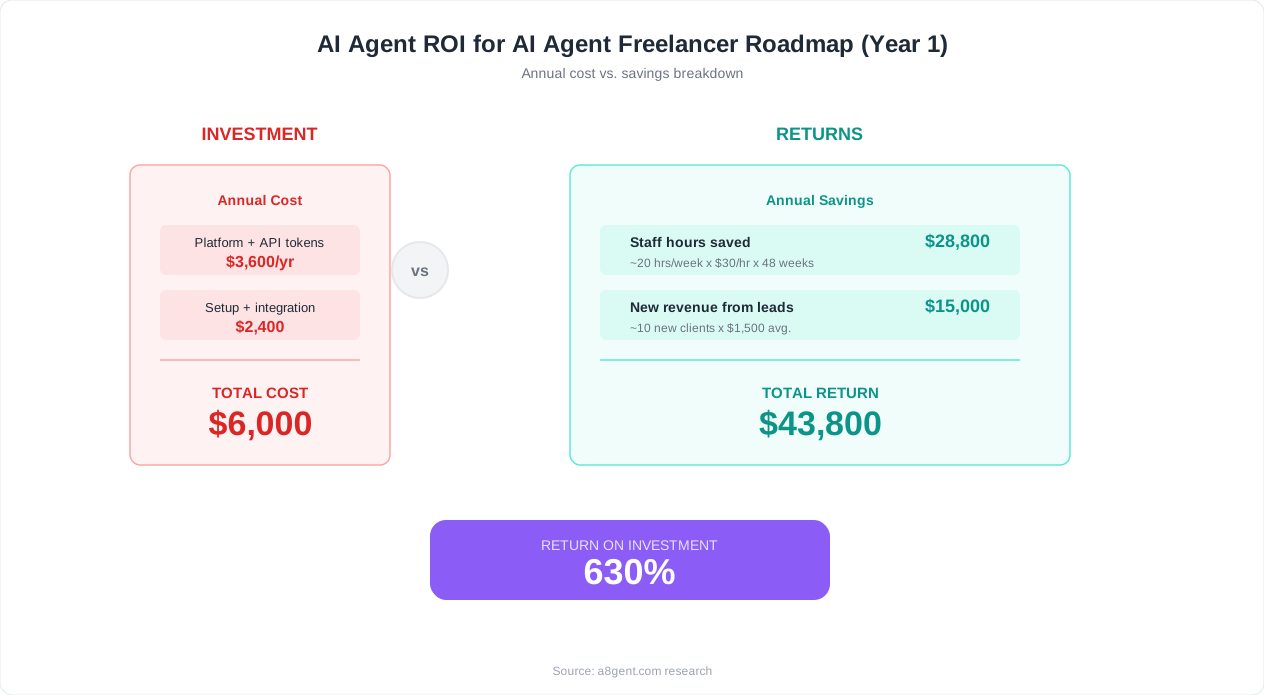
- High ROI for clients - AI automations typically save businesses $2,000-$10,000 per month in labor costs. When you charge $3,000 for a project that saves $5,000/month, clients are eager to pay.
- Recurring revenue built in - AI agents need monitoring, updates, and optimization. This naturally creates retainer relationships worth $500-$2,000/month per client.
- Low competition - Most marketing agencies and IT consultants have not added AI agent services yet. You are not competing against established players.
- No-code tools make delivery fast - Platforms like n8n, Make, and Relevance AI mean you can build and deploy automations in days, not weeks.
The freelancers who are reaching $10K/month are not genius programmers. They are people who learned the tools, picked a niche, and started selling. This roadmap gives you the exact steps they followed. If you want to assess whether your current skills are ready for AI freelancing, take our free readiness assessment first.
Phase 1: Building Your Skills Foundation (Weeks 1-8)
The biggest mistake new AI freelancers make is spending six months taking courses before they touch a real project. You do not need to know everything before you start. You need a working foundation that you build on through practice.
Weeks 1-2: Learn one automation platform deeply. Pick one of these three and commit to it for at least two weeks before trying another:
- n8n - Best if you have some technical background. Open-source, self-hostable, extremely flexible. Free to start.
- Make (formerly Integromat) - Best for visual learners. Drag-and-drop interface with 1,500+ integrations. Free tier available.
- Relevance AI - Best for AI-native workflows. Purpose-built for AI agent creation with built-in LLM integration. See our detailed Relevance AI review.
During these two weeks, complete every tutorial on the platform's website. Build at least 5 practice automations: an email responder, a lead capture workflow, a data sync between two apps, a scheduled report generator, and a chatbot. These will not be portfolio-worthy yet, but they teach you the fundamentals.
Weeks 3-4: Learn AI agent fundamentals. Understand how large language models work at a practical level. You do not need to understand transformer architecture - you need to know how to write effective prompts, when to use different models, and how to handle edge cases. Resources that matter:
- OpenAI's prompt engineering guide (free)
- DeepLearning.AI short courses on LangChain and AI agents (free)
- Our AI Agent Fundamentals course which covers practical deployment patterns
Weeks 5-8: Build three portfolio projects. These projects need to solve real business problems and produce measurable results. Do them for free if you have to - for a friend's business, a local nonprofit, or your own side project. What matters is that each project has a clear before-and-after story with numbers. We cover exactly which projects to build in our portfolio projects guide.
By the end of week 8, you should be able to build a multi-step AI automation workflow in under 4 hours and explain the business value of what you built to a non-technical person. That is your minimum viable skill set for starting to sell.
Phase 2: Landing Your First 3 Clients (Weeks 9-16)
Finding clients is where most technically skilled freelancers get stuck. They build impressive automations but have no idea how to get someone to pay for them. Here is the outreach system that works consistently for AI automation freelancers.
Step 1: Pick a niche. This is non-negotiable. "I do AI automation for anyone" is a recipe for getting zero clients. Pick one of these proven niches to start:
- Real estate agencies - Lead follow-up, listing management, client communication. See our guide on AI agents for real estate.
- E-commerce stores - Order processing, customer support, inventory alerts. See AI agents for e-commerce.
- Marketing agencies - Client reporting, social media, content workflows. See AI agents for marketing agencies.
- Professional services - Appointment scheduling, client onboarding, invoice follow-up.
Step 2: Build your outreach list. Find 100 businesses in your chosen niche using LinkedIn, Google Maps, and industry directories. Look for businesses with 5-50 employees - large enough to have painful manual processes, small enough to make fast decisions.
Step 3: Offer free workflow audits. Your first outreach message is not a sales pitch. It is an offer to audit their current workflows and identify automation opportunities - for free. Here is why this works: it gives you a conversation without asking for money, and once a business owner sees a report showing they are wasting 20 hours per week on manual tasks, they want a solution.
The audit itself is simple. Spend 30 minutes on a call asking about their daily workflows, what tools they use, and where they spend the most time on repetitive tasks. Then create a one-page document showing 3 specific automations you could build, the estimated time savings, and the estimated cost savings. This document is your proposal.
Step 4: Convert audits to paid projects. Of every 10 audits you do, expect 2-3 to convert to paid projects. That means you need to do about 10-15 audit calls to land your first 3 clients. At 3-5 outreach messages per day, you can generate enough audit calls within 2-3 weeks.
For your first clients, keep pricing simple: charge $1,500-$3,000 for a single automation project that takes you 15-25 hours. As you get faster and more experienced, your effective hourly rate will naturally increase. Read our complete pricing guide for detailed rate strategies.
Do not worry about building a website, creating content, or running ads at this stage. Direct outreach is how every successful AI freelancer lands their first clients. Marketing comes later, after you have case studies and testimonials to share.
Phase 3: Productizing Your Services (Months 4-6)
After completing 3-5 client projects, you will notice something: most clients in your niche need the same 2-3 automations. This is your signal to productize - turning custom projects into repeatable packages with fixed pricing.
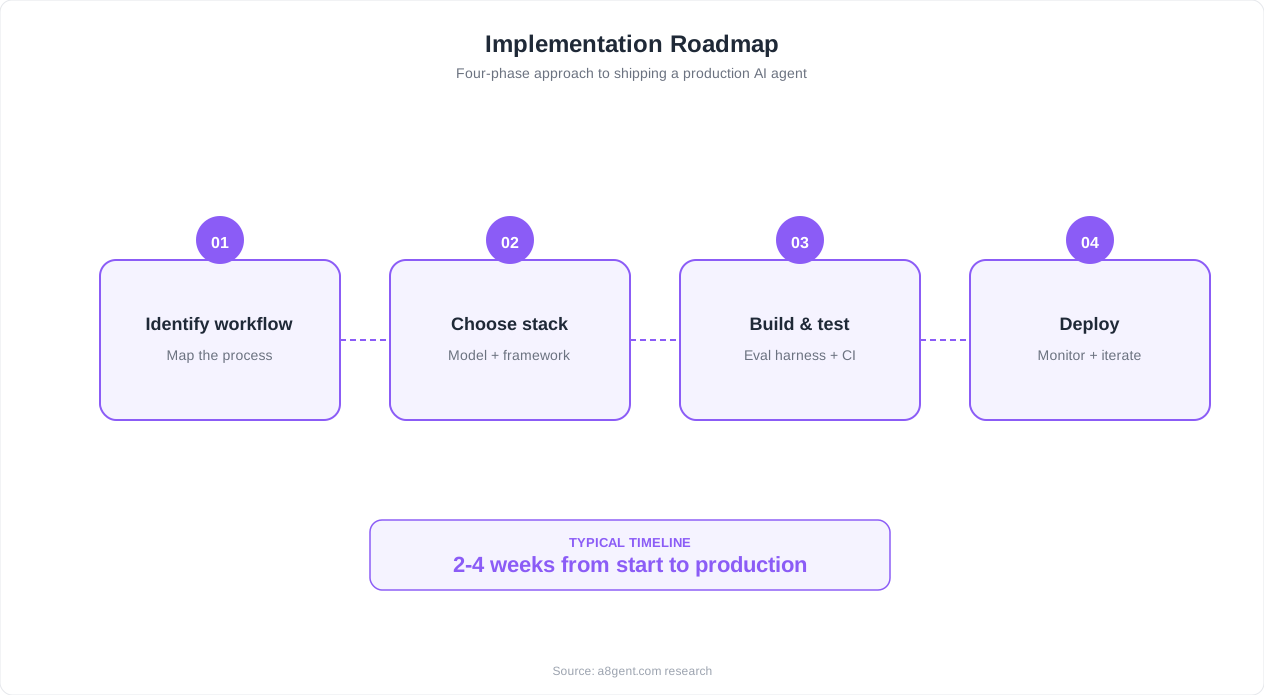
Why productizing matters: Custom projects require discovery calls, custom scoping, and unique builds every time. Productized services let you sell the same solution repeatedly, which means faster delivery, higher margins, and easier sales conversations. Instead of "tell me about your business and I will figure out what to build," you say "here is exactly what I build, here is what it costs, and here are the results my other clients got."
Here is how to create your productized packages:
- Identify your repeatable wins. Look at your completed projects. Which automations delivered the most value? Which were fastest to build? Which got the best client feedback? These become your packages.
- Create 3 tiers. Structure your offerings as Starter ($500-$1,500), Growth ($2,000-$5,000), and Premium ($5,000-$10,000). Each tier adds more automations and integrations. This gives clients a clear path to spend more without a separate sales conversation each time.
- Document your delivery process. Write down every step from kickoff call to handoff. This becomes your internal playbook and ensures consistent quality as you take on more clients. Our client onboarding guide has a complete template you can adapt.
- Build reusable templates. Create base automation templates in your platform that you can clone and customize for each new client. A template that takes 2 hours to customize instead of 15 hours to build from scratch is how you scale.
Adding retainers to your model: The real money in AI freelancing is not one-time projects - it is monthly retainers. After delivering a project, offer a maintenance and optimization retainer for $500-$2,000/month. This includes monitoring automations, fixing issues, adding small improvements, and providing monthly performance reports.
At this stage, your income model should look like this: 1-2 new projects per month at $2,000-$5,000 each, plus growing retainer revenue from past clients. By month 6, most freelancers following this roadmap have $3,000-$5,000/month in retainer revenue alone, with project revenue on top.
If you are looking for proven service packages to model yours after, check out our guide on selling AI automations as a service which includes specific package structures that top freelancers use.
Phase 4: Scaling to $10K/Month (Months 7-12)
The difference between a $5K/month freelancer and a $10K/month freelancer is not skill level - it is systems. At this stage, you know how to build automations and deliver results. What you need now is a predictable way to get clients and a delivery process that does not require you to work 60-hour weeks.
Build your inbound engine. Until now, you have relied on outreach. That works, but it is time-intensive. Start creating content that brings clients to you:
- LinkedIn content - Post 3-5 times per week about your automation projects, results, and lessons learned. Share screenshots of dashboards, before-and-after metrics, and client testimonials. LinkedIn is where business owners spend time.
- Case studies - Write detailed case studies for every completed project (with client permission). These are your most powerful sales tools. Include the problem, solution, and specific results with numbers.
- YouTube walkthroughs - Record short videos showing automations in action. Business owners who see a working demo are 3x more likely to reach out than those who just read about it.
Raise your prices. If you are consistently delivering 5x-10x ROI for clients (saving them $5,000-$10,000/month with a $2,000 project), your prices are too low. Increase project rates by 30-50% and test the market. Most freelancers find that conversion rates barely change because the value proposition is so strong. Refer to the FreshBooks freelancer pricing data for market benchmarks.
The math to $10K/month: Here is what a typical $10K month looks like for an AI automation freelancer:
- 5 retainer clients at $1,000/month = $5,000 recurring
- 1-2 new projects at $2,500-$5,000 each = $2,500-$10,000
- Total: $7,500-$15,000/month
Notice that retainers make up at least half the revenue. This is intentional. Retainer revenue is predictable, requires less sales effort, and compounds over time. Every new project you complete is a potential new retainer client.
Consider subcontracting. Once you hit capacity (typically 8-10 active clients), you have a choice: raise prices further or bring on help. Many freelancers start subcontracting specific tasks to junior automation builders while they handle client relationships and strategy. This is the beginning of transitioning from freelancer to agency owner.
The Essential Freelancer Tool Stack
Your tool stack directly impacts your delivery speed and profit margins. Here is what successful AI automation freelancers use in 2026, organized by function:
Automation platforms (pick 1-2 to master):
- n8n - Best for technical freelancers who want maximum flexibility. Self-hosted option keeps costs low. Free tier plus $20/month for cloud hosting.
- Make - Best for visual workflow building and rapid prototyping. $9-$29/month for most freelance work.
- Relevance AI - Best for AI-native agent workflows. Built-in LLM orchestration saves significant development time. See our platform comparison tool for detailed feature breakdowns.
AI and LLM tools:
- OpenAI API - GPT-4o for most tasks, GPT-4o-mini for high-volume low-complexity tasks. Budget $20-$100/month per client depending on usage.
- Anthropic Claude API - Excellent for longer documents, analysis tasks, and coding assistance. Often preferred for professional services clients.
- Embedding databases - Pinecone or Weaviate for RAG (retrieval-augmented generation) workflows. Essential for chatbots that need to reference company documents.
Business operations:
- Calendly or Cal.com - For scheduling discovery calls and audit sessions. Never go back and forth on scheduling via email.
- Notion or Google Docs - For proposals, project documentation, and client communication. Keep it simple.
- Stripe or PayPal - For invoicing and payment collection. Set up recurring billing for retainer clients.
- Loom - For recording quick walkthrough videos to explain automations to clients. Saves hours of meetings.
Total monthly cost for your tool stack: $50-$150/month for platforms and tools. This is remarkably low overhead for a business generating $5,000-$10,000/month. Your primary investment is time, not money.
One important note: resist the urge to learn every platform. The freelancers who earn the most are specialists in 1-2 tools, not generalists who know a little about everything. Deep expertise in one platform means faster delivery, fewer bugs, and more confident client conversations. You can always expand your stack later as client needs require it.
7 Mistakes That Keep AI Freelancers Stuck Below $5K/Month
After working with hundreds of AI automation freelancers, these are the patterns that separate those who hit $10K/month from those who plateau below $5K:
1. Not niching down. "I automate anything for anyone" sounds flexible, but it makes you invisible to potential clients. A real estate agent searching for automation help will hire "the AI automation specialist for real estate" over "a general freelancer who also does real estate." Pick one niche for at least 6 months before expanding.
2. Underpricing based on hours instead of value. If your automation saves a client 40 hours per month at $30/hour ($1,200/month), charging $500 for the project is leaving money on the table. Price based on the value delivered - 10-20% of annual savings is a common framework. That same project should be priced at $1,500-$3,000.
3. Building before selling. Do not spend 3 months building a "perfect" automation template before you have a single client. Sell first, then build. Your first clients will teach you exactly what the market wants, which is almost never what you assumed.
4. Ignoring retainers. Every project you deliver without offering a retainer is recurring revenue you are leaving behind. AI automations need monitoring, updates, and optimization. Clients expect to pay for this - you just need to offer it.
5. Over-engineering solutions. Clients do not care about elegant architecture. They care about results. A "messy" automation that saves 20 hours per week and runs reliably is infinitely more valuable than a beautifully designed system that is not deployed yet. Ship fast, iterate based on feedback.
6. Not collecting testimonials and case studies. After every successful project, ask for a written testimonial and permission to use the project as a case study. Do this while the client is still excited about results. These are your most powerful sales assets, and most freelancers forget to ask.
7. Trying to do everything yourself forever. At some point (usually around $7K-$8K/month), you hit a ceiling because there are only so many hours in a week. Start documenting your processes so you can eventually delegate the repetitive parts. The transition from solo freelancer to small agency is how you break through that ceiling.
The good news is that these mistakes are all fixable. If you recognize yourself in any of them, adjust course now. The AI automation market is forgiving because demand is so high - even a mediocre sales process can generate consistent income if your delivery is solid. For more on building your client pipeline, read our guide on how to sell AI agents to businesses.
Two companion pieces: the AI automation specialist roadmap if you prefer employment over freelancing, and our honest breakdown of which AI agent course is actually worth it. Freelancers should also skim AI agents for freelancers to automate their own back office first.
FAQ
Do I need to know how to code to freelance with AI agents?
No. The majority of successful AI automation freelancers use no-code and low-code platforms like Make, n8n, and Relevance AI. Basic technical literacy helps (understanding APIs, data formats, and logic flows), but you do not need to write code. That said, knowing Python or JavaScript at a basic level opens up more possibilities and lets you handle edge cases that no-code tools cannot.
How long does it realistically take to reach $10K/month?
For someone following this roadmap consistently (20-30 hours per week), 9-12 months is realistic. Some freelancers hit it in 6 months, especially if they already have a professional network or sales experience. The key variables are how quickly you land your first 3 clients and whether you implement retainers early. The skill-building phase takes 6-8 weeks; the rest is sales and delivery execution.
What should I charge for my first AI automation project?
For your first 2-3 projects, charge $1,000-$2,000 per project. This is below market rate, but it gets you real client experience, testimonials, and case studies. After you have 3 completed projects with measurable results, raise your prices to $2,500-$5,000 per project. By month 6-8, most freelancers are charging $3,000-$7,000 per project depending on complexity.
Which niche is most profitable for AI automation freelancing?
Real estate, e-commerce, and marketing agencies are currently the most profitable niches because they have high transaction volumes, repetitive workflows, and business owners who understand ROI. Professional services (law firms, accounting firms, consulting) are also strong because they have high hourly rates - meaning automation savings are larger in dollar terms. Pick the niche where you have the most existing knowledge or connections.
Should I start a full agency or stay solo?
Stay solo until you hit $7K-$10K/month consistently. Starting an agency too early adds overhead (hiring, management, tools) that eats into the income you are trying to build. Once you have a repeatable service, consistent clients, and documented processes, then consider bringing on a subcontractor for delivery while you focus on sales and client relationships.