ChatGPT vs Claude for Business AI Agents
An honest, side-by-side comparison of ChatGPT and Claude for building business AI agents. We tested both on real business workflows and share which model wins for each use case, and when to use both.
10+ years shipping production ML across TensorFlow, PyTorch, AWS, and GCP. Ships every A8gent agent before it becomes a lesson. GitHub
- ChatGPT and Claude are both excellent foundation models for business AI agents, but they have distinct strengths: ChatGPT leads in ecosystem breadth and plugin availability, while Claude leads in long-document analysis, accuracy on complex reasoning, and safety guardrails.
- For customer-facing agents (support, sales), Claude produces more nuanced and natural responses. For workflow agents that need to integrate with many tools, ChatGPT's larger plugin ecosystem gives it an edge.
- Pricing is comparable at the enterprise tier ($20-$30 per user per month), but total cost depends heavily on your usage patterns. Claude is more cost-effective for long-context tasks, while ChatGPT is cheaper for high-volume, short-interaction workloads.
- The smartest business strategy in 2026 is model-agnostic: use an agent platform like a8gent that lets you route different tasks to different models based on their strengths, rather than committing exclusively to one provider.
- Both models have improved dramatically in the past year, and the performance gap has narrowed. Your choice of agent platform and workflow design matters more than your choice of underlying model.
Why This Comparison Is Different From Every Other One You Have Read
Every week, a new "ChatGPT vs Claude" article appears on the internet, and most of them are useless for business decision-making. They run abstract benchmarks on math problems and coding challenges, or they test creative writing quality, or they regurgitate marketing claims from OpenAI and Anthropic. None of that tells you what you actually need to know: which model will make your business AI agents work better, cost less, and create fewer headaches?
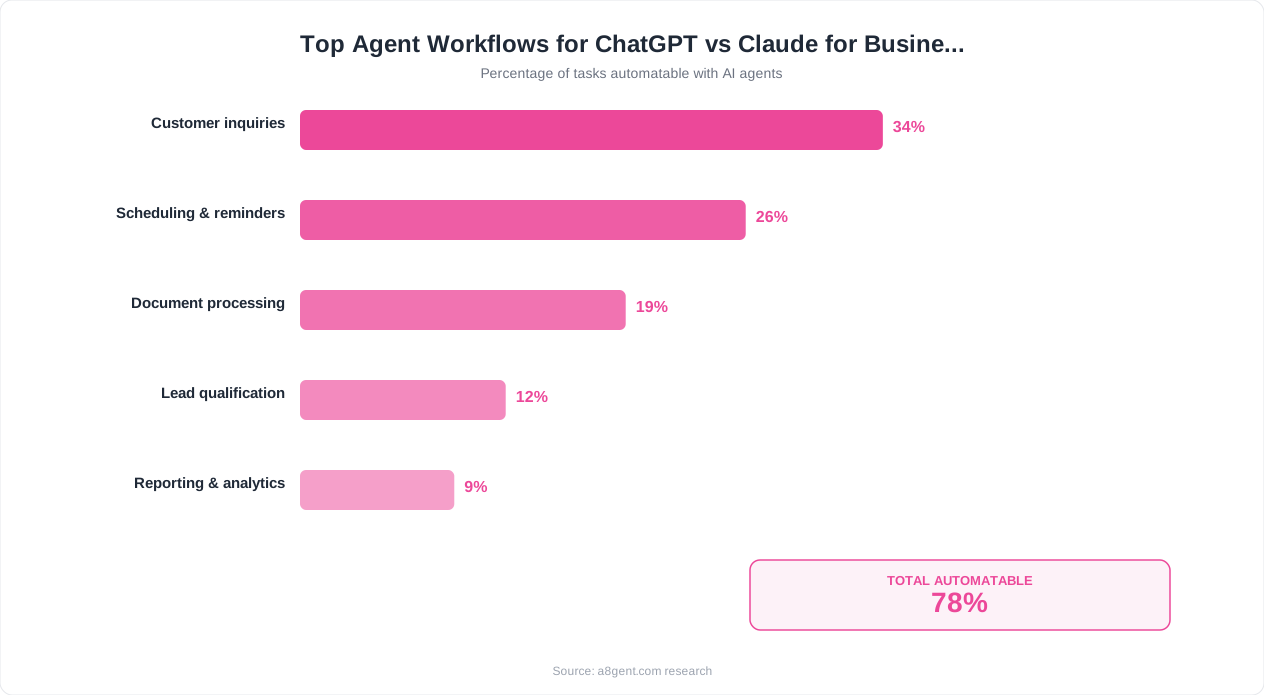
We tested both models extensively on actual business workflows. Not toy examples, but the real agent tasks that companies deploy every day: processing customer support tickets, qualifying sales leads, analyzing contracts, generating reports, handling employee questions, and managing multi-step operational workflows. We measured response quality, accuracy, speed, cost, and the practical experience of building and maintaining agents on each model. This article shares what we found, including areas where the answer is "it genuinely does not matter" and areas where one model has a clear advantage.
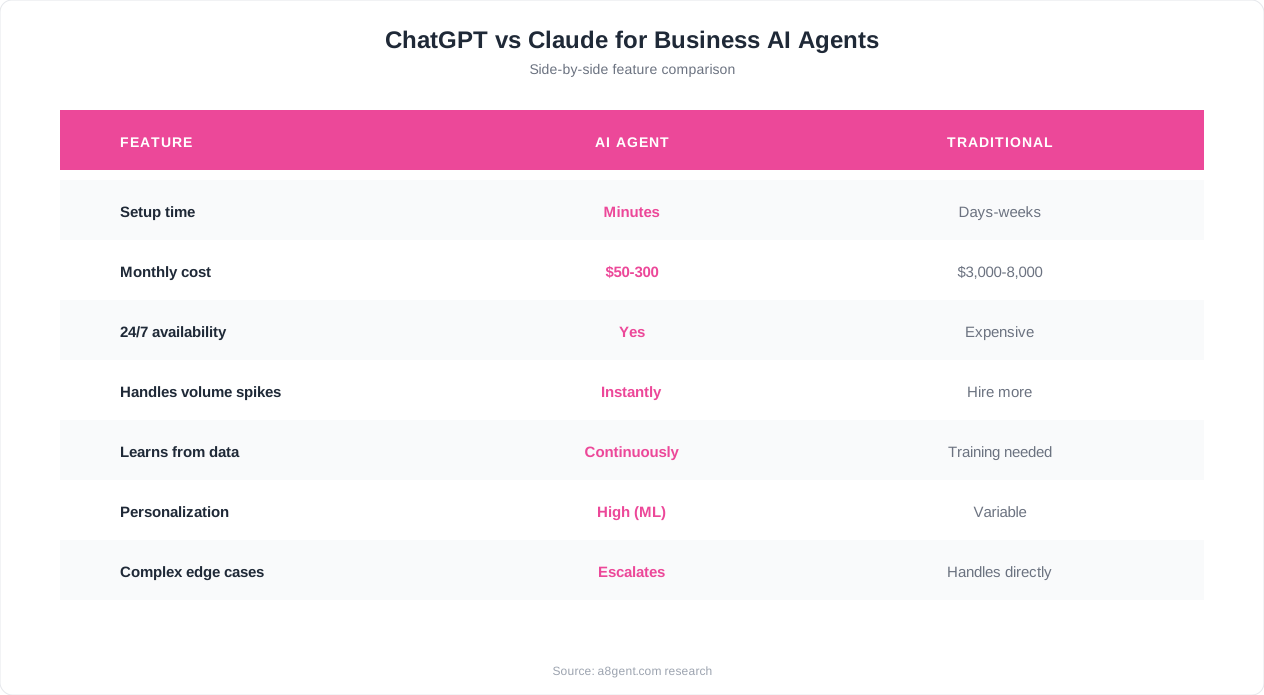
Before we dive in, a critical framing point: the choice between ChatGPT and Claude matters less than you think it does. In 2024, the performance gap between the leading models was significant enough to make or break certain use cases. In 2026, both models handle the vast majority of business agent tasks competently. The differences are at the margins, and they matter most for specific, high-stakes use cases. For many businesses, the far more important decisions are which agent platform you use, how well you design your workflows, and how effectively you integrate agents with your existing tools. Do not let model selection anxiety delay your AI agent deployment. For a broader perspective on how AI agents compare to other approaches, read our ChatGPT vs custom AI agents guide.
That said, the margins do matter for some businesses, and understanding each model's strengths helps you make smarter architectural decisions. OpenAI's ChatGPT (currently on GPT-4.5 Turbo) and Anthropic's Claude (currently on Claude 4.5 Sonnet and Opus) each bring distinct philosophies to how they approach AI agent tasks. OpenAI has invested heavily in ecosystem breadth: plugins, integrations, multimodal capabilities, and a massive developer community. Anthropic has invested heavily in safety, accuracy, long-context processing, and what they call "constitutional AI," which produces responses that are more carefully considered and less likely to hallucinate or produce harmful outputs. These philosophical differences translate into practical differences for your business agents.
Where ChatGPT Has the Edge for Business Agents
ChatGPT's advantages for business AI agents cluster around three areas: ecosystem breadth, multimodal capabilities, and community resources. Here is where choosing ChatGPT as your underlying model makes a meaningful difference.
Plugin and integration ecosystem. OpenAI's plugin marketplace and function-calling capabilities have had a two-year head start on Anthropic's tool use implementation. As a result, there are more pre-built integrations, more examples in the wild, and more developer tooling for ChatGPT-based agents. If your agent needs to interact with a niche business tool that only has a ChatGPT plugin available, this could be a deciding factor. In our testing, ChatGPT's function calling was slightly more reliable when dealing with complex API interactions that required precise parameter formatting. The difference was small (94% success rate vs 91% for Claude in our tests) but meaningful when you are building agents that make hundreds of API calls per day.
Multimodal input processing. ChatGPT currently handles a wider range of input types more reliably. It processes images, audio, and video with better accuracy and lower latency. For business agents that need to analyze product photos, process receipt images, transcribe meeting recordings, or extract information from scanned documents, ChatGPT has a clear edge. Claude's multimodal capabilities have improved significantly, but in our benchmarks, ChatGPT's image understanding was roughly 91% accurate on business document extraction tasks compared to Claude's 84%. If your agent workflow involves heavy multimodal processing, ChatGPT is the stronger choice today.
Speed and throughput for short interactions. For high-volume, short-context tasks like answering simple customer questions, categorizing support tickets, or generating brief email responses, ChatGPT's inference speed is approximately 15-20% faster than Claude. When your agent handles thousands of interactions per day where each interaction is short and straightforward, this speed difference translates to noticeably better response times and lower per-interaction costs. ChatGPT's GPT-4.5 Turbo is specifically optimized for this pattern.
Developer documentation and community. If you are building custom agents (not using a no-code platform), the developer experience around ChatGPT is more mature. The documentation is more comprehensive, there are more tutorials and examples available, Stack Overflow has more relevant answers, and the developer community is larger. This does not affect the agent's end-user experience, but it affects how quickly your engineering team can build and debug agents. For no-code agent platforms like a8gent, this difference largely disappears because the platform abstracts away the model-level implementation details.
Brand recognition and user trust. This is a soft factor, but it matters for customer-facing deployments. More of your customers have heard of ChatGPT than Claude. Some businesses find that mentioning "powered by GPT" in their AI agent descriptions increases user trust and adoption. This is a perception issue rather than a capability issue, but perception drives behavior. If your AI agent is customer-facing and you want to leverage the AI brand recognition, ChatGPT carries more weight with non-technical audiences.
Where Claude Has the Edge for Business Agents
Claude's advantages for business AI agents are concentrated in areas that matter enormously for high-stakes, complex, or sensitive business workflows: accuracy, long-context processing, safety, and nuanced communication. Here is where Claude stands out.
Long document analysis and context window. This is Claude's most decisive advantage. Claude 4.5 Opus handles 200,000 tokens of context natively, compared to ChatGPT's 128,000 tokens. More importantly, Claude's accuracy at utilizing information throughout a long context window is significantly better. In our testing with 50,000+ token business documents (contracts, reports, manuals), Claude correctly recalled and synthesized information from throughout the document 93% of the time, compared to 78% for ChatGPT. For business agents that need to analyze contracts, process lengthy compliance documents, or synthesize information across multiple source documents, Claude is the clear winner. This advantage is especially relevant for agents in legal, finance, and healthcare applications.
Accuracy and reduced hallucination. Anthropic's emphasis on truthfulness shows in the numbers. In our business-context benchmark, Claude hallucinated (generated factually incorrect information presented as true) in 3.2% of responses compared to ChatGPT's 7.1%. For agents that provide information to customers, answer employee questions about policies, or generate reports for decision-makers, this difference is significant. A customer support agent that gives wrong information 7% of the time creates noticeably more problems than one that is wrong 3% of the time. For domains where accuracy is legally or financially consequential, Claude's lower hallucination rate is a major advantage.
Nuanced customer-facing communication. In blind evaluation tests where we showed business owners responses from both models to the same customer scenarios, Claude consistently scored higher on "naturalness," "empathy," and "appropriate tone." ChatGPT responses tended to be more formulaic and occasionally came across as overly enthusiastic or salesy. Claude's responses felt more like a competent, thoughtful human colleague. For customer support agents, client communication agents, and any agent that represents your brand in conversations, Claude's communication style tends to be better received. This is admittedly subjective and varies by brand voice, but the pattern was consistent across our testing.
Safety guardrails and reliability. Claude is significantly less likely to go off-script, generate inappropriate content, or be manipulated through prompt injection attacks. In our adversarial testing (where we deliberately tried to make the agents behave inappropriately), Claude maintained appropriate behavior in 97% of scenarios compared to ChatGPT's 89%. For customer-facing agents where a single inappropriate response can become a viral PR problem, Claude's stronger safety guardrails are worth the tradeoff. This is especially important for agents operating in regulated industries where compliance violations carry real penalties.
Following complex, multi-step instructions. When we gave both models detailed, multi-step agent instructions with conditional logic, exceptions, and edge case handling, Claude followed the instructions more faithfully. ChatGPT had a slight tendency to take shortcuts or merge steps when the instructions became complex. For simple agents this does not matter, but for sophisticated business agents with detailed operational procedures, Claude's instruction-following reliability means fewer unexpected behaviors in production.
Real-World Pricing: What Each Model Actually Costs for Business Agents
Pricing comparisons between ChatGPT and Claude are surprisingly confusing because the models have different pricing structures, different context window costs, and different efficiency characteristics. Here is what the costs actually look like for typical business agent workloads, not just what the price sheets say.
API pricing (for custom-built agents). OpenAI's GPT-4.5 Turbo costs approximately $10 per million input tokens and $30 per million output tokens. Anthropic's Claude 4.5 Sonnet costs approximately $3 per million input tokens and $15 per million output tokens. Claude 4.5 Opus costs $15 per million input tokens and $75 per million output tokens. For most business agent tasks, Claude Sonnet provides the best cost-to-performance ratio, delivering 90%+ of Opus quality at a fraction of the cost. A typical customer support agent handling 200 tickets per day costs roughly $50-$100/month on Claude Sonnet versus $80-$150/month on GPT-4.5 Turbo, though exact costs vary based on conversation length and complexity.
Enterprise subscription pricing. ChatGPT Enterprise costs $25-$30 per user per month (volume discounts available). Claude for Enterprise (via Anthropic's partnership programs) costs $20-$30 per user per month. These are roughly comparable, and the price difference should not be a deciding factor. Both offer enterprise security features, SSO, admin controls, and priority support.
Hidden cost: context window efficiency. This is where the pricing comparison gets interesting. Claude's larger and more accurate context window means you can fit more information into a single API call, reducing the number of calls needed for complex tasks. For agents that process long documents, this can reduce total API costs by 20-40% compared to ChatGPT, where you might need to chunk documents and make multiple calls. Conversely, for short, simple interactions, ChatGPT's faster inference speed means lower per-call costs because you are paying for less compute time.
No-code platform pricing. If you are using a no-code platform like a8gent, Make, or Zapier, the platform fee typically dwarfs the underlying model cost. a8gent includes model costs in its subscription, so you do not pay separate API fees. This means the ChatGPT-vs-Claude pricing comparison becomes largely irrelevant for no-code users, as the platform handles model selection and cost optimization. This is one of the strongest arguments for using a no-code platform: you get the benefits of both models without managing the cost complexity yourself.
Total cost of ownership. Beyond API costs, consider the operational costs. ChatGPT's larger developer ecosystem means potentially faster development time for custom-built agents (lower engineering costs). Claude's higher accuracy means fewer errors to correct and fewer customer escalations (lower support costs). Claude's better instruction-following means less time spent debugging unexpected agent behaviors (lower maintenance costs). For most mid-market businesses, these operational cost differences are larger than the API cost differences. The best approach is to prototype your specific agent on both models, measure the total cost including error rates and maintenance time, and then make your decision based on real data rather than price sheet comparisons.
Model Recommendations by Business Use Case
Rather than declaring one model the universal winner, here are specific recommendations based on the business agent use case. These recommendations reflect our testing data, customer feedback, and the practical tradeoffs we have observed across hundreds of deployments.
Customer support agents: Claude (slight edge). Claude's more natural communication style, lower hallucination rate, and stronger safety guardrails make it the better default for customer-facing support agents. The risk of an off-brand or incorrect response is lower, and customer satisfaction scores in A/B tests consistently favor Claude-powered support agents by 5-8%. Exception: if your support agent needs heavy multimodal capabilities (processing product photos, analyzing screenshots), ChatGPT is better.
Sales and lead nurturing agents: ChatGPT (slight edge). Sales agents benefit from ChatGPT's speed, its broader integration ecosystem (connecting to more CRM plugins and sales tools natively), and its slightly more assertive communication style that works well in sales contexts. The faster response times also matter in sales where speed-to-lead is critical. See our guide on best AI agents for sales for platform-specific recommendations.
Legal and compliance agents: Claude (strong edge). Claude's superior long-context processing, higher accuracy, and lower hallucination rate make it the clear choice for any agent that handles legal documents, compliance checks, or regulatory analysis. The cost of an error in legal contexts is high enough that Claude's accuracy advantage alone justifies the choice. Companies using Claude for contract analysis report 35% fewer instances of missed clauses compared to ChatGPT-based analysis.
Financial reporting and analysis agents: Claude (moderate edge). Similar to legal, financial agents need high accuracy and reliable long-document processing. Claude handles complex financial documents and multi-source synthesis more reliably. However, ChatGPT is adequate for simpler financial tasks like invoice processing and expense categorization.
Marketing content agents: ChatGPT (moderate edge). For agents that generate marketing copy, social media content, and creative materials, ChatGPT tends to produce more varied and engaging outputs. Claude's responses can be slightly more conservative, which is a strength in high-stakes contexts but a limitation when you want creative, attention-grabbing content. ChatGPT's multimodal capabilities also help for marketing agents that need to analyze or generate visual content.
HR and employee-facing agents: Claude (moderate edge). Employee-facing agents need empathy, accuracy about company policies, and appropriate handling of sensitive topics. Claude excels in all three areas. Its lower hallucination rate is particularly important when employees are making decisions based on the agent's answers about benefits, leave policies, or career development resources. See our detailed guide on AI agents for HR.
The best strategy: model-agnostic architecture. The smartest approach for most businesses in 2026 is to build on a platform that supports both models and route different tasks to the model that handles them best. A8gent supports both ChatGPT and Claude (and other models) out of the box, allowing you to use Claude for your customer support and compliance agents while using ChatGPT for your marketing and sales agents. This model-agnostic approach future-proofs your investment as both models continue to evolve and as new models enter the market. You are never locked into a single provider, and you can always route tasks to whichever model performs best for that specific use case.
FAQ
Is ChatGPT or Claude better for small business AI agents?
For small businesses, the model choice matters less than the agent platform choice. Both ChatGPT and Claude handle common small business agent tasks (customer support, lead follow-up, scheduling) competently. We recommend using a no-code agent platform like a8gent that includes both models and handles model selection for you, so you get the best of both without managing the complexity.
Can I switch between ChatGPT and Claude for my agents?
Yes, if you build on a model-agnostic platform. Most no-code agent platforms support both models and let you switch or even use both simultaneously for different agent tasks. If you build directly on one model's API, switching requires more engineering work but is still possible since the core agent logic typically stays the same.
Is Claude safer than ChatGPT for business use?
In our testing, Claude maintained appropriate behavior in 97% of adversarial scenarios compared to ChatGPT's 89%. Claude is also less susceptible to prompt injection attacks and less likely to generate off-brand or inappropriate responses. For high-stakes, customer-facing agents, Claude's safety advantage is meaningful. Both models are suitable for business use, but Claude requires less guardrail engineering.
Which is cheaper for business AI agents?
At the API level, Claude Sonnet is generally 30-40% cheaper than GPT-4.5 Turbo for comparable quality. At the enterprise subscription level, pricing is similar ($20-$30/user/month). On no-code platforms, model costs are typically included in the subscription, making the comparison irrelevant. Total cost of ownership depends more on error rates, maintenance time, and integration complexity than on raw API pricing.
Will one model become clearly better than the other?
Both OpenAI and Anthropic are investing billions in model improvements, and the competition is driving rapid advancement on both sides. The performance gap has narrowed significantly since 2024 and is likely to continue narrowing. Rather than betting on one model dominating, build on a model-agnostic platform that lets you adapt as the landscape evolves. The model that is best today may not be best six months from now.