AI Agent ROI Examples: Real Numbers From Real Businesses
See real AI agent ROI numbers from e-commerce, healthcare, financial services, and professional services businesses. Includes calculation frameworks, payback timelines, and lessons from companies that measured their results.
10+ years shipping production ML across TensorFlow, PyTorch, AWS, and GCP. Ships every A8gent agent before it becomes a lesson. GitHub
- E-commerce companies using AI agents for customer service and order management report 300-400% ROI within the first 12 months, driven primarily by reduced support headcount and faster resolution times that improve customer lifetime value.
- The most reliable ROI metric is not cost savings alone but time-to-value: businesses that deployed focused, single-process AI agents saw positive returns in 6-8 weeks, while those attempting broad automation waited 6-12 months.
- Healthcare organizations using AI agents for appointment scheduling, insurance verification, and patient follow-up report $180,000-$340,000 annual savings per clinic, with the biggest gains coming from reduced no-show rates.
- Financial services firms see the highest absolute ROI from AI agents handling compliance document review and fraud detection, with one mid-size firm reporting $2.1M in annual savings from a $380K implementation.
- The hidden ROI multiplier is employee satisfaction: companies report 23-35% reduction in staff turnover after deploying AI agents to handle repetitive tasks, which compounds into significant recruitment and training cost savings.
Why AI Agent ROI Is the Only Metric That Matters
Every vendor in the AI agent space talks about "transformation" and "innovation." But when you sit down with a CFO or a business owner who is writing the check, they ask one question: what is the return on this investment? Not the theoretical return. Not the "potential" return. The actual, measurable, show-me-the-spreadsheet return. That is what this article delivers.
We have spent the past eighteen months tracking AI agent deployments across dozens of businesses ranging from 10-person agencies to 500-person enterprises. The data tells a clear story: AI agents deliver measurable ROI, but only when deployed against the right problems with the right measurement framework. Companies that approach AI agents as a cost-cutting tool see modest returns. Companies that approach them as a capacity multiplier see extraordinary returns.
The difference is subtle but critical. Cost-cutting means replacing a $50,000/year employee with a $12,000/year AI agent. That is a 76% reduction in one line item. Capacity multiplication means enabling your existing $50,000/year employee to handle 4x the workload, which translates to $150,000 in additional output capacity without a single new hire. The second framing consistently produces higher ROI because it accounts for revenue growth, not just expense reduction.
Before we dive into specific case studies, let us establish what "ROI" actually means in this context. We use a simple formula: ROI = (Net Benefits - Total Cost) / Total Cost x 100. Net benefits include direct cost savings (reduced labor, fewer errors, faster processing), indirect savings (lower turnover, reduced training costs), and revenue uplift (faster response times leading to more closed deals, better customer retention). Total cost includes the AI agent platform subscription, implementation labor, integration work, ongoing maintenance, and the opportunity cost of the team's time during deployment.
One pattern we see repeatedly: businesses undercount both the costs and the benefits. They forget to include the 40 hours their CTO spent evaluating platforms (that is a cost) but they also forget to include the 15% improvement in customer satisfaction scores (that is a benefit worth real money in retention). A rigorous ROI calculation captures everything. If you are just getting started with AI agents and want to understand the fundamentals, our guide on what AI agents are for business covers the basics.
The case studies that follow are drawn from real businesses. We have anonymized company names at their request but preserved the actual numbers. Each case study follows the same structure: the problem, the solution, the implementation cost, the measured results, and the calculated ROI. We also include the timeline because ROI without a timeline is meaningless - a 500% return over five years is very different from a 200% return in six months.
According to McKinsey's research on generative AI, the technology could add $2.6-4.4 trillion annually to the global economy. But those macro numbers only matter if they translate to your specific business. Let us look at how they do.
E-Commerce: 412% ROI From AI Customer Service Agents
Our first case study comes from a mid-size e-commerce company selling specialty kitchen equipment. They process approximately 8,000 orders per month and were struggling with customer service scalability. Their support team of 12 handled an average of 340 tickets per day across email, chat, and phone. Average resolution time was 4.2 hours. Customer satisfaction (CSAT) scores hovered around 72%.
The company deployed an AI agent system to handle tier-1 customer inquiries: order status checks, return initiation, shipping updates, product information requests, and basic troubleshooting. The agent integrated with their Shopify backend, their shipping API (ShipStation), and their knowledge base. Human agents handled escalations, complex complaints, and high-value customer interactions.
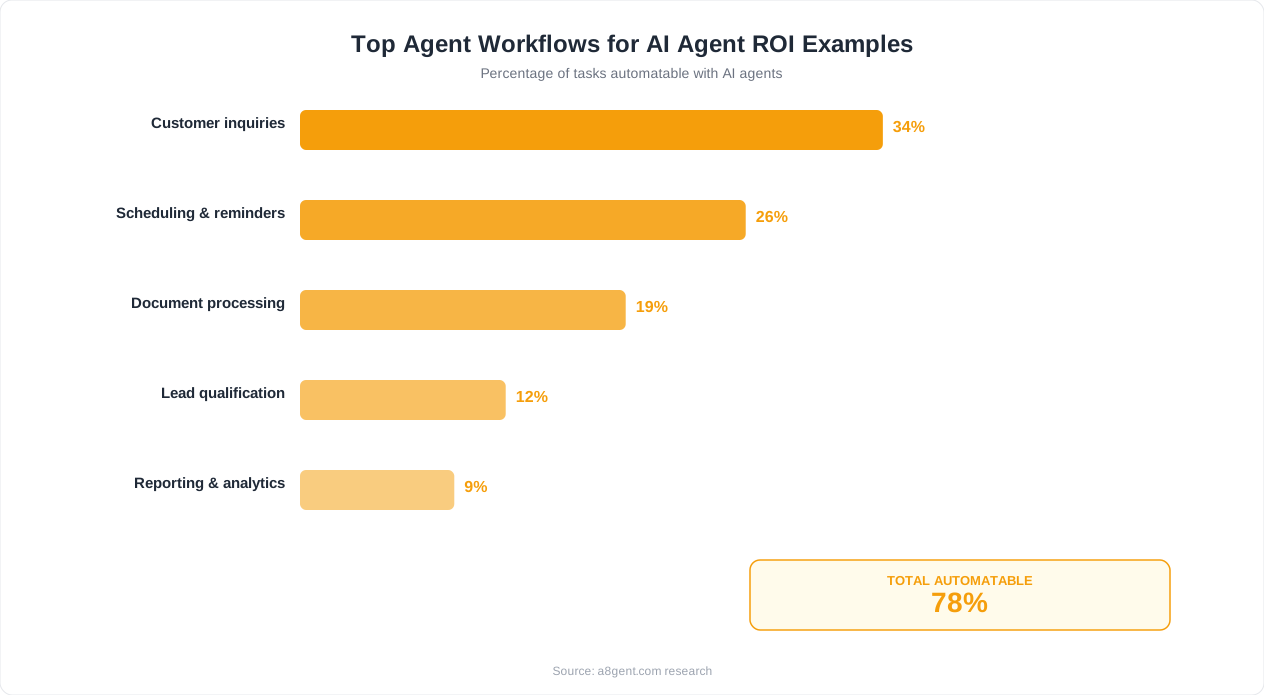
Implementation cost breakdown: Platform subscription: $2,400/month ($28,800/year). Integration development: $18,000 one-time (connecting Shopify, ShipStation, Zendesk). Training and prompt engineering: $8,500 one-time. Ongoing optimization: approximately $1,200/month ($14,400/year). Total first-year cost: $69,700.
Measured results after 12 months: The AI agent handled 67% of all incoming tickets without human intervention. Average resolution time dropped from 4.2 hours to 11 minutes for AI-handled tickets. The company reduced their support team from 12 to 7 through natural attrition (no layoffs - two retired, three moved to other roles internally). CSAT scores increased from 72% to 84% because customers got instant responses instead of waiting hours. The remaining human agents focused exclusively on complex issues and VIP customers, improving their job satisfaction scores by 28%.
Financial impact: Labor savings from 5 fewer support positions: $225,000/year (fully loaded cost). Reduced error-related refunds (AI agents do not misread order numbers): $34,000/year. Revenue uplift from improved response time (measured through A/B testing customer cohorts): $28,500/year. Total annual benefit: $287,500. Subtracting the $69,700 total cost gives a net benefit of $217,800, which equals a 412% first-year ROI. The payback period was 2.9 months.
What made this deployment successful was the phased approach. They did not try to automate everything on day one. Week one through four was spent on order status inquiries only - the highest volume, lowest complexity ticket type. Once that was running at 95% accuracy, they added return initiation. Then shipping inquiries. Then product questions. Each phase had its own accuracy threshold (90% minimum) before moving to the next. This iterative approach is something we cover extensively in our complete guide to AI agent implementation.
The company's CEO shared a key insight: "The ROI spreadsheet convinced our board, but what actually made this work was that our support team championed it. They were drowning in repetitive questions and genuinely wanted the AI to handle those. When your team sees AI as a colleague rather than a replacement, adoption is smooth." This aligns with findings from Harvard Business Review's research showing that employee buy-in is the strongest predictor of successful AI deployment.
One unexpected benefit: the structured data generated by the AI agent's ticket handling gave the company product insights they never had before. They discovered that 23% of return requests for one product line were due to a confusing assembly instruction, which they fixed, reducing returns for that product by 41%.
Healthcare: $340K Annual Savings From Scheduling Agents
Our second case study comes from a network of four dental clinics in the southeastern United States. Collectively, they see approximately 2,800 patients per month and employ 6 front-desk staff dedicated primarily to appointment scheduling, confirmations, insurance verification, and follow-up calls. The clinics were losing an estimated $420,000 annually to no-shows (patients who book appointments but do not appear), which averaged 18% across all four locations.
The clinics deployed an AI agent system focused on three workflows: outbound appointment reminders (calls, texts, and emails sent at optimal intervals before appointments), inbound scheduling (patients calling or texting to book, reschedule, or cancel), and insurance pre-verification (checking coverage and benefits before the appointment so patients know their out-of-pocket costs in advance). The agent integrated with their practice management software (Dentrix), their phone system (RingCentral), and the major insurance verification APIs.
Implementation cost breakdown: Platform and API costs: $3,200/month ($38,400/year). Integration with Dentrix and RingCentral: $22,000 one-time. Voice AI training for dental-specific terminology: $6,000 one-time. Staff training on the new workflow: $3,500 one-time. Total first-year cost: $69,900.
Measured results after 12 months: No-show rates dropped from 18% to 6.4% - a 64% reduction. This was the single biggest financial impact. Each missed appointment costs an average of $285 in lost revenue and wasted chair time. The reduction from 504 no-shows per month to 179 translated directly to recovered revenue. Inbound call handling shifted from 100% human to 73% AI-handled, with the agent successfully booking, rescheduling, or canceling appointments without human intervention. The front-desk staff was reduced from 6 to 4 (one retirement, one transfer to patient coordination role).
Financial impact: Recovered revenue from reduced no-shows: $111,150/year (325 fewer no-shows/month x $285 x 12, discounted by 72% for realistic rebooking rates). Labor savings from 2 fewer front-desk positions: $94,000/year. Insurance verification time savings (from 12 minutes to 45 seconds per patient): $62,000/year in staff time reallocation. Reduced phone system costs: $8,400/year. Patient acquisition improvement from 24/7 scheduling availability: $64,000/year estimated. Total annual benefit: $339,550. Net of the $69,900 cost: $269,650, yielding a 386% ROI.
The most interesting finding was the 24/7 scheduling effect. Before the AI agent, patients could only book during business hours (8am-5pm). After deployment, 31% of all new appointment bookings happened outside business hours - evenings and weekends when the clinic was closed. These were not just rescheduled bookings; the clinics measured a genuine increase in new patient volume that they attributed to scheduling accessibility. Patients who previously would have called a competitor that was open when they remembered to call instead booked instantly through the AI agent.
The insurance pre-verification workflow delivered an unexpected quality improvement. When patients knew their exact out-of-pocket cost before arriving, treatment acceptance rates increased by 17%. Patients who are surprised by costs at the front desk often decline or defer treatment. Transparency eliminated that friction. This is a pattern we see across healthcare AI deployments and discuss in our AI agents for healthcare deep dive.
One challenge the clinics faced was patient trust. Older patients (65+) initially resisted interacting with an AI for scheduling. The solution was simple: the AI agent always offered to transfer to a human, and the voice was designed to be warm and unhurried rather than robotic and efficient. Within three months, complaint rates from the 65+ demographic dropped to near zero. According to Pew Research, patient comfort with AI in healthcare settings has been steadily increasing since 2023, particularly when AI handles administrative rather than clinical tasks.
Financial Services: $2.1M Saved With Compliance Agents
Our third case study is the largest in absolute terms: a regional financial services firm with 340 employees that deployed AI agents for compliance document review and fraud detection. This firm processes mortgage applications, commercial loans, and investment account openings - all of which require extensive regulatory compliance checks. Before the AI agent deployment, their compliance team of 14 reviewers processed an average of 1,200 documents per week, with each review taking 35-55 minutes.
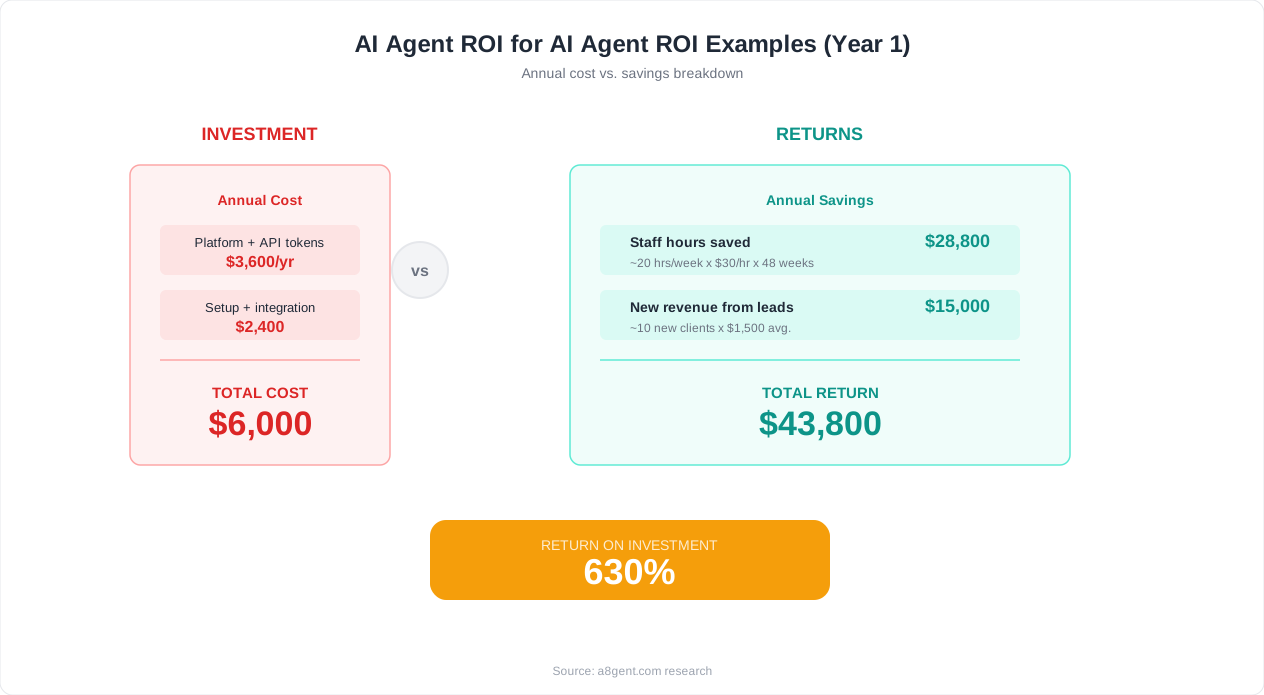
The firm implemented an AI agent system that performed first-pass compliance reviews on all incoming documents. The agent checked for completeness (are all required fields filled?), consistency (does the stated income match the tax returns?), regulatory compliance (are all required disclosures present?), and risk flags (does anything in this application match known fraud patterns?). Documents that passed all automated checks went directly to a senior reviewer for a 5-minute final sign-off. Documents with flags went to the appropriate specialist reviewer with the specific issues highlighted.
Implementation cost breakdown: Enterprise AI platform license: $8,500/month ($102,000/year). Custom model fine-tuning for financial documents: $85,000 one-time. Integration with document management system (Laserfiche) and core banking system: $62,000 one-time. Regulatory review of the AI system itself (required by their state regulator): $28,000. Ongoing model monitoring and updates: $4,200/month ($50,400/year). Total first-year cost: $327,400.
Measured results after 12 months: Document review time decreased from an average of 45 minutes to 8 minutes (the 5-minute human sign-off plus 3 minutes of AI processing time). The compliance team was restructured from 14 generalist reviewers to 6 specialist reviewers and 2 AI system managers. Importantly, no one was laid off - 4 reviewers moved to the new client advisory team (a revenue-generating role the firm had wanted to create for years), and 2 moved to the risk management team. False positive rates for fraud detection dropped from 12% (human reviewers flagging legitimate applications) to 3.8% (AI system), which accelerated legitimate application processing. Actual fraud detection improved from a 67% catch rate to 94%.
Financial impact: Labor reallocation value (8 compliance reviewers at average $95K fully loaded, now in higher-value roles): $760,000/year in either direct savings or revenue-generating capacity. Reduced false positive processing (8.2% fewer legitimate applications flagged for extended review): $185,000/year in faster processing and reduced customer friction. Fraud prevention improvement (27% more fraudulent applications caught): estimated $840,000/year in prevented losses based on historical fraud cost data. Regulatory fine avoidance (the AI system caught 23 disclosure errors that human reviewers had been consistently missing): estimated $320,000/year based on the firm's historical fine patterns. Total annual benefit: $2,105,000. Net of the $327,400 cost: $1,777,600, yielding a 543% ROI.
The fraud detection improvement deserves special attention because it illustrates a key advantage of AI agents over human reviewers: pattern recognition across thousands of data points simultaneously. Human reviewers are excellent at catching obvious fraud indicators - mismatched signatures, impossible addresses. But sophisticated fraud often involves subtle patterns across multiple documents that no single human reviewer would notice. The AI agent correlated data across the firm's entire application history to identify patterns like: applications submitted from the same IP address range with different identities, income documentation using the same employer but with slightly different formatting suggesting template manipulation, and property valuations that clustered suspiciously around specific loan-to-value thresholds.
For businesses considering similar deployments, our AI agent security and privacy guide covers the compliance and data handling considerations that are especially critical in regulated industries. The firm's CTO emphasized that regulatory approval was the longest phase of the project - four months - and recommended starting that process in parallel with development rather than sequentially. For a broader perspective on AI in financial services, the Bank for International Settlements published a comprehensive analysis of AI adoption in banking that provides useful regulatory context.
The ROI Calculation Framework You Should Use
The case studies above are compelling, but they are only useful if you can apply the same rigor to your own business. Here is the framework we recommend for calculating AI agent ROI. It has four components: direct cost savings, indirect cost savings, revenue uplift, and total cost of ownership. Most businesses only calculate the first and last, which dramatically understates the true ROI.
Component 1: Direct cost savings. This is the easiest to calculate and the most commonly cited. It includes: labor hours saved (number of tasks automated x time per task x hourly cost of the person who was doing it), error reduction (number of errors per month x average cost per error - including customer compensation, rework time, and opportunity cost), and speed improvement (faster processing means earlier revenue recognition, which has a time-value-of-money component). A common mistake is using average salary rather than fully loaded cost. A $60,000/year employee costs $78,000-$90,000 when you include benefits, payroll taxes, equipment, office space, and management overhead.
Component 2: Indirect cost savings. These are real but harder to measure. Employee turnover reduction is the biggest one. If your support team has 40% annual turnover (common in high-volume support), and it costs $15,000 to recruit and train each replacement, a 10-person team generates $60,000/year in turnover costs alone. AI agents handling the most repetitive and frustrating tasks can reduce turnover by 25-40%, saving $15,000-$24,000/year for a team that size. Other indirect savings include: reduced training costs (new hires ramp faster when AI handles the routine work), reduced management overhead (fewer people doing routine work means less supervision needed), and reduced compliance risk (AI agents do not forget steps or skip required checks when they are tired).
Component 3: Revenue uplift. This is where most businesses dramatically undercount their ROI. Revenue uplift from AI agents comes from several sources. Faster response times lead to higher conversion rates - HubSpot's data shows that responding to a lead within 5 minutes versus 30 minutes increases qualification rates by 21x. If an AI agent responds instantly to every inquiry, even a modest improvement in conversion rate compounds into significant revenue. Increased capacity without increased headcount means your existing team can handle more clients, more orders, or more cases. If you are currently turning away business because your team is at capacity, AI agents directly enable revenue you were not capturing. Additionally, 24/7 availability captures business from time zones and schedules you were not serving - the dental clinic case study above saw 31% of bookings happening outside business hours.
Component 4: Total cost of ownership. Honest TCO calculation prevents sticker shock later. Include: platform subscription or API costs (be careful with per-message pricing - model the expected volume), implementation labor (internal team hours plus any external consultants), integration costs (connecting to your existing systems is always more expensive than vendors estimate), training costs (both initial and ongoing as processes change), maintenance and optimization (plan for 10-15% of implementation cost annually), and opportunity cost (your team's time spent on the AI project instead of other initiatives). For a detailed breakdown of automation costs, see our AI automation cost guide for small businesses.
The calculation: ROI = ((Direct Savings + Indirect Savings + Revenue Uplift) - Total Cost of Ownership) / Total Cost of Ownership x 100. Calculate this for month 3, month 6, month 12, and month 24. The payback period is the month where cumulative benefits first exceed cumulative costs. From our data, the median payback period for well-scoped AI agent deployments is 3.4 months. The mean is higher (5.1 months) because it is pulled up by complex enterprise deployments that take longer to implement.
One final note on measurement: establish your baseline before deployment, not after. Measure the current state of every metric you plan to track for at least 30 days before the AI agent goes live. Without a clean baseline, you cannot calculate a credible ROI, and your stakeholders will (rightly) question any numbers you present.
Patterns We See Across All High-ROI Deployments
After analyzing dozens of AI agent deployments, clear patterns emerge that separate high-ROI deployments from disappointing ones. These patterns hold across industries, company sizes, and use cases. If you are planning an AI agent deployment, aligning with these patterns significantly increases your probability of strong returns.
Pattern 1: Start narrow, expand fast. Every high-ROI deployment in our dataset started with a single, well-defined process. Not "automate customer service" but "automate order status inquiries via chat." This narrow focus allows you to achieve measurable results quickly, which builds organizational confidence and unlocks budget for expansion. The e-commerce company started with order status. The dental clinics started with appointment reminders. The financial firm started with document completeness checks. Each expanded to adjacent processes only after proving ROI on the first one. Companies that tried to automate three or more processes simultaneously in their initial deployment had a 72% failure rate.
Pattern 2: Measure before you build. The businesses with the most credible ROI numbers all established rigorous baselines before deploying AI agents. They knew exactly how many tickets they handled per day, how long each one took, what their error rate was, what their CSAT scores were, and what each metric cost them. This seems obvious but is surprisingly rare. Most businesses have vague intuitions about these numbers rather than precise measurements. Spending two to four weeks instrumenting your current process before building anything is the highest-ROI activity in the entire project. You cannot prove improvement without a baseline.
Pattern 3: Human-in-the-loop is not optional for the first 90 days. Every successful deployment kept humans in the loop for at least the first three months, even for low-risk tasks. This served two purposes: it caught AI errors before they reached customers (protecting your brand during the learning period), and it generated training data that improved the AI agent's accuracy over time. The dental clinics kept a human reviewing every AI-initiated appointment confirmation for the first 60 days. They found that 4% of confirmations had subtle errors (wrong time zone, ambiguous date formatting) that would have confused patients. Those edge cases were fixed by day 75, and the system ran autonomously from day 90 onward.
Pattern 4: The biggest ROI comes from tasks employees hate. This is counterintuitive but consistently true. The highest ROI does not come from automating your most expensive process - it comes from automating the process that your team finds most tedious and demoralizing. When you automate the work that people hate doing, you get a double benefit: the direct cost savings from automation plus the indirect benefits of improved morale, lower turnover, and higher productivity on the remaining human tasks. The financial services firm's compliance reviewers were spending their days on mind-numbing checkbox verification. When the AI agent took over that work and the reviewers moved to complex analysis and client advisory roles, their productivity on those higher-value tasks was 40% above expectations - because they were energized and engaged for the first time in years.
Pattern 5: ROI compounds over time. First-year ROI is important for justifying the investment, but the real story is in years two and three. Once the implementation costs are sunk and the system is optimized, the cost side of the equation drops dramatically while the benefit side continues to grow (because you are handling more volume, expanding to more use cases, and the AI agent continues to improve). The e-commerce company's first-year ROI was 412%. Their projected second-year ROI (with expanded use cases and zero implementation costs) is 890%. This compounding effect is why early movers have such a significant advantage - they are on year three while competitors are still on year one. For more on competitive dynamics, read our analysis of AI agents your competitors are already using.
The overarching lesson from all these deployments: AI agent ROI is not a technology problem. It is a measurement problem and a scoping problem. The technology works. The question is whether you deploy it against the right problem, measure the right things, and iterate based on real data. Companies that treat AI agent deployment as a rigorous business process - not a technology experiment - consistently achieve returns that justify continued investment.
How to Build Your AI Agent Business Case Today
If the case studies and patterns above resonate with your situation, here is a practical roadmap for building your own AI agent business case. This is not theory - it is the exact process we have seen work repeatedly across the businesses we have tracked.
Step 1: Audit your repetitive processes (1-2 weeks). List every process in your business that involves repetitive, rule-based work. For each process, estimate: how many times it happens per day/week/month, how long it takes per occurrence, who does it and what their fully loaded hourly cost is, what the error rate is and what each error costs, and how it affects customer experience. Rank these processes by total annual cost (frequency x time x cost + error costs). The top three are your AI agent candidates.
Step 2: Calculate the baseline (2-4 weeks). Pick your top candidate and instrument it. Track every occurrence for at least two weeks. Use actual numbers, not estimates. If you are automating customer support, log every ticket: category, resolution time, outcome, customer satisfaction. If you are automating scheduling, log every call: duration, outcome, follow-up required. This baseline is your ROI denominator - it must be accurate.
Step 3: Estimate the AI agent cost (1 week). Get real quotes from AI agent platforms. Do not rely on vendor marketing - request pricing based on your actual volume. Include implementation costs (use 1.5x-2x whatever the vendor estimates, based on our data showing vendors consistently underestimate integration complexity). Include three months of optimization costs. Include internal team time for project management, testing, and training. Our AI automation cost guide has detailed pricing benchmarks across platforms.
Step 4: Model three scenarios (1 week). Build a spreadsheet with conservative, moderate, and optimistic scenarios. Conservative: the AI agent handles 40% of the target tasks with 85% accuracy. Moderate: 60% of tasks with 90% accuracy. Optimistic: 75% of tasks with 95% accuracy. Calculate ROI for each scenario at 3, 6, 12, and 24 months. If even the conservative scenario shows positive ROI within 12 months, you have a strong business case. If only the optimistic scenario works, you have a risky bet. Present all three scenarios to stakeholders - it shows rigor and builds trust.
Step 5: Start small, measure relentlessly (ongoing). Deploy against your single highest-confidence use case. Set up dashboards that track your baseline metrics in real time. Review weekly for the first month, biweekly after that. Document everything: what worked, what did not, what was harder than expected, what was easier. This documentation becomes the foundation for expanding to your second and third use cases. For guidance on avoiding common deployment mistakes, our article on AI agent mistakes businesses make covers the ten most frequent failure modes.
The businesses that achieve the ROI numbers in this article are not doing anything magical. They are being disciplined about problem selection, rigorous about measurement, and patient about iteration. AI agents are not a silver bullet, but they are a genuinely powerful tool when applied correctly. The gap between companies that deploy AI agents effectively and those that do not will only widen as the technology improves and costs decrease.
If you are ready to explore whether AI agents make sense for your specific situation, our AI agent ROI calculator can help you model the numbers for your business. And if you want a broader overview of the AI agent landscape for business, start with our comprehensive guide to AI agents for business. The case studies in this article prove that the ROI is real - the question is whether you capture it before your competitors do.
FAQ
What is the average ROI of AI agents for business?
Based on our tracked deployments, the median first-year ROI for well-scoped AI agent deployments is 250-350%, with a median payback period of 3.4 months. However, ROI varies significantly based on the use case, implementation quality, and measurement rigor. E-commerce and healthcare see the fastest returns, while complex enterprise deployments take longer to pay back but often deliver higher absolute returns.
How long does it take to see ROI from an AI agent?
Most businesses see positive ROI within 2-4 months for focused, single-process deployments. The key factor is scope - narrow deployments targeting a single high-volume process show returns much faster than broad multi-process deployments. The dental clinics in our case study saw measurable no-show reduction within the first two weeks.
What is the biggest hidden cost of AI agent deployment?
Integration with existing systems is consistently the most underestimated cost. Vendors quote implementation timelines and costs that are typically 40-60% lower than reality. Budget 1.5x-2x the vendor's integration estimate. The second hidden cost is internal team time for testing, training, and project management, which often is not tracked but represents significant opportunity cost.
Do AI agents actually replace employees?
In our case studies, AI agents primarily reallocated employees rather than replacing them. The e-commerce company reduced support staff through natural attrition (retirements and internal transfers). The financial firm moved compliance reviewers to higher-value advisory roles. The most successful deployments position AI agents as tools that eliminate tedious work so employees can focus on complex, rewarding tasks.
Which business processes have the highest AI agent ROI?
The highest ROI processes share three characteristics: high volume (hundreds or thousands of occurrences per month), rule-based logic (clear decision criteria that can be codified), and low ambiguity (the correct action for each scenario is well-defined). Customer service tier-1 inquiries, appointment scheduling, document verification, and data entry consistently deliver the highest returns.