How No-Code AI Agents Are Changing Business Operations
No-code AI agents are transforming how businesses operate by letting non-technical teams build autonomous workflows. From customer support to supply chain, here is how real companies are deploying agents without writing code.
10+ years shipping production ML across TensorFlow, PyTorch, AWS, and GCP. Ships every A8gent agent before it becomes a lesson. GitHub
- No-code AI agents have moved beyond simple chatbots to handle complex multi-step business workflows including customer support, lead nurturing, invoice processing, and employee onboarding.
- Companies deploying no-code AI agents report 60-80% reduction in manual task time and average ROI payback within 3-6 weeks, compared to 6-12 months for traditional software implementations.
- The biggest shift in 2026 is that operations managers and business analysts, not developers, are building and deploying AI agents using visual platforms like a8gent, Make, and Zapier.
- No-code AI agents are most effective when deployed for high-volume, rule-based processes that currently require human decision-making at predictable bottlenecks.
- The companies seeing the fastest results start with one high-impact workflow, prove ROI in 30 days, then expand to adjacent processes rather than trying to automate everything at once.
The No-Code AI Agent Revolution Is Already Here
Something remarkable has happened in the last eighteen months. The ability to build sophisticated AI agents, autonomous systems that make decisions, take actions, and complete multi-step workflows, has shifted from the exclusive domain of machine learning engineers to anyone with a clear understanding of their business processes. This is not hype or speculation. It is happening right now in companies of every size, across every industry, and the results are reshaping what "operations" means in a modern business.
According to Gartner's 2026 Technology Adoption Survey, 67% of mid-market companies now use at least one no-code AI agent in their daily operations. That number was 12% in early 2024. The acceleration has been driven by three converging forces: large language models becoming dramatically cheaper to run (GPT-4-class models now cost 95% less than in 2023), no-code platforms building genuinely intuitive visual agent builders, and a critical mass of success stories proving that non-technical teams can build agents that actually work in production.
But what does "no-code AI agent" actually mean in practice? It is not just a chatbot you embed on your website. A no-code AI agent is an autonomous system that you build using visual tools, configure with plain English instructions, connect to your existing business software, and deploy to handle entire workflows independently. It reads incoming emails and categorizes them. It processes invoices and flags anomalies. It follows up with leads on a personalized schedule. It handles employee onboarding paperwork. And it does all of this without you writing a single line of code or being present to supervise every action.
The implications for business operations are profound. Traditional process improvement required hiring consultants, building custom software, training staff on new systems, and waiting months to see results. No-code AI agents compress that timeline to days. An operations manager can identify a bottleneck on Monday, build an agent to address it on Tuesday, test it on Wednesday, and have it running autonomously by Thursday. That is not an exaggeration - it is the reality we are seeing across a8gent's customer base and confirmed by platforms like Make and Zapier.
The companies still treating AI as "something the IT department will figure out eventually" are falling behind rapidly. Their competitors are deploying agents that handle customer inquiries at 3 AM, that follow up with every lead within five minutes, and that process invoices in seconds instead of days. The operational advantages compound over time, and the gap between AI-adopting and AI-ignoring companies is becoming harder to close with each passing quarter. If you are wondering whether your business is ready for no-code AI agents, take our free assessment to find out.
Real Companies, Real Results: No-Code AI Agent Case Studies
Theory is useful, but nothing communicates the power of no-code AI agents like seeing what actual companies have accomplished. These are not hypothetical scenarios or best-case projections. These are documented results from businesses that deployed no-code agents in the past twelve months.
Case Study 1: A 15-person marketing agency eliminates 25 hours per week of manual work. BrightPath Digital, a marketing agency in Austin, was drowning in client reporting. Every Friday, team members spent 4-5 hours per person pulling data from Google Analytics, social platforms, and ad managers, compiling it into reports, and emailing clients. They deployed a no-code AI agent using a8gent that connects to all their data sources, generates client-specific reports with AI-written insights, and delivers them via email every Friday at 9 AM. Total setup time: 3 days. Weekly time saved: 25 hours. Annual savings: approximately $65,000 in billable hours that were previously consumed by reporting. The agent also caught data anomalies that humans had been missing, leading to better campaign optimization for clients.
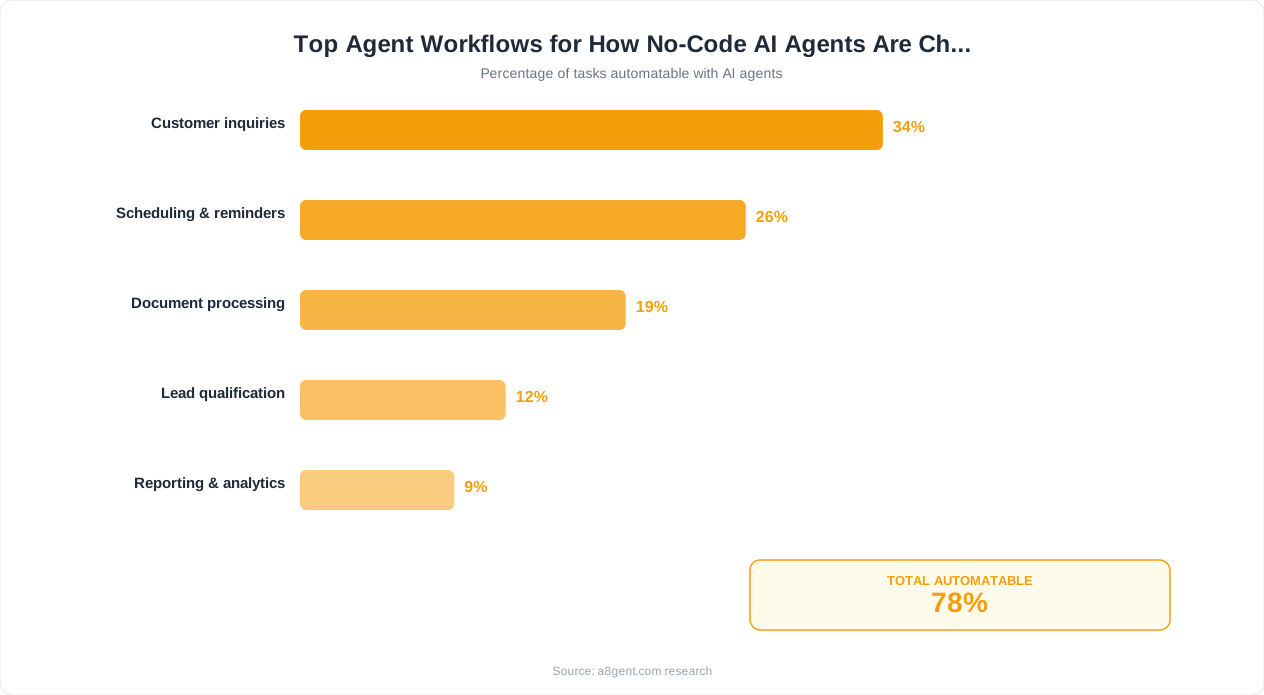
Case Study 2: An e-commerce brand automates 80% of customer support tickets. NaturalGlow Skincare receives approximately 200 customer inquiries per day across email and their website chat. Before deploying AI agents, they had three full-time support representatives handling these tickets. They built a no-code AI agent that handles order tracking inquiries, return requests, product questions from their knowledge base, and basic troubleshooting. The agent resolves 80% of tickets autonomously and escalates complex issues to human agents with full context. Result: they reduced their support team from three to one full-time person (the other two moved to customer success roles), response time dropped from 4 hours average to under 2 minutes, and customer satisfaction scores actually increased by 12% because customers got instant answers.
Case Study 3: A law firm automates client intake and document preparation. Hartfield & Associates, a personal injury law firm with seven attorneys, built a no-code AI agent that handles their entire client intake process. When a potential client calls or submits a web form, the agent collects case details through a conversational interface, checks conflict databases, schedules an initial consultation, sends engagement letters, and prepares a preliminary case summary for the assigned attorney. What previously required a full-time intake coordinator working 8 hours per day now runs autonomously. The firm hired their intake coordinator into a paralegal role and saw their client conversion rate increase by 22% because no leads were falling through the cracks during busy periods. Read more about AI agents for law firms for the full implementation playbook.
Case Study 4: A property management company handles tenant communications at scale. Greenfield Properties manages 340 residential units across six buildings. Tenant maintenance requests, lease renewal reminders, payment reminders, and general inquiries were consuming the equivalent of two full-time employees. They deployed no-code AI agents for each workflow: maintenance requests are logged, categorized by urgency, and routed to the appropriate vendor automatically. Lease renewals trigger a personalized outreach sequence 90 days before expiration. Payment reminders are sent with escalating urgency. The result is that their two administrative assistants now focus on high-touch tenant relationships and property improvements rather than transactional communications. Tenant satisfaction scores improved by 18%, and they manage 40% more units per staff member than before. Check our guide on AI agents for property management for specific workflow templates.
Which Business Operations Are Best Suited for No-Code AI Agents
Not every business process is a good candidate for AI agent automation. The companies that succeed fastest are the ones that pick the right workflows first, prove the concept, and then expand. After analyzing hundreds of successful deployments, we have identified the characteristics that make a process ideal for no-code AI agents.
High volume, predictable patterns. The best candidates are processes that happen frequently and follow recognizable patterns. Customer support tickets that cluster around the same ten questions. Lead follow-up sequences that repeat the same steps for every new prospect. Invoice processing that follows the same validation rules every time. If your team handles the same type of task more than 20 times per week, it is almost certainly a strong candidate for an AI agent. The volume justifies the setup time, and the predictability means the agent can learn the patterns quickly.
Decision-making at known bottlenecks. The most valuable AI agents are not just doing data entry - they are making decisions that previously required human judgment at specific points in a workflow. Should this support ticket be escalated or handled with a standard response? Does this invoice match the purchase order, or does it need review? Is this lead qualified enough for a sales call, or should they receive more nurturing content? These decision points are where no-code AI agents create the most value, because they remove the bottleneck of waiting for a human to make a judgment call.
Cross-system coordination. Many operational inefficiencies exist not because individual tasks are hard, but because information needs to move between multiple systems. A customer places an order in Shopify, inventory needs updating in your warehouse system, a confirmation email needs to go out via your email platform, and the sale needs recording in your accounting software. No-code AI agents excel at this kind of orchestration because they can connect to dozens of business tools through pre-built integrations. Platforms like a8gent and Make offer hundreds of native integrations that make cross-system workflows trivial to set up.
Time-sensitive responses. Any process where speed matters is an excellent AI agent candidate. Lead response time is the classic example: research from Harvard Business Review consistently shows that responding to a lead within 5 minutes makes you 100x more likely to connect than waiting 30 minutes. No human team can consistently respond in 5 minutes around the clock, but an AI agent can. Similarly, customer support tickets, appointment confirmations, and vendor communications all benefit from instant response times that only agents can provide. Read our deep dive on AI-powered sales follow-up for specific response-time benchmarks.
What to avoid automating first. Do not start with processes that require high emotional intelligence (sensitive HR conversations, complex client negotiations), processes where errors have severe consequences with no easy reversal (financial transactions over certain thresholds, legal filings), or processes that change frequently and unpredictably. Start with medium-stakes, high-frequency tasks where mistakes are easily correctable. As you build confidence and your agents prove reliable, gradually expand into more complex territory. The companies that try to automate everything at once almost always fail. The ones that start small and scale methodically almost always succeed.
How to Deploy Your First No-Code AI Agent in 7 Days
We have helped hundreds of businesses deploy their first no-code AI agents, and we have refined the process into a seven-day playbook that works regardless of your industry or technical background. Follow these steps in order, and you will have a working AI agent handling a real business workflow by the end of next week.
Day 1-2: Identify and map your highest-impact workflow. Do not overthink this. Look at your last two weeks and ask: "Where did my team spend the most time on repetitive, predictable tasks?" Common first agents include email triage and response, lead qualification and follow-up, appointment scheduling and reminders, customer FAQ handling, and invoice data extraction. Pick one workflow. Just one. Write down every step in that workflow, including the decisions made at each step and the tools involved. This map becomes the blueprint for your agent. If you need help identifying the right workflow, our assessment tool analyzes your business and recommends the highest-ROI starting point.
Day 3-4: Choose your platform and build the agent. For most businesses, we recommend starting with a8gent because it is purpose-built for AI agents rather than general automation. However, if you already use Zapier or Make extensively, building on your existing platform reduces the learning curve. Connect the relevant integrations (your email, CRM, calendar, etc.), set up the trigger condition (what starts the agent's workflow), define the agent's decision logic using plain English instructions, and configure the actions the agent takes at each step. Most first agents take 4-8 hours to build, including testing. Platform tutorials and templates can cut that time in half.
Day 5-6: Test with real data in shadow mode. Before letting your agent run autonomously, deploy it in shadow mode: the agent processes real incoming data and prepares its actions, but sends them to you for review instead of executing them. This is critical. Review 20-30 agent decisions and compare them to what you or your team would have done. You will typically find that the agent handles 85-90% of cases correctly on the first try. For the remaining 10-15%, refine the agent's instructions. Common adjustments include adding edge case handling, tweaking tone for customer-facing messages, and adjusting decision thresholds.
Day 7: Go live and monitor. Once your shadow mode testing shows 90%+ accuracy, switch the agent to autonomous mode. Set up monitoring alerts for any agent action that falls outside expected parameters (unusually long response, confidence score below threshold, escalation triggered). Check the agent's performance dashboard daily for the first week, then weekly after that. Most agents improve over their first month as you provide feedback and refine instructions based on edge cases that appear in production.
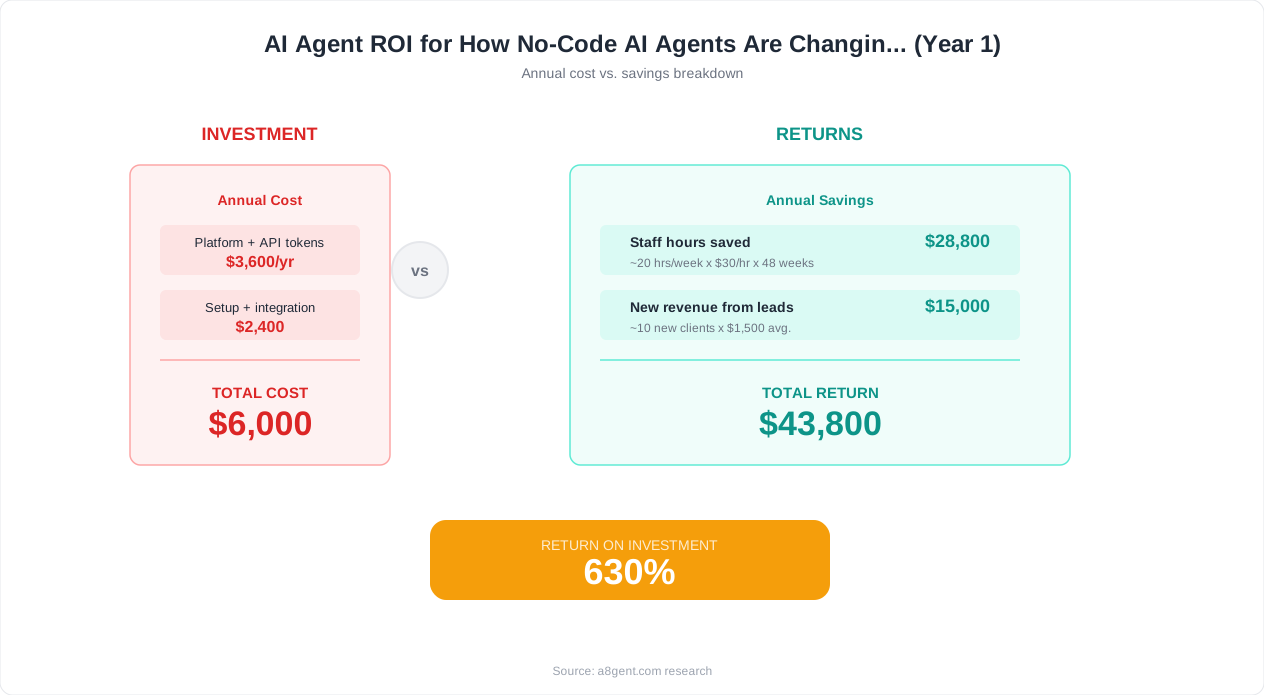
What to expect in the first month. Based on data from hundreds of deployments, here is a realistic timeline. Week one: the agent handles 60-70% of cases autonomously, with you reviewing the rest. Week two: after refinements, autonomous handling rises to 80-85%. Week three: you start to forget the agent is there because it just works. Week four: you begin identifying your second workflow to automate. By the end of month one, most businesses report 10-15 hours per week saved on the automated workflow alone. That is 40-60 hours per month, or roughly $2,000-$5,000 in labor cost savings depending on the role that was previously handling those tasks. Dive deeper into the economics with our AI agent ROI calculator and guide.
Where No-Code AI Agents Are Headed: 2026 and Beyond
The current generation of no-code AI agents is impressive, but we are still in the early innings of this transformation. Understanding where the technology is heading helps you make smarter investment decisions today and positions your business to take advantage of emerging capabilities as they arrive.
Multi-agent collaboration. The next major leap is agents that work together. Instead of a single agent handling one workflow, you will deploy teams of specialized agents that coordinate with each other. A sales agent qualifies a lead, hands it to an onboarding agent that sets up the new customer, which triggers a success agent that monitors engagement and intervenes when churn signals appear. This is already technically possible on platforms like a8gent, and by late 2026 it will be the standard approach. Companies that learn to orchestrate agent teams will have a dramatic operational advantage. See our guide on AI agent implementation for the multi-agent architecture patterns emerging today.
Proactive rather than reactive agents. Today's agents mostly respond to triggers: an email arrives, a form is submitted, a deadline passes. The next generation will be proactive. They will analyze trends in your business data and surface opportunities before you ask. "Your top customer's engagement has dropped 30% this month - should I trigger the retention workflow?" "Three competitors launched similar features this week - here is a competitive analysis and suggested response." This shift from reactive automation to proactive intelligence is going to redefine what a "business operations team" looks like.
Voice and multimodal agents. No-code platforms are rapidly adding voice capabilities. By the end of 2026, building an AI agent that handles phone calls, processes voice messages, and communicates through multiple channels (text, email, voice, video) will be as simple as building a text-based agent today. This opens up entire categories of automation that were previously impossible without custom development: receptionist services, phone-based customer support, voice-driven field worker reporting, and more. For industries like healthcare and real estate where phone communication is still dominant, this will be transformative.
Embedded intelligence everywhere. The long-term trajectory is not "you build agents and deploy them." It is that every piece of business software you use will have agent capabilities built in. Your CRM will not just store contacts - it will autonomously nurture them. Your accounting software will not just record transactions - it will flag anomalies, suggest optimizations, and handle reconciliation. No-code agent platforms like a8gent will evolve from "tools for building agents" to "operating systems for intelligent business processes" that coordinate AI capabilities across your entire software stack.
What to do now. The companies that will benefit most from these future capabilities are the ones building AI agent competency today. Every agent you deploy now teaches your team how to think about automation, builds your institutional knowledge about where AI adds value, and creates data and feedback loops that make future agents smarter. Start small, start now, and scale methodically. The gap between AI-native operations teams and traditional ones is already wide, and it is only going to grow. If you are ready to take the first step, explore a8gent's platform or read our guide on solving your manual task overload with AI.
FAQ
What is a no-code AI agent?
A no-code AI agent is an autonomous software system that you build using visual, drag-and-drop tools without writing any programming code. It connects to your business tools (CRM, email, calendar, etc.), follows instructions you provide in plain English, makes decisions based on defined logic, and executes multi-step workflows independently. Unlike simple automations, AI agents can handle variability, make judgment calls, and adapt their responses based on context.
How much do no-code AI agent platforms cost?
Pricing varies by platform and usage. Zapier AI starts at $20/month for basic automations. Make starts at $9/month with AI capabilities. a8gent starts at $49/month for full AI agent capabilities. Enterprise plans typically range from $200-$500/month. Most businesses report that a single AI agent saves $2,000-$5,000/month in labor costs, making the ROI payback period 1-4 weeks.
Can no-code AI agents handle sensitive business data securely?
Yes, reputable no-code AI agent platforms implement enterprise-grade security including data encryption at rest and in transit, SOC 2 compliance, GDPR compliance, and role-based access controls. Your data is processed through the agent but typically not stored permanently by the platform. Always verify the specific security certifications of your chosen platform, and read our guide on AI agent security and privacy for a complete checklist.
How long does it take to set up a no-code AI agent?
A simple agent (email triage, FAQ responses) can be built in 2-4 hours. A moderately complex agent (lead nurturing with decision logic, customer onboarding workflow) takes 1-3 days. Complex multi-agent systems with extensive integrations take 1-2 weeks. The total time includes mapping your workflow, building the agent, testing in shadow mode, and going live.
Will no-code AI agents replace my employees?
In most cases, no-code AI agents augment your team rather than replace them. They handle the repetitive, time-consuming parts of your employees' roles, freeing those employees to focus on higher-value work that requires creativity, empathy, and strategic thinking. The most common outcome is that employees are redeployed to more impactful roles, not laid off.