How to Sell AI Automations as a Service
Learn how to package, price, and sell AI automation services to business clients. Covers service packaging, pricing models, sales conversations, objection handling, and proven outreach strategies that convert.
10+ years shipping production ML across TensorFlow, PyTorch, AWS, and GCP. Ships every A8gent agent before it becomes a lesson. GitHub
- The most successful AI automation sellers use a free workflow audit as their primary lead generation tool - it converts at 25-35% compared to 2-5% for cold pitches.
- Productized service packages with fixed pricing ($500-$15,000 per tier) outsell custom proposals 3:1 because they reduce buyer decision fatigue.
- Selling outcomes (hours saved, revenue gained) instead of technology (AI agents, LLMs) is the single biggest factor in closing deals with non-technical business owners.
- Monthly retainers ($500-$3,000/month) should be offered at project completion, not as a separate later conversation - timing the offer during peak client satisfaction increases conversion by 3x.
- The best niches for selling AI automations in 2026 are real estate, e-commerce, marketing agencies, and professional services - they have high transaction volumes and clear ROI stories.
How to Package AI Automations Into Sellable Services
The biggest mistake AI automation freelancers make is selling custom work. Every new client means a new discovery process, a new scope, and a new build. This approach caps your income because you are trading time for money with no leverage.
pricing tiers from $500-1.5K for starter to $15-50K+ for enterprise, with monthly retainers at $500-3K" />The solution is productized services - pre-defined automation packages with fixed deliverables and fixed pricing. Here is why this works:
- Faster sales conversations. Instead of "tell me about your business and I will figure out what to build," you say "here are three packages - which fits your needs?" Decision time drops from weeks to days.
- Higher margins. When you build the same automation pattern for the 10th time, it takes you 3 hours instead of 15. But you charge the same price. Your effective hourly rate skyrockets.
- Easier to market. "AI-powered lead follow-up system for real estate agents - $2,500" is a clear value proposition. "Custom AI automation consulting" is not.
How to structure your packages:
Create three tiers. Every pricing psychology study shows that three options maximize revenue because most buyers choose the middle option.
- Starter ($500-$1,500): One core automation workflow. Perfect for clients who want to test AI automation before committing to a larger investment. Example: "Automated lead response system - AI agent responds to new form submissions within 60 seconds with a personalized email."
- Growth ($2,000-$5,000): 3-5 connected automations that solve a complete business problem. This is your most popular package. Example: "Complete lead management system - AI lead scoring, automated follow-up sequences, meeting scheduling, and weekly performance dashboard."
- Premium ($5,000-$15,000): Full department automation with custom integrations, advanced AI features, and white-glove setup. Example: "Full sales automation suite - lead capture, qualification, nurturing, proposal generation, follow-up, CRM integration, and executive reporting."
Each package should include a clear list of deliverables, estimated time savings, and the platforms or tools used. Make it easy for the client to compare tiers and see the value progression. For detailed pricing strategies, see our complete pricing guide.
One important nuance: productized does not mean inflexible. You can customize within a package structure. The package defines the core deliverables and pricing - you adjust the specifics (which CRM, which email platform, industry-specific prompts) for each client. The structure saves time; the customization delivers relevance.
The Sales Conversation Framework That Closes Deals
Selling AI automations to business owners requires a specific approach because most prospects do not understand AI technology - and they do not need to. Your sales conversation should focus entirely on business outcomes.
The PAIN framework for AI automation sales:
P - Problem identification. Start every sales conversation by uncovering the client's specific pain. Do not ask "are you interested in AI automation?" Instead, ask "how many hours per week does your team spend on [specific repetitive task]?" or "what happens when a lead does not get followed up within an hour?" These questions reveal concrete problems that you can solve.
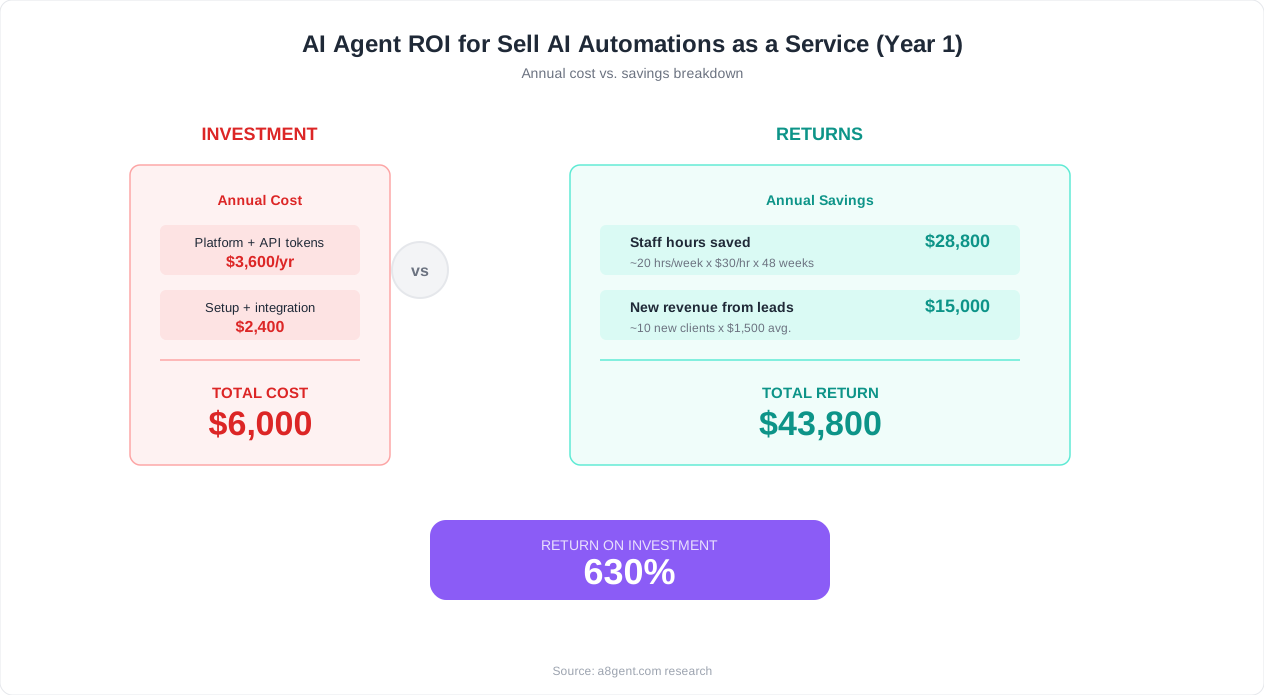
A - Amplify the cost. Once you identify a pain point, help the client understand its full cost. If they spend 20 hours per week on manual data entry, that is 80 hours per month. At $25 per hour, that is $2,000 per month or $24,000 per year in labor costs. Plus the opportunity cost - what could that person be doing instead? This reframing makes your $3,000 project fee look like a bargain.
I - Illustrate the solution. Show (do not tell) what the automation looks like. Use case studies from similar clients, screen recordings of existing automations, or even a quick live demo. Business owners need to see AI automation working to believe it. "Let me show you how this works for another [real estate agent / e-commerce store / marketing agency] just like yours" is one of the most powerful sentences in your sales vocabulary.
N - Next steps with urgency. End every conversation with a clear, specific next step. "I would like to do a free workflow audit for your team next Tuesday at 2pm. I will map your current processes and show you exactly where AI automation can save you the most time and money. Does that work?" This is a low-commitment ask that moves the sale forward.
Phrases that work:
- "This would save your team approximately X hours per week"
- "My clients in [industry] typically see a 5-10x return within the first month"
- "The automation handles the routine work so your team can focus on [high-value activity]"
- "You would not need to change any of your existing tools - this works alongside what you already use"
Phrases to avoid:
- Technical jargon: "LLM," "API integration," "prompt engineering," "RAG pipeline"
- Overpromising: "AI will replace your staff" or "This handles everything automatically"
- Vague value: "This will improve your efficiency" (be specific with numbers)
For a deeper understanding of how to position AI agents versus alternatives that prospects might consider, read our comparison guides on AI agents vs Zapier vs hiring and AI agents vs virtual assistants.
The Free Workflow Audit: Your Best Lead Generation Tool
The free workflow audit is the single most effective strategy for generating AI automation clients. It works better than cold emails, better than content marketing, and better than paid ads. Here is why and how to use it.
Why the free audit works:
- It is a low-risk offer for the prospect - they give 30-45 minutes of their time and get a valuable analysis in return
- It positions you as an expert advisor, not a salesperson
- It gives you the information you need to write a compelling proposal
- It creates reciprocity - the prospect received value from you and feels inclined to reciprocate
- It is a natural filter - only businesses with real automation needs will take you up on the offer
How to offer the audit in outreach:
Here is a proven outreach template that generates 15-25% response rates on LinkedIn and email:
"Hi [Name], I noticed [specific observation about their business - e.g., 'your team handles a high volume of property listings' or 'you are running multiple ad campaigns across platforms']. I help [industry] businesses automate [specific task] with AI agents, typically saving 15-25 hours per week. I would like to offer you a free 30-minute workflow audit where I map your current processes and identify 3 specific automation opportunities with estimated savings. No pitch, no obligation - just a useful analysis you can keep regardless. Would next [day] at [time] work for a quick call?"
Key elements that make this work:
- Personalization - Reference something specific about their business. This takes 2-3 minutes of research per prospect but dramatically increases response rates.
- Specificity - "15-25 hours per week" is more compelling than "significant time savings."
- Low commitment - "30 minutes" and "no obligation" reduce perceived risk.
- Clear value - "3 specific automation opportunities with estimated savings" tells them exactly what they will get.
Outreach volume targets: Plan to send 10-15 personalized outreach messages per day. At a 20% response rate, that generates 2-3 audit calls per day. At a 30% audit-to-client conversion rate, that means 1 new client every 2-3 days. Scale this up or down based on your capacity to deliver projects.
The audit process itself follows the discovery call framework we cover in our client onboarding guide. After the audit, deliver a written summary within 48 hours and schedule a proposal review call. This rapid turnaround signals professionalism and keeps the prospect's attention while their pain points are fresh.
According to Salesforce research on sales effectiveness, value-first outreach methods like free audits generate 4.2x more qualified leads than traditional cold pitching approaches.
Handling the 5 Most Common Sales Objections
Every AI automation sale encounters objections. The good news is that 90% of objections fall into 5 categories, and each has a proven response. Here they are:
Objection 1: "It is too expensive."
This objection means you have not communicated the ROI clearly enough. Respond with: "I understand the investment feels significant. Let me walk through the numbers: your team currently spends [X hours per week] on [task], which costs you [$Y per month] in labor. This automation reduces that to [Z hours per week], saving you [$A per month]. That means the project pays for itself in [B weeks]. After that, the savings are pure profit." Always reframe the price as an investment with a measurable return. For businesses evaluating AI automation costs, our cost guide for small businesses provides helpful context.
Objection 2: "What if it does not work?"
This is a trust objection. Address it with social proof and risk reversal: "Great question. Here is a case study from [similar business] where we implemented the same type of automation and they saw [specific result]. I also offer a satisfaction guarantee - if the automation does not hit the performance targets we define in our scope document, I will refine it at no additional cost until it does." A strong guarantee paired with evidence from similar clients eliminates most risk concerns.
Objection 3: "We tried automation before and it did not work."
Dig deeper: "Can you tell me what you tried and what happened?" Usually, the previous attempt was a generic tool without customization (like setting up Zapier without proper configuration) or a vendor who overpromised. Explain the difference: "What I build is not off-the-shelf software. It is a custom automation designed for your specific workflows, with AI that understands your business context. Plus, I monitor and optimize it after deployment to ensure it keeps performing."
Objection 4: "I need to think about it / discuss with my partner."
This usually means they are interested but not convinced enough to decide now. Respond with: "Absolutely, take the time you need. Would it be helpful if I sent over a one-page summary of the automation plan with the ROI projections? That way you have something concrete to review together. And I am happy to jump on a brief call with your [partner/team] to answer any questions they might have." Then schedule a specific follow-up: "How about I check in on [day]?"
Objection 5: "Can AI really handle this? Our processes are complex."
Acknowledge the complexity, then pivot to specifics: "You are right that not everything can be automated. That is exactly why I start with an audit - to identify which parts of your process are automation-ready and which need to stay manual. In most cases, 60-80% of the repetitive steps can be automated while keeping human oversight on the complex decisions. The goal is not to replace your team - it is to free them from the tedious work so they can focus on the parts that actually require their expertise." Direct them to our guide on what AI agents can actually do for business for additional context.
The overarching principle for objection handling: never argue or get defensive. Acknowledge the concern, empathize, and then provide specific evidence or a concrete next step that addresses it. The best salespeople treat objections as opportunities to deepen the conversation, not obstacles to overcome.
Best Niches for Selling AI Automations in 2026
Not all niches are equally profitable for AI automation services. The best niches have three characteristics: high volume of repetitive tasks, clear financial ROI, and business owners who are willing to invest in technology. Here are the top niches ranked by opportunity.
1. Real Estate Agencies (Highest opportunity)
Real estate agents drown in repetitive tasks: lead follow-up, listing management, client communication, document preparation, and showing coordination. A single AI automation package can save an agent 15-25 hours per week. The industry is also highly competitive, which means agents are motivated to adopt tools that give them an edge. Average project value: $2,500-$7,500. Read our detailed guide on AI agents for real estate.
2. E-commerce Stores
E-commerce businesses process high volumes of orders, customer inquiries, inventory updates, and marketing tasks daily. AI automations for customer support (reducing ticket volume by 40-60%), inventory alerts, order processing, and personalized marketing campaigns deliver immediate, measurable ROI. Average project value: $3,000-$10,000. See AI agents for e-commerce.
3. Marketing and Digital Agencies
Agencies have a unique pain point: they serve multiple clients with similar workflows. An AI automation that automates client reporting, social media scheduling, content creation, and campaign optimization can be deployed across their entire client base. This means your automation multiplies in value. Average project value: $3,000-$8,000. See AI agents for digital marketing agencies.
4. Professional Services (Law Firms, Accounting, Consulting)
High hourly rates in professional services mean that automation savings are larger in dollar terms. Automating document processing, client intake, appointment scheduling, and billing follow-ups for a law firm where associates bill at $200-$400/hour creates enormous ROI. Average project value: $5,000-$15,000. See our guides on AI agents for law firms and AI agents for accounting.
5. SaaS Companies
SaaS businesses have sophisticated tech stacks and are comfortable with automation. They need AI agents for customer onboarding, support ticket routing, churn prediction, and user engagement automation. The sales cycle is often faster because decision-makers understand technology. Average project value: $5,000-$20,000. See AI agents for SaaS companies.
Niche selection strategy: Choose the niche where you have the most existing knowledge, connections, or experience. A former real estate agent selling AI automations to real estate agencies will always outsell a generalist because they speak the language, understand the workflows, and have credibility. If you do not have industry experience, pick the niche that interests you most and invest 2-3 weeks learning the industry before you start selling.
Building Recurring Revenue With Retainers
One-time projects are how you start. Monthly retainers are how you build a sustainable business. Every AI automation you deploy needs ongoing monitoring, optimization, and occasional fixes - this is your natural path to recurring revenue.
Why retainers are essential:
- Predictable income. Ten clients on $1,000/month retainers is $10,000 in guaranteed monthly revenue before any new project work. This stability changes how you run your business.
- Lower sales costs. Acquiring a new client costs 5-10x more than keeping an existing one. Retainers keep clients in your ecosystem without constant reselling.
- Compounding value. The longer you work with a client, the more you understand their business and the more automations you can deploy. Each month of retainer work deepens the relationship and increases switching costs.
Structuring your retainer offering:
- Maintenance tier ($500-$1,000/month): Monitoring all automations for failures, fixing issues within 24 hours, monthly performance report showing tasks automated, time saved, and error rates. Includes up to 2 hours of optimization work. Best for clients with 1-3 simple automations.
- Growth tier ($1,500-$3,000/month): Everything in Maintenance plus 5-10 hours of new automation development per month, priority support (4-hour response time), quarterly strategy review to identify new automation opportunities. Best for clients who want to continuously expand their automation footprint.
- Enterprise tier ($3,000-$5,000+/month): Dedicated support, unlimited optimization, 15-20 hours of new development, bi-weekly strategy calls, and SLA with guaranteed uptime. For larger clients with mission-critical automations.
When and how to offer retainers:
The optimal moment is during the project handoff meeting, immediately after presenting results. The client has just seen concrete ROI from your work. Their satisfaction is at its peak. This is when you say: "To keep everything running smoothly and continue finding new automation opportunities, I recommend our Growth retainer. Based on what we have built so far, I estimate there are at least 3-4 more high-impact automations we could deploy over the next quarter."
Present two options (Maintenance and Growth) and let them choose. Offering a choice between two yeses is more effective than a single yes/no question. Our experience shows 67% conversion when offered at handoff versus 23% when offered via email later.
Retainer client management: Deliver a monthly report to every retainer client showing: automations monitored, issues resolved, performance metrics, and recommendations for next month. This justifies the ongoing fee and keeps the client engaged. If a retainer client does not hear from you for a month, they start questioning the value. Regular communication is the key to retention.
For the full picture of running an AI automation agency, including team structure and operations, see our complete guide for agencies. And for understanding where your pricing should fall relative to the market, our pricing guide has comprehensive benchmarks.
FAQ
How do I find my first AI automation client?
Start with your existing network - past colleagues, friends who own businesses, LinkedIn connections. Offer free workflow audits to 10-15 business owners in your target niche. Post about AI automation on LinkedIn 3-5 times per week. Join industry-specific communities (Facebook groups, Slack channels, Reddit) where your target clients hang out. The fastest path is direct outreach with a personalized free audit offer. Plan to contact 50-100 prospects to land your first 2-3 paying clients.
What if I am not technical enough to sell AI automations?
Most successful AI automation sellers are not deeply technical - they are good communicators who understand business problems. You need to be proficient with one automation platform (Make, n8n, or Relevance AI) and understand what AI agents can and cannot do. You do not need to understand machine learning theory or write code. If you can build a working automation in your chosen platform and explain its business value clearly, you have enough technical skills to sell and deliver.
Should I offer a free pilot project to win clients?
Yes, but strategically. Do not build the entire project for free - offer a free quick win (a single small automation that takes 2-4 hours to build) as part of your audit process. This demonstrates your capabilities without giving away significant work. The full project should always be paid. Free pilots that are too large attract price-sensitive clients who will never pay market rates.
How do I compete with cheap freelancers on Upwork and Fiverr?
You do not compete on price - you compete on specialization and results. A generic freelancer on Upwork charges $500 for a basic automation. You charge $3,000 for a specialized AI automation package designed for a specific industry, backed by case studies showing 10x ROI. Business owners with real budgets are looking for experts who understand their industry, not the cheapest option on a marketplace. Focus your marketing on industry expertise and proven results, not hourly rates.